#oneaday Day 875: Kiryu Kazuma

20120612-030746.jpg

I've been playing a lot of the Yakuza series recently — I'm intending on playing them all back-to-back, and at the time of writing am probably slightly less than halfway through Yakuza 2.

I'd specifically like to talk about Yakuza 2 because the first Yakuza game was covered in a suitably comprehensive level of detail by the Squadron of Shame in this podcast:

The original Yakuza was great. It was another fine example of a "kitchen sink" game — a type of game which incorporates a wide variety of other experiences to produce one surprisingly coherent whole. In the case of Yakuza, it blends JRPG, brawler, dating sim, scavenger hunt and open-world adventure into one of the finest experiences of the PS2 era, marred only by long-ass loading times, a sometimes-clunky fighting engine and the questionable decision to use American voice actors (including some surprisingly big names like Eliza Dushku, Mark Hamill and Michael Madsen) swearing more than your average Tarantino movie to depict the unique idiosyncracies of the Japanese criminal underworld.

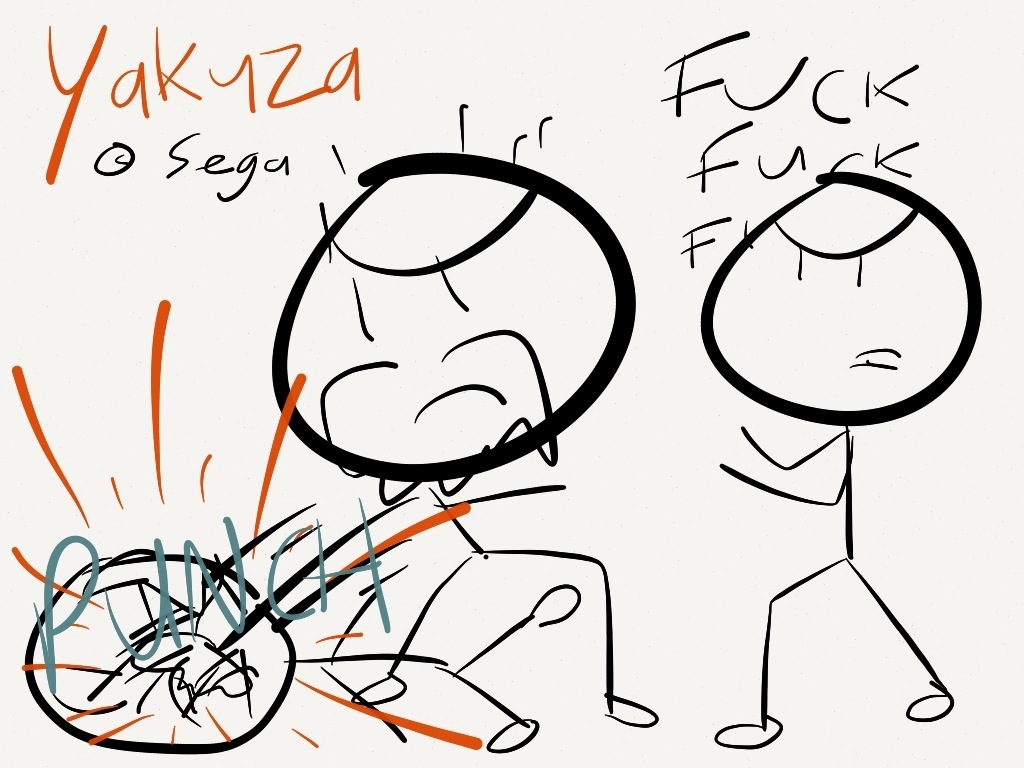
Yakuza 2, still on the PS2, fixes almost everything that was flawed about its predecessor. It's still riddled with loading breaks, but they're much shorter than in the first game. The American voice acting has been replaced by a much more authentic Japanese voice track — though the subtitles are well-localised and entertainingly written rather than being a literal translation. The fight sequences have been refined to be much more fluid, incorporating far fewer instances of protagonist Kazuma facing the wrong direction and unleashing a devastating combo onto thin air and far more situations where it's possible to make use of the brutal (and darkly amusing) "heat" actions — smashing people's faces into walls, battering them over the head with street furniture, sticking a beer crate on their head and then punching them repeatedly in the stomach to name just three.

For the uninitiated, the Yakuza series' game flow is much more akin to a traditional JRPG than something like Grand Theft Auto, to which it got rather unfairly compared on its first appearance in the West. Kazuma wanders around the extremely well-realised fictional district of Kamurocho (based on Kabukicho in Tokyo) in an attempt to get to the bottom of whatever disaster is befalling him and his buddies in the organised crime world this time. Along the way, he'll encounter a wide variety of non-essential activities to distract him, many of which are deep, involved quests in their own right, and the pursuit of which causes a game which can be completed in about 12 hours to balloon up to well over 40 hours in length.

By far the best thing about Yakuza is the sheer variety of things to do. It's an evolution of the Shenmue series' anal attention to detail, though rather than providing players with the ability to open every drawer in every house for no apparent reason, Yakuza provides players with a well-realised city district in which they can romance hostesses, get into street fights, collect lost locker keys, gamble at an illegal casino, get a "massage" of questionable morality, play slot machines, play a crane game and play baseball. Yakuza 2 adds even more to the mix, including a lengthy sequence where you have to run your own hostess club; another lengthy sequence where Kazuma becomes a host at a club in an attempt to unmask the manipulative, abusive owner; a full Mahjong simulation; a first-person fighting game; golf; "video booths" where Kazuma sometimes learns new abilities; and some other stuff I doubtless haven't discovered yet. Oh, and Yakuza 2 also includes a whole other district almost as large as Kamurocho again, also packed full of things to do.

None of this stuff really feels like "filler" though, because it is clearly optional — the experience point rewards for completing any of these activities are generally laughable, though sometimes you get some cool items. Rather, the inclusion of all these activities helps the world of Yakuza to feel far more alive than almost any other game world I've ever encountered. Not only that, but it gives the player an incredibly strong understanding of Japanese culture, with a particular focus on the seedy underbelly of it — the side that Japan doesn't like to talk about. It's a game that draws you in with its interesting story and then encourages you to stay for the hostess bars, gambling dens and men with "FART" written on the back of their hoodies.

Of course, the great thing about the series is that if you do want to rush through them and just see the story, you're not penalised for doing this in the slightest. I'd already played the first Yakuza back when we recorded the aforementioned podcast, but I just wanted to remind myself of what happened, so I raced through without doing any of the side missions and still had a satisfying experience. (In fact, one could argue that the story is a little more coherent if the game is played in this way, but I wouldn't trade all the other stuff for anything.)

Yakuza 2, so far, then, is proving to be every bit as good as its predecessor and then some. I have no idea how long it's going to take me to beat, but I'm enjoying taking my time with it so far. And once it's done, I get to move into the HD age with Yakuza 3 and 4… and possibly the utterly bizarre Dead Souls after that. It's quite a ride.
#oneaday Day 874: 21 Hours Left to Get Indie Game Music Bundle 3

20120611-000611.jpg

As I type this, Indie Game Music Bundle 3 has just 21 hours left on the clock. The package aims to give your ears a good rogering with the soundtracks to Terraria, Plants vs. Zombies, Dustforce, Ilomilo and Frozen Synapse, and is a cheap date, too — it's available under the fashionable "pay what you want" scheme.

There's a caveat, though — break the $10 barrier and you get a bunch of extra soundtracks, too. Specifically, you get the following additional albums on top of the already-awesome package detailed above:

  • Offspring Fling Original Soundtrack — Alec Holowka
  • Mubla Evol Ution: NoituLove 1&2 and More — Joakim Sandberg
  • Cardinal Quest Original Soundtrack — Whitaker Blackall
  • InMomentum Original Soundtrack — Gareth Coker
  • Impeccable Micro — _ensnare_
  • Bluescreen Chiptune/Jazz — Protodome
  • Beautiful Lifestyle — George & Jonathan
  • Rise of the Obsidian Interstellar — Disasterpeace
  • Deorbit — Disasterpeace
  • Gungirl 2 Original Soundtrack — Josh Whelchel
  • Astroman Original Soundtrack — Jeff Ball
  • The Blocks Cometh Original Soundtrack — Hyperduck Soundworks
  • Fittest Original Soundtrack — Zircon
  • Songs for the Cure '11 — Various Artists
  • Songs for the Cure '10 — Various Artists

You may not be familiar with any or all of the above artists, but rest assured that this is a fantastic bundle to pleasure your lugholes with for 19 and a half hours, covering a wide range of different musical styles. To be honest, it's worth your money for the fantastic Frozen Synapse soundtrack alone, which is aural sex.

Game music is traditionally a "love it or hate it" sort of thing, though in recent years we've started to see a huge shift in attitudes towards it. Whereas game soundtracks were once bleepy-bloopy loops made to fit into the amount of memory it takes to write a single sentence in a Microsoft Word document these days, today they're impressive affairs that are frequently on par with movies.

In fact, big-budget triple-A video games (particularly those from the West) try a little too hard to be movies, with sweeping orchestral scores composed by the likes of Hans Zimmer. In some respects, these modern soundtracks, while impressive, have lost a lot of the character that game music used to have — by working around the technological limitations of the era, old-school game musicians came up with catchy earworms that you'd remember for years afterwards. This happens much less these days because composers can pretty much run free with whatever they want to do. As an exercise, hum the Super Mario Bros. theme to yourself now. Then hum the Modern Warfare 3 theme. You probably can't do the latter. (Though you probably can hum the Halo theme, showing that some composers still "get it".)

Anyway, my point is that soundtrack composers for independently-developed titles such as these tend to "get" what made game soundtracks of the past so memorable much better than those composing for big-budget titles, and these indie composers are then able to apply this knowledge to modern compositional techniques and technology in order to create some truly excellent pieces of music. Some deliberately make use of chiptune sounds; others have their own distinctive aural aesthetic. All are unique. All are most definitely worth your $10.

Grab a copy of the Bundle here.

#oneaday Day 873: Cardinal Quest is Out on iOS, and You Should Probably Buy It

20120610-013720.jpg

There's a surprising dearth of good roguelikes on mobile platforms. While I wouldn't wish to shoehorn the ridiculous number of key commands from something like Angband onto a buttonless phone, the basic concept is a good fit. Explore randomly-generated dungeon, kill monsters, get treasure. The basic controls you need to make a roguelike work — directions and inventory, mostly — are pretty workable on a touchscreen, and the turn-based nature of the genre means that the frustration factor of trying to be accurate with non-physical controls is simply not there.

This isn't to say there aren't good roguelikes out there, however. On iOS, there's 100 Rogues, Sword of Fargoal and several others I haven't tried. On Android, the pickings are a bit more slim, though there are a few out there for the taking.

Today, iOS added Cardinal Quest to its lineup, a rather wonderful little roguelike with a pleasing retro aesthetic, streamlined gameplay and the kind of addictive nature that is perfect for mobile games.

Cardinal Quest isn't a new title, however; it's been available for Windows, Mac OS X and Linux machines for quite a while now, and there's a free demo you can play over on Kongregate. But its release on iOS today marks its first jump onto portable devices.

For the uninitiated, Cardinal Quest is a simplistic dungeon-crawler that cites Gauntlet, Golden Axe and red-box Dungeons & Dragons games as its key inspirations. Taking on the role of one of three different pixelated heroes, the player descends into the randomly-generated dungeons to seek their fortune and hopefully defeat the evil minotaur lurking in the depths. Along the way they'll discover treasure and a variety of different spells to make their journey easier.

Cardinal Quest adds a few nice little twists on the conventional roguelike formula. Walking over an item of equipment, for example, causes your character to automatically decide whether it's better than what he already has or not, and replace it if necessary. There's no faffing around with comparing stats, it simply takes care of it for you. This might irk purists a bit, but it keeps things nice and pacy.

Similarly, special abilities aren't learned, but are instead found as treasure. Five can be equipped at once, while others are stored in the inventory. Instead of using a magic points system, each skill has a cooldown determined by one of the character's stats, making some inherently more suitable for certain classes than others — though, so far as I can tell from my brief time with the game so far, any class can use any spell.

Also, while the game does feature permadeath as all good roguelikes should, there's a bit of a safety net in place in the form of a "lives" system that lets the player walk away from a couple of fatal encounters before succumbing to oblivion. It makes the experience a little more friendly to newbies while still remaining brutal enough to provide genre veterans with a decent challenge.

Wrap the whole thing in pleasingly blocky pixel-art, retro sound effects and chiptune music and you've got Cardinal Quest in a nutshell. Grab it here for $1.99.

#oneaday Day 871: A Change of Heart

20120608-021801.jpg

It's not easy to change your own opinions, for any reason. It's even harder to change it when someone else makes a convincing argument as to why you are wrong and therefore a big dumb-dumb poopy-head. But sometimes it's something you have to do in order to move with the times.

I have two very different issues in mind for which I've encountered the above concept. I'll tackle them in order of difficulty to comment on.

First up is mobile gaming.

Last year, I wrote this post. In it, I described how I thought the supposed pressure from Nintendo's investors for the Japanese giant to start developing for smartphones rather than its own proprietary hardware might not actually be a terrible idea. I actually still don't think it's an awful idea, but after a year of reflection, observation and immersion in the mobile gaming industry, it's clear that what I describe and suggest in that post isn't going to happen.

For all some iOS developers' attempts to take the iPhone and iPad seriously for gaming purposes, there are at least ten times as many developers churning out free-to-play or quick-hit casual games. For every developer who is up front about the cost of their app and refuses to nickel-and-dime the player with additional in-app purchases, at least ten times as many incorporate some sort of means of endless monetization, be it an "energy" system, a means for players to buy in-game currency without earning it or the facility to unlock content without having to progress naturally through the game.

I don't begrudge these developers their income, of course — games cost money to make, and every developer wants to make it big with their titles. But, unfortunately, the prevalence of such business models in the mobile gaming space makes it all but impossible for the "core" gaming community to take it seriously. As much as many of us moan about grinding for levels or money in games, a lot of us secretly quite enjoy it — it provides us with "war stories" about how we played Mahjong for six hours straight in Yakuza 2 in order to be able to afford a fancy dress to give to a girl, or how we accumulated fifteen bajillion souls in Demon's Souls only to die and then die again on the way back to retrieving them, losing them all forever.

In short, the effort and personal sacrifice involved in accomplishing feats in some of these games is rendered meaningless if someone can just come along and pay ten quid to bypass all the pain and suffering. Sure, it's convenient, but it renders achievements meaningless — particularly if the game's monetization strategy features "pay to win" items, whereby players can pay real money in order to gain a significant in-game advantage, be it the ability to "continue" after death without score penalty or simply acquiring powerful new equipment.

What this means is that "core" gamers as a community don't take mobile gaming seriously, which means that when developers do come along wanting to do something serious and non-exploitative, they often get ignored — particularly if their game is seen as "expensive" compared to the myriad free and 69p apps out there. If you want a recent example of this in action, just consider the Kickstarter campaign for Republique that I wrote about here. Despite starting as an effort to get "triple-A" games on iOS, the team behind the project gradually had to accept that this mission statement wasn't going to get them the funding that they wanted, and eventually had to expand and promise PC and Mac versions. Even then, it looked for a long time like they weren't going to make it.

Anyway. I was wrong. I accept that. Mobile gaming is its own thing, and that's cool. I will continue to appreciate it when a developer treats me as a player rather than a customer (or worse, cash cow) and provides me with deep, meaningful, worthwhile experiences on iOS, but I'm no longer holding my breath for it to be the next big thing in portable gaming — at least not for the "core" audience. There is still a place for dedicated handhelds.

Now for the second issue. I kind of don't want to talk about this much because there's been a lot of angry table-thumping surrounding it in recent weeks. There are, too, a lot of very vocal commentators on the subject and I really don't want to attract their ire — firstly, because that is by no means my intention, and secondly, because I've seen people really get laid into as a result of such arguments.

I am, of course, talking about gender issues and the question of whether or not the video games industry constitutes a rape culture.

Some context, first. Apologies to those whom the following offends, but it's necessary to include it for context. (NSFW, duh.)

This trailer for the upcoming game Hitman Absolution made a lot of people very angry, for various reasons. The ridiculous nun disguises covering impractical porn-star dominatrix outfits. The question of how exactly a nun conceals a rocket-launcher inside her habit. The fact that this really didn't look like the Hitman series people knew and loved.

By far the biggest concern, though, was the violence towards women depicted in the trailer.

I am not going to get into the broader discussion of whether or not this is indicative of a rape culture here as, to be frank and honest with you, I do not know enough about the subject and therefore feel ill-qualified to comment on it.

What I can discuss, however, is how my own thought processes went.

My initial reaction to the trailer was simply "WTF". This was shortly followed by "that's clearly sexist and unnecessary", and I commented as such on Twitter around the time it was emerging. My opinion was that the trailer was the result of a horny marketing department making deliberately sexually-provocative promotional material in order to get people talking about the game. On that note, it certainly worked.

I thought little more of it for a while, until articles like this one started to appear, claiming that the trailer was indicative of a larger problem — the trailer was, to paraphrase Brendan's piece, not simply sexist, but evidence of a culture that normalised violence against women, and specifically sexual violence. In short, a rape culture by its very definition.

I had no idea what "rape culture" meant when I saw the initial discussions surrounding this trailer. My initial reaction, like many others, was to assume that "rape culture" in fact meant "directly endorsing rape". Despite being conscious of the fact that I had publicly spoken out against the trailer, the accusations flying around and the increasing anger of commenters on the subject — on both sides — made me feel deeply uncomfortable and, yes, defensive. No-one likes to be told that something they care deeply about has such an odious undercurrent, after all.

But I stepped back for a moment and considered what was going on. This was clearly a hot-button issue for a lot of people, and one that I knew wading into with ill-informed opinions would be desperately, desperately unwise. I'd already seen a few weeks previously that a friend who had inadvertently ventured into a similar discussion got very publicly torn a new one (a little unfairly, I feel — though that's an altogether different story) as he attempted to discuss the matter.

So here's what I did: I stepped away. I read through the various angry tweets, blog posts and articles with a degree of detachment, attempting to understand where these people were coming from and why those who were saying "it's no problem, what's the big deal?" were pissing them off so much. I read up a little on what "rape culture" as a term actually meant.

And I came out of it feeling differently to the defensiveness I felt before. I already knew there was a problem with sexism in the industry, but now I felt I had an increased (though by no means comprehensive) understanding of the issue. I am aware that there are still things I do not understand about issues of feminism, gender, sexuality, rape culture and cultural norms — people spend years studying these things, after all — but I am willing to at least learn about these subjects before sticking my oar into a debate I am currently ill-qualified to have. I am also aware that many of the commenters who feel so passionately about this issue are not, as might first appear, condemning the entire industry and everyone involved in it as sexist, misogynist perpetuators of a rape culture, because gross generalisations are never helpful.

Let's get off the specifics because, as I've said several times, I don't want to get into that particular discussion right now.

The key issue is that a little consideration and reflection goes a long way. Knee-jerk, immediate, passionate, emotional and ill-informed reactions might feel good in the short term, but often they leave you looking like a jackass. I'm glad that I stepped back and considered the way I felt about the discussion surrounding this issue — and why — before even thinking about jumping in and potentially making a twat of myself.

It pays to have flexible opinions, a willingness to educate yourself and, yes, the ability to admit you were wrong (and understand why), in short. That's not to say that you should blindly follow the herd — quite the opposite, in fact. You should take the time to explore an issue, find out as much as possible and gather sufficient information for you to be able to accurately decide whether or not your initial reaction was, in fact, correct.

If it was — in your opinion, anyway — then you'll be well-equipped to argue your case. And if it wasn't, it's important to be humble enough to admit it.

#oneaday Day 870: On the Exploration of Space Via the Medium of Video Games [UPDATED]

20120607-014321.jpg

[Now updated with some titles I meant to include in the first place but forgot because it was late when I wrote this and I was tired and WHARGGGHHH. Or something.]

Space, they say, is big. Really big. There's a whole universe of infinite possibilities out there, and being boring old humans we're (mostly) stuck on this planet, unable to explore the great black beyond. We can, of course, observe it and take exciting pictures and footage, such as what we've seen from the recent Venus transit. But for the everyday person, exploration of space is the stuff of pure science fiction.

Video games are a great way to immerse yourself in that sense of exploring the great unknown. Plenty of games are set in space, obviously, but it's a smaller subset that actively deals with exploration and discovery rather than simply blowing shit up. Star Trek as opposed to Star Wars, if you will, though I'm aware that's a gross oversimplification of and a great injustice to both series. But never mind.

Here are some of my favourite space games.

Star Control II

What a fantastic game this is, well deserving of its classic status. Star Control II casts the player in the role of a human captain returning to Earth after a long stint on a faroff colony only to discover that our homeworld has been captured and enslaved by the evil Ur-Quan. Thus begins a galaxy-spanning adventure of diplomacy, combat and collecting lots of minerals.

Star Control II is one of those games that blends lots of different play styles together to create a distinctive whole. You have Asteroids-style combat incorporating ideas from one-on-one fighting games — each ship has its own "special moves" and is well-matched against certain other vessels. You have space exploration — the game tells you very little about where to find things, and God help you if you don't note down the offhand mentions of alien species that some characters make. You have resource management in the form of keeping an eye on your ship's crew, fuel and cargo space. You have RPG-style upgrading as you turn your ship into an unstoppable behemoth and recruit various escort vessels to accompany you. And you have adventure-game style dialogue trees as you make contact with the weird and wonderful races of the galaxy in an attempt to recruit them to your cause.

Best of all, you can grab the enhanced port of the 3DO version for modern computers here, or pick up the original version and its prequel from GOG.com.

Star Trek Online

Star Trek Online is an excellent Star Trek game, although it may be a little too heavy on the combat to be completely true to its source material. The game does successfully capture the feeling of piloting a huge vessel around the galaxy to seek out new life and new civilisations and all that jazz, though, and the fact that the game has a strong focus on user-generated content ranging from player-constructed alien races to full mission sequences makes it a great deal of fun. It's not as polished as it could be and PvP is broken as hell, but it's a free-to-play title that doesn't gouge you for in-game purchases at every opportunity.

Find out more here.

Endless Space

I wrote a little about the upcoming 4X space strategy title Endless Space a little while back. The game is now in beta testing as it gets closer to release. I haven't tried it yet but am planning to give it a go over the weekend.

Endless Space is less "personal" than other titles due to the fact that you're not controlling your own individual vessel, you're overseeing a whole empire. That doesn't stop it from being full of the joy of discovery and exploration, however — finding a star system with planets rich in valuable resources is immensely satisfying, and successfully defending it against incurstion from your opponents is even more satisfying.

X: Beyond the Frontier

I haven't played this game for ages, nor have I played its sequels and expansions. But the original game struck me as an impressive experience that truly made you feel like an insignificant speck in a massive galaxy that would most certainly go on with its own business without you. Over time, in true space opera style, you could make a name for yourself and work your way up to being an immensely powerful individual, but the journey was a long, slow, tough one — rewarding, though.

Grab it from Steam.

Spore

Having returned to playing this recently I had forgotten quite how excellent the space section of this game was — it's certainly the most well fleshed out component.

After designing your custom race's custom spaceship, you then take to the randomly-generated stars to colonise new planets, trade with other spacefaring races, toy with the natural order of things on developing worlds, discover lost relics, complete missions, mine for valuable resources, paint planets and carve obscenities into the ground using rivers. It's very freeform in how the player can tackle it, which gives each game the potential to be completely unique.

Will you seek peaceful solutions to conflict? Will you only expand your empire to planets already capable of supporting life, or will you terraform barren rocks into new Edens? Will you go to war with rival empires or attempt to buy them out? And will you satisfy yourself with building out your empire, or will you embark on a quest to get to the centre of the galaxy and uncover the mysteries of the universe?

Grab it from Steam or Origin.

Starflight

I played this game on the Atari ST. It was brilliant. It was a relatively early title from Electronic Arts, and was immensely freeform in its gameplay. Taking on the role of a starship captain, the player was simply tasked with exploring the galaxy. This involved flying to new star systems, descending to planets, exploring in a "rover" vehicle, engaging in diplomacy between alien races and battling enemies. There was supposedly an overarching plot, but I never got that far when playing it as a youngster — I simply enjoyed flying around and exploring space. It may well be one to revisit with the eyes of an adult.

Space Rogue

A space sim from Origin (as in the software company, not the digital distribution platform) that cast the player in the usual role of a "privateer", Space Rogue was interesting for the fact it wasn't just about flying around shooting things and hauling goods from planet to planet. Landing at a base launched a top-down roleplaying component during which you could explore, talk to people, engage in combat against enemies and take part in a galaxy-spanning plot that, again, I can remember very little about besides a series of fetch quests that involved you ferrying messages back and forth between two sisters called Cebak and Tiwa. There were text-based adventure sections, too.

Space Rogue, then, was something of a precursor to the next game I'm going to mention.

Space Rangers 2

An utterly bizarre yet lovable game from Russia, Space Rangers 2 takes players on a wild ride across the galaxy, taking in turn-based strategy, real-time strategy, third-person shooter combat, text-based adventures, trading, RPG-style levelling up and all manner of other crap along the way. It's an absolute Frankenstein's Monster of a game and all the better for it. It's almost futile to describe the experience of playing it, particularly when you can check it out for yourself for super-cheap thanks to GOG.com.

#oneaday Day 869: Eeeeeeee by 3

20120605-232511.jpg

E3's leaving me a bit cold this year. The fact I'm not covering it for a gaming website is actually a blessed relief, as it means I don't have to stay up until ass o' clock in the morning watching cringeworthy live performances from executives who should know better. But I'm not even feeling particularly inspired to seek out the big news from it myself — nothing's grabbing me as hugely exciting. The most interesting thing to me is probably Nintendo's new console, which does some genuinely innovative and cool things — but we'll have to wait and see on pricing.

E3's not necessarily about people like me though. It's first and foremost about the suits and the money, secondly about the press and the actual gaming public comes in a distant third somewhere. It is, in essence, a huge PR circus whereby lots of companies can make outlandish promises about their new products and hope no-one remembers by the time the product in question actually comes out. (See: anything Peter Molyneux or Microsoft have ever said, anything regarding motion control, anything regarding Vitality Sensors.) It's an important time for publishers to show off their big new titles to keep their shareholders happy, and for the press to help keep the buzz flowing.

I've never been to an E3, so I can't speak for what the experience of actually being there is like. I'm sure smaller developers and publishers are there, too, but I feel a bit sorry for them. As is always the case, the big news is always about what Sony, Microsoft, Nintendo, Ubisoft and EA are up to — and probably something Call of Duty-related from Activision, too. Smaller companies are there to get their products noticed, too, but it must regularly seem like an uphill battle to them when all the big sites want to cover is Halo 4, Call of Duty 300 and other Games With Guns In.

There have been a few surprises, of course. Ubisoft's Watch_Dogs is looking cool — at least it did until the dude pulled a gun out — and David Cage's latest project is sure to be just as interesting and divisive as his previous work. I'm not yet convinced by The Last of Us (ugh, zombies) and I want to know more about pricing before I get too excited about Wii U.

Herein lies the rub, though. I couldn't give a crap about the "big games". I know that plenty of people do, otherwise we wouldn't be on our sixth Halo game, our fifth Assassin's Creed game (not counting spinoff titles) and our four hundred and seventy-sixth Mario title. And the big sites certainly cover the big games with aplomb. But where is the discussion about more niche titles like Larian Studios' upcoming new Divinity game and the batshit-crazy looking Dragon Commander? Where's the love for independent developers? Where can I find what I'll be putting in my shopping cart without question next time there's a Steam sale?

This information is out there, I'm sure, but it's hard to find. It's easy to be cynical about E3 because of the information that gets the highest priority. "Biggest budget" seems to equate to "most important" in the eyes of a lot of press and public alike, and that's a bit of a shame. For me, the most important titles should be the ones that move the genre forward, the ones that do genuinely interesting things, the ones that I'd want to discuss on the Squadron of Shame SquadCast. But I guess they call things like that "niche" for a reason.

Also, fuck E3 memes. If one more person makes a "my body is ready" joke I will punch them. Hard.

#oneaday Day 866: NierCast

20120603-013721.jpg

I've finally beaten Logic into submission and got it up and running on my new Mac, which means I've finally been able to edit the most recent Squadron of Shame SquadCast. Here it is:

(Direct link for those who can't see the inline player)

The subject of the podcast is Nier, an action RPG for PlayStation 3 and Xbox 360 published by Square Enix and developed by Cavia. You may recall I was enthusing about this game quite a lot back in early May, and that enthusiasm was what sparked the desire for us to do this particular podcast.

Nier is a fascinating game. Whether or not it's actually a good one is up for debate somewhat, but it's certainly a unique experience in the console space. In fact, to call it an "action RPG" as I did above is a gross injustice, since the game also incorporates elements of bullet hell shooters, text adventures, 2D platform games and open world quest-based "traditional" RPGs. The only games I can think of that offer a comparable experience include Space Rangers 2 and King Arthur: The Role-Playing Wargame, both for PC, and both offering wildly divergent experiences from Nier, but both taking this "kitchen sink" approach to genre blending.

Nier also distinguishes itself by having a mature plot that is worth following through. Sure, it's pure fantasy, but it's good, compelling fantasy — and the fact that the game was released as part of a much larger opus that spans several forms of media is very much apparent if you take the time to read up on it using sources such as Grimoire Nier. The game can most certainly be enjoyed in its own right without exploring any of the additional background material, but it becomes a far richer experience once you delve into the lore of the world — and, for that matter, the story of the game's creation. It's very much an example of a game whose world and characters are "bigger" than the game they inhabit, much like an author who plans out their characters by writing scenes for them that never appear in the book in question.

Perhaps the most interesting thing about Nier, though, is its treatment of "New Game+" — the ability to go back and replay it after you've beaten it once. In many role-playing games, taking on a New Game+ is simply a matter of starting again with all your awesome items, equipment and buffed-up characters from the end of your first playthrough and then romping through the game slicing off heads with gay abandon and nary a fear for your own safety. Nier certainly does this — on subsequent playthroughs, boss fights that were once challenging are an absolute joke — but it's not the most important point.

Without getting into spoilers, Nier's New Game+ gradually adds new layers of complexity and nuance to the plot, calling into question the actions that you undertook without even thinking in your first playthrough. The player is given additional context with which to understand exactly what is really going on — and this manages to seamlessly pull the player's perspective around between several different characters and conflicting viewpoints while still keeping them in direct control of the titular hero. It's a very interesting experiment in a variation on the "unreliable narrator" trope, and one which could really only be done so effectively in an interactive form of entertainment such as a video game. It also makes Nier's New Game+ something that is actually worth doing rather than something which is just there for a bit of fun — and it's worth noting that it makes it abundantly clear when you've done absolutely everything there is to do by actually deleting your save file when you're done. In the context of the game, this somewhat dramatic action makes a great deal of sense (though you are asked to confirm whether you're sure you're okay with this five times) — but can you imagine what would have happened if, say, Mass Effect had pulled something similar? It would have been brilliant, but those complaining about the game's ending would have been even more furious than they are.

The final thing worthy of note about Nier is that it takes no more than 40 hours to do absolutely everything in the whole game including three New Game+ runs (an utterly stupid real-time farming minigame aside, which can be easily gamed by dicking around with your console's clock), making it eminently friendly to the busy lifestyles we grown-ups tend to lead these days.

So if you've never given Nier a shot, give it a chance. You might be pleasantly surprised. And if you have played and loved Nier — or, indeed, have no intention of ever playing it, ever — be sure to listen to our podcast for some in-depth discussion on this remarkable game.

#oneaday Day 865: All Change on Squad Mountain

20120602-003703.jpg

Those of you who follow what I do over at the Squadron of Shame may have already noticed that some changes have been going on recently.

First up, longtime mainstay hosts of our podcast Chris Whittington and Jeff Parsons have moved on from their presenting duties to host their own show. Too Old For This… is a show for ageing, busy geeks who still like to keep up to date with the latest happenings in comics, games, movies, music and beer (lots of beer), and it's a great listen. Chris and Jeff have a great dynamic together and their show deserves your support.

With Chris and Jeff out of the podcasting picture over at the Squad, we're going to be doing a lot more in the way of our traditional "mission" podcasts whereby we investigate a "shameworthy" game thoroughly and then discuss it at great length. This decision came about partly due to the success of our show on Katawa Shoujo, which attracted a bunch of new listeners and community members, but also because it's something we've always done well — and something which is still very distinctive in the crowded world of gaming podcasts. That's not to say we won't be doing any more "topic" shows or "genre primers" — but a bunch of listeners have been clamouring for more "missions" for a while now, so it's time to give them what they want.

The long-term goal for the Squadron of Shame has always been to be a place for mature, wordy, niche-loving geeks to call home. The "Squawkbox", our freeform discussion board which I set up temporarily several years ago using WordPress. has been a good start to that, but I figured it was time we took it to the next level. We have a number of talented writers among our ranks, so I thought we should showcase that fact a little better. And those who don't want to write will certainly appreciate some interesting things to read and comment on.

Enter our new experimental Articles section, in which long-form articles can be presented, featured and archived separately from the main Squawkbox discussion. They still appear in the main feed, but have their own dedicated sections now. Over time, this part of the site will hopefully become populated with numerous long-form pieces from our members (and guests) about things they think are truly "Shameworthy". The categories I've put in place so far are largely games-focused, but there's no reason this can't expand to other media over time — the joy of using WordPress is that it's easy to tweak, poke and rejig everything as the need presents itself.

I'm excited about what the future might hold for our little site, and this is the first step towards that bright future. Be sure to drop by, join the conversation and let us know what you think.

#oneaday Day 864: Spore-adic

20120601-022035.jpg

On a whim, I started playing Spore again recently, this time with the Galactic Adventures expansion installed, which I never got around to trying previously. I still haven't got far enough in my new game to come across any of the aforementioned Galactic Adventures, but I thought I'd revisit my thoughts on the original game, as I last contemplated it way back in 2008.

Spore caught some flak on its original release for a number of reasons — mainly dodgy DRM with very strict activation limits and early online connectivity issues (some things never change, huh?) — but also attracted criticism for not living up to its hype. Originally dubbed SimEverything, the game was supposed to be Will "SimCity" Wright's last great masterpiece, simulating the entirety of life right from single-celled primordial soup up to space exploration. A lofty goal, for sure. But how well did it manage, really?

Beginning as a single-celled organism that is either carnivorous or herbivorous, you're thrown into the primordial soup and tasked with surviving. Carnivores must eat little red chunks, herbivores must eat little green chunks. Both can be found just floating in the water, but carnivores can help the process along by killing other organisms. Herbivores, conversely, spend a lot of time running away to begin with.

As you eat, you gain DNA points which can be spent on improving your creature with various parts. In order to evolve your creature, you must mate with another of your kind, which pops up the creature editor and allows said parts to be bolted on. These range from various fins and tentacles that improve speed and agility, to spiky things, poison-spitters and other defensive measures. It's even possible, with enough available points, to replace the creature's mouth to turn it from a herbivore into a carnivore — or even to give it two mouths, allowing it to eat everything.

This process continues for a while, with your creature regularly expanding in size until once screen-filling enemies become tiny little minnows in the background, until you eventually fill the progress bar at the bottom of the screen and evolve a brain. At this point, it's possible to continue swimming around in the soup to gain further points and collect any parts you missed, but the game nudges you in the direction of the next stage, which focuses on your creature's life.

After climbing out of the ocean and evolving legs (which you attach yourself as you see fit), you then get to explore the surface of the randomly-generated world your game takes place on. At this point, progress mostly comes about through either befriending or destroying other species. New creature parts can be found on long-dead skeletons on the planet, and the player's creature evolved with these parts, each of which offer various bonuses to either social or combat abilities.

Upon confronting another creature and choosing whether to befriend or kill it, a little minigame occurs. Combat is rather MMO-ish, with a small hotbar of up to four different abilities available. Socialisation, meanwhile, involves watching what the rival creatures do and copying their moves. As this phase progresses, the player's creature gains the ability to bring along a "pack" of other creatures — either of their own species or allied organisms — which makes both socialisation and combat easier.

To make life a bit more interesting, certain species are naturally aggressive and will attack anything on sight, and there are a few "epic" creatures wandering around who are considerably larger than everything else on the planet. These can be defeated in combat with a bit of care, but for the most part they're something to avoid and admire from afar.

Once the Creature phase is over, the Tribe phase begins. Here, the player is no longer in control of a single member of their species, but instead takes on a more "overseer" role, controlling their tribe like an RTS. Progression through this phase is determined by either befriending or destroying rival tribes.

You begin this stage with a small, simple village and the ability to construct a few "tools". Food must be gathered to feed the tribe and is also used as currency to purchase tools and create new tribe members. Tools fall into two main categories, as with creature parts: social and combat. Social tools take the form of musical instruments, while combat tools are weapons and a healing ability.

Upon meeting another tribe, like in the Creature phase, players must choose what stance to approach them in. If approaching in social stance, both tribes will line up in front of each other and one will "perform" for the other. The "audience" tribe will call out different instruments that they want to hear, and the player must quickly activate their instruments to please them before the audience gets bored. Combat is simple point-and-click RTS-style, though there is also a hotbar of special abilities according to what weapons the tribe has equipped at the time.

Following this point, the game enters the Civilization stage, where the player must conquer the planet they are on by taking over, buying or destroying all the rival cities. The game becomes more complex at this point, with a lot more building, trading and military conquest — though as with the previous components of the game, this phase can be passed through peacefully with a bit of effort.

Following this, the Space phase begins, and some would argue this is where the game begins proper — indeed, this is the phase that the Galactic Adventures expansion concentrates entirely on. Players must explore the galaxy in their custom-designed ship, fly down to planets, collect items, terraform, secure "spice" mines, trade with other species, complete missions, defeat enemies and, eventually, if you want to "finish" the game, build yourself up enough to take a lengthy expedition to the centre of the galaxy — a risky prospect, since this is where the Borg-like Grox, the main antagonists of the game, live.

So Spore certainly does follow life from its humble beginnings up to the space age, and it's very satisfying to look at the comprehensive "history" screen in the game and see how your creature has evolved over time. The main criticisms that were levelled at the game on its original release, however, were more to do with the fact that none of the game's phases had a lot of depth to them — it wanted to be "five games in one" but didn't really pull it off as well as some people wanted.

It doesn't really matter, though. Revisiting it now has reminded me that Spore is a very entertaining game — sure, it's pretty lightweight compared to some heavy hitters in the strategy and god game genres, but that only serves to make the game accessible to all. I'm actually rather glad about this, since I find a lot of strategy games rather heavy going and consequently find myself trounced by computer or human players on a regular basis. I can succeed in Spore while still feeling like I've been challenged somewhat, and simply enjoy the sense of progression, discovery and ever-expanding scale that the game offers — not to mention its wry sense of humour and wonderfully self-referential nature. The game even plays music from M.U.L.E. at certain points, for pity's sake.

And I haven't even mentioned what was one of the main draws of the game on its original release: its focus on user-generated content. All through the game, your galaxy is populated by creations from other players. With the Galactic Adventures expansion, this user-generated content goes far beyond player-made creatures, buildings and vehicles — there are full missions designed by players. It's impressive that it all works as well as it does — content simply "invades" your game seamlessly, and built-in community features allow you to rate, comment on or, if necessary, ban content without leaving the game.

I haven't yet touched the Galactic Adventures content since my current save has only just advanced to the Civilization stage, but I'm looking forward to investigating it. Further thoughts will follow when I've had time to check it out. In the meantime, if you get the chance to grab a cheap copy of Spore, it's well worth a shot.

#oneaday Day 863: Trash-Talkin'

20120531-023836.jpg

It's not often I feel able to say this and mean it, but there's a piece over on Kotaku right now that is an excellent read. Go check it out, then come back to me.

I can't comment on being a rape survivor or anything like that, but I think that article sums up why I feel deeply uncomfortable with the idea of playing online with strangers in competitive games. I hate abuse, particularly pointless, rage-filled, deliberately offensive abuse designed to provoke an intensely emotional reaction out of the victim — and competitive online gaming seems to pride itself on this so-called "trash talking".

In my own case in the past (and not in games, in the "real world") abuse I have received has been in the form of hurtful comments about my appearance and my weight. I can't begin to fathom what must have gone through the minds of the bullies in question as they said those words that lashed at me like a cat o' nine tails, but they hurt. They perhaps weren't intended to hurt quite as much as they did — "I was only having a laugh" is seen as a valid defence by many these days — but the fact is that they utterly ruined my day when they burst into my ears, regardless of intention.

If I feel that shitty after some stranger makes some low jab at my appearance, I can only imagine how awful it must feel to be a rape survivor and hear how freely the word "rape" is bandied about to mean "beat" or "defeated". I feel uncomfortable using the word, given that I know at least a couple of survivors (to my knowledge), so picturing how it must feel to have such an awful thing trivialised by, say, Gears of War players is disturbing, to say the least. Like the behaviour of the bullies I described above, the intention may not necessarily have been to offend or upset, but there are plenty of people for whom such comments could completely ruin an otherwise fun experience — and, really, let's face it, there's no need for it, is there?

Lest you think me some sort of prude, I will point out at this juncture that I'm certainly not above light-hearted insults with my friends, which often skate into sexist, racist, homophobic and other generally offensive territory. But that's something that we do among ourselves in private — we've set the boundaries as to what is "acceptable" in our group, we stick to it and, crucially, we don't do it in public where anyone might misinterpret our words as genuine sexism, racism, homophobia or any other form of misanthropy. Not one of us would even contemplate the prospect of telling a complete stranger that they'd "raped" them — or indeed hurl any other sort of abuse at them, whether or not there was social "context" for such behaviour.

An example springs readily to mind. I was playing the then-new Dungeons and Dragons Online MMORPG, and I was doing my first run through one of the game's cooperative dungeons with a "pick-up group" of random players. All had been going well until we got to the end and there was an unnecessarily difficult platforming section. The platforming controls in D&D Online were not very good, to say the least, so it took me a good few minutes to get through the bit that the other (evidently more experienced) players had passed with ease. I apologised and made light of it, hoping that they'd do the same. Instead, I was confronted with a torrent of abuse through the private chat channels. I turned the game off at that point and never played it again.

The unnecessary, unprovoked wrath of a complete stranger had ruined the game for me. Whether or not they had intended to upset me that much was irrelevant. It had happened. I grant that I am the sort of person who is very easily upset even by heated arguments, debates and disagreements, let alone abusive words, but being sensitive about such things shouldn't preclude you from taking part in certain activities. Something like an online computer or console game — regardless of whether it's cooperative or competitive — should bring people together, not leave them feeling marginalised, or that their own anxieties, issues and mental scars are somehow trivial. There's no excuse for it, and it's something which gaming culture really needs to clean up if we want our hobby to be inclusive to all.

Therein lies part of the problem, I think, though; some people don't want that inclusiveness. Some people want to feel powerful, to be the top of that little clique, to feel like they have achieved something important and are therefore "better" than others. And they go about that by lashing out at the weak spots, triggers and hot buttons of others. Anything goes in the quest to make them feel like The Big Man. (Or Woman. But let's face it, it's significantly more likely to be a male person.)

It feels like such a futile question at times, but why can't everyone just, you know, get along?