#oneaday Day 922: Interactive Tales

As you may have realised if you read my lengthy series of pieces about Katawa Shoujo (and one about Kana Little Sister, which I really must get around to replaying), I am a big fan of the "visual novel" genre, a style of video game that tends to be big on story and light on interaction.

I came to this genre through the Ace Attorney series, which remains one of my favourite video game franchises of all time. (Hurry up and release those iOS remakes, Capcom!) Phoenix Wright and its sequels combined the strong sense of narrative, puzzle-solving and dialogue choices from adventure games with a style of presenting the story that really allowed you to get in close with the characters, giving you a real sense of what made them "tick". Audio-visual presentation was very simple, with detailed anime-style characters overlaid over static backdrops, and a large degree of imagination on the part of the player being required.

Ace Attorney is a relatively good entry into the visual novel genre because it's fairly family-friendly (despite being based around solving a variety of murder cases) and doesn't delve into the less salubrious side of things that some of the more "niche" titles explore. There's no fucking in it, basically, despite Franziska von Karma's clear tendencies towards S&M.

I've talked extensively about Katawa Shoujo in the past, so I won't delve into that too much here, but I did want to mention a new acquisition which showed its face on my doorstep today. School Days HQ from JAST, which is apparently a remake of an earlier title of the same name, and an adaptation of an animé I know nothing about aside from something to do with "nice boat". Or possibly some other combination of those things. I'm not sure.

School Days is an unusual visual novel in that it's fully animated. Yes, rather than watching static images and reading mountains of text, the game is essentially an interactive, episodic animé series, where the player watches what unfolds and occasionally makes choices that direct the path of the story — choices that, unusually for the genre, can include remaining silent through inactivity. Structurally, it's identical to something like Katawa Shoujo — decision points branch the narrative down various "paths" leading to either "good" or "bad" endings, and the game client is set up in such a way as to easily allow players to "rewind" and try other choices — the virtual equivalent of putting your fingers in the possible pages you could turn to in a Choose Your Own Adventure book.

I've only played the first of the game's episodes so far, but the setup is intriguing — and, as with most visual novels, pleasingly mundane. Makoto likes Kotonoha. Kotonoha likes Makoto. Both of them are too shy to do anything about it, so in steps Sekai, Makoto's classmate, who manages to get the two of them together but steals a kiss from Makoto as "payment" for her services. Already there have been a couple of hints about Sekai being dangerously unhinged, so I will be very curious to see how the inevitable love triangle unfolds.

But anyway. I'm not here to talk plot. I'm here to talk about this style of game, and wonder what happened over the course of the last twenty years to make it "okay" to develop a narrative-focused game in which the player's interaction is largely limited to occasional choices.

You see, I vividly remember back in the late '90s when the CD-ROM revolution started. The vastly-superior storage capacity of CDs allowed developers to put a whole bunch more content in their games than was previously possible. One of the most common uses of this space was full-motion video — real actors performing scenes in games. And thus, the "interactive movie" was born. The exact implementation of the "interactive movie" genre varied from traditional adventure games which happened to include full-motion video (Sierra's Phantasmagoria and Gabriel Knight: The Beast Within spring to mind here) to titles which already had designs on movies taking the next step (say hello, Wing Commander III and IV) and, at the far end of the spectrum, games that were quite literally movies that sometimes stopped for — you guessed it — the player to make a choice. (Submarine-themed game Silent Steel is the first game of this type that I remember.)

At the time, the latter option was ridiculed for offering only the most rudimentary of gameplay while flaunting the new technology unnecessarily — and often making it painfully apparent that most game developers didn't have the same budgets as movie studios. (How times change, huh?) But now, this style of gameplay has become a firmly-established genre, particularly in the Japanese market, with a little spill-over into the West thanks to publishers like JAST and hard-working enthusiasts like Four Leaf Studios, the crowdsourced team behind Katawa Shoujo.

I'm not complaining, really — I must confess that even in the late '90s I found interactive movies to be something of a guilty pleasure, despite their poor reviews — but I find it interesting that a style of play which many commentators at the time believed would be nothing more than a passing fad is now a firmly-entrenched part of the landscape of gaming. A niche part, sure, but one that certainly doesn't appear to be going away any time soon. School Days is an interactive movie, and unashamedly so — it has rewind and fast-forward buttons at the top of the screen, for heaven's sake — and there certainly seems to be plenty of people clamouring to play it.

Naturally, the apparently popularity of School Days is nothing to do with the fact that it, unlike Ace Attorney, does have fucking in it. (I also discovered post-install that it supports a USB-connected wanking machine (yes, really, and no, you probably shouldn't click that link at work), which is a mildly terrifying prospect in and of itself. No I don't have one.) Actually, it might be, though perhaps not for the reasons you're doubtless thinking of right now. The visual novel genre represents a sector of gaming that is absolutely unashamed to deal with issues that would be unpalatable to mainstream publishers (and possibly consumers, too). It tackles adult issues — sexuality in its many forms, violence and people acting like people rather than game characters — and does so without patronising the player or being "preachy", unless of course the story calls for it to do so for whatever reason. While there will undoubtedly be those who come to School Days purely to get their rocks off — and the game caters to those people by allowing the sex scenes to be viewed again once they have been "unlocked" in the story (that and the wanking machine compatibility, of course) — I have a sneaking suspicion that a lot of people are attracted to titles like School Days and indeed the visual novel genre in general because, for the most part anyway, it treats them like adults.

Which, coincidentally, is something that a lot of interactive movies failed to do. The lack of budget that many of these titles suffered caused them to feel cheap and nasty, and any violent, sexual or otherwise graphic scenes tended to come across as rather laughable rather than an integral part of the story. Phantasmagoria, for example, featured a "rape" scene that was badly handled and clearly put in purely for shock value. Mention of this notorious scene made up a significant proportion of the game's viral marketing, though when it actually came down to it, it was terribly executed, poorly acted and had the complete opposite effect to what such a scene should have. Instead of being horrifying, traumatic and, most importantly, mature, it was just laughable, embarrassing, dumb. Compare and contrast, meanwhile, with a number of very uncomfortable scenes in, say, Katawa Shoujo (and I'm guessing the later stages of School Days, given the fact that it carries a warning for "violence" as well as "sexual content" on its box), all of which were thought-provoking, respectful of the player's intelligence and had a strong, real impact.

As I drift further and further away from the "blockbusters" of the games industry to get my entertainment, it pleases me that certain barriers seem to be gradually collapsing. While once the prospect of playing an "eroge" visual novel would be shameful, now people will happily and freely admit to it — thanks, at least in part, to a much better cultural understanding of the difference between "porn" and "containing erotic content". (That said, people are a lot more open about their porn consumption these days, too.) While I wouldn't recommend titles like School Days or Katawa Shoujo to someone not mature (or open-minded) enough to be able to handle their content, I'm very happy that they exist, providing true entertainment for adults without any of the associated skeeziness of porn.

(I can't get away from that wanking machine option in the menus, though. That's just odd. Does the game prompt you when to get your knob out? And how do you… oh, no. Never mind. Probably best not to think about it too much.)

#oneaday Day 918: We Dig, Dig, Dig, Dig...

Yes, I've been playing Minecraft again, thanks largely to several members of the Squadron of Shame finally biting the bullet and jumping on the bandwagon. And, once again, I am rediscovering the sheer joy of that game.

The first time I played Minecraft I wasn't overly enamoured with it. Not because of the deliberately lo-fi graphics — on the contrary, I found them highly endearing — but because I had literally no idea what I was supposed to do, and at the time I started playing, it was largely up to the player to either work things out for themselves or refer to a wiki. Nowadays, of course, there are achievements to guide your early days in the game and basic techniques are practically common knowledge — the Xbox version also removes the need to remember the specific "patterns" to craft tools altogether, making it even more accessible and a great jumping-on point for those who have no idea what Minecraft is all about.

After spending a hefty proportion of time in Minecraft's many pixelated, blocky worlds, however, that sense of "what on Earth do I do now?" is, as it turns out, precisely what appeals to me about the game. I have no goals aside from the ones I set for myself. There is no "end" to the game aside from the time when I wish to stop playing. (Well, technically that's not quite true — you can "finish" Minecraft through a long and convoluted process culminating in a difficult boss battle against a giant evil dragon thing. But you can carry on playing after that.) The world is different each time I start a new game. And therein lies Minecraft's biggest joy.

Minecraft is like being a kid again, assuming you were a kid who never had to get home in time for dinner, and a kid who was trusted with various sharp implements. Minecraft taps into that youthful desire to explore, to discover, to see what's over that next hill, around that corner, on the other side of that sheer rock face. It taps into that youthful fear of being lost in the middle of nowhere and having no idea of how you're going to get back home. And, like those youthful expeditions into forests and caves, it's much more fun with friends.

Minecraft is what you make of it. I currently play on two multiplayer servers — one with a small group of "real-life" friends and the other with a group of people I primarily know online — the aforementioned Squadron of Shame. The differing approaches we take on each server are very interesting, and represent two very different social dynamics.

On my "real-life friends" server, everyone quickly staked their claim to their "territory" and built something big and impressive there to mark it. Tim built a huge castle; James built a wizard's tower and network of connected walkways with giant mushrooms (plus a huge tree made of trees); Andie built some quaint (and practical) little houses; and I built a large, experimental pyramid-like structure and enormous, intricately-carved bridge.

On the Squadron of Shame server, meanwhile, things were a lot more cooperative from the get-go. I was one of the first people on the server, so I took the time to establish a basic base camp — wooden hut with crafting table and furnace, sufficient to last the night. Over time, and with the assistance of others, this hut expanded with an extra room containing beds, and a large mine beneath it. Other structures sprang up nearby until our improvised "base camp" started to look like a small village. I built roads in every direction as I explored, and others followed suit to help us find our way to various impressive landmarks. When we found a cool piece of randomly-generated scenery, we talked about it as if it was a real place. Other "citadels" sprang up around the map, and we as a group went further and further afield. I constructed some kick-ass bridges.

In both cases, the world feels alive — because it is alive. It's constantly growing and changing according to how far people have explored and what they have built. It's an immensely satisfying experience to know that you've played a part in the shaping of a virtual world, whatever your contribution and whatever your particular skill sets might be. In many ways, it's similar to the satisfaction of playing an active role in something like Second Life, which I've been known to spend time in in the past, and which I once referred to as "taking a walk through other peoples' imaginations". The key difference here, though, is that Minecraft has a great deal more immediacy than Second Life — and considerably fewer prostitutes.

So if you've been holding off on playing Minecraft, I suggest you give it a shot — preferably with friends. If you have no idea what you're letting yourself in for, fire up the Xbox version and play online or in split-screen. When you're ready, grab a copy of the full experience on PC and prepare yourself for the most immersive game world you'll ever experience — the one you helped create.

#oneaday Day 916: You Have Earned a Trophy

I go back and forth on whether or not I like Achievements/Trophies/equivalents. Sometimes I like them. In Diablo III, for example, they became an addictive metagame once you'd ploughed your way through the main (rather predictable and marginally disappointing) story. In World of Warcraft, they provide a wide variety of things to do that reward you with tangible things with which to outfit your character. In The Secret World, they're a handy way of tracking what you have and haven't done.

But in other cases — typically in story-heavy games — they just make the sense of ludonarrative dissonance even more pronounced than it needs to be. The most egregious example I can think of was Oblivion, in which I raced through the various Guild questlines in order to get all the achievements, then the Shivering Isles expansion, then the main quest. By the end, I had all Oblivion's achievements, but had completely lost all sense of that thing that made The Elder Scrolls series special — that sense of you being a character and forging your own path in the world as if you "lived" there. Instead, all I had done was follow a checklist. It ruined it. And it soured me on Skyrim somewhat. (Well, that and the realisation that Bethesda RPGs have great worlds but some of the worst characters and storytelling in all of gaming. But that's another matter altogether.)

At the moment, I'm playing Yakuza 3. The joy of the Yakuza series is, like its spiritual predecessor Shenmue, exploration and discovery giving you a sense of immersion in the game world. What's down this side alley? Oh, it's an arcade! I wonder if I can play the arcade machine? Oh, I can! That's kinda cool. I wonder if the crane game works? Yes it does! Awesome! Oh, hey, there's an irritable-looking lady, I wonder what's wrong with her? Oh, she's had her bag snatched… etc. etc.

Since Yakuza 2, the series has had a "completion" menu that taunts players with how many sidequests they've completed, how many cabaret girls they've romanced and what foods they've eaten in restaurants. After 40 hours of Yakuza 2, I had beaten the main plot but apparently only "beaten" 33% of the game. I didn't feel short-changed, as a lot of the stuff I'd missed was simply eating as much food as possible and playing some minigames that, while fun, weren't the reason I was playing Yakuza.

Yakuza 3 compounds this problem with a Trophy list. Not only do you have a "completion" menu now, but you also have an actual checklist of Things to Do. I wouldn't mind so much if these trophies simply tracked your progress through the game, but when they demand that you spend time playing indecipherable Japanese board, dice and card games in order to score some sort of virtual trophy, that pulls me right out of the experience. It puts me in a quandary while I'm playing — "should I go and do this stuff I don't really enjoy just to get a trophy?"

The answer, of course, is "no". There is no sense in playing a game if it's not enjoyable — unless, of course, it's something like Pathologic, in which case its sole reason for being is to be less than enjoyable — but I continually see people who insist on "Platinuming" or "1000Ging" their games and feeling like they've short-changed themselves if they don't. That's fair enough, and of course it's their call if they choose to do that, but the fact is that in most cases, it becomes abundantly clear that these people are not having any fun. By following these arbitrary checklists, they are voluntarily sucking the fun out of a game that might have been a favourite.

"Oh, but chasing the trophy list is fun in itself," you might say. And for some people it might be. But for the trophy whores I follow online — who, for all I know, could be in the minority, I'll admit — pretty much every single one refers to their relentless pursuit of Platinum/1000G as "work", a "slog", a "grind", and they express relief rather than joy when it's done. That, to me, is just bizarre. Why continue doing something long after it has ceased to be fun in the pursuit of something intangible that, in most cases, doesn't benefit your in-game experience at all? Are we so vain that we need to brag about the fact that we started ten fights in first-person mode (an actual achievement in Yakuza 3) or that we spent three hours mastering an ultimately-irrelevant darts minigame just so that we could get a "hat trick" (another actual Yakuza 3 achievement)?

Apparently we are. I'm not judging you if you're one of those people who likes (if that's the right word) chasing Platinum trophies. I'm saying that I find it completely unfathomable. I have no desire to grind my way through abject tedium purely so I can get a differently-coloured virtual trophy that no-one will look at or care about. I don't beat a game, look at that trophy list and feel I've not had my money's worth if I haven't got 100% of the game's trophies. I beat a game, roll the credits and then, in most cases, move on to any one of the bajillion other titles waiting on my Pile of Shame — which, I have to admit, has only got bigger during the recent Steam summer sale.

It's easy enough to ignore Achievements and Trophies, I guess, and they certainly don't hurt anyone. But I kind of resent the "torn" feeling they give me when playing a title like Yakuza 3. I'd much rather they not be there at all than pull me out of the experience by making me wonder whether or not I should be seeking out locker keys, cabaret girls, karaoke bars, dartboards… you get the idea.

My favourite implementation of achievements in a narrative-based game? Deadly Premonition, which rewarded you with one achievement per completed chapter, one for completing 100% of its sidequests and one for completing it on each difficulty level. That's how it's done. I don't need any more incentive than that. Build your reward structure into the game and build the achievements around that — don't give me a list of arbitrary objectives that don't actually improve my game experience at all.

Achievement whores, I salute you. I'm a patient sort of guy in most cases, but you guys must be like saints.

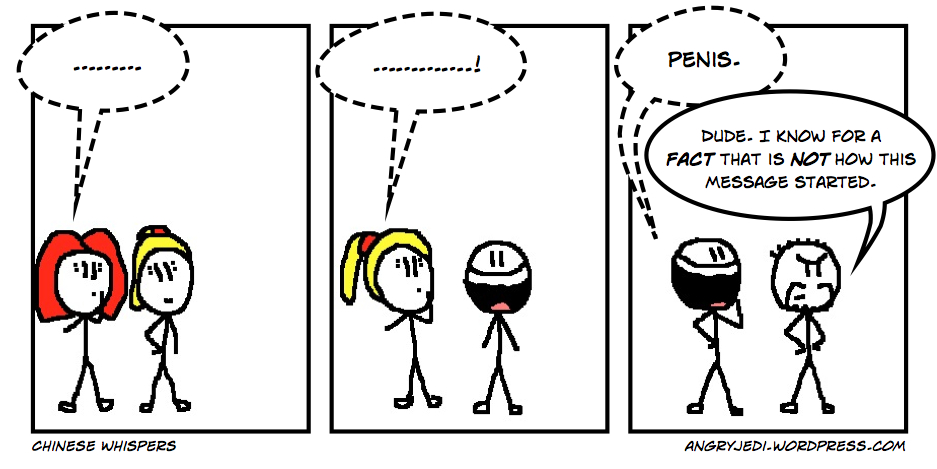
#oneaday Day 914: Chinese Whispers

Twitter was angry today. There was some degree of justification — the horrific shooting in Aurora at the screening of the new Batman movie had emotions running high, and I certainly don't begrudge anyone that. But it demonstrated, once again, some of the dangers inherent in social media — a force which should, by all accounts, be a positive thing.

Misinformation spreads like wildfire on the Internet thanks to services like Twitter. People post things without thinking, without bothering to back things up with research and evidence. Journalists encourage this, with TV news being a particular offender, inviting people to contribute their own thoughts on a particularly pertinent story using hashtags. It thus becomes something of a challenge to determine exactly what the facts are, and what is simple hyperbole dreamed up by the increasingly-hysterical mass of people who suddenly all think that They Know Best.

I shan't talk too much about the Aurora shooting specifically here because I haven't read up on all the gory details myself as yet. I will refer to a couple of other recent incidents where this phenomenon became particularly apparent, however.

Most recently was the "Arctic Ready" campaign, in which Shell apparently made the amateurish misstep of opening up a slogan competition on a controversial subject — drilling in the Arctic — to the public. The "Let's Go! Social" gallery page promptly became filled with anti-drilling, environmentalist slogans and it looked, by all accounts, to be one of the most colossal fuck-ups in social marketing history.

Except that it wasn't. It was actually a genius piece of social marketing, but not by Shell. No; the whole thing was, in fact, a clever ruse by Greenpeace, who then went on to troll Shell even further by picking a "winner" from the supposed competition and putting it on a billboard right outside Shell's Houston headquarters.

It should have been pretty obvious to anyone who stopped to think about the whole thing for a moment that this clearly wasn't Shell's doing. The kind of people who handle social media marketing are generally fairly savvy sorts (though there are exceptions) and would have stepped in to deal with the mass trolling of the supposed competition. In fact, they would have probably removed it altogether fairly sharpish. They certainly wouldn't have left it up for several weeks, opened up a new Twitter account just to repeatedly request that people don't retweet "offensive" adverts and generally keep poking the fire.

Unfortunately, it wasn't obvious to a lot of people. It caught people out not once, but twice — first, when the "Arctic Ready" site first appeared, and again a few weeks later when the Twitter account appeared. People posted, retweeted and commented without stopping to think about whether or not it was real. Others who were wise to it posted, retweeted and commented about how it was clearly fake. But amid all the noise from both sides it became impossible to differentiate who was talking sense and who was simply repeating the digital equivalent of what they had heard down the pub while drunk.

The Shell incident isn't the only one either. The "Today Is The Day They Went To In Back To The Future Part II" hoax has been around twice, too. Both times it caught people out. Why? Because, again, no-one bothered to check. No-one took a moment to fire up the movie and take a look. If they had, they would have seen that the claims made by whoever started that ridiculous rumour on each occasion were patent nonsense.

It happens in journalism too, and particularly in games journalism. One site posts a "Rumour:" or "Report:" story, and others pick up on it. The content spreads and becomes somewhat distorted over time. It happened today with a story from MCV which, as it turned out, apparently misreported the facts in the first place (or rather, more accurately, posted a story with a misleading headline) and was then sourced by Destructoid and a ton of other sites. This then inspired Ben Kuchera, official unelected and self-styled arbiter of How To Do Games Journalism On The Internet, to pen this piece bemoaning the whole situation, and by God I hate agreeing with Ben Kuchera — but he had a point. With a bit of research (or indeed just carefully reading the quotes that MCV included in its own piece) it's clear that the "story" (or, more specifically, the headline) that was going around simply wasn't true.

It's exhausting at times to keep up with all this stuff, and while it's great to be able to tap the pulse of everyone at the same time on a hot topic, it's less great to find yourself in the world's biggest game of Chinese Whispers. So do me a favour. Before you blindly retweet something that seems a little "off", take a minute and check to see whether or not it's actually genuine.

#oneaday Day 910: Continued Adventures in The Secret World

I'm still playing The Secret World and still enjoying it. Generally a pretty good sign for an MMO is if it can maintain my attention through the first month and convince me to continue paying the subscription fee (if applicable) past that point. The Secret World is certainly keeping me occupied and entertained, and I'm enjoying it a great deal.

I've progressed somewhat since the last time I discussed the game. I'm in the second of the game's main "adventure" areas, which is another part of the Innsmouth-style Lovecraft town. Rather than the more "towny" area that you start in, the second part is more like a forested outskirts area. There are fewer houses, streets tend to wend their way into the depths of the woods, and there are creepy Twin Peaks-style lakes with mist rolling off them (and monsters lurking in the fog, of course).

The missions continue to display an excellent amount of variety. There are a few more "kill [x] of [y]" action missions than I'd perhaps prefer there to be, but they generally have more of a narrative incentive to progress than in other MMOs. For example, in one mission I completed tonight, I was tasked with killing a bunch of draugr and then burning their bodies. This attracted some more powerful draugr, which I then had to kill and impale on some spikes. This attracted a draugr queen, which I then had to kill and splay out on a pointy rock. This attracted a draugr berserker, which I… you get the idea. This process continued through several steps, with increasingly more difficult fights along the way. At the end of the quest, my "handler" and I reached the conclusion that the draugr had an organised hierarchy and chain of command that could potentially be exploited in the future. Much cooler than simply returning to a questgiver and them going "thanks for killing all those wolves". (Praise should also be given to the fact that, this being the modern world, you turn in quests simply by phoning your handler rather than having to return to whoever gave you your quest.)

The fact that most missions incorporate something a little more than just plain killing is the best thing, though. In another one I completed today, I had to gather mushrooms from various areas around the map (guarded by horrible slobbering things from the depths of the ocean, natch) and then mix them together according to a recipe on a scrap of paper I had to remember I'd been handed at the start of the quest. The Secret World assumes a certain degree of intelligence on the part of the player, and doesn't remind you that, say, the instructions you need to complete a quest are safely in your journal — or, indeed, that sometimes you have to use the crafting interface to complete an objective.

Speaking of the crafting interface, it's a surprisingly cool approach somewhat reminiscent of Minecraft, of all things. Disassembling equipment you don't need rewards you with raw materials, which can then be combined together to make various objects. The twist is, you have to arrange them into the correct formations to produce the things you're after. You can then add things like glyphs to give them special abilities and bonuses and customize them.

I even tried a bit of PvP the other night. I normally hate PvP in MMOs because in most cases it's a horribly unbalanced afterthought that simply isn't any fun whatsoever. It is terrible in Star Wars: The Old Republic, for example, and I've never really been a fan of it in World of Warcraft, either. The Secret World has some interesting ideas, though, that make PvP well worth engaging in.

There are currently (I think) three PvP areas in the game. Two of these are instanced battlegrounds in which players take part in timed team-based matches according to whichever faction they're on. The other, though, is a large map which has persistent PvP going on at all times. A number of facilities cover this map, and it's up to each faction to capture (and, ideally, hold) each of these locations. There's a strong incentive to do so, because all players of a given faction receive ongoing buffs according to how many facilities their secret society is in control of.

And people are playing it well. The chat channels in the PvP areas are full of people actually bothering to talk to each other, strategise and coordinate their efforts. The Templars appear to have a bit of a numbers advantage, but that certainly hasn't stopped my faction, the Illuminati, from having a bit of fun — especially during quiet periods. Which is nice.

All in all, then, Funcom have done an excellent job in shaking up the very stale MMO space and creating something that it distinctive, entertaining and downright compelling. Its writing is good, its world is beautifully crafted and the whole experience is wrapped together with some unconventional but very effective game mechanics that successfully distinguish it from the million and one World of Warcraft clones out there. I strongly suggest you give it a try if you get the chance.

#oneaday Day 908: Customer Disservice

I wanted to share a customer service experience I had today as I found it immensely disappointing. It was partly my fault, I accept that, but the way in which it was handled left me with a very sour taste in my mouth and a feeling of disillusionment in a company for whom I had previously had nothing but good things to say.

After purchasing a copy of Super Street Fighter IV Arcade Edition in the currently-running Steam Summer Sale, I decided that the time had come for me to get an arcade stick and see if I could actually improve my generally-dreadful fighting game skills. I took a trip into town to my local CEX — they'd opened recently so I wanted to support them — and was pleased to see that a Street Fighter IV Tournament Edition FightStick was in the window for half its usual "new" price. A bit of preliminary research online had revealed that this stick from MadCatz was one of the best ones out there, and to see it for half its usual price was a deal too good to pass up.

The stick in question was designed for PlayStation 3, but uses a USB connection. I looked online and consensus said it worked with some PCs, though the chipset the computer in question was built on determined whether or not it would actually work. Intel chipsets were fine, apparently, but nVidia or AMD ones were not. Having been poking around inside my computer recently to fit a new power supply, I was pretty confident I had an Intel chipset.

Unfortunately, I was wrong. I brought the stick home, connected it up to the computer, Windows recognized it and then… nothing. No response from the stick in Control Panel, no response in game, no means to get it to register any inputs whatsoever. I tested it in the PS3 to make sure the device wasn't actually faulty, and sure enough, the PS3 had no issues with it whatsoever. Unfortunately, I don't have any fighting games (or even "arcade-style" titles) for PS3 that would necessitate the use of an arcade stick, so I had essentially wasted £70.

Or had I? No, I thought, if I head straight back to town now I'll have time to return it, get my money back and be home in time for dinner. So off I went, back to CEX, and queued up in an attempt to return it.

"I'd like to return this," I said, explaining the situation. Being an honest sort of guy — curse that particular character trait — I said that the stick wasn't faulty, but that it didn't work with my computer. (To be fair, lying and saying it was broken wouldn't have achieved much — CEX has a rigorous policy of testing things to prevent shysters trading in broken crap.)

"This isn't the selling till," said the woman behind the counter. "You need to join that queue."

I was taken aback by the bluntness for a moment after she had been helpful earlier in the day when I had purchased the thing. Fortunately, her colleague jumped in and pointed out that I wasn't trying to sell something to the shop, I was simply trying to get a refund.

She took the stick and scanned it, then explained to me that CEX's policy was that since it wasn't faulty, all she could do was give me store credit.

"Well, do you have an Xbox 360 stick available?" I asked. (Xbox 360 sticks work with Windows no problem.)

"No," she said.

"Okay," I said. "Then that's no help to me, really, is it? I've spent £70 on something I can't use. I would like my money back, please."

It was at this point that the cashier in question — Emily, her name was — decided that she couldn't handle this and called her supervisor who then launched into an obviously-rehearsed speech.

"I'm sorry it didn't work for you," she said with an incredibly patronising tone of faux-understanding. "I appreciate that it's frustrating, but unfortunately we're only able to give a refund as store credit."

I was really not in the mood for argument — I hate confrontation at the best of times — so after asking whether or not the voucher could be used online — apparently it can, but only through an unnecessarily convoluted process that involves paying the full price for the item then claiming a rebate — I grudgingly accepted and was on my way. I left immensely disappointed with the poor service I had received from CEX, and thinking that I would be considering things very carefully before making use of their services again.

Here's the thing that annoyed me most about the whole thing: there was no sense of the staff wanting to help me. I was quoted policy and simply shut down without any discussion. No consideration was given for the fact that I had bought the item that same day and had returned it in the exact same condition in which it had been sold to me. No consideration was given for the fact that I had wasted £70 and was being offered store credit in exchange when there was nothing I wanted to spend it on in said store. No effort was made to make me feel better about what I freely admit is my own mistake. Rather than doing something that would have built goodwill and allowed me to leave satisfied and happy while leaving them no worse off than they had been before I bought the thing in the first place, I was simply the recipient of a speech that had obviously been given many times before.

Customer service is a fine art, and CEX in Chippenham is clearly sorely lacking. CEX's return policy as a rule is unnecessarily harsh on those who make honest mistakes, and leaves no room for employees to "surprise and delight" a customer. I don't think this case is actually in breach of the Sale of Goods Act as the goods do work as described — the stick worked fine on PlayStation 3 and the people at the shop didn't explicitly tell me it worked on PC — but the fact is from a customer service perspective, CEX let me down. Store policies shouldn't be so inflexible that they leave a customer walking out of the store dissatisfied, disappointed and upset. Apple are good at this, often exchanging items for free simply as a means to, as said above, "surprise and delight" their customers. Head into an Apple store with a pair of dodgy iPod headphones, for example, and the store team will usually swap them straight out for you, no questions asked. Go in there with a broken iPhone/MacBook/whatever that's just out of warranty, and if you ask nicely they'll often help you out as if you were still covered. And on those occasions when they do turn you down, there's usually a good reason for them not being able to help you.

It would have cost nothing for CEX to help me out today. Had they refunded me and taken the stick back, they would have been no worse off than they had been this morning, and I would have left satisfied and confident in purchasing from them again. Instead, I am left with a piece of paper worth £70 and, currently, nothing to spend it on, as the Xbox 360 version of the stick is not available online. I am also writing about my poor experience on the public forum that is the Internet rather than praising them or simply keeping quiet.

So basically, CEX Chippenham, I'm exceedingly disappointed in the service (or lack thereof) I received today and will be thinking very carefully before I buy anything expensive from you again. You had the chance to surprise and delight me; instead you stonewalled me and flipped the bird. THANKS A LOT.

#oneaday Day 902: Follow the Rules (That Haven't Been Written Yet)

I've been playing a bunch more of The Secret World today and I stand by my initial impressions that it's a significant step, nay, leap forward for the MMORPG genre. My only slight criticism would be that so far I've had very little incentive to actually play alongside other people, but 1) this is nothing unusual for modern MMOs and 2) I haven't tried any "dungeon" missions yet.

It's in the Investigation missions that I mentioned yesterday where the game truly distinguishes itself. I shall try and resist spoiling specifics at this point, but completing one today involved searching for something in the game world, finding a laptop (password-protected, natch) and then having to break into it. The clue on the computer was vague at best, and there was nothing in the immediate vicinity to help. A little exploration was required, and then some actual honest-to-goodness deduction and lateral thinking on the part of the player. It was a true case of "I wonder if this works… holy crap, it does." As I say, spoiler-free, but it involved the sort of shenanigans normally reserved for "alternate reality games". Which is impressive stuff.

What all this clever puzzle-solving leads to, though, is something of a dilemma for the community. In other MMOs, the General chat channel is the home for people asking how to do things — when it's not the home of teenage boys soliciting sex from hot female Night Elf avatars, of course. It's sort of expected that if you ask a question such as "where is quest objective x?" that you'll get a straight answer. And that's fine — a lot of MMOs are still a bit clunky on the whole "user-friendliness" part and thus often forget to point the player in the right direction, necessitating either a lot of tedious searching the game world or simply asking other players.

In The Secret World, however, the confusion inherent in these Investigation missions is part of the appeal. The sense of satisfaction when you unravel one of the game's cryptic clues is unprecedented in the usually rather predictable MMO genre. Assuming you worked it out yourself, of course — and herein lies the problem.

Players coming to The Secret World straight from titles like World of Warcraft and Star Wars: The Old Republic will come to General chat or the dedicated Help channel and pose the usual sorts of questions. One of two things then almost inevitably happens — 1) someone posts the answer and everyone then yells at them for spoilers. 2) someone posts a vague clue and the new player then gets annoyed at not being able to get a straight answer.

Actually, this is an exaggeration — so far, from what I've seen, the vast majority of the community is on the side of "give hints, not answers" and only a few people ruin that. The trouble is, if you happen to glance at General chat when one of these people is spoiling a quest solution — perhaps unintentionally — then you can't unsee it. You'll know forever that Dr Bannerman's computer password is — wait, hang on, you won't get it out of me that easily!

Funcom's GMs are apparently being pretty strict about those they catch posting spoilers in the chat channels, so hopefully the community will be "trained" out of that particular practice sooner rather than later. The trouble is, tempers often run unchecked online, meaning that some people will fly off the handle to a disproportionate degree at these spoiling types — who, in many cases, simply hadn't yet got a handle on the game etiquette. Sure, it's common sense that in a game with a heavy puzzle-solving component that people might not want to just hear the answers blurted out, but it's entirely possible for the reasons I mentioned above that people may not have considered this. Getting yelled at and verbally abused by people isn't going to help them change their behaviour — it's simply going to make them defensive and often lash out back at their "aggressors", thereby perpetuating a cycle of people bitching and complaining at each other unnecessarily.

In many ways, it's the same as in teaching. In the classroom, if you spot someone misbehaving — or if another child comes up and "tells on" the miscreant, the worst possible thing you can do is yell, shout, scream and otherwise draw attention to their inappropriate behaviour. In many cases, the child was simply seeking attention, so to succeed so completely — even if it's with negative attention — will not train them to behave more appropriately in the future. Instead, a more assertive approach is the way to play it — take the child aside and discuss quietly and discreetly with them why what they did was wrong rather than encouraging them to get upset and strike back.

Now, obviously most of the players of The Secret World are a little older than primary school children (hopefully), but this approach is still a sound one. If someone behaves inappropriately — such as by posting spoilers — it may be easy to simply publicly shame them in General chat with an "FFS" and a few choice expletives, but all that will do is make them call you a "moron" (or worse) and ensure that you both end up on each other's Ignore lists. Instead, a simple, polite private message explaining why what they did was inappropriate or unacceptable is the way forward. No malice, a simple — but assertive — desire to help them out and make the experience more pleasant for everyone involved. Easy, right? Well, it should be. In practice it doesn't always work that way, but people will settle down over time as the "norms" of the game community are established.

The way online communities interact with one another is something that's always been fascinating to me, and the fact that The Secret World is even running into this issue at all shows what a big shift away from conventional, predictable MMO thinking it really is. The community is going to have tom come up with established conventions and ground rules — perhaps policed by GMs in the early stages — and those used to a different set of norms will have to adjust and adapt appropriately.

Anyhow. That's that. If you haven't figured it out already, The Secret World is most definitely worth your time and money, particularly if you have the slightest interest in Lovecraftian horror, or if you enjoyed Funcom's adventure titles The Longest Journey and Dreamfall. While it has its flaws and its bugs, it's certainly a far more interesting experience than the vast majority of other online titles out there, and I recommend you give it a shot — even if you're not normally into MMOs.

#oneaday Day 901: Lost in The Secret World

Well, I've spent a great deal of today playing Funcom's new MMO The Secret World and… and…

Well. Wow.

You remember how everyone hailed The Old Republic as a massive step forward for MMORPGs — before everyone realised it was actually just World of Warcraft in space, that is? Yeah. The Secret World actually is a significant step forward for MMORPGs.

Why, you ask?

Well, let's consider its thematic content for starters. The Secret World is a lush, rich combination of all manner of influences, including, among other things, Illuminati/Templar/some Asian dudes conspiracy theories, The X-Files and the work of H.P. Lovecraft. The early stages of the game feel very much like what a hypothetical Arkham Horror Online would play like — you're an "investigator" for one of the three factions in a town called Kingsmouth (which, in the "creepy American small town" stakes is in the unenviable position of being somewhere between Lovecraft's Innsmouth and Silent Hill's, uh, Silent Hill), you wander around trying to get to the bottom of what has caused a zombie apocalypse (I KNOW, ZOMBIES, but bear with me) and the mysterious fog that has come in from the sea. Also, big slobbering tentacle monsters. And people going "a bit mental." Apparently Cthulhu is involved at some point, but I haven't got that far as yet.

So The Secret World eschews the usual fantasy or sci-fi tropes of the MMORPG genre in favour of a modern-day setting dripping with Lovecraftian atmosphere — at least in its initial stages, anyway. And it actually bothers to tell a fully-realised story (with full speech and cutscenes) rather than a limp, loosely-connected set of questlines. But it's not just the theme and the strong narrative that distinguishes The Secret World from its numerous competitors. The game systems are also an impressive breath of fresh air.

Let's start with the quests. While some quests do include objectives such as "kill [x] [y]s", these are usually part of a longer chain of events. Where things get interesting are when you break away from what the game refers to as "action" missions and you get to take on "sabotage" and "investigation" quests. While "action" missions, as you might expect, involve killing things, "sabotage" and "investigation" challenges are a little different.

In a sabotage mission, stealth and environmental puzzle solving is emphasised. In an early example, you have to retrieve a number of security cameras from abandoned businesses around the town and set them up in strategically advantageous places for both the police and your faction. Many of the cameras are out of reach from ground level, necessitating a bit of exploration as you figure out how you can actually reach them. As the mission progresses, you eventually find yourself exploring an instanced "mini dungeon" in which you have to avoid security cameras and laser tripwires while working out a route to disable various control panels without being spotted.

Investigation missions, meanwhile, are a lot more elaborate. The current one I'm working on has 18 steps in it. If you consider that your average MMO quest has 3 steps at most (get quest, kill/collect shit, return to questgiver), this is pretty impressive. When you look at what some of these steps involve, it's even more impressive.

In investigation missions, the fourth wall is broken slightly as the player has to put their own intelligence to the test. Clues are given for various challenges, and it's up to the player to figure out how to solve them. An early, simple example involves working out the password for someone's computer using a couple of hints they've left around the place, but later ones see you doing everything from deciphering morse code messages to making use of the in-game web browser to research real-world things. (Of course, you could just cheat using said web browser, but the community is already rather sensitive about spoilers, so you'll be surprised at how few "answers" are out there already.)

This brilliantly diverse questing system is coupled with an excellent levelling mechanic. Players level up at a consistent rate throughout the game and can eventually unlock all the skills from all the disciplines — but it's only possible to equip seven active and seven passive skills at once, much like how Guild Wars does things. It's possible to save these "decks" of skills, however, allowing you to easily switch your character build on the fly according to the situation you're in or what the group you're with needs you to do.

Combat, too, is quite interesting. While it's the usual "hotbar and cooldown" approach, there's a much more "action game" feel to it here, thanks in part to the fact that positioning is important — particularly when baddies start doing area-of-effect attacks. You can take on a lot more enemies at once than in many other MMOs, giving the game a much more exciting, dynamic feeling rather than simply getting into the rhythm of pressing the number keys that titles like World of Warcraft offer.

In short, The Secret World is evidence that there is still some creativity among those who make MMOs. Not everyone wants to make a World of Warcraft clone, and Funcom have succeeded in creating an experience that is very much its own thing — and very much worth your time and money. C'mon. You can't say the prospect of doing a raid on Cthulhu doesn't appeal just a little bit.

#oneaday Day 900: Gravity Rush Wrap-Up

I finished Gravity Rush on Vita tonight. I was rather disappointed to note it's a game that gets significantly worse the further you go rather than better. That's not to say it's not worth playing, however — more that it's clear roughly 75% of the way through that the team simply ran out of ideas.

Gravity Rush is a joy to play initially. Once you get your head around the strange gravity-flipping mechanic and realise it's different from a conventional "flight" system (you can't really steer while "falling", for example — you have to stop and then start "falling" in a different direction) it's a lot of fun to swoop around, run up walls and leap down onto things.

The thing is, the whole gravity-shifting thing seems somewhat underused. There aren't any particularly clever puzzles through the game that require you to run up walls or on the ceiling or anything, so after some time you begin wishing that protagonist Kat could just fly like a proper superhero.

This problem is compounded when we get to the dreadful aerial combat, which coincidentally is the reason the game's "fun factor" takes a significant nosedive when on the home straight. I mentioned this a few days ago, but it became the cause of significant teeth-gnashing frustration as the game progressed. Allow me to explain.

When floating in the air, Kat is able to launch a "gravity kick" move by aiming the on-screen reticle at something and then holding the Square button. She then swoops towards the thing you pointed at, hopefully causing damage. Fair enough.

The trouble with this is that a lot of enemies, particularly later in the game, are only vulnerable in specific weak points. If said weak point is on the far side of an enemy, Kat will simply plough into said enemy and do no damage whatsoever, usually putting herself in harm's way. (This isn't helped by the fact that a lot of late-game enemies also have the ability to fire bullets at Kat, which the player has to dodge by swiping on the touchscreen.) A lot of late-game combat simply becomes a case of launching Kat at enemies from a distance and hoping she hits them — because more often than not, they'll simply dodge out of the way before impact, and it's honestly difficult to tell whether or not the game actually "locks on" to these enemies or not. (I believe it is supposed to, though you could have fooled me.)

By far the worst thing, though, was the "Special Forces" DLC that came free with the "special edition" of the game I got — it was the same price as the normal game for a limited period, so I figured there'd be no loss in getting it.

Oh man. If ever there was an argument for DLC being tacked on, pointless, moneygrabbing shite, this is it.

It contains just two missions, both of which are immensely tedious "fetch and kill" quests, and the latter of which incorporates a totally unreasonable time limit in which to accomplish your objectives — which, by the way, aren't marked with navigation pointers unlike in the rest of the whole game. The latter mission also makes heavy use of the game's idiosyncratic "throwing" system, whereby Kat can pick up objects in her gravity field and then fling them at things. The trouble is, this mission requires Kat to fling things precisely, but the game regularly decides that you actually wanted to aim at that enemy a little to the left of where you were actually pointing when you pressed the "throw" button. In a non-time sensitive situation, it would have been helpful to have this quasi-"lock on" facility when throwing things; when attempting to fling water towers at fires, however, it's a pain in the arse.

I'll be honest, I didn't finish the DLC because it irritated me so much — thankfully, it's possible to cancel out of the missions once they've started and simply proceed back on with the main story. As a matter of fact, the second mission in the pack soured me so much on the game by making its flaws so abundantly apparent that it significantly impacted my enjoyment of the finale which, on reflection, wasn't terrible.

Gravity Rush isn't a bad game. In fact, it's a very good game, and a fine showcase of the Vita's capabilities and unique features. But with a bit of work it could have been an amazing game. It looks fantastic, it has an endearing main character and a wonderfully entertaining core game mechanic, but it simply falls to pieces at the end with a string of unimaginative fetch and kill quests. These just make you want to get to the end so you don't have to play any more, not because you want to see the end of the story (which, incidentally, leaves a whole lot of frustratingly unanswered questions).

It may sound like I'm being unduly harsh on this game and perhaps I am. I did like it overall, and I'm glad I played it. If you own a Vita, you should play it too.

It's not perfect. It has potential, though, and that's quite exciting. The possibilities that a Gravity Rush sequel might offer are very intriguing indeed. For my money, I'd like to see more creative use of the gravity mechanic for puzzle-solving, less aimless open world flying around, less combat (or at least combat that isn't so incredibly irritating) and a story that wraps up properly.

That's that for now, though. Next up is Persona 2.

#oneaday Day 896: Gravity Rush

20120703-010706.jpg

I've been playing a fair ol' bit of Gravity Rush on the Vita recently. My feelings about it are somewhat mixed, but on the whole it's a very good game, and certainly one of the most impressive handheld games I've ever played.

Of all things, my least favourite thing about it is the name. "Gravity Rush" is not the name of an epic, sprawling, visually sumptuous adventure. "Gravity Rush" is, to me, the name of an iPhone game — perhaps an Angry Birds Space ripoff — or an obscure downloadable console title at best, perhaps. (Or perhaps I'm just associating it too much with Gravity Crash on PSN, which is nothing to do with Gravity Rush.)

That aside, though, there's a lot to like.

For the uninitiated, Gravity Rush is ostensibly an open world… platform game, I guess you'd call it if you had to pin it down to an established genre, but to pigeonhole it thus is to do it a gross disservice. It's a platform game. A racing game. A mindbending puzzle game. An air combat game. And plenty of other things besides. It actually has a surprising amount in common with underrated open-world gem Crackdown, of all things. Oh, and it was designed by Keiichiro Toyama, who true game geeks will know is the creator of the Silent Hill series. According to Wikipedia, Gravity Rush was the first game he ever wanted to create, but was only able to bring his vision to fruition recently.

In Gravity Rush, you play Kat, a young amnesiac girl with red eyes, blonde hair and surprisingly dark skin for an anime-style character. Kat is also clad in an outfit best described as "bizarre", and is accompanied by a black cat. Oh, and she can shift gravity at will with the assistance of said black cat, allowing her to "fall" in any direction she pleases, stick to walls, skid along the ground and do gravity-defying flying kicks.

Kat is far and away the highlight of the game. Despite her hackneyed amnesiac introduction, she quickly proves herself to be a fun character to play with. She's a bit dizzy, she's confused, she's obsessed with her own appearance and appeal to the opposite sex, and she's easily distracted. But despite these flaws, she has a noble streak — she wants to do the right thing and use her powers to help people, despite not really understanding where they came from or what they're for. As the game progresses, the residents of the city where the majority of the game is set go from fearing her strange powers to respecting and appreciating her talents.

Gameplay in Gravity Rush is mission-based, but it's up to the player when they want to trigger each subsequent mission. Between missions, it's possible to tool around any of the unlocked city areas collecting gems (which can be used to level up Kat's abilities), talking to residents to gain a greater understanding of the strange world the game is set in and taking part in "challenge missions." The latter are very difficult timed tasks of various kinds — some might see Kat having to defeat as many enemies as possible in a time limit, others see her racing through a series of checkpoints, perhaps with some limitations on her abilities in place. Each challenge has three tiers of rewards, with increasing numbers of gems available for completing these tricky tasks by more impressive margins.

This may all sound relatively unremarkable so far, but it's the excellent way that Gravity Rush makes use of the Vita's distinctive capabilities that make it interesting. The "gravity shifting" mechanic is a prime example. By tapping the R button, Kat floats up into the air; tapping it again causes her to "fall" forwards according to where the screen is pointing, regardless of which way is "up". The specific direction she falls can be controlled using the Vita's right analogue stick, but a surprising degree of precision can be attained by combining the stick controls with the tilt sensors in the Vita. If you're feeling completely un-self conscious, you can completely control the direction of the camera in these floaty bits by tilting and rotating the Vita, but that would be both impractical and undesirable for most people, so the combination of stick and tilt works very well.

Similarly, when Kat uses her "slide" move (accomplished by pressing and holding on the bottom two corners of the touchscreen), it's possible to steer her by tilting the Vita side to side and jump by "flicking" the device. You can also "drift" in a Wipeout style by releasing one corner of the touchscreen as Kat goes around a corner.

A more subtle use of the Vita's capabilities comes in the comic-style cutscenes that punctuate each mission. Tilting the device causes the perspective on the comic panels to shift slightly — unnecessary, but cool — while swiping with a finger advances to the next panel, just like in an iOS/Android comic reader app. These little touches arguably don't add much to the experience, but they certainly don't hurt it, either.

The game is a joy to navigate — gravity shifting and "falling" through the skies towards your destination is thrilling every time, and the world is an interesting, beautifully-designed environment to explore — but things do fall apart a little when it comes to combat. On the ground, Kat is limited to a not-particularly-effective kick attack as well as a useful "dodge" move achieved by swiping on the touchscreen. In the air, Kat can do a "gravity kick" manoeuvre where she "locks on" to an enemy then flies through the sky with high heel outstretched, with more damage being done if she "falls" on the enemy from a greater distance.

This is all very well and good and would be absolutely fine were it not for the fact that every enemy is only vulnerable in specific weak spots. Crash into an enemy anywhere other than their obvious glowing weak spots and you'll do no damage. Early in the game this isn't an issue, because the weak spots are in easily-accessible locations, but later enemies have multiple weak points all over their body and often thrash about, making it difficult to hit them. One boss in particular will have you flinging your Vita in frustration as it seemingly always dodges aside just as you get lined up perfectly. None of these challenges are insurmountable, but it does sometimes give the game some rather artificial-feeling difficulty spikes, which is a bit of a shame.

The game's considerable charms (mostly in the form of Kat and the interesting, mysterious story she becomes embroiled in) outshine its flaws, however — at least to me. I've been playing it quite a bit today and I've found it an engrossing, immersive experience. I think quite a bit of that is due to the fact it's a handheld game, which surprised me — traditionally, I've regarded handheld experiences to be less immersive, not more — but Gravity Rush draws you in like few other games I've played recently, and then doesn't let go.

If you have a Vita, be sure to grab a copy. If you don't have a Vita, it's certainly a great example of what the system can do. Is it a "killer app" for the system? Perhaps — it's certainly not perfect, but I can't imagine it working quite the same on, say, a console. The touch and tilt controls are excellently integrated into the more traditional button-based commands, and the whole thing feels like it was designed specifically for the Vita rather than envisaged as a console title with Vita features shoehorned in later. The gorgeous cel-shaded graphics, heavily influenced by a combination of French comics and anime, also make it one of the most distinctive-looking games I've seen for a long time.

If nothing else, it's a game I'd certainly like to see a sequel to in the future, so let's hope it enjoys some success.