#oneaday Day 967: I Love You, Irina

I have already said a few positive things about batshit crazy visual novel My Girlfriend is the President on here and done a writeup over at Games Are Evil, but I feel it's worthy of another post as I'm still playing it. My initial writeups were based on a single playthrough, you see, and like any good visual novel worth its salt, there are several possible "routes" through the narrative. (Interestingly, once on a route, there only appears to be one ending and minimal decision-making along the way — something which I thought would bother me a lot more than it does, which is not at all.)

(Author's note: it is nearly 2am and I am tired, so I apologise in advance for incoherent rambling.)

Mild to moderate spoilers follow.

Currently I am about halfway through Irina's route. Irina Putina is the Rusian (sic) president who shows up early in the game's (fixed) first act and then sticks around for varying amounts of time in the remaining three, depending on which route you chose. She's a textbook tsundere in almost every respect, seeming abrasive, grumpy and quick to anger on the surface but regularly demonstrating that she has a soft centre beneath all the slapping. And to be fair to her, protagonist Jun deserves every single slap he gets from her.

Playing Irina's route directly after Yukino (the titular "girlfriend" — actually better translated as "childhood friend") is interesting. On Yukino's route, a huge deal was made out of her history with Jun, particularly a key event in their past which made them the close friends (and, later, lovers) that they are in the game's story. On Irina's route, the pair are still very close to one another, but Jun's attitude towards Yukino is markedly different, at least so far as I have progressed. The pair still play with one another — Yukino's "puppy" impression is particularly adorable ("Wan! Wan!") — but over time as Jun becomes increasingly aware of Irina, he becomes self-conscious about his relationship with Yukino and about how he is stringing her along and making her jealous.

Jun, just in case you haven't read my other entries on the subject, is a bit of a dick at the start of the game. Specifically, he's a wannabe sex pest, constantly making inappropriate comments and lusting after his female friends, most of whom know exactly how to put him in his place. It's worth bearing in mind that he is a teenage boy, however, and consequently is wracked with perpetual horniness and no outlet into which to channel this energy. Moreover, his "harassment," as he calls it, doesn't escalate beyond ill-chosen words and an occasional bit of peeping at things he shouldn't. His actions are regularly completely inappropriate, of course, but he could also be much, much worse.

It's this thoroughly objectionable nature that Jun has at the start of the story that allows him to take such a bold personal journey over the course of the narrative, even as utter insanity is unfolding around him and his friends. By beginning as a heavily flawed character, a pervert, he has the potential to grow and change into something better, and the girls of the story provide the catalyst for him to change. In the case of Yukino, he learns to respect and respond to the feelings of others; in the case of Irina, he learns restraint and gentleness. (I can't speak for Ell or Ran as I haven't played their paths at all yet.)

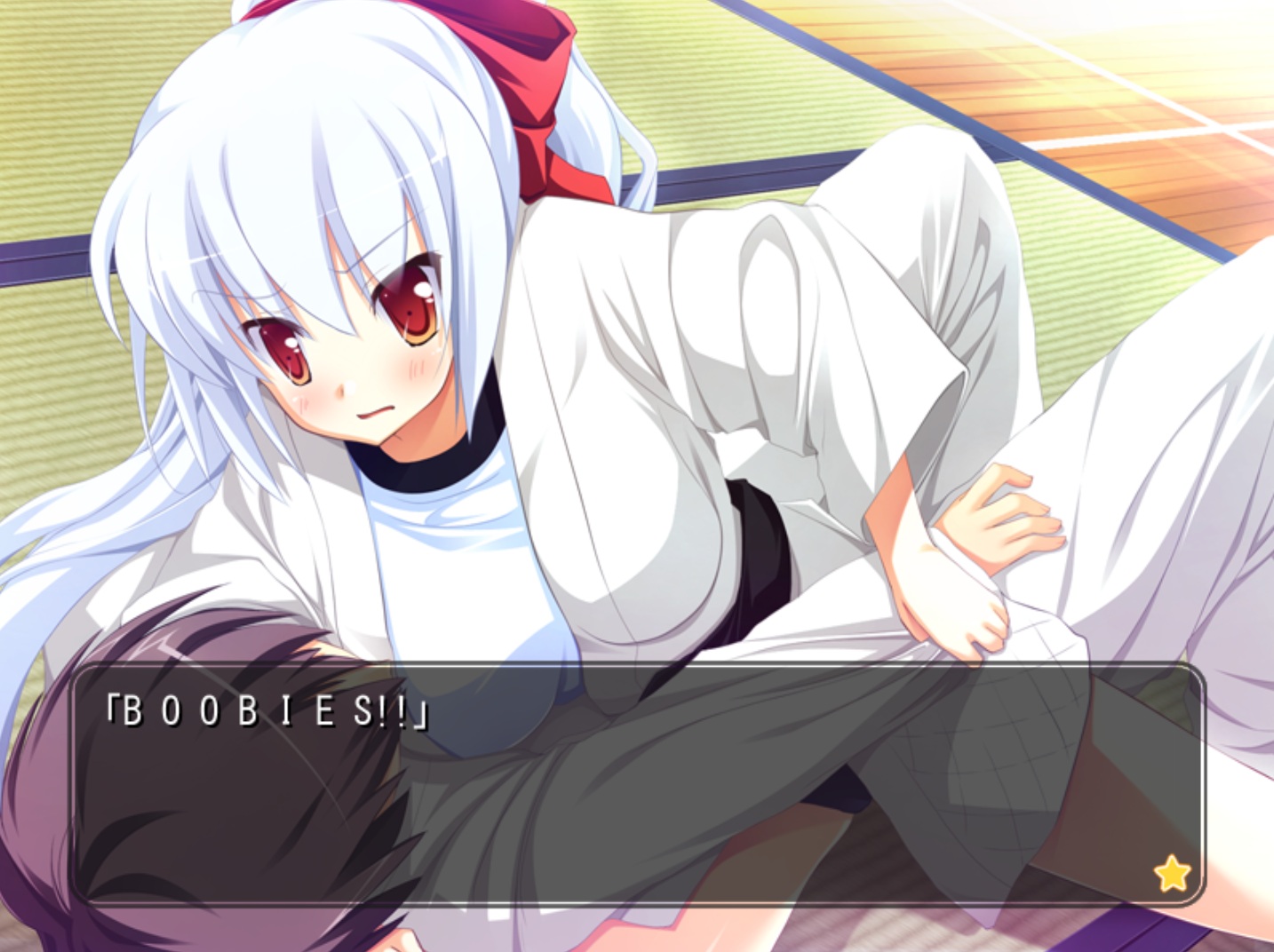
It's actually quite touching to see. We first witness Jun going through some changes on Irina's path when she comes with him to a judo class and shows him her passion for the sport. When he ends up pinned beneath her and starts teasing her about her breasts, she gets absolutely furious at him and storms out. Normally, Old Jun would have just shrugged this off, but he actually feels bad that he has hurt her feelings by mocking something she loves so much. He goes out of his way to try and make things right — even more remarkable given that he knows she's going to leave in a couple of weeks and thus he could just as easily stay out of her way. His feelings grow, and he realises that he wants to make her happy, to give her the opportunity to be a "normal" girl for those two short weeks rather than the "girl president" position she's been lumbered with.

It's an interesting twist on what happens with Yukino's path. When Jun and Yukino become lovers, Jun stands by her, swears to support her and goes out of his way to help her complete her mountains of work — without her knowledge in some cases. As he grows to love Irina, however, he seemingly wants to provide her with an "escape" from reality for a short period, to let her be "herself" rather than the "Rusian Fairy" facade she normally has to keep up.

I really love that a game with such an utterly nonsensical overarching plot as My Girlfriend is the President still has such wonderfully-defined characters and a genuine sense of emotional engagement in its narrative. The game is absolutely masterful at building up sexual tension in particular, meaning the player is right there with Jun throughout, feeling the electricity of every stolen glance, flushed cheek and hesitant word of affection.

That sense of involvement, of being inside the heads of the characters? That's why I love VNs. There are few other places in gaming where you can have such profound experiences.

#oneaday Day 965: Geometry Makes the Best Games

Being "in the zone" is a curious experience. On the one hand, it's enjoyable and satisfying, whatever the context — sports, games, music, writing — but on the other, it can be terrifying. The second you become aware of your own "in the zoneness", panic strikes. Your pulse races and you worry that you will fall out of said zone any moment. You struggle to maintain your "in the zoneness" but as you become more and more stressed, you get more and more likely to make some sort of critical mistake until, eventually, you give up and go and do something else.

This is the feeling you are constantly battling against while playing Super Hexagon, a new iOS game from Terry "VVVVVV" Cavanagh.

In Super Hexagon, you play the role of a teeny-tiny triangle attempting to not meet a sticky end against the various walls that are being inexplicably flung at it from outside the screen. Or perhaps it's attempting to escape a maze without crashing into any walls. Or… well, it doesn't really matter what it actually is. It's an abstract, "pure gameplay" game in which the aim is simply to survive as long as possible. In essence, it's similar to those "endless running" games that are so popular on mobile platforms right now, with the difference being that you're rotating a shape around a point rather than jumping, ducking and sliding.

In your first couple of games of Super Hexagon, you're likely to last a matter of seconds — five at most. This brutal level of difficulty will likely be enough to put many people off immediately, and that's fine. Stick with it, though, and you'll find yourself increasingly slipping into "the zone" as you survive just a tiny bit longer each time, your skills consistently improving as you learn to spot the various patterns that come your way — and how to deal with them.

Then, of course, you make the mistake of thinking "gosh, I'm doing quite well this time" and plough straight into a wall while 0.05 seconds away from beating your high score. Then, you will immediately tap the screen to try again and be unable to break this cycle for at least half an hour. (Consequently, I do not recommend playing Super Hexagon on the toilet.)

The simple, addictive, abstract nature of the game brings my love affair with Geometry Wars 2 to mind. Both are completely different types of game, of course, but both also have a lot in common. Both tend to have relatively short play sessions, both have an aesthetic so abstract that it stirs the imagination to a surprising degree, and both have a relatively low "penalty" for failure. Mess up and you're back in the game within a second or two to try again.

This latter quality is one of the most important factors in making a game "addictive". Super Meat Boy is another game that understands this — fail a level in that and simply by pressing a button, you're trying again, with no loading breaks, no obtrusive "You Failed" screens or statistical breakdowns, just a tap of the "Retry" button and an immediate response. Geometry Wars 2 did this; Super Hexagon does this. Because it's so simple and habit-forming to just tap the screen to retry after a failed attempt, you get locked into a compulsive cycle, determined that this time is the one, that this time you'll be able to progress just a little bit further and hear Jenn Frank's voice whispering the name of a shape with even more sides at you.

Super Hexagon is out now for just 69p. Grab it from the App Store.

#oneaday Day 961: I am Thou

I wrote a piece about Persona 3 over on Games Are Evil earlier today. Go read it, please.

I have, as you may have guessed from the fact I chose to write about Persona 3 today, been playing Persona 3. I have been meaning to play the extended FES version for many, many years now and have started several times. This time I intend to finish it, including battling my way through The Answer, which I understand is a bit of an ordeal. Then, if I'm feeling particularly masochistic, I will proceed to play Persona 3 Portable as the female protagonist.

I fucking love Persona 3 and 4. They are still my favourite games of all time. I own the first two for PSP/Vita, too, but found the first one a little hard to follow plot-wise and haven't delved particularly deeply into 2 yet. Fortunately, each one stands quite nicely by itself — though 3 and 4 are nicely interconnected, even if certain aspects clash (why do the kids in P3 need Evokers to summon their Personas, but the ones in P4 don't?).

My love for these games stems primarily from the fact that they push all my gaming happy buttons. I love JRPGs and I love visual novels, and Persona 3 and 4 combine the best bits of both genres. You have a simple-to-understand, hard-to-master combat and character development system; you have an in-depth storyline tackling very "human" issues. You have "saving the world" drama; you have characters dealing with personal crises that can, at times, seem more important than impending disaster. Somehow the game manages to avoid pretty much every cliché that critics of JRPGs hate to create an emotional, mature experience with an absolutely badass soundtrack.

The highlight is, of course, the cast of characters throughout. And as I said in my piece over on Games Are Evil, the interesting thing about Persona is that it's not only the heroes and villains who "matter" in the grand scheme of things. The "Social Link" mini-stories that arise as the protagonist gets to know his new school friends and people in the community are fascinating plotlines to follow through in their own right, and help to lend a greater sense of poignancy to the overarching narrative of the Persona-users attempting to Sort Shit Out. In other words, everyone has their own demons to deal with — sometimes these are literal demons, others they are the barriers we create for ourselves: fear, anxiety, shyness, a lack of self-belief. Watching the protagonist touch the lives of these people and be there with them as they come to terms with their own issues gives the small game world a much greater feeling of "life" than almost any other RPG I've played.

It also, once again, highlights the difference between Eastern and Western game design philosophy. When it comes to RPGs, I am firmly in the Eastern camp. I am yet to come across a Western RPG that has captivated me in the same way as the Persona series. You can rant and rave all you like about the beautifully-rendered worlds of Bethesda adventures or BioWare's (increasingly questionable) storytelling chops, but, for me anyway, no-one has the Japanese beat when it comes to interpersonal relationships and a sense of "human" drama amid supernatural chaos.

#oneaday Day 960: Moe Moe Kawaii... Wait, What Are You Doing...?!

Where do you draw the line between art, entertainment, sexist nonsense and porn? It is a rather fine and difficult line to walk, particularly when the definitions of all of those terms vary enormously from person to person according to their open-mindedness, experience with various works, gender and general social attitudes. It's a particularly pertinent question with regard to the genre of games that I seem to be spending a fair amount of time with at present — the ol' visual novel.

The current game I'm playing is called My Girlfriend is the President. I will refrain from talking about it in too much detail as 1) I haven't yet finished it and 2) I will be doing a READ . ME column on the subject for Games Are Evil this Sunday. Suffice to say, however, it is utterly bananas — and yet, there is a slight sense of discomfort while playing. Not enough to prevent me from enjoying it, but just enough to make me think that it might, in fact, be deliberate.

The tension stems from the game's protagonist, whom in TV Tropes terms is probably best described as a Chivalrous Pervert. He openly admits to sexually harassing women and getting turned on by ogling his female peers in a less than honourable fashion. He takes every opportunity to make a smutty comment just to "try his luck". And he's a peeping tom. In short, he should be an immensely dislikeable dick whom any self-respecting player wouldn't want to spend any time inside the head of whatsoever.

And yet he's not. At least part of his perpetual horniness can be attributed to the fact that he is a teenage boy, and consequently subject to the same hormonal urges that all teenage boys find themselves afflicted with. His supposed sexual harassment never leads anywhere, as his female peers are all well aware of the fact that he is a wannabe pervert and thus make sure he doesn't have the opportunity to do anything truly inappropriate — not that he actually would given the opportunity. Several of them even take every chance they get to toy with him, making him more and more wound up and frustrated while at the same time making it clear that they are the ones with the true power in their relationship.

And alongside all this perversion comes the fact that, at heart, he doesn't want anything bad to happen to these girls. He takes every opportunity to attempt to prove his "manliness" and "protect" them, even if they don't really need protecting. He gets embarrassed, flustered and overexcited if anything actually does happen, and when it comes to his adorable childhood friend (the titular President) he is — for the most part, anyway — respectful and sweet.

It puts the player in something of a quandary. Since the game takes place from the perspective of this horny young gentleman, we're frequently subjected to his male gaze sizing up the bodies of the people he's with and pondering what's under their clothes. If he thinks there's the chance he'll see something naughty and the girls in question aren't in any actual physical danger, he'll stand by and watch rather than preventing something embarrassing happening to them. But when the chips are down and Bad Things are happening, he's the first to spring into action in an (often misguided) attempt to keep them safe — usually with hilarious slapstick results.

So what does all this mean? Is the game itself sexist, or is it simply putting the player inside the head of a protagonist with definite sexist tendencies? Or is it somewhere in between?

I don't know for sure. Whatever it is, My Girlfriend is the President is most certainly a gloriously guilty pleasure that I have absolutely no shame in saying that I am enjoying a great deal right now!

#oneaday Day 959: Free iOS Games That Don't Suck: Zookeeper Battle

From a personal perspective, I have grown to pretty much loathe the mobile gaming industry. I find it interesting to write about for my day job, but as time passes, I find myself wanting less and less to do with it in my free time. It has become abundantly apparent that "free to play" or "freemium" is seen as the way forward, with most developers believing it impossible to get your game seen if it costs money up front; and when developers do release something of comparable quality and price to something you'd see on a dedicated gaming handheld — see: anything Square Enix puts out — everyone seems to complain, even if they wouldn't hesitate to pay $20+ for, say, a PSP or Vita title.

Consequently, it's a genuine pleasure when I come across an iOS game that doesn't feel like it's violating my wallet and badgering me to do things I don't want to do. It's even more of a pleasure if said game falls into the "free to play" category and doesn't feel in any way exploitative to the player, nor does it feel like a cynical, lazy clone of something else.

I present to you, then, exhibit A: Kiteretsu's Zookeeper Battle.

Zookeeper Battle is a "match-3" puzzler of the Bejeweled Blitz mould. You have coloured shapes — in this case, zoo animals — and must swap them around to make groups of 3 or more of the same colour either horizontally or vertically. Doing so causes them to disappear and more to fall down in their place. It's the player's aim to do as much of this matching as possible against a tight time limit.

In the case of Bejeweled Blitz, players are simply competing for a high score, but in Zookeeper Battle, it's a head-to-head competition against another player — and live, rather than asynchronous. Matching animals adds to a player's attack or defense score for a round, and after time has expired the two players will attempt to smack seven shades of shit out of each other. Attack points are absorbed by the opponent's defense points, after which they translate directly to damage. Whoever reduces their opponent's life bar to zero first — or whoever has the most life remaining at the end of five rounds — wins. It's simple, effective and incredibly addictive, and regular "quests" with custom backgrounds, greetings and other non game-breaking goodies on offer help provide incentive to play regularly.

What I find quite surprising about Zookeeper Battle is that it does most of the "freemium" tricks that I abhor so and yet somehow manages to come out not being obnoxious. There's an energy (sorry, "CP") bar throttling how much you can play in a single session, for example — but it restores quickly and the game also provides you with five "energy drinks" to restore it for free upon first booting it up. It's also pretty rare that when I sit down to play Zookeeper Battle that I want to play more than one or two matches anyway, so in practice, despite energy systems being the worst thing that has ever happened to gaming, here it's not too obtrusive.

The same goes for the in-app purchases. Zookeeper Battle allows players to spend real money in exchange for "booster" items, all of which allow the player to counter special "attack" items that may be sent their way during a match. The thing is, though, these paid items aren't actually that helpful and are certainly no guarantee of winning, as all of the "attack" items either lose their effects after a few seconds or are easily countered. In other words, a system that could have easily become "pay to win" is more a system that just doesn't need to be there at all — like the energy system, it's a shame it's there, but it doesn't really get in the way of the core game, which is solid.

While I would perhaps prefer that Zookeeper Battle dispensed with this freemium crap altogether, I appreciate that such monetization strategies often prove somewhat lucrative for developers — certainly more lucrative than asking for a single, one-off "price of admission". What I believe Kiteretsu should be praised for in this instance is incorporating all the usually-obnoxious freemium mechanics in such a manner as to not be obtrusive to players who don't want to play — and, more to the point, not to provide such a massive advantage to paying players that it just makes the game completely pointless to play at all.

The only thing that is a real shame is the fact that the Game Center leaderboards for the title have, as usual, been rendered completely useless by cheating players. The current number 1 player in the world has apparently won over two billion games. Assuming an average of three minutes per game, this would mean that the player had been playing for six billion minutes in total. To put it another way, this would equate to a hundred million hours or 11,408 years. I'm pretty sure the game hasn't been out for 11,408 years. I'm also pretty sure that iPhones haven't been available for 11,408 years. And I'm fairly sure that the person in first place isn't over the age of 11,408 years.

Oh well. I can be happy with my performance so far. Feel free to challenge me — I'm Angry Jedi on Apple's Game Center, so feel free to add me if you have an iOS device.

#oneaday Day 958: Gratuitous Self-Promotion (And Promotion of Others, Too)

Hello! How are you? Great!/Sorry to hear that! (delete as applicable)

I have something to share with you that I've been working on recently. Some of you may have already seen what I've been up to; it may be news to some of you. I thought I'd share it here, though, in the hope that I can get more people looking at it.

I'm talking about the website Games Are Evil. I was a contributor there a while back in the post-Kombo years, but was then lucky enough to score my gig at the late GamePro. I kept abreast of what the team was up to during and after my time at GamePro, and always felt a certain degree of "attachment" towards it, even during the times when I wasn't actively involved.

So when it became apparent that the site was in need of a bit of a "reboot" and resuscitation, I was keen to step forward while I had a bit of free time on my hands. I'm lucky enough to have a flexible (and well-paid) enough day job that I have time to take on a "pet project" like this as well as fulfilling my other responsibilities, so I figured it would be a good opportunity to gain some experience in running a site as well as experimenting with some "alternative" directions and content strategies.

That "alternative" thing is key. Having had some interesting conversations with a couple of my friends in the PR industry in recent months, it became clear that a lot of representatives were becoming frustrated that the vast majority of gaming sites focused on the upcoming blockbusters, while "B-tier" titles (for want of a better term — I'm not saying their quality is lower, only their profile) went forgotten, or were barely acknowledged with a somewhat dismissive news story. As such, I felt that there was clearly a gap in the market for a site to cater to the "niche". Since Games Are Evil was not particularly beholden to advertisers or investors, the time was ripe to launch something of an experiment — a video games site that deliberately eschews stories regarding things like the Call of Duties and the Mass Effects of this world in favour of smaller-scale titles and interesting stories from around gaming culture. My original manifesto from when I took over can be found here, if you're curious.

Since taking over the reins at GrE, I've launched a series of regular columns from a range of talented and enthusiastic writers keen to write about their passions. These columns are becoming the main focus of the site, supported by a few daily news stories and occasional reviews when we have code to hand. Each column has a tight, narrow focus and  concentrates on a specific genre or aspect of gaming culture, meaning that readers of Games Are Evil will be able to follow their favourite niche and get to know the writer of said column in the process rather than having to scroll through page after page of news which might not be relevant to them. The model which I wanted to follow with this was the way old-school 1up used to work — people came for the personalities rather than necessarily the specific content of the articles. It's too early to determine whether or not this has been successful or not so far, but I am very proud of what the team has achieved to date — we've seen some great columns ranging from comprehensive roundups of Minecraft news to in-depth explorations of obscure strategy games.

Here's some handy links for you to find your favourite column and follow it:

  • Distant Worlds — a weekly roundup of news from the MMO sector. What's new, what's hot, what's not.
  • FreePlay — a weekly delve into free-to-play and freeware games to sort out the "must plays" from the microtransaction-riddled crapfests.
  • Insert Coin — a weekly exploration of arcade machines, arcade restoration and arcade culture.
  • READ.ME — a weekly foray into the world of visual novels (I do this one!)
  • Swords & Zippers — a weekly roam through the colourful worlds of Japanese role-playing games (I do this one too!)
  • Tactical Tuesday — a bi-monthly deep dive into some of the most obscure, underappreciated and fascinating strategy games available for PC.
  • The Craft — a weekly roundup of what's new in the world of Minecraft.
  • The Vault — a weekly dive into the annals of history to rescue underappreciated or forgotten classics from obscurity. Fans of the Squadron of Shame will be right at home here.

It's early days for the site's new direction as yet, but things are starting to come together nicely. If you've been reading the daily new content, thanks! If you haven't, please feel free to check it out. Leave a comment on articles you'd like to discuss. And please, please share anything you happen to read that you find interesting, entertaining or just plain awesome. With your help, we can make Games Are Evil into the go-to destination for "alternative gaming".

Gratuitous self-promotion (and promotion of others) now over. Normal business will resume tomorrow.

#oneaday Day 953: Like A Dragon

I beat Yakuza 3 tonight, which is why I'm up so late.

The Yakuza series is excellent for many reasons, chief among which is protagonist Kazuma Kiryu, who is just so effortlessly badass throughout that you can't help but admire him. And yet he somehow manages to be this way without falling into the testosterone-fuelled arsehole trap, which is good. One could argue that it's further evidence that the Japanese are actually rather good at writing strong, interesting, deep and flawed characters, while the West is often stuck in Tropesville. (This is a gross generalisation, of course, but Yakuza does provide good ammunition against anyone who says Eastern games are just about big-eyed anime girls and floppy-haired teenage protagonists.)

However, one thing was at the back of my mind while I was playing, and it relates to this (rather ranty) Eurogamer opinion piece from a week or two back, during the "girlfriend mode" scandal, also known as "Game Developer Says Something Stupid, Episode 357". The article had a point — people should speak up when misogyny and sexism rear their ugly heads — but the fact that the article specifically called out Yakuza for being sexist really bothered me.

It raised an interesting question, you see. Yakuza certainly features depictions of a particular breed of sexism and misogyny endemic to Japanese big-city life, but does that make the game, in itself, inherently sexist? Does the fact that the game allows its protagonist to visit "hostess bars" and attempt to romance the women within mean it is a sexist work? Does the fact that the game allows the protagonist to visit a poledancing club mean that it is misogynistic?

You could argue the case for "yes", clearly, but the perspective from which I approach the Yakuza series is that it provides a (mostly) realistic depiction of another culture that is relatively alien to my own. Part of that culture is sexist, and to deny that it exists causes the depiction of that culture to no longer be accurate or realistic, putting the developers in something of a quandary. Sure, we could probably do without the lengthy cutscenes depicting poledancers doing their thing just before there's a big manly fight, but for the most part, the Yakuza games depict sexism rather than actually being outright sexist. (As a matter of fact, the incidental female characters in the "hostess bars" are considerably more well-developed than any number of T&A-toting heroines from Western games in recent years. The game also passes the Bechdel Test with flying colours.)

Should we decry Yakuza as a bad thing for showing it like it is and not attempting to make a positive change in society? No, no we shouldn't. Because not all art is there to make life better. Not all art is there to make a positive change. Not all art is there to create a utopian vision of What Life Should Be Like. Some art is there to depict How Life Is, and Yakuza succeeds in that admirably.

While I do believe it is important to call out sexism and misogyny in the industry when it comes up, I don't believe the Yakuza series is the biggest problem. I don't believe it's a particular problem at all, to be honest. The writers of Yakuza create female characters who are real, interesting people rather than sex objects, and the protagonist interacts with them accordingly. Any sexism present in the game is a result of accurately depicting a sexist society — with the possible exception of the aforementioned poledancing cutscene, but one could argue that was there to establish ambience and atmosphere. And it's not as if Kazuma goes around beating or raping women, either — every antagonist in the game is male, and Kaz himself treats all the women he comes across with nothing but respect, save for the odd option to give a cheeky, innuendo-filled response to a hostess.

Were the Yakuza series to be sanitised and watered down, with anything deemed to be sexist or misogynistic stripped out, a big part of the game's authentic-feeling Japanese atmosphere would be gone. As much as we would like to believe we live in a world where there is true equality, the fact is we do not — and in many places around Japan, this is particularly obvious. To deny that this happens by whitewashing your content — particularly in a game that is aimed at adults — would just be short-sighted, and I'd argue that it's more helpful to acknowledge that all this goes on without being hysterical or sensationalist about it.

But anyway. Yakuza 3 is pretty great. You should play it.

#oneaday Day 952: 伝説のブログ

I've been pretty much immersing myself in Japanese culture recently thanks to the various games I've been playing. Between Yakuza 3, School Days HQ and the Persona 4 anime that I've just started watching in preparation for Persona 4 Arena's delayed European release, it's been super-Eastern around here, to the extent that it actually felt a bit strange to boot up Guild Wars 2 earlier and hear people speaking English.

I would like to learn Japanese. I have been saying this for years, but worrying about it being difficult has stopped me on several occasions. I have, however, now found a decent iOS app (Human Japanese) that walks you through both the spoken and written forms of the language, so I will use that to give myself a good introduction and then see where I need to go after that. I am trying to devote a few sessions per week — ideally each day, but that's not always practical — to studying. So far I have learned how to write the hiragana for the vowels, which is more hiragana than I have ever learned. I would type some to prove it, but I have no idea how to type Japanese characters on a computer as yet (except by copy and pasting from Google Translate, which is how I got the title for this post), so we'll cross that bridge at a later time.

What I've found, however, is that through immersing myself in Japanese media, I've actually picked up a surprising number of words and phrases. Okay, I can't spell them, write them in Japanese script or, in many cases, even say them properly, but I recognise plenty of words and phrases. Words like "densetsu" (legend), which I first came across when I heard the Japanese name of Secret of Mana — Seiken Densetsu, literally Legend of the Holy Sword. For quite a while I didn't know that "densetsu" meant "legend" but I picked it up somehow, meaning that when someone in School Days HQ mentioned a "legendary break room" in the subtitles, I deduced that the part of the Japanese sentence that meant that bit was densetsu no kyuukeishitsu. (I know Romanji sucks, but it's all I've got right now, yo!) I knew that the "no" after "densetsu" meant that "legend" was being used to describe another word (essentially the equivalent of tweaking a noun to become an adjective in English) so therefore I figured that kyuukeishitsu means "break room". And sure enough, it does. Hurrah for apparently having the right kind of mind to work out language.

There's a few other phrases I've picked up from Japanese media, too, some of which might even be useful. I can say hello in various ways (konnichiwa, osu! (tatakae! Oueeeeeendaaaaaaaa– wait, no)), good morning (ohayou!), sorry (gomen nasai), yes (hai), no (iie, pronounced confusingly similar to someone saying "yeah" hesitantly), goodbye (sayonara — if you've never studied any Japanese before I was as surprised as you are that it's an actual word in another language rather than a made-up one) and express gratitude before a meal (itadakimasu, apparently bellowed by everyone before diving into one's bento if School Days HQ is anything to go by). Oh, and strawberry (ichigo). And laughing like a shy schoolgirl (ufufufufu!).

Now all I need to be able to do is 1) incorporate these snippets and phrases into actual Japanese conversation and 2) be able to figure out how to write them in scary squiggly script. Both of those things will probably involve a lot of practice, so if I start talking about the densetsu no bento next time I'm having lunch with you, gomen nasai.

#oneaday Day 949: I Love You, Kotonoha... No, Wait, Sekai

You may recall back when I was rather obsessed with visual novel Katawa Shoujo that I put together a lengthy series of posts dissecting each of the characters and each narrative path it was possible to follow in the game. School Days HQ is inspiring me to do that again, and I know that there's at least one person reading this who is finding my descriptions of this game interesting (Hi, Calin!) so… well, here we go.

I make no apologies for the length of this post.

Spoileriffic thoughts follow. If you're going to play School Days HQ and don't want it spoiled, stop reading. Yeah, you.

The first thing I'll say is that I have not seen all of this game's endings yet. Given that there are twenty of them (I think), doing so will take a while. I have, however, seen five of them, and I feel this is starting to give me a good understanding of the characters involved.

School Days is structured in an interesting manner. As opposed to Katawa Shoujo's heavily branching first act and then five completely discrete "paths" through the game, School Days' narrative branches all over the bloody place. There are two distinct "paths" that the story splits into at the end of the second of the game's six "episodes", each seeing protagonist Makoto apparently pursuing one of the two leading ladies, but whether or not he will end up with his "chosen" girl is by no means a foregone conclusion. The various paths which the story can follow give additional context to various scenes, and help provide the player with additional understanding of a variety of characters — both the three leads and the more incidental characters. Let's look at them one at a time.

Makoto

Protagonist Makoto is, unlike a lot of visual novel/eroge protagonists, his own person rather than a "blank slate" onto which the player can project themselves. We join him as he finds himself attracted to the mysterious girl he sees on the train every day. This is Kotonoha. Shortly afterwards, his homeroom teacher rearranges the class' seats, and Makoto ends up sitting next to Sekai, whom he has not had much occasion to speak to before.

Makoto initially isn't sure how to respond to Sekai — she appears to be strong, pushy, loud and talkative. When she catches him apparently attempting to do a "charm" with his mobile phone — schoolyard rumour has it that if you take a photo of the person you like and keep it a secret for three weeks, they'll fall in love with you — things get interesting.

The very fact that Makoto is attempting this charm in the first place shows us that he's obviously quite a lonely person. He seems quite solitary at the best of times, and lacks the confidence to approach Kotonoha on the train. It takes Sekai's assistance for him to be able to talk to Kotonoha, and even then he struggles. Conversely, he appears to have absolutely no trouble talking to Sekai, though that might just be because she doesn't take "no" for an answer.

But why is Makoto lonely? We see that he has friends — he often hangs out with his best buddy Taisuke in class, for example, and he still has occasional contact with Katou, a girl whom he went to his previous school with. But he's distant, cold and aloof at times. At least some of this can probably be attributed to his home life. His parents are divorced; he lives with his mother and his little sister lives with his absent father. We don't see Makoto's sister often (or possibly at all — I can't speak for paths I haven't followed yet) but it's clear that he misses her; on a number of routes, he seems genuinely pleased that he's going to get to spend the weekend with her when we hear that she is coming to visit.

When Makoto does eventually get into a relationship, we find out a few more things about him. We discover that he's quite awkward in embarrassing situations, particularly when coupled with the equally-awkward Kotonoha, but like any red-blooded male, he has "needs" — specifically, a need for physical intimacy, even if it's just holding someone's hand. His sensitive side comes out even here, though — in one conversation with Sekai he worries about coming across as "perverted" when all he did was take Kotonoha's hand. Granted, she did slap him around the face when he did so, however, so what is the poor chap to think?

We also learn that he's easily swayed, particularly by women. He is weak-willed and unable to stand up for himself when another woman confesses their attraction to him, and he finds saying "no" difficult to do. Given the other facets of his character we know about, however, it's probably fair to say that this isn't because he's a horny pervert — on the contrary, he's a very considerate lover, given the evidence we see — but rather because he doesn't want to hurt anyone's feelings. This is a character trait he clings onto in most paths, though in the one where he focuses on Kotonoha to the complete exclusion of everyone else around him, he says explicitly to her that he no longer cares who he hurts, so long as he gets to be with Kotonoha always.

Despite the fact he is so easily swayed, he does have the capacity to devote himself to something (or, indeed, someone) and tune out all other distractions. While it takes quite some time in most of the paths for him to figure out whether it's Kotonoha, Sekai or someone else he wants, once he does figure this out, he sticks to his guns. Unfortunately, whoever ends up spurned doesn't always cooperate.

Which brings us neatly on to Kotonoha.

Kotonoha

Kotonoha initially appears to be a "Hanako" — a shy girl who is almost painfully awkward in social situations, particularly those involving members of the opposite sex. She speaks in a quiet voice and clearly thinks about the things that she is going to say before she says them, presumably in an attempt to ensure that they are the "right" things and that she doesn't make a fool out of herself.

We discover in several paths what one of the root causes of Kotonoha's shyness is: bullying, both in the past and the present. We learn that Sekai's tomboyish friend Nanami went to the same school as Kotonoha in the past, and Kotonoha regards her as a bully. We also learn that the other girls in her class bully her and take advantage of her whenever possible. This becomes particularly apparent at the school festival, when they leave her to man their class' reception desk all day while they go off hunting for boys to take back to the secret "break rooms" to have their way with them.

Kotonoha's difficulties stem largely from her appearance. She's cute and she has noticeably larger breasts than many of the other girls, and she tells Sekai that it has been this way since the end of primary school. She resents this fact, however, because it makes the boys look at her "in an indecent manner" and the girls assume that she is wrapping all said boys around her little finger. The truth of the matter is quite the opposite, however, as Kotonoha has never dated anyone prior to meeting Makoto, which explains her awkwardness around him.

Kotonoha is heavily hung up on the conventions of polite Japanese society. It takes her two days of effort to summon up the courage to ask Makoto if she can call him by his first name, even after they've already been on a date and have spent several days eating lunch together. She is terrified of being touched, worrying about being seen doing anything improper, and resists all of Makoto's advances when they are first together.

This particular facet of Kotonoha's personality can be attributed to her father, whom we don't see but we do hear about. He's very strict and doesn't approve of her consorting with boys, and also imposes a curfew on her to ensure she doesn't step too far out of line. Interestingly, her mother, whom we do see much more often, is the polar opposite of this, encouraging her to take more bold steps with Makoto, even going so far as to teach her the family's "secret lemonade recipe".

Kotonoha, like Makoto, isn't quite sure what to do once she's in a relationship. However, one thing is abundantly clear in every path: once she considers herself to be in a relationship, she considers that to be for keeps. She is not good at admitting when something isn't working, and continues clinging to false hope long after the object of her affections has clearly sought solace elsewhere.

If Makoto decides that Sekai is the one he really likes, then Kotonoha will continue to doggedly pursue him, eventually assuming that the reason he doesn't want her is because of her reticence and fear of being touched. She grows more and more bold and discovers that she can take advantage of Makoto's easily-swayed personality, particularly if sex is involved. She appears to develop something of a taste for sex after she seduces Makoto for the first time, going so far as to do some rather indecent things to him on the way home, and in one last-ditch attempt to break him and Sekai up (if, indeed, that is the path down which the story is going) seduces him once more and surreptitiously snaps a photograph of him in a very compromising position.

Kotonoha's stubborn, dogged determination stems from the fact that she has nothing to lose. We learn early on that she has no friends, preferring to absorb herself in a book than try and make peace with the girls who bully her in her own class. She welcomes Sekai into her life, however, believing that she is helping her altruistically. When it becomes clear that Sekai also has feelings for Makoto, however, Kotonoha becomes very jealous and clearly worries that she is going to end up alone again, so figures that she might as well throw everything she's got into trying to rekindle whatever spark there once was. On the flip side, if Makoto devotes himself to her, she doesn't appear to care one little bit about Sekai's feelings, because she knows that she'll always have Makoto and doesn't have to worry any more.

Kotonoha is a prime example of a character who is not at all what she seems at first glance. The shy, demure-looking cute girl actually turns out to be something of a master manipulator if provoked — given that she has nothing to lose, who knows what she's capable of if things really don't go her way?

Sekai

Sekai is the exact opposite of Kotonoha in almost every way. While Kotonoha is always immaculately-groomed and generally in her shy, quiet and demure persona, Sekai has shaggy, scruffy hair and is loud, brash, and confident, usually saying exactly what she thinks. She has a close group of friends whom she confides in regularly, and she latches on to Makoto as soon as the pair are made to sit next to one another.

It transpires, of course, that Sekai has actually had her eye on Makoto since the school's opening ceremony, when Our Hero helped out her childhood friend Setsuna. (Setsuna also fell for him around this time, though this only becomes apparent or an issue in one path that I've seen so far.) She is secretly delighted at the chance to spend more time with him, even if it is just to get him together with someone else.

It quickly becomes apparent that Sekai's interest in Makoto is a borderline obsession, as she refuses to give up on him even if it's clear he's favouring Kotonoha. She allows herself to be strung along in a "friends with benefits" relationship that arises from Makoto's frustration and Kotonoha's unwillingness to be touched. She is frustrated by this arrangement, but sees it as better than nothing. "It's a lie," she says every time Makoto tells him he loves her, "but it makes me so happy." On the rare occasions where she does get frustrated and voices these concerns to Makoto, he immediately apologises and decides that they should stop doing what they're doing, but every time she retracts what she says out of fear of losing him.

On the occasions when she does lose him, she shows that she does not cope well with rejection. She sinks into a deep depression, often becoming so upset that she's completely unable to function. Often her friends are able to help her out of this, but if Makoto proceeds down the path where he devotes himself entirely to Kotonoha, she becomes completely inconsolable. She loses all sense of self-respect and self-worth, submitting to Makoto's friend Taisuke as a "second best" option, culminating in a horrifying scene where Makoto and Kotonoha walk in on the aftermath of her clearly having been raped, despite the fact that both parties involves deny this. (This is the same path where Makoto comments that he doesn't care who he hurts any more, so his reaction to seeing one of his best friends having clearly been abused by another of his best friends is simply to be irrationally turned on by the fact he saw her in a dishevelled, half-naked state, going so far as to whack one off over the memory when he gets home. What a cock.)

Alongside the fact she is prone to depression, she also has something of a defeatist streak. In one path, her mother gets a new job in Paris and it becomes apparent that Sekai is going to have to leave with her. She does everything possible to try and avoid this but eventually concludes that it is hopeless and gives up entirely. It takes Setsuna stepping forward and mock-seducing Makoto (and secretly hoping that it can go further) for her to realise that she is willing to fight for him, and is unwilling to give up on her own happiness just because of something that may or may not be out of her own control.

Sekai does not appear to have a mean bone in her body. Even when Kotonoha is doing her best to secure Makoto as her own, Sekai never stoops to insults or manipulation, instead preferring to "win" on her own merits. The worst she gets is yelling "Coward! Idiot! Die!" down the phone at Makoto towards the start of the game when he's getting cold feet about asking out Kotonoha — a sequence which caused me to mistakenly describe her as "dangerously unstable" when I first started playing.

And while she describes herself as "quite a perverted girl" (despite being a virgin when Makoto first meets her) she never uses sex to get what she wants, unlike Kotonoha — although it could perhaps be argued that the times when she willingly goes along with Makoto's "friends with benefits" relationship is a form of manipulation to try and keep him around for as long as possible. She has no real power, however; she even jokes at one point that getting Makoto to say that he loves her more than Kotonoha is "more than I can get you to say, even with your dick in my hand".

Sekai's clearly a better fit for Makoto. The two of them both seem considerably happier when they're together, but shaking off Kotonoha proves to be rather difficult on most of the paths through the game. When they do get it together, though, there's much less of a feeling of "bittersweetness" than in some of Kotonoha's endings.

____

All three characters are fascinating to study, and not one of them falls into the trope trap. All of them have a surprising degree of hidden depth, and their interactions with one another is what makes School Days such a fascinating game to play. I'm looking forward to discovering even more about them as I creep ever-closer to 100% completion — it might be a while yet, though, since after seeing five endings I'm still just at 31%.
#oneaday Day 947: Further Enthusing Regarding School Days HQ

When I picked up School Days HQ, it was largely out of a combination of curiosity at why the game (or, more specifically, its 2005 original incarnation) was such a fondly-regarded game that J-List and JAST USA were pushing so hard, and a general enthusiasm for any kind of story set in a school. Seriously, I'm loco for anything set in a school. Persona, Buffy the Vampire Slayer, even crappy teen "coming of age" movies. (Fortunate, then, that Andie enjoys such works also.)

Regardless of the reasons for my fascination with school in general, I was expecting to be done with School Days relatively quickly and to be moving on to other things.

I was wrong.

After a single playthrough, the game helpfully informed me that I had seen just 12% of what it had to offer. After a second playthrough, that was largely similar throughout but had a very different ending, I was at 17%. Third time around, I'm starting the third episode of six and I'm somewhere around the 20% mark.

What's keeping me coming back and playing this rather simple game over and over and over again?

Story. Characters. Simple as that. Each playthrough has followed a different narrative path and has taught me something new about the characters and their relationships with one another.

In my first playthrough, I played it "straight". I always do this with visual novels or titles such as Catherine that are clearly inspired by them — all choices I make are the ones that I — or possibly the person I would like to be — would make. In School Days, you have the added pressure of having to make decisions in a relatively short space of time, with refusing to act at all also being taken as a valid choice, so I had to go with first impulses. I ended up with an ending that was somewhat bittersweet.

Spoilers follow.

School Days' setup is that protagonist Makoto likes pretty but shy girl Kotonoha. Sekai, the confident girl he's been forced to sit next to when his class changed seats, immediately latches on to Makoto and discovers that he likes Kotonoha thanks to the picture on his phone that he surreptitiously (and slightly creepily) snapped on the train. She agrees to help him get together with Kotonoha, and one of twenty different endings ensues.

In my first playthrough, as I say, I played it straight, or as if I was Makoto and genuinely in love with Kotonoha. I maxed out Kotonoha's "affection bar" pretty quickly by saying the right things and being supportive of things like her phobia of being touched. Makoto dropped everything to do things with her. He let her be alone when she wanted to be alone, and was there when she needed him. This all went terribly well, culminating in her opening up to Makoto (in more ways than one, fnarr) and accepting him as her boyfriend. Eventually, the pair made plans to spend Christmas Eve together in an expensive hotel paid for by Kotonoha's family, where they proceeded to, not to put too fine a point on it, bang each other senseless.

Unfortunately, all this happened without any consideration whatsoever for Sekai's feelings. Early in the game, we get an indication that Sekai might, in fact, like Makoto when she steals a kiss from him as "payment" for her help with Kotonoha. She denies this, however, giving the couple space and dealing with her own issues by herself. This doesn't stop rumours circulating that she and Makoto are together, however, which doesn't make her feel any better. She enters a cycle of depression, ending up so wrapped up in her own sorrow that she is almost unable to function. Her friends intervene and rescue her, but whatever there once was between her and Makoto is gone forever. Makoto himself says to Kotonoha in this ending that he doesn't care who he has to hurt, as long as he's with Kotonoha. She seems quite happy with this situation.

My second playthrough followed an initially similar path. Despite my attempts to get Makoto and Sekai together instead, I still found myself on the "Kotonoha" plot branch — the story diverges quite wildly at the end of the second episode and proceeds down either the "Sekai" or "Kotonoha" route according to the choices made at the beginning, splitting into about a bajillion other branches along the way.

This time around, however, Makoto was clearly confused, and more than a little miserable. He wasn't sure that he wanted to be with Kotonoha, and missed Sekai, who was deliberately distancing herself from the couple in order to let them be together. Makoto tried to confess his love to Sekai, but she told him to stop being such an idiot and focus on his girlfriend. And rightly so.

But things continued to decline. Makoto's heart really wasn't in the time he spent with Kotonoha, and things came to a head at the school festival. In my first playthrough, Kotonoha takes the bold step of inviting Makoto to the hidden "break room" behind her class's display to, uh, get over her phobia of being touched; this time around, however, the same situation arose and Kotonoha said nothing, largely because Makoto made his excuses and pretty much ran away before they could talk about anything.

Instead, Makoto made a choice: he went and found Sekai, who was waiting by the bonfire at the end of the festival. The school's traditions and legends dictate that a couple who dances together by the bonfire will stay together for at least the next year, and knowing this full well, Makoto and Sekai dance together, and they both seem genuinely happy for the first time. The two enter a curious "friends with benefits" relationship, where Sekai agrees to be Makoto's "practice girlfriend" with whom he can do all the stuff that Kotonoha won't let him do, but it is abundantly clear that both of them actually like each other.

To cut a long story short, Kotonoha shows her latent bunny-boiler tendencies, forcing herself on Makoto and snapping a compromising picture of him in order to try and convince Sekai to give up. Sekai is understandably devastated and refuses to talk to anyone, let alone Makoto, but when he spends the entire night sitting on her doorstep looking completely and utterly defeated and is found by her mother, her heart melts and the two share the genuine couple's embrace that they've been craving, while Kotonoha is left to stew and Think Very Hard About What She's Done.

In my third playthrough, which I haven't finished yet, I made a specific effort to woo Sekai from the beginning. It's tough to do this — firstly because Sekai is seemingly resistant to Makoto's advances and secondly because it genuinely makes me feel like absolute shit to treat Kotonoha like crap — but if you keep pushing enough in the right direction, the plot takes a wildly divergent path in a different direction. Rather than focusing on Makoto and Kotonoha, Sekai takes centre stage. It seems that she's been avoiding both Makoto and her own friends — the former because she doesn't want to get in the way of the relationship she helped build, and the latter because they believe her to already be together with Makoto and keep asking questions. It was impressive how much of a change some slight tweaks to remarks and context made to the plot, and I'll be interested to see how this particular path develops.

End spoilers.

As that lengthy explanation probably demonstrated fairly aptly, this is a title with a considerable degree of depth — not in gameplay terms, but in a narrative sense. Both Kotonoha and Sekai (and Makoto, for that matter) are very complex characters with a variety of facets to their personality — only some of which you appear to see on any one given playthrough. Three times around and I'm still learning new and interesting things about these characters, which will hopefully help me to make the "right" choices in the end.

But that then begs the question: with 20 different endings, what is the "right" one? School Days certainly has its fair share of bad endings (though I haven't seen any yet) but who's to say these are "wrong"? Similarly, the first ending I got with Kotonoha was technically a "good" ending, I guess, but I was still left feeling distinctly shitty about how I'd treated Sekai in the process.

This is genuine emotional engagement right here. The Feels, if you will. And along with that comes a real sense of your choices having real consequences. This combination of factors, it turns out, is enough to keep me coming back time after time to see what happens next. I don't need beautifully-rendered guns, I don't need slick platforming, or creative mechanics; all I need for a game to keep me compelled is three strong characters and some increasingly fucked-up relationships between them.

Further posts on this subject will undoubtedly follow, especially if I come across any particularly noteworthy endings along the way.