1285: Wake Up Club

I hate mornings.

Actually, that's not quite accurate. I don't mind mornings in and of themselves, and in fact if I get my day started early enough I'm always pleasantly surprised how much free time I have left at the end of it. What I actually hate is the combination of waking up and getting up.

Waking up is the first challenge. Or rather, remaining awake after waking up for the first time is the first challenge — the actual act of waking up isn't, in and of itself, especially difficult.

I've mentioned this before, but I tend to have very vivid dreams in the morning after I've woken up for the first time and fallen asleep again. Sometimes I have very vivid dreams immediately before I wake up for the first time, too, and the immediate temptation is to fall back asleep again to "finish" them, because waking up almost inevitably interrupts them at an interesting, exciting or otherwise pleasing point. (Sometimes they're nightmares — err, morningmares? — but even then there's a sort of morbid curiosity to see how things pan out.)

It's so easy to just close my eyes and drift back off to sleep again, particularly if Andie has gone out to work and I've been left by myself. Without anywhere I "have" to be and with a job that I don't need to start until late morning, I can quite feasibly fall back asleep again if I want to.

Doing that isn't really compatible with having a productive day, though, and certainly isn't compatible with the programme of light exercise (walking 3-4 miles a day at a fairly leisurely pace) I've been following for the past couple of weeks. So I've been forcing myself out of bed in the morning, even if I don't really want to. And this morning I really didn't want to, but I managed it anyway.

One tool I've found quite helpful in making myself wake up and get up first time is a freebie download for Vita called Wake Up Club. This is basically little more than an alarm clock app, but it has a few little features built in that engage the brain enough to prevent you from falling asleep again.

There are two main ways it does this. Firstly is the fact that in order to get it to shut up in the first place, you have to actually pick up the Vita, press the "Yes" key when it asks if it's all right to let the Wake Up Club app bring the Vita out of sleep mode without you having to touch the power button. Once the app is open, you then have to tap on a leisurely bouncing image of your PSN avatar to actually get the thing to be quiet.

Except there's another step after that, too, which is where the "club" bit of the app's title comes from. Every morning, Wake Up Club picks a bunch of people who have all set their alarm for the same time and invites them to harass each other if they don't wake up immediately. You do this by tapping on their avatar, which causes their Vita to yell at them until they, too, inform their device that they have indeed woken up and could they please stop shouting at them?

I'm actually yet to have to do this on other "players" who are using the app, since everyone seems to wake up fairly quickly. The only time I get to tap on other people's avatars are if there's no-one else "playing," or if the Vita has had some sort of PSN-related meltdown in the night and has lost connection. Then you get to tap on the avatars of computer-controlled "club" members until they wake up, which takes a good few seconds. By the time you have finished tapping on things, you're well and truly awake, those simple motor actions being enough to get your brain moving beyond that point that will allow you to fall asleep again as soon as your head hits the pillow.

Also there are trophies if you are a trophy whore and like receiving arbitrary rewards for "gamifying" your life. So there's that.

Anyway. Yeah. If you're having trouble waking up, get some form of alarm clock that requires you to do something more than just hit it to shut it up. If you have a Vita, Wake Up Club is as good as anything, particularly as it's free.
1282: Dead Body Gathering

I've been replaying Corpse Party recently due to the fact that I've owned the sequel Book of Shadows for ages and haven't gotten around to it yet. Since Book of Shadows is more of a spinoff that tells other concurrent stories that take place during the first Corpse Party, I figured it would probably be a good idea to refresh my memory on the original.

I'm reminded how much I liked the game first time around, for a number of reasons. It has its frustrating elements, sure — chief among which is the lack of a "fast forward" function for scenes you've seen before and want to skip after reloading from a "Wrong End" — but there's a lot more to like than there is to dislike.

The most impressive thing about Corpse Party is still its sound. Not only does it have some fantastic music, but it also makes use of some utterly brilliant 3D sound effects that are alarmingly realistic when listened to on headphones. There's one sequence partway through where a character is listening to someone's voice on their phone, and the way the sound is positioned actually makes it sound like a phone held up against your ear. Elsewhere, careful positioning of sounds in the stereo field can make it sound like they're coming from over your shoulder, or off in the distance.

Alongside the marvellous 3D sound is some incredible voice acting. I have pretty limited knowledge of Japanese seiyuu, but it's clear that those who signed on to voice Corpse Party's cast really know what they're doing. The delivery of their lines is packed with character and some really genuine-sounding emotion. When a character shouts, they sound angry. When a character is crying, it's heartbreaking. When a character screams, it's enough to send shivers down your spine.

The game, as I've said on a few occasions previously, is also a masterclass in that essential part of horror — "less is more". While Corpse Party has its share of explicitly gory moments, its most horrifying scenes are completely invisible in terms of visuals, instead unfolding entirely through sound effects, text and occasional flashes of colour. The imagination really gets to work in these scenes, filling your mind with some truly, truly unpleasant mental images that are all the worse for the fact you know that you're responsible for picturing them. I often find myself wincing at explicit, gory horror movies, but Corpse Party is the only game that's managed to genuinely get me squirming using nothing but a minimalist approach.

I'm into the game's fourth chapter, so I'm making good progress on my playthrough. I've managed to avoid a lot of the "Wrong Ends" so far, though the growing completionist streak I appear to be developing will probably insist I go back and get them all in order to fill in all those "Ending List" stars at some point. And this time I will actually play the "Extra" scenes that you unlock as you play through, too — for some reason I didn't get around to those last time around.

Anyway. Yeah. Corpse Party. If you're yet to experience this creepy classic on PSP and Vita and are hungry for something scary, get on that right now.

1280: More Truckin'

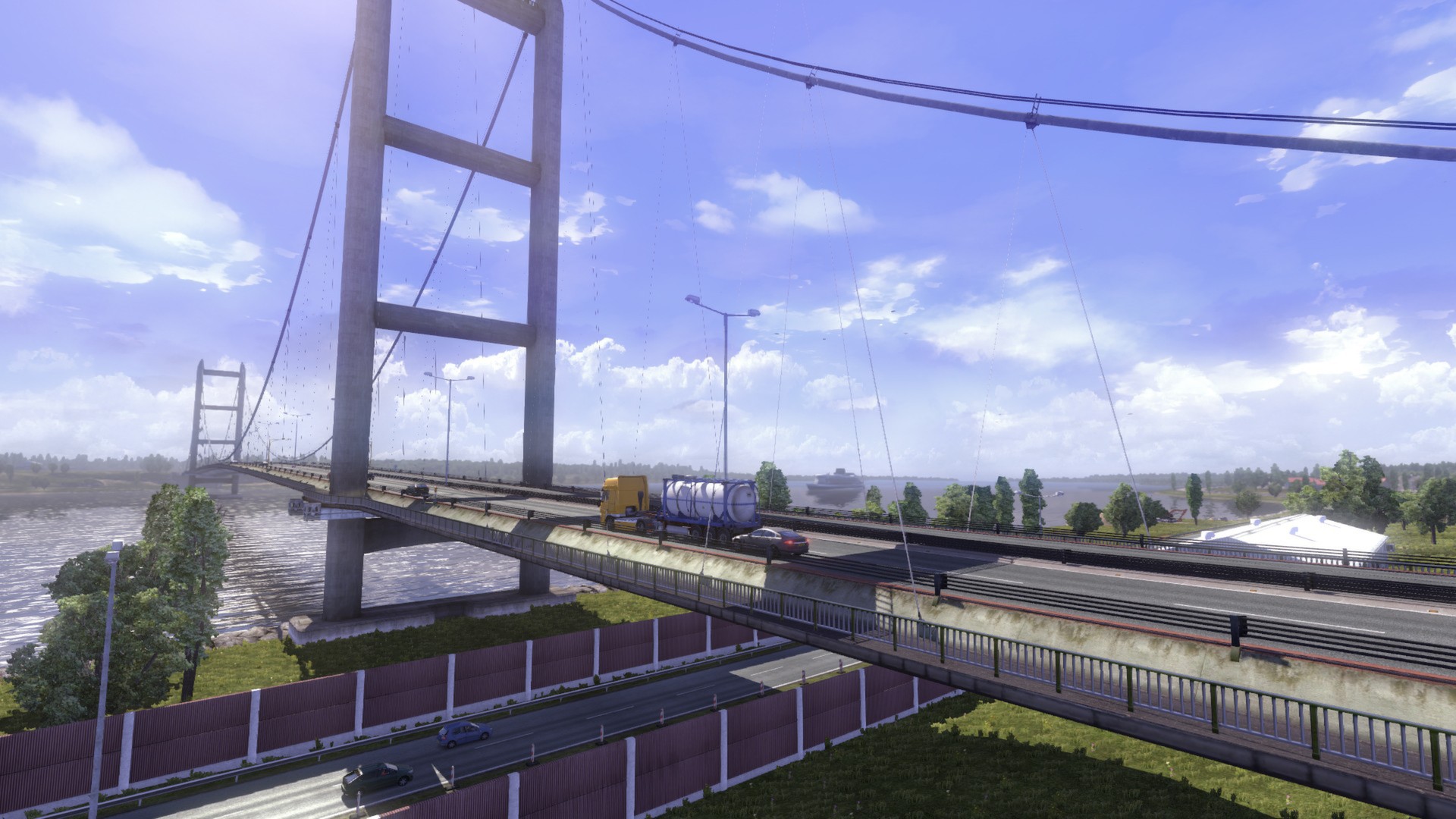
I had an all-too-brief chat with my good friend Mr Alex Connolly earlier today, during which I briefly extolled the virtues of Euro Truck Simulator 2, which I played for a good few hours today. This post is primarily intended for Alex — and anyone else who is similarly curious about Euro Truck Simulator 2 — since we only had a brief moment to talk earlier.

Here's what Euro Truck Simulator 2 is all about, then.

ss_e6136cb13ef9a7c8f920319d096eac97985ee1c8.1920x1080

You start the game by creating your driver profile by giving yourself a name, naming your haulage company-to-be, choosing a logo for yourself and selecting a truck you like the look of. You then choose a home base somewhere in Europe, and then it's off to work you go.

Your first job is what is later referred to in the game as a "quick job" — you're provided with a truck already loaded up with cargo, and all you have to do is deliver it to the destination. If you elect to follow the tutorial, you're walked through various elements of the interface, though you're not told where a few important keys (headlights, windscreen wipers, indicators) are, so you'll need to check the options menu for that. (I recommend assigning all of those controls to a controller, if you're using one.)

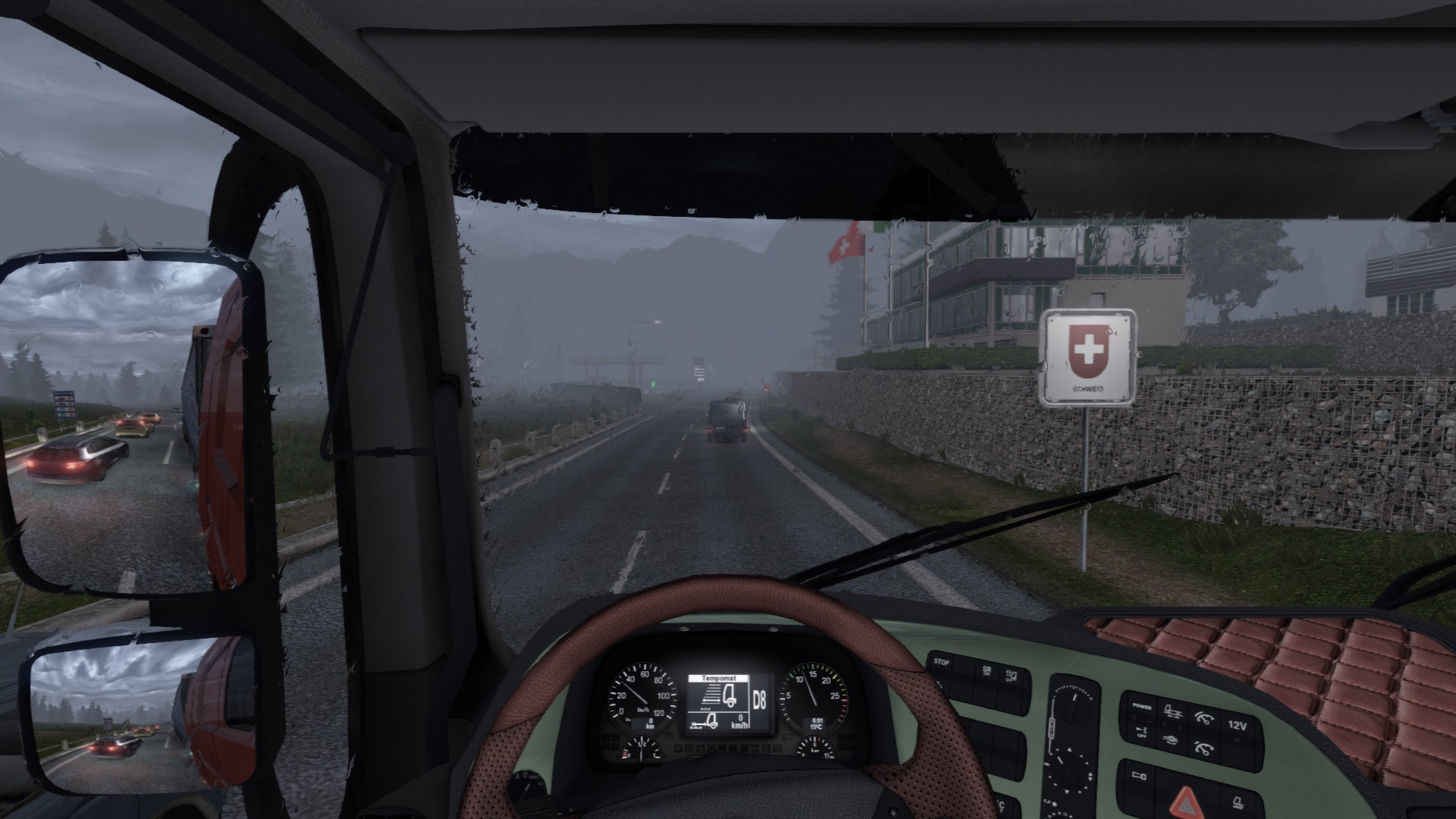
Delivering cargo is a simple matter of following your GPS, which sits in the corner of the screen like a space sim's multi-function display. (Indeed, here it is multifunction, too, allowing you to switch between views of your route, diagnostic information and other helpful bits and pieces.) While driving, you'll have to be reasonably careful. Hitting things can damage your truck and potentially cargo, too — the latter will cost you some of your fee at the end of the run. Similarly, breaking the rules of the road will cause you to be fined, though much like reality, you can get away with speeding so long as no-one catches you doing it.

The roads are convincingly rendered, meaning you'll have to merge carefully onto motorways, slow down for country roads, and stop-start-stop-start at the traffic lights found in city centres. If you're driving in the UK, you'll have to drive on the left; head out onto the continent, meanwhile, and you'll be on the right. Both left- and right-hand drive trucks are available.

Once you reach your destination, there'll be a glowing parking space that you must reverse into. This is harder than it sounds, as trucks and trailers behave strangely when in reverse. You can, of course, press the "auto-park" button, but if you do so you're effectively declaring that you're a big wuss.

Once you've successfully parked and detached your cargo, you'll be rewarded with money and experience points, with a bonus if you parked yourself. Levelling up rewards you with skill points, which you can plug into one of several different skills — one allows you to transport hazardous (and consequently higher-value) cargo of various types; another allows you to take on more long-distance jobs; another still provides you with larger rewards for heavy, oversized or otherwise valuable cargo. You can effectively tailor your driver's profile according to the types of job you like to do.

ss_17df8ee8a12f3fdf9b862ee6ffec89e893aaab1d.1920x1080

After a couple of successful runs, you'll be invited to head along to a truck dealership that sells the type of truck you indicated was your "preferred" type at the outset of the game. A new truck will inevitably be much too expensive for you to afford with the few thousand Euros you've acquired from a couple of jobs, so you'll receive an email shortly afterwards from the bank inviting you to take out a loan. Here you have a choice; keep doing quick jobs for reasonable pay until you can afford to buy a truck outright, or take out a loan, buy your own truck immediately, and ensure you make enough money each in-game day to pay off that particular instalment.

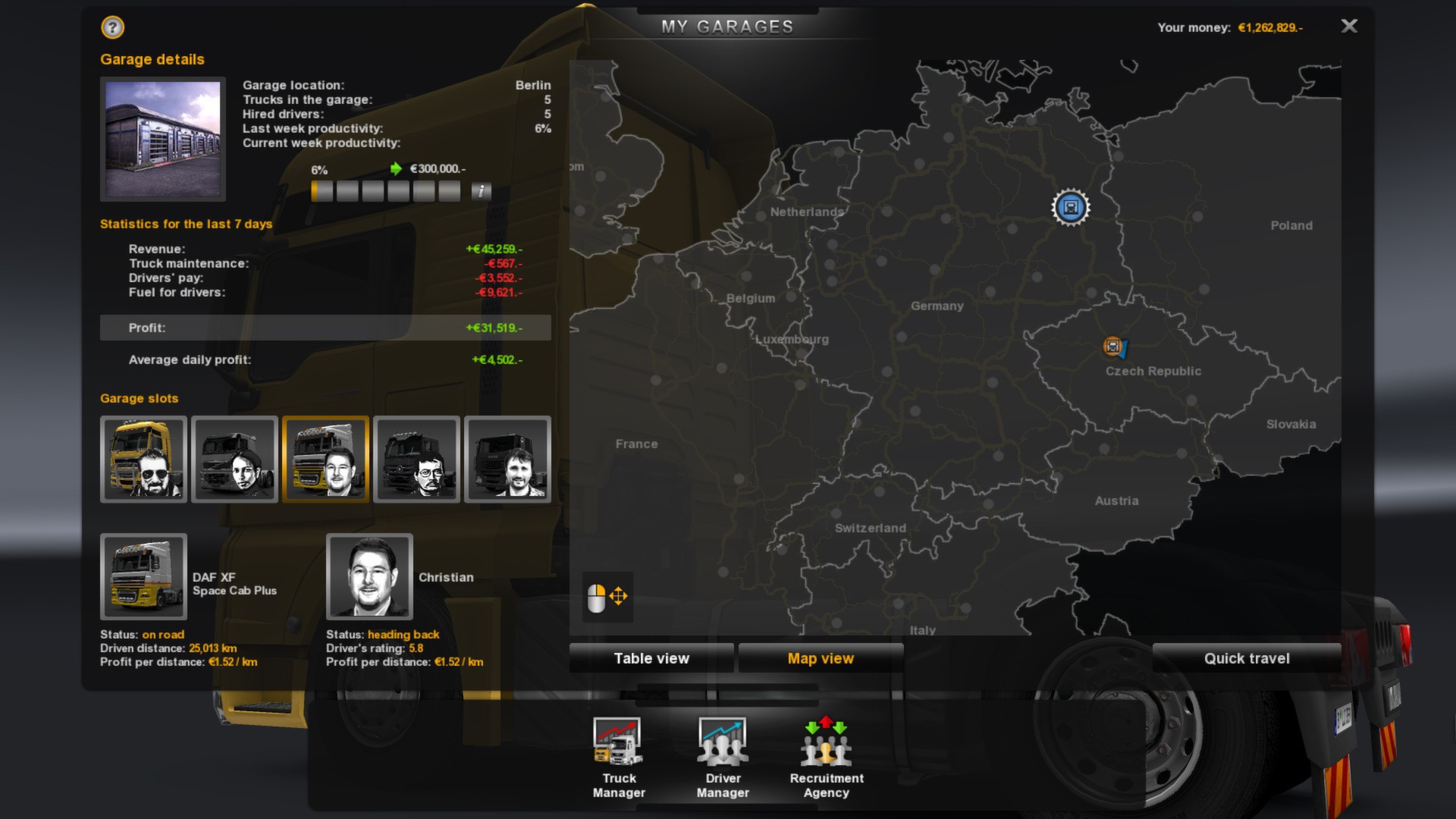
Once you have your own truck — which can be customised in numerous ways, more of which open up as you level up — you have a lot more freedom. You can freely drive around Europe at your leisure, and the in-game map keeps track of how much of the road network you've explored. Arriving at new towns "discovers" them and unlocks them as a starting point for future jobs; coming across "?" markers on the map reveals new truck dealerships, recruitment agencies for hiring additional drivers for your fleet and other facilities; stopping at petrol stations or hotels allows you to restore your fuel and fatigue levels respectively.

ss_e06178175ea311428d1123f3655d4eb189140c35.1920x1080

Having your own truck allows you to take jobs from the "Freight Market" rather than the "Quick Job" menu. Here, you have to actually drive to the place where the job offer is — they expire after a while, so if you don't get there quickly enough, you're not doing the job — and then manually attach the trailer to your truck.

From here, it's a case of proceeding to do more jobs and build up your available funds, then gradually build up your fleet of trucks and drivers so it's not just you hauling shit around Europe, but your very own army of bearded chain-smokers too. Each of your hired drivers can be levelled up the same way as your own character, so you can get different drivers to specialise in different things.

All in all, it's a really neat game. I didn't think it would have much to offer beyond the initial appeal of "WOW I'M DRIVING A LORRY" but there's actually a surprisingly competent game in there, too. And even if you struggle to handle one of these many-wheeled beasts, you can have some fun by causing chaos on the open world. Which is nice.

Anyway, there's my enthusing on the subject of Euro Truck Simulator 2. It's surprisingly worth your time, particularly if you like open-world driving games where you just pootle around rather than killing everybody. Plus there's something inherently satisfying about driving such a gigantic vehicle and not killing everyone around you, or ending up on your side. (Though it is possible to end up on your side.)

So there you have it. Euro Truck Simulator 2. Enjoy.

1279: Hauling Ass (and Wood, Propane and Other Exciting Things)

I picked up Euro Truck Simulator 2 in the Steam Sale the other day on a bit of a whim. This is one of those simulator games that, like Farming Simulator, was roundly mocked upon its original release, but promptly turned out to be a rather good game.

I haven't spent a huge amount of time with it so far and I don't know how much time I will spend with it in the long term, but early impressions are that it is basically a game that I've thought should exist for a long time — that is to say, it's Elite, but on the roads instead of in space.

Okay, that's perhaps not quite accurate; you're not really "trading" stuff, you're simply taking jobs and hauling shit (sometimes literally) from one place to another, and there's certainly no "combat" besides any accidents you deliberately cause yourself, but the idea of fusing a management/business game with a vehicle simulator is a sound one, and it has always surprised me somewhat that we've only ever seen it happen in space, really.

Euro Truck Simulator 2 is an odd experience. It's a driving game, but without all the jostling for position and chaos that normally accompanies driving games that focus on racing. It's an open-world game, but without anything to really "do" besides seek out truck dealerships, try and visit every road in the game and sightsee. I haven't got far enough into the game to look at the business sim side of things yet, but I assume that will add an element of light strategy to the mix, particularly once you start hiring other drivers, too.

It's a peculiarly relaxing experience to play. Once your truck is out on the open road, you don't really have to do a lot besides ensure you don't hit anything, and try not to get caught by speed cameras. But it's pleasingly chilled out to just trundle along at 50mph down some convincingly-realised (if geographically-inaccurate) roads that go to real, actual places with recognisable landmarks. It also implements another feature that I've always thought should be in open-world driving games — the ability to stream Internet radio stations as the soundtrack to your drive. I was listening to some pleasingly mellow German jazz while I drove from Southampton to Dover earlier.

I say it's a relaxing experience to play. Well, that's only mostly true: it's relaxing until you reach your destination and have to reverse the fucking thing into a parking space. Parking a truck is horrendously difficult and I have new-found respect for anyone who is able to do it successfully, particularly in a yard that doesn't have very much space available. I don't really understand how to make it go the correct way when I'm reversing it yet, but I'm sure it's something that comes with practice.

Anyway, I guess what I'm saying in a roundabout way is that if you've seen Euro Truck Simulator 2 in the Steam sale and are mildly curious about it, do yourself a favour and download it. You might just find yourself enjoying the experience. It's just a shame there isn't multiplayer; hauling stuff around Europe with a friend would be a lot of fun, I feel.

1277: Failing to Resist the Urge to Call This Post 'Rim Job'

I'M SORRY. (I'm not sorry.)

I went to see Pacific Rim this evening with my similarly-named friends Tim and Tom. This, along with Akira the other night, means that I've officially been to the cinema more times in the past week than I have in the last year.

As for Pacific Rim, it was enjoyable, if cheesy. Good, dumb fun on the surface, but a movie clearly designed with an appreciation — possibly even reverence — for Japanese giant robot anime. Throughout the whole thing, I couldn't help thinking that the movie might have been better just as a straight-up anime. In fact, partway through the movie, I found myself making mental comparisons with the visual novel Deus Machina Demonbane, with which Pacific Rim actually shares a significant number of similarities.

Lest you're unfamiliar with Deus Machina Demonbane but have seen Pacific Rim, the former is a visual novel about giant robots battling monsters loosely inspired by the work of HP Lovecraft; the latter is a movie about giant robots battling monsters with too many mouths. Already quite similar, albeit the Lovecraftian twist on Demonbane is a pleasant break from the norm.

Then we have the whole "you need two people to pilot a giant robot" thing, which is present in both Demonbane and Pacific Rim; in the former, the pilot is paired up with a "tome" (in the case of the protagonist, an absolutely adorable personification of the Necronimicon), while in the latter, two people have to "drift" together and share their consciousness, or memories, or something.

Then there's the fact that the main "hero" robot gets the crap kicked out of it repeatedly, yet somehow always gets repaired to immaculate condition every time, which is present in both works.

And the fact that the giant robots fighting do just as much damage — if not more so — to the places they're trying to protect than the monsters they're fighting, which is, again, present in both works.

Demonbane does have a bit of a twist in that the antagonists are given personalities and stories of their own, rather than just being "GRRR ARRGH MONSTERS". There's an overall "bad guy" in Demonbane, who is responsible for the Lovecraftian beasts invading our dimension, and there are some truly loathsome "lieutenants" who give the protagonist and the other characters in the story a lot of grief, to say the least.

Also, there is more fucking in Demonbane, while there is none in Pacific Rim, what with it being a 12A and all while Demonbane is an adults-only title. For the most part, the sexual scenes in Demonbane are more horrific than titillating, though; it's one of those "I can't fap to this!" games, unless you have some seriously weird tastes. Likewise, you cannot fap to Pacific Rim, but for different reasons.

Anyway, I guess what I'm saying is that if you enjoyed Pacific Rim and you're open to the idea of playing sexually explicit visual novels, then you should give Deus Machina Demonbane a look. It's one of the more memorable, well-written visual novels I've played in my time, and it's satisfyingly hefty in length, too, particularly if you go for all the endings.

I am hot and sweaty. I am going to drink something cold and go to bed. Good night.

1276: Be Patient

Those who are "against" video games are always quick to mock how supposedly "brainless" and "useless" they are — the other day, for example, a writer for The Times displayed a staggering amount of ignorance on the issue, which resulted in this article.

But video games can teach us all manner of new skills and abilities. Besides the old favourite hand-eye co-ordination — everyone says it because it's true — games also help train our reflexes, develop the problem-solving parts of our brain, express our creativity, socialise with others and all manner of other things.

One of the things they've helped me with most over the years is the matter of patience. I have a significant amount of patience for irritating situations, which is something I was regularly complimented on back when I was a teacher. (Having patience to endure irritating situations is very much a benefit when you're dealing with a class of 30 misbehaving little scrotes.)

Actually, it's not just irritating situations I have patience for; it's the patience to keep beavering away at something until I'm successful (also file under: stubbornness); the patience to try and achieve something even if I don't know that I can do it; the patience to learn things that initially seem difficult.

A combination of video games and learning musical instruments growing up taught me this particular virtue. And it pays off.

My patience means that I have a lot more time for, say, games that take a while to get going; games that might not be the most accomplished technically, but which have their heart in the right place. My patience means that I am able to keep trying a particularly difficult part of a game until I'm successful at it; my patience means that I'm willing to explore beyond the superficial in games that have hidden depths.

This sense of patience has persisted over the years, too; replaying old first-person shooters such as Blake Stone: Aliens of Gold recently has revealed that they're a lot more difficult than I remember, and people with less in the way of patience would undoubtedly give up very quickly. But I've been persisting, and it's been an enjoyable experience to return to these games that I grew up with — while they may look dated, they're still extremely fun, so long as you can deal with the fact that these are games that make much more of an effort to actually kill the player than a lot of modern titles.

I'm weirdly proud of my sense of patience, because it means I can find a lot more things enjoyable than some other people. The games in which I've made use of my patience to look past flaws and problems have become some of my favourite games of all time, no exaggeration, and it's largely due to the fact that I know relatively few people have seen the things I have.

That may sound smug and superior and for that I apologise (a bit, anyway) — but I wouldn't have things any other way.

1273: You Have Earned a Trophy

I can feel my attitudes towards achievements and trophies mellowing somewhat. While I still think people who play games just to get the trophies/achievements are big pillocks — and people who refuse to buy a PS3 game if it doesn't have a Platinum trophy are even bigger pillocks — I have started to think about them a bit differently, particularly with regard to PSN's implementation of them.

The way I've started thinking of them now is as another means of showing my appreciation for a quality (or at least enjoyable) piece of entertainment to the people who make it. Trophy data is public and synced online, so it's not unreasonable to assume that developers and publishers are looking at the proportion of people who achieve particular milestones in their games. Thinking of it in that way, I'm happy to put in a bit of extra effort to attain a Platinum trophy in a game I especially enjoyed, as it shows that I liked the game enough to want to see everything it had to offer. That enjoyment is then recorded permanently — or as permanent as my PSN profile is, anyway — for all to see.

I've achieved Platinum trophies — or 100% completion, where a game doesn't have a Platinum — in relatively few games to date. One was Thatgamecompany's Flower, which remains one of the most beautiful, moving interactive experiences I've ever had — and yes, I think it's better than Journey. The second was Hyperdimension Neptunia mk2, which ended up being way better than I thought it would be; the third was Ar Tonelico Qoga, which was the climax to a series of games that now ranks among my favourites of all time. At my present rate, the fourth will be Time and Eternity, which I want to give some recognition and love to purely because it's been so thoroughly (and slightly unfairly, in my opinion) panned by a lot of critics, and completely ignored by others. In the case of all these trophies, attaining the Platinum represented a good balance between being able to enjoy the game normally, and going out of my way to make a bit of effort; I wouldn't have bothered if achieving it required too much in the way of unenjoyable grindy bollocks. (On Xbox, incidentally, the only games I've achieved 100% of the, uh, achievements on are Oblivion and Pac-Man Championship Edition DX. In the case of Oblivion, chasing the achievements actually spoiled the experience significantly for me because it directed what should have been a freeform experience far too much, and Pac-Man Championship Edition DX had insultingly easy achievements that really didn't reflect whether or not you were actually good at the game.)

I think much more fondly of PSN trophies than I do of Xbox or Steam achievements for some reason. I think it's because the "value" of PSN trophies is more immediately obvious. Sure, Xbox achievements have Gamerscore values, but Gamerscore is fairly meaningless, particularly as it's applied inconsistently between games and, well, doesn't do anything. Trophies, meanwhile, have instantly recognisable values; bronze ones are "fodder" for the most part; silver ones require a little more effort; gold ones are generally either challenging or time-consuming; and platinum ones show true dedication to a game. To say you have "Platinumed" a game is a much simpler, more elegant way of saying that you've done everything on that game's arbitrary checklist than "I got all the achievements".

Also, the PSN "You have earned a trophy" noise is infinitely better than the Xbox's "plink", and anyone who says otherwise is wrong. The Xbox noise is the same sound as when someone comes online, for heaven's sake; the PSN one sounds like you've picked up a powerup in a retro game. See? BETTER.

1271: Don't Read the... You Know

Popular gaming site IGN has decided to crack down on shitty comments. Given that a single IGN article attracts thousands of comments — the post describing the proposed changes currently has 2,309 and it was only posted a few hours ago — this is very much a good thing.

I've never really read IGN all that much. I had a couple of pieces posted there a few years ago — here and here (I was not responsible for the dreadful headline on that one, by the way) — but I've never really felt the need to engage with the community. There's a few good writers there — a couple of whom I know personally — but it's not, on the whole, a site I check regularly. And, by extension, it's not a site I tend to look at the comments form.

My God.

Yeah. They need this crackdown. The comments section is a mess. Just on that one post linked above, there's a surprising amount of negativity ranging from people insulting the writers (and their names… yes, his name is Steve Butts; grow the fuck up) to perpetuating stupid fanboy platform wars. The few positive comments that are there are quickly drowned out or reacted to with further abuse, and the "upvote/downvote" system the site has in place courtesy of popular third-party comment solution Disqus is completely abused; "good quality" comments aren't upvoted, but dumb comments from "popular" posters are. Meanwhile, people advocating reason and praising the site's changes are downvoted. Ridiculous.

I have to question how on Earth it got like that in the first place, and I can only assume it was a matter of complacency — of assuming that problems would sort themselves out after a while. But, since a lot of Internet commenters on sites like IGN are seemingly children and teenagers (or at least act that way), they'll try and push the boundaries. If they encounter no resistance, they'll continue to push further. It's exactly the same as in teaching; if you don't set expectations up front, you are only making life difficult for yourself down the road.

I've been fortunate with this blog that I only get a few commenters, all of whom are very welcome, and pretty much all of whom I'd call friends. Meanwhile, over at my new professional home USgamer, we're already building a strong community of intelligent, articulate commenters who have plenty of value to add to the conversation. The quality of our content and the way in which we have written it — to provoke and inspire discussion — has helped set those initial expectations in place, so hopefully things will continue in a positive direction. I have no doubt we'll have to deal with troublemakers before long — we've already had one charming chap call Kat Bailey a "bitch" for not liking Project X Zone as much as he did, and we swiftly and positively dealt with it — but for now, I'm very much liking the rather mature, erudite community we appear to have attracted for the most part so far.

Internet comments are both a blessing and a curse, as the cliché goes. On the one hand, it's great to be able to have discussions around things that writers have posted on the Web; on the other hand, there's little value in them if they always descend into trolling, name-calling and insulting. Fortunately, a lot of sites seem keen to put a stop to the bullshit; it remains to be seen if, in the long term, anything good will happen.

1269: In Sickness and In Health

So, now I've written my review for USgamer, I can talk a little about Time and Eternity, the game I've been playing recently.

For those too lazy to click through and read my review, the gist: Time and Eternity is an anime-inspired JRPG that makes use of hand-drawn, hand-animated anime cels instead of polygonal characters. Its story is based around two people — one of whom is actually two different people in a single body, so it's actually three people, I guess — who are trying to get married but find their wedding interrupted by assassins. Naturally, the thing to do when this happens is to travel back in time and get to the bottom of what is going on.

I won't go on too much about the game itself, because my review covers that territory in more detail. What I did want to talk about is how much I appreciate the fact this game exists, and how it highlights some issues with conventional criticism.

Time and Eternity has been mostly panned since its release, leading to severely negative preconceptions about it, even among the hardcore JRPG-lovin' community. I personally enjoyed it a lot — I've finished it once, and am contemplating going back for a New Game Plus run to get the "special ending" — but at the same time acknowledge the fact that it most certainly isn't a game that has universal appeal.

However, just because it doesn't have universal appeal is not to say that it doesn't have any appeal whatsoever. This is the thing that a lot of reviews I've seen seem to be missing to a certain extent; this is a game aimed at a specific, niche audience, which means by definition that it won't appeal to everyone. Should it be punished for this fact? Absolutely not; in fact, it should be celebrated.

To qualify that statement, let me explain. One of the most common criticisms of modern gaming — modern mainstream gaming, I should say — is the dumbing down of popular franchises to appeal to a mass market. The idea that a new entry in a popular series needs to sell literally millions of copies to have been worth making in the first place. All too many times recently, we've seen high-quality games fail to reach the overambitious expectations set by their publishers and be declared a failure, despite the fact that something like Time and Eternity would kill for those numbers.

Meanwhile, however, titles like Time and Eternity from niche-focused publishers like NIS America bob along under the radar, only to be occasionally noticed by reviewers who aren't really into the niche they're aiming for, and thus get woefully, woefully misunderstood. Consequently, they get treated unnecessarily harshly.

This isn't me being defensive about a game I enjoyed that everyone else didn't; this is something that I feel is going to become a bigger issue as time goes on. Not every critic bears in mind the potential target audience for something; very few outlets have the "specialists" on staff to be able to handle all titles in an appropriate manner, and I've mentioned before how frustrating it is to read a criticism of something from someone who obviously hasn't given it the amount of time it deserves, or who isn't "well-read" enough in the genre to be able to make informed comments. I am under no illusions that I am able to handle every type of game out there, but I know what I'm interested in, and I know the things that I know well. I wouldn't take on a review project for a genre I didn't know well or didn't have experience of; it wouldn't happen in any other medium.

So anyway. If you've read my Time and Eternity review you'll know that I quite liked it, but wouldn't recommend it to everyone. There are only a select few people in my circle of friends that I would specifically recommend it to, in fact, but I have a feeling those people would enjoy it. Everyone else will probably not. And that's fine. Not every game is for everyone, and the sooner we figure that out the better.

1268: Printing Press

Print media is very much on the way out, particularly in the games industry, but I enjoy keeping some around for old times' sake.

Specifically, as I've probably mentioned a few times before, I have several back issues of the now defunct PC Zone magazine on my shelf, each of which contains a single article that I wrote on a freelance basis — mostly game walkthroughs, because no-one likes writing those.

Occasionally I like to have a flip through those old magazines. It's nice to look back on what the games industry looked like nearly 20 years ago (jeez) and see what people were excited about. It's also interesting to ponder which grand plans came to fruition and which didn't; which supposedly "big games" ended up being massive successes, and which were big wet farts.

One of the most interesting things about reading an old magazine in 2013, though, is realising what an impact the Internet has had on our brains. More than once I caught myself reading something in one of these old Zones and habitually looking to the end of the article for the comments section. Of course, being a magazine, there is no comments section (unless you scribble on the page yourself) and thus this is a stupid thing to do, but I found it interesting that the way The Internet works is now so firmly ingrained into my brain that I just do things like that on reflex.

The letters pages are also interesting to look at. One of the most fascinating things I rediscovered recently is that people have been whingeing about tacked-on multiplayer modes ever since 1997 — one chap got a Letter of the Month award for complaining about how X-Wing vs Tie Fighter wasn't as good as either X-Wing or Tie Fighter because it didn't have the story-driven campaigns of its predecessors. (He had a point.)

The other one that raised a bit of a smile was a selection of gentlemen defending the fact that they found Lara Croft attractive — yes, the low-poly, big-lipped, pyramid-breasted Lara from 1997, not the gritty one from the recent reboot. Of all things, it brought to mind the popular otaku discussion of whether "2D" or "3D" is better. (Inevitably, to most otaku, the answer is "2D", but that's a topic for another day, I think.) "Lara is a collection of pixels," runs the slightly flawed argument, "and Pamela Anderson is just a collection of pixels or ink on a page, because none of us are ever likely to actually meet her." Well, true, I guess, but… oh, let's not get into that now.

Anyway. If you happen to have any old magazines lying around, think twice before you throw them out; they make interesting cultural artifacts to look back on, as they take a snapshot of how people thought and felt at a particular point in time. They're also something to do on the toilet on the off-chance all the electronic devices in your house are out of battery.