1314: Day One in Eorzea

So it's finally here: Final Fantasy XIV. Of course, this isn't the first time I've played, as well you'll know if you've been paying attention to my enthusing, but we're at last at the stage where the game won't be "turned off" for significant periods of time (maintenance periods aside), and all characters people are playing as now are for keeps. (Here's mine, if you happened to be curious.)

While I'm not exactly what I'd call a hardcore MMO player, I have been present at the launch of a number of reasonably-to-large-sized MMOs, including World of Warcraft, Star Trek Online, DC Universe Online and a few others I've doubtless forgotten. And I have to say I've been pleasantly surprised at how well things have been going for Final Fantasy XIV so far — more often than not, an MMO's launch is a complete disaster, with servers going down, significant gameplay problems and at least one Legendary Error that becomes a meme before the first day is out.

Today's experience on Final Fantasy XIV hasn't been completely flawless — on more than one occasion, there has been problems with the instance servers, for example. For those not au fait with MMO lingo, an "instance" is a private copy of part of the game world specifically for your character and, in some cases, your party. Final Fantasy XIV makes extensive use of instances not just for multiplayer dungeons, which is how World of Warcraft popularised their use to the world, but also to keep significant "story events" for your character private and free of naked catgirls wandering around ruining the atmosphere (or enhancing it, depending on your view on naked catgirls).

FFXIV isn't completely reliant on these instances, thankfully, but the game's main story quest and class-specific quests do make use of them quite frequently, so the fact that they haven't been working properly for part of today has meant some people haven't been able to make as much progress as they'd like to have done. Naturally, some players have expressed anger at this — this is the Internet, after all, where people start petitions to remove Ben Affleck as the next Batman, for fuck's sake — but, as ever, this isn't particularly reasonable. Sure, it'd be lovely to have the game working as intended from the moment it's turned on, but we're currently in an "Early Access" period, with official service not starting until Tuesday for players who didn't preorder or play the previous incarnation of the game. As such, it's a good opportunity for Square Enix to work out any last-minute kinks — like this instance issue — and ensure things are running as smoothly as possible when new, non-preorder players start to arrive.

I should also draw attention to the fact that Square Enix hasn't just been sitting back and letting these problems go on; they've been investigating the causes and trying their best to fix them. There was a maintenance period earlier today that temporarily fixed the instance issues, but then they came back; as I type this, they think they've found the solution, but are testing it thoroughly before rolling it out to the game proper. By later tonight, it should hopefully be a lot more stable.

So far, then, FFXIV's launch has been one of the smoother ones I've seen. It hasn't been without issues, no, but at the same time they've been handled as well as can be expected — and things can only improve from here.

So here's to many more adventures in Eorzea; I've had fun today, and I'm looking forward to the further adventures of my character Amarysse as she becomes an ever more skilled thaumaturgist.

1313: Whew

Aug 23 -- End of the WeekThat's what's felt like a very long week over and done with. And I'm happy to see the back of it. It's been tiring and stressful, though I'm not entirely sure why; nothing really specifically stressful or distressing has happened as such, it's just been… bleh.
I haven't had particularly restful sleep all week; that's part of the problem, I think. We appear to be bang in the middle of Flying Things That Like to Bite You About the Arse, Legs and Arms season. I'm not sure exactly what form said Flying Things That etc. are taking this particular year, but I'm pretty sure I've heard mosquitoes at the very least. Bastard things.

Trouble is, it's at that frustrating sort of temperature where if you shut the windows it's too warm, open the windows and it's slightly too cold (plus Flying Things That etc. come in uninvited), put a fan on and you wake up with a mouth like a badger's been sticking its arse in it all night long.

I'm not sure why I'm telling you all this. I think my brain has just plain shut down for the weekend, suggesting that I should attempt to get some sleep and hopefully feel a bit fresher in the morning. After all, it is Final Fantasy day tomorrow — Early Access for Final Fantasy XIV starts tomorrow, which I've been looking forward to a lot.

I levelled my Thaumaturgist class to 20 — the level cap for the recent open beta — and made a start on the Weaver crafting class. I'm torn as to what to do when I get back in, though; should I start a new class, or carry on developing the ones I've already been working on? I haven't tried a "Disciple of the Land" gathering class at all yet, and I've been curious to.

I guess I don't even have to decide if I don't want to. That's one of the nice things about the new game; once you've reached level 10 in your starting class and completed the appropriate quest, you can then switch classes whenever you want simply by swapping out your weapon. This is absolutely ideal for situations where you want to play with friends who are perhaps just starting out in the game — I'd be able to swap to a class I haven't levelled at all and help them out from the very beginning. For situations where that isn't practical, the Level Sync function artificially limits your level in situations like dungeons and boss battles to ensure you're never overpowered and that you always have a decent challenge to take on.

Incidentally, if any of you reading this are planning on playing the game and want to meet up with me, my character's name is Amarysse Jerhynsson (naturally) and she calls the Ultros server home. Depending on how many of my colleagues at USgamer I manage to rope into joining me, I may start an official USgamer Linkshell on that server; in the meantime, I'm part of the Giant Bomb Linkshell and will continue to be part of that once the game goes live. (A Linkshell is basically a global chat channel; not quite a guild, but a means of a group of people to communicate with one another. FFXIV does have "guilds" in the form of Free Companies, too; a single character can be in one Free Company and, I think, eight Linkshells at once.)

I'm just rambling now. I'm off. Good night all.

1311: Shorty and the EZ-Mouse

Aug 21 -- Bust A Groove"Kitty-ENN. Versus. GAAAAAS-OOOOOOOOO!"

…

"I will never ever run away, I will live to fight another day, I will make you re-a-lise, I'm always here, right by your side, now our love is sanc-ti-fied, I'm here to bust this groove."

…

"It is me or is the timing off a little bit?"

"Nah. I'm just more skilled than you are."

"No, I seriously think the timing's off."

"C'mon, man, stop being a sore loser."

"No! I'm serious! I'll go and get my PlayStation right now and prove it."

"Fine. Go ahead. And you'll see that I'm just better."

"All right. See you in a bit."

…

"So, do you believe me, now?"

"…Fine. All right. I believe you."

—

That incident actually happened. The game in question was Bust-A-Groove, a PlayStation offering that helped spawn (or at least popularise) the now all but dormant music game genre. This was no Guitar Hero precursor, though; Bust-A-Groove was very much its own thing, and there hasn't really been a game quite like it since. (Well, apart from Bust-A-Groove 2, but that's sort of a given.)

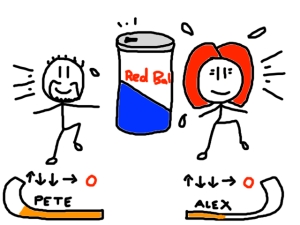
Bust-A-Groove was a peculiar blend of fighting game (sort of) and rhythm-based music game. Each "bout" was a one-on-one competition between two of the weird and wonderful characters, and victory was determined by whoever the camera was closest to at the end of the bout. (Yes, really.) In order to attract the camera towards yourself, you have to correctly punch in the directional inputs on the screen and then tap either the circle or X button in time with beat "4" of a bar. If you press the triangle button instead of O or X, you'll unleash an attack on your opponent, which will interrupt their flow if it hits them, but which they can dodge if they tap the square button instead of O or X.

That's it. That's all the game was, and yet it was massively addictive, thanks at least in part to the magnificent soundtrack. Each character, much like in a fighting game, had their own stage with unique crazy animations going on in the background, and each stage had its own piece of music that told you something about the character — it was implied that, in most cases, the "owner" of the stage was singing the song, and it helped give both the game and its cast a huge amount of personality.

Also it ended with you defeating a giant robot by standing on a rooftop and dancing at it, which was awesome.

The timing issue I alluded to above came from the fact that, at the time Bust-A-Groove came out, I was struggling on with a Japanese PlayStation, and consequently, in order to play European games, I had to prop the system's lid open with a biro lid and a bit of Blu-Tac, boot it up with a Japanese game in, whip the Japanese disc out when it stopped spinning quite so quickly then quickly swap in the European disc. (I later acquired an actual European PlayStation after I completely knackered the lens on the Japanese system by doing this all the time. I promptly chipped it so that I could play import games. Still one of my favourite consoles of all time; I wish I still had it.)

Anyway, the fact that a Japanese PlayStation is designed to run on a 60Hz display and a European PlayStation was designed to run on a 50Hz display (this was the pre-HD era, folks) meant that the Japanese PlayStation ran slightly faster than the European game was expecting it to, meaning that the on-screen button prompts did not line up properly with the beat of the music. Having grown accustomed to this naturally, I didn't notice it, but my friend Woody, with whom I was playing the game's two-player mode, was immediately thrown off by it. (We were both absolute S-Rank Bust-A-Groove players, so every match should have ended in stalemate; he was perturbed to find himself repeatedly losing due to being unaccustomed to my PlayStation's wonky timing.)

Not sure why I shared that little anecdote, but whatever. Bust-A-Groove was great… and I am now searching Amazon and eBay for cheap copies.

1310: Nice Job, Sony

It was a day of press conferences at Gamescom in Germany today — always a long, tiring day, so forgive me if tiredness gets the better of me and I either start making ridiculous typos or fall asleep on my keyboard.

Out of the three conferences we saw today (or heard about second-hand in the case of Microsoft, who weren't streaming their event), for my money, Sony's was clearly the best. For my particular tastes, anyway.

What's kind of cool, though, is that in each of the three cases — Microsoft, EA, Sony — there were clear target audiences, and while sometimes they overlapped, for most of the time they were very distinct from one another. This is good. This makes things exciting and interesting, and means we don't keep seeing the same things over and over again.

The big divide seen today came largely between Sony versus Microsoft and EA. The latter put out huge, dubstep-fuelled trailers featuring lots of shooting and sports and other manly pursuits. The former opened the show with Shuhei Yoshida quietly playing with the console live on stage, closely followed by one of its least exciting games (Gran Turismo) accompanied not by dubstep, but with some rather stirring orchestral/choral music.

Microsoft and EA have their audiences — the people who enjoy their triple-A blockbuster experiences; the people who enjoy playing sports games; the people who are happy to play nothing but games with Battlefield in their title — and that's cool. But it was even cooler to see Sony catering to its own niche rather than trying to emulate Microsoft. Some gorgeous looking independent titles; some solid support for the Vita; some intriguing looking exclusives — good stuff, and it got me far more excited than Microsoft and EA's stuff. And that's fine — I've long thought that various companies should specialise their output a little more rather than attempting to, as Jim Sterling so frequently mocks, "appeal to a wider audience".

Interestingly, opinions have been a little split today. For the most part, my Twitter feed was enthusiastic about Sony's conference while it was happening, but I've seen a few people expressing disappointment. Those who were particularly disappointed were either 1) in Microsoft and EA's target audience, which is understandable because Sony very obviously aimed in the opposite direction, or 2) fans of Japanese games, of which there weren't any on display. Still, there's always TGS for the latter, at least, so it's a little premature to worry about the PS4 — and I remain convinced that Sony platforms will remain the place to be for Japanese titles, especially if their publishing partners teased back when the PS4 was first announced are anything to go by.

Anyway. My eyelids are drooping so I'm off to sleep.

1309: Dress-Up

A guilty pleasure of mine that I've always had is playing dress-up. It doesn't matter if it's in reality or in some sort of virtual world (more commonly the latter these days, to be honest) — I love picking out outfits and accessories and attempting to coordinate and/or clash them horribly. It's ironic, really, given my own complete lack of interest in fashion — though this comes about more from being a big guy who can't get any decent clothes that fit than anything else.

A number of different interactive experiences have scratched my dress-up itch over the years. Most recently, I've been having fun with the "attachments" feature in Namco Bandai's Tales of Xillia, which allows you to deface all of your party members with various accessories, extra bits of hair and glasses, then enjoy your monstrous creations in battle, in the field and in cutscenes. Despite the potential for mischief, though, I've stayed largely restrained and sensible: protagonist Milla is sporting a pair of elf ears (that really suit both her looks and personality); "childhood friend" character Leia is sporting some adorable pigtails and half-rim glasses; young girl Eliza has her adorability factor amped up to 11 with the addition of wiggly rabbit ears and a fluffy tail.

Final Fantasy XIV has its share of amusement value from clothing and appearance options, too. I spent quite a long time on creating the look of my character this time around, eventually settling on a Hyur (human) female with red hair (of course) with some bright highlights giving her a slightly "frosted" look — very Final Fantasy. XIV's character creation tools give you a wealth of options to play with, some of which you'll only ever see in cutscenes, but it's nice to be able to take advantage of them. My character, for example, has a small heart-shaped tattoo on her cheek that is all but invisible unless you look closely, and also has odd-coloured eyes. No-one I'm playing the game with will notice those things as, generally speaking, you don't get close enough to other players to see that much detail. But when I see her doing her thing in cutscenes, I'll see those little details I added and she'll feel like my avatar, rather than something arbitrarily chosen for me.

I used to play on a roleplaying server for World of Warcraft, which meant a significant proportion of my time in the game was spent sitting around talking to other players and pretending to actually be our characters. It was a lot of fun, particularly as WoW offered you a few "non-combat" outfits that you could dress in. Since my character was a skilled tailor, she'd managed to make herself a nice array of different dresses to suit various occasions, and it was always fun to show up in a new outfit and have it acknowledged.

This particular guilty pleasure of mine means that there's one type of DLC I have a total weakness for, even with my general like of nickel-and-dime pointless DLC that doesn't add anything to the experience, and that's costume DLC. If I have the option to customise my characters' appearances further with new downloadable costumes, chances are I will take that opportunity. This likewise means that if a game provides the opportunity to earn a new costume by completing various challenges, I will generally drop everything I'm doing to try and earn that costume. I recall a ridiculous amount of grinding in Dark Chronicle (aka Dark Cloud 2 to earn a leopard-print bikini, but man, it felt good to finally earn it and subsequently take on the final boss in a woefully underdressed state.

Anyway. I digress, before I start getting into a lengthy discussion of how immensely fashionable my Second Life avatars were in their heyday…

1308: Adventurer's Guild

The Final Fantasy XIV beta closes down early tomorrow morning, so I've been making the most of it this weekend. I've levelled my Thaumaturgist class all the way to 20 — the level cap for the beta — and had a play around with the Weaver crafting class for a bit, taking that up to level 11. This gives me a nice head start ready for when live service begins — though the nice thing about Final Fantasy XIV is that if at any point you fancy a change, just switch out your weapon and bam! You're another class.

This carries its own considerations however — the main one being that if you switch to a class based in a city you've already done all the low-level quests in, you might struggle to find things to do if you're not used to all the additional stuff the game offers. In that particular situation, you turn to any one of a number of different possibilities: the short, snappy, time-limited Levequests; your Hunting Log, which challenges you to hunt down specific monsters in set quantities in exchange for very generous experience point rewards; Guildhests, which are short, extremely fun co-op challenges you take on alongside other players; or simply grinding.

I wanted to give another shout-out to the amount of effort that's been put into the game's story. As well as the usual MMO-style "random people need you to do odd jobs" quests you get around the place, there's a "main quest" to follow, too. After a certain point, this quest tasks you with travelling to the other two capital cities in the world to meet their leaders and start making preparations for what is clearly going to be some sort of Epic Battle later in the plot. What was particularly great about this quest was the fact that it makes you feel super-important — you're sent off on an airship to the other cities, and as the ship leaves, the Final Fantasy prologue theme triumphantly blares out, as majestic as ever. Then you get some awesome "meanwhile" scenes — something that doesn't tend to happen in MMOs — that give you a real feeling of the plot unfolding even when you're not present. There's some characters who look a lot like FFXII's Judges in play, it seems, and I'm looking forward to the inevitable confrontation with them later in the story.

It's hard to pin down one thing that's quite so satisfying about FFXIV because it really is an example of lots of overlapping systems complementing each other very well. There are lots of different ways to play, and plenty of means to ensure that you shouldn't find yourself getting bored or with nothing to do — unless, of course, you don't enjoy the base mechanics, in which case there's probably not a lot that can be done for you. The final game's going to be great; I can't wait to see what the future holds in updates and expansions.

1307: Thaumaturgist

You'll have to excuse any typos in this post; I'm very tired due to having spent a significant proportion of the day/evening playing the Final Fantasy XIV beta. And I'm pleased to confirm that it's very much living up to my expectations.

I'm playing a Thaumaturgist this time around — in the last phase of beta I played a Pugilist. I was a little concerned that the game would fall into the usual MMO trap of all classes playing in a pretty similar manner — spamming the same combination of hotbar items over and over again, repeat until dead — but the Thaumaturgist plays noticeably differently to the Pugilist. As it should be.

While the Pugilist is a melee character that demands you get close in to — and preferably behind — your enemies, the Thaumaturgist is a ranged magic damage dealer. Unlike your common or garden usual MMO mage, though, the Thaumaturgist makes use of an interesting mechanic that, thematically, represents their "aetherial balance" between "Astral Fire" and "Umbral Ice". Essentially, what this means is one of two things: if you're in Astral Fire state, you do increased damage with your fire spells, but they also cost more magic points to cast; if you're in Umbral Ice state, your spells do less damage but your magic points regenerate a lot more rapidly than they would usually. Playing a Thaumaturgist effectively involves knowing how to use these two states effectively to ensure you have good damage output while also keeping your stock of magic points high.

That's not all, though. Each of the classes in FFXIV has its own unique questline to follow, with new "episodes" in the story coming every five levels or so. The nice thing about these is that they have their own storyline to follow, but also they help teach you things about your class you might not have realised. The level 15 quest for the Thaumaturgist, for example, is essentially a stealth mission that teaches you about the effectiveness of your Sleep spell: you're tasked with sneaking in to retrieve an artifact, and rather than fighting the strong enemies who are between you and it, you simply put them all to sleep and prance through singing "trollolololol" or something.

What I've really been surprised about is how much effort's been put into the narrative side of things — something that's often neglected in MMOs. The genre giant World of Warcraft, for example, has an enormously rich and detailed setting to draw on, and yet — at least in its early incarnations, I haven't been back since Catacylsm — this storytelling potential was utterly squandered in boring quests that were given to you in the form of dull text readouts.

Final Fantasy XI, XIV's predecessor, was somewhat better in that there were "missions" as well as "quests" to do — these often incorporated cutscenes, story progression and even boss fights at times, but XI's difficulty and painfully slow progression meant that a lot of people might not have got very far.

XIV nails the balance. There's a ton of solo content you can do, with a storyline to follow that makes your character feel important. There are recognisable non-player characters whom you come to have various feelings about, and events occur that actually have some sort of meaning. There's also a lot of instanced battles where you get your own private special event without other players interrupting — proper boss battles. And these aren't just like fighting any other monster — sometimes you'll be battling alongside other non-player characters in a huge skirmish, other times you'll have to hold out against seemingly overwhelming odds until an NPC shows up to tip the balance in your favour.

It all feels like an actual Final Fantasy, in short, rather than an MMO with a Final Fantasy skin atop it. Your incentive for progression comes as much from the unfolding story and the cool setpieces as it does from gaining yet another level.

I haven't done a lot of group stuff yet, but I did try a Guildhest earlier. This also gave me the opportunity to try the Duty Finder system, whereby you mark yourself as wanting to do a specific multiplayer "thing" — be it a Guildhest, a dungeon or something else — and then let the game match you with other people looking to do the same thing automatically. Pleasantly, you can continue playing while you wait to find a party — it's a good time to take on the short, snappy, time-limited "levequests" for some pocket money and experience.

As for the Guildhest, it was short but very enjoyable. It was essentially a party-based arena battle intended to give players practice at working together and trying not to aggro multiple groups of enemies. Initially, you and your teammates must simply take out two parties of relatively easy monsters; then another set appears, accompanied by a huge boss monster. Inevitably, they all come charging towards you, so it becomes necessary to prioritise your targets — taking out the smaller things first before starting on the big boss. When you've successfully completed it, the iconic Final Fantasy fanfare plays as if you'd just completed a battle in a "normal" Final Fantasy game — a nice touch.

I'm really looking forward to seeing how the game continues once it officially launches later this month — the current beta only allows you to progress up to level 20 and is still lacking a couple of features. The only real challenge is going to be — as ever — juggling both it and other games I want and/or need to play!

1304: Reppin' the Row

The Saints Row IV embargo lifted earlier today, and some of you may have already read my contribution to USgamer's review. Since I wasn't the main reviewer on that, though, I thought I'd take a moment or two to write something a bit more personal about why I like it so much and why you, dear reader, should probably pick the game up when it comes out.

Saints Row IV is exactly, as many people have already said today, where the series needed to go. Rather than aping Grand Theft Auto — something the series hasn't really been doing since its first installment, and even then it was its own distinct thing to a certain extent — it's gone full-on batshit crazy, and is all the better for it.

Let's back up a moment and look at a game that clearly had a significant impact on Saints Row IV's development: Crackdown.

Crackdown was an interesting game, and one of the more underrated titles in the Xbox 360's library. Most people picked it up purely for access to the Halo 3 beta, but I spent a lot of time with both Crackdown and its subsequent sequel. It wasn't perfect, but it was good fun, particularly when you shared the experience with a friend. It was one of the few games in which the relative lack of storyline helped rather than hindered the experience — it meant that leaping around from rooftop to rooftop collecting those elusive "agility orbs" didn't feel at odds with what you were "supposed" to be doing in narrative terms. Rather, Crackdown set itself up to be a superpowered playground, and that's exactly what it provided. To make things even better, it makes the best use of Achievements I think I've ever seen on the platform, encouraging players to cooperate with their friends to complete various silly challenges, such as playing tennis with a car and a pair of rocket launchers.

Crackdown's biggest thrill was its sense of freedom — the feeling that you could go anywhere, do anything, or at least anything within the constraints of the controls you were provided with. The game encouraged you to explore and try to do ridiculous things. One of the first things a lot of people tried to do was climb the tallest tower in the city, then leap off without dying. Sure enough, in the full version of the game you get an achievement for doing both of these things. It's a game that not only encourages its players to have fun, it rewards them for it.

Saints Row IV is, to a certain extent, the same. While it has a more structured narrative than Crackdown ever did, it has that same sense of freedom that comes from the use of ridiculous superpowers. Not long after starting the game, you're provided with both super speed and super jump powers, both of which can be gradually upgraded. Eventually, you're not only hurtling along the roads faster than traffic, you're running up walls, leaping from building to building, gliding across half the city in a single bound, then crashing down to earth, scattering everything and causing chaos around your landing area. You're encouraged to make full use of these powers by collecting Saints Row IV's equivalent of Agility Orbs — and there are over a thousand of them to find. You're also challenged to make skilful use of them by climbing vertigo-inducing alien towers, and to use them in creative ways to clear out heavily-fortified alien outposts.

The activities you'll be indulging in while playing Saints Row IV are diverse, and there's been an obvious and conscious move away from the more "criminal" activities seen in Saints Row The Third. You're still doing things like deliberately injuring yourself for insurance fraud, though this time around your superpowers causes your ragdoll to go cartwheeling down the road for miles at a time, making the experience far more akin to something like Burnout Paradise's Showtime mode than anything else. At another moment, you might be using telekinetic powers to throw objects, cars and people through hoops. On another occasion, you might be carefully using your superjump to accurately land on platforms in an abstract environment, or racing through Wipeout-style tunnels in an attempt to score as many points as possible before you reach the end. There's a lot to do, and pretty much all of it is genuinely fun, whether you're alone or playing co-op with a friend.

The story provides a good impetus to keep playing, too. The characters are all endearing, despite all of them having "asshole" tendencies to varying degrees, and there's a real sense of camaraderie between them. Those who have played earlier games in the series will be pleased with some significant nods towards series continuity — including a guest appearance by Eliza Dushku, who played Shaundi back in Saints Row 2 — but this is never done in such a way as to feel exclusionary to those for whom this is their first Saints Row game. Collectibles include audio logs from each of the major characters, so you can delve into their backstory as much or as little as you like — and it's clear that the team at Volition considers this motley crew far more than just generic tropes.

By far the best thing about the whole experience, though, is how much ownership you can take of it all. You can design your own character to be however you please. It can be male, female, transgender or anything you please. It can be attractive, ugly, fat, thin, realistic, alien-looking… the list goes on. And once you're into the game, you can continue to feel like your character is "yours" by choosing their voice, the way they taunt people and the way they compliment them. Seeing them in cutscenes is a constant delight, even if they don't look anything like "you" — there's something inherently satisfying about seeing a character that is entirely of your own design playing the leading role in a game. Of course, it's mostly an illusion — there's only a limited selection of voices to choose from, for example — but even knowing that, there's a huge amount of joy to be had from it being "your" character while still having a personality that has obviously been written with some care.

Short version, then: you should play Saints Row IV. It's out soon. Buy a copy. You won't regret it.

1302: ZETTAI RYOUI-- I mean HERO

Have I mentioned ZHP, aka Zettai Hero Project: Unlosing Ranger vs. Darkdeath Evilman on these pages yet? I forget. If not, I'm about to. If I am about to repeat myself, eh, whatever.

ZHP, as I will refer to it from now on to save my sanity, is an RPG from Nippon Ichi for PSP (Vita compatible). Its aesthetic and style is strongly reminiscent of NIS' flagship strategy RPG series Disgaea, but it's a very different sort of game — rather than being a turn-based strategy RPG, it's a turn-based sort-of-roguelike in which you control a single character.

The concept of ZHP is pleasingly ridiculous. The Earth's hero, the Unlosing Ranger, is on the way to save the world from villain Darkdeath Evilman when he gets run over. As he dies, he passes on his powers to the silent protagonist you spend the rest of the game playing. You, as the new Unlosing Ranger, are immediately thrown into NES-style turn-based RPG combat against Darkdeath Evilman and are defeated almost as quickly as combat begins. Thus begins a lengthy adventure to "train" yourself how to be a proper hero.

I'm only about 10 hours or so into the game so far so I can't comment with any authority on how the game progresses, but I'm really enjoying it. It's pleasantly portable friendly while at the same time being deep enough to also encourage hefty play sessions if you've got the time or inclination. Despite being turn-based, the dungeon crawling, exploration and combat feels very fast-paced and enjoyable. There's a lot of loot to collect, all of which is reflected on your character's appearance when you equip it, but a lot of it is very temporary — items have very limited durability, and thus become all but useless after a while.

Progression in ZHP is unconventional and bizarre. Unlike a traditional roguelike, there's no permadeath — instead, being defeated in a dungeon tots up all the levels you gained on that particular run and adds them to your "Total Level". This, in turn, provides bonuses to your base statistics, which means that "level 1" the next time you go into a dungeon is a significantly better "level 1" than it was at the start of the game. This progression can be supplemented by inserting various objects into your body, at which point they become "chips" that affect your base statistics. Then there's Hero Energy to direct around, booster items to plug into your chips and all manner of other nonsense. It's unlike anything I've ever seen before, but it seems to work really well.

At the stage I've just got to in the game, I've just unlocked a 60-floor dungeon that is clearly intended for grinding purposes. Given that the maps, enemies and even environments are randomly generated each time you enter, the whole game could have been this enormous dungeon and I'd have been happy, but there's a fun and surprisingly "nice" story running alongside it all too — part of the game's concept is that by running through the dungeons in "Bizarro World" you're helping solve the problems of "real" people back on Earth while simultaneously powering yourself up enough to battle Darkdeath Evilman.

Anyway. If you need a portable RPG — and one that's both toilet- and commute-friendly — then it's well worth a look. Don't let the Disgaea-esque aesthetic put you off if you weren't a fan of that series — ZHP is a very different beast indeed and well worth your time.

1297: "Remember When..."

"…games were fun?"

It's a question often trotted out any time there's some sort of controversy in the video games medium, whether it's someone saying something stupid, or something in a game offending someone. Basically any time there's discussion beyond "this game are good, I liked the graphics the best".

Actually, that's grossly unfair to those who do good work on video games criticism when there isn't some sort of overblown controversy going on, but it is accurate to say that there are some people out there who use "remember when games were fun?" as a method of attempting to shut down discussion beyond simple, relatively superficial comments.

"Games are fun" isn't even a particularly accurate statement to make these days, because there are plenty of experiences out there that are specifically designed to be not fun. Take something like Corpse Party, which I wrote a little about yesterday, or Silent Hill — neither of those series are intended to get you thinking "this is fun; I'm having a good time". Quite the opposite, in fact — both are intended to unnerve, disturb, frighten and depress you. This doesn't make them bad games, however; in fact, it makes them extremely good games, because they both succeed admirably in achieving what they set out to do; both are genuinely unnerving, disturbing, frightening and depressing experiences.

Take something like Journey or Flower, too; neither of those carry the deliberately negative emotional baggage of stuff like Corpse Party or Silent Hill, but neither are they particularly designed to be "fun". Rather, they're artistic, contemplative experiences that are enormously open to interpretation; your own personal interpretation of both games might be that you find them fun, but likewise you might find them sad, or they might make you angry, or they might leave you awestruck at the scenery, or… you get the idea.

Visual novels, too, aren't designed to be "fun", at least not in the traditional sense of "having fun gameplay". No, you might find the characters, setting or story of a visual novel to be fun to hang out with or immerse yourself in, but the actual act of "playing" a visual novel is not fun at all. And that's fine — it's not a negative thing at all. In the case of visual novels, "gameplay" can distract from the narrative, which is the reason to play (or, more accurately, as many fans say, "read") these games in the first place. (There are exceptions, of course; Aselia the Eternal strikes a great balance between narrative and gameplay, and successfully integrates both into a surprisingly coherent, if technologically rather primitive, experience.)

So yeah. I remember when games were just fun. That was cool, I guess, but I'm much more of a fan of the diversity of experiences we have today. I enjoy the fact that modern games make me think or make me feel something. I'd be kind of sorry if we didn't strive for anything more than "just fun" in interactive entertainment.