Art/Fart

Now with pictures! Happy now? 🙂

The idea of "games as art" is an over-discussed topic and has been since the days of the later Final Fantasy games, which many regard as one of many points where video games just started to show their potential to tell interesting stories in interesting ways.

So I'm not going to talk about games as art – at least, not "mainstream" games. I want to take a moment to share a few curious experiences I've had recently. I hesitate to call all of these examples except one "games" by virtue of the fact that they're not really traditional "games" as such, more interactive artistic works, and I think that's fast becoming a genre of its own – something I'm all for.

A few of these games are probably quite well known by the side of the gamer community that is interested in this sort of thing, a couple of others you may not have heard of. So I hope that by the end of this post you might be inspired to check out some things a little bit outside the box. You may well find them pretentious, boring and crap – I'm sure many people do – but like any work of "art", there are bound to be differing opinions, expectations and feelings about them.

So let's jump in with probably the most well-known of the titles I'm going to discuss today. There may be spoilarz ahead… and you can click the game titles to visit the sites for them. (If you're reading this on Facebook, you might not be able to. Click here to read this post properly.)

Braid
Braid
Braid

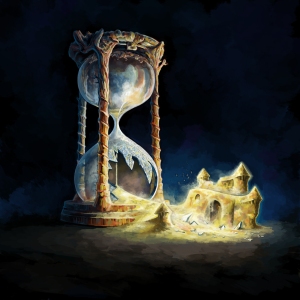
Braid is a game by Jonathan Blow that represents, to me, one of the interesting things about the Xbox 360 – the fact that this is a console with such diversity that triple-A "blockbuster" titles like Gears of War 2 and independent "arthouse" (for want of a better term) games like this can happily coexist on the platform quite comfortably. With the recent launch of the NXE and the Community Games project, I think it's relatively safe to say that Braid will not be the last game of its type that we'll see.

But what is Braid? Ostensibly it's a platform game that largely centres around puzzles rather than action. The central game mechanic is an interesting "time rewind" system which has an interesting twist put onto it in each of the game's worlds. In some worlds, you can simply rewind time if you make a mistake. In others, certain areas or objects are immune to time manipulation, so you can rewind time in the areas around the object and remain unaffected by this. In yet others, time winds forwards while you run to the right and backwards while you run to the left. It's an interesting mechanic that makes for some absolute brain-benders, and I maintain that I'm far too stupid to ever solve the game without help.

Still, the interesting thing about Braid for me, and the thing which divides opinion the most, is the "meaning" behind it all. Each world is preceded by a series of text interludes, describing the main character's quest to reach a princess in floaty, dreamy, vague language and tying the central mechanic of each world in with the main character's conflicting emotions and feelings about time, place, love and loss as he proceeds through the game. It's a fine line between "emo bullshit" and "existential masterpiece" – and there's plenty of people on both sides of the debate on this one. One thing is certain though, everyone who has played the game has plenty to say about it, whether it's good or bad.

Passage and Gravitation
Gravitation
Gravitation

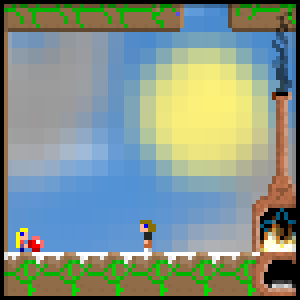
These two "autobiographical" games by Jason Rohrer at first glance appear to be simplistic "retro" style games with eye-catching super low-res pixel art. But look into them a little deeper (or, if you need a little prompting, as I did, read the Creator's Statement that Rohrer has thoughtfully posted for each game) and you'll find that each of these two games represent a deeply personal exploration of a certain aspect of "life" to Rohrer – with Passage offering a look at mortality, companionship, ambition, love, loss and the balance between these things and Gravitation looking at the concept of fatherhood, the creative process and again, the balance between these things.

Each is represented very simply with the aforementioned low-resolution pixel art. But it's the little things about the presentation and the games themselves that carry the deeper meaning. In Passage you start on the left of the screen, with more of the "world" – your life – stretching out ahead of you. Very shortly after the beginning, you have the choice of picking up a companion, who then stays with you until almost the end of the game. This makes you unable to reach some areas of the game, but it's actually quite difficult to consider leaving her behind. If you're me, anyway.

As you progress through the game, you gradually move across the screen towards the right side, meaning that at the beginning, you are looking forward to what is ahead, while at the end you are looking back on where you have just been. Shortly before the end, had you chosen to take your companion with you, she dies, leaving you as an old, lonely man left to trudge on towards his own death alone. This moment, although it is represented simply by the companion suddenly turning into a gravestone and the speed of movement of your character suddenly cutting to a quarter of what it was originally, is a hugely touching moment due to how understated it is. For me, it put across the idea that death is unglamorous, is unavoidable, but there is always someone left behind to trudge on without the person who is gone. I found it to be quite a beautiful, thought-provoking sentiment that is all the more poignant when you read Rohrer's description of the meaning behind the game.

Gravitation, conversely, does not deal with a subject such as death, but rather the struggle that a creative person has between his art and his family. The game starts with you playing "catch" with a child figure. Each time you bounce the ball back to the child, a little heart appears above their head, but you cannot make any progress in the game itself by doing this. To score "points", you have to leap up a huge tower, with gravity that is constantly changing, presumably representing varying degrees of motivation (or "mania" as the Rohrer puts it), and collect stars, which fall to the ground and form rocks. Following this, you have to drop back down and push these blocks into a furnace.

The twist is, the more stars that drop, the less able you are to get to your child to play with them, as the rocks that appear form directly in front of your child, blocking your way to her, and this also seems to have an effect on the gravity of the game. So it becomes a balancing act between play with your child and the "work" of pushing the blocks into the furnace.

These two games are two of my favourite examples of this subgenre because of their simplicity of presentation and gameplay, and the amount of "interpretation" that can be had by looking more closely at what is happening. I think it's also really interesting to see "autobiographical" games, as Rohrer calls them, and he himself points out that this is not something that many developers have done as yet.

The Majesty of Colors
The Majesty of Colors

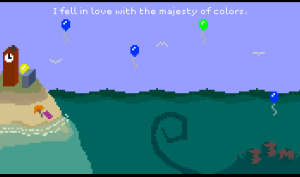
This is another game that chooses to use 8-bit style pixel art as its means of presentation, giving it a distinctive look and character that seems entirely appropriate for the game. I can't pin down why this is, but I love it. This is also the first of two games hosted on Kongregate, which originally became my favourite Flash games site purely for the presence of Desktop Tower Defense following my brother's recommendations, but seems to be developing into an interesting community of indie developers, "interesting game enthusiasts" like myself, and illiterate 12 year olds who just want to play stuff with badly-drawn animé-style characters. Fortunately, like the Xbox 360, the groups seem to coexist quite happily, meaning we get titles like this.

In The Majesty of Colors, you play a betentacled sea monster. The game opens in black and white with balloons floating past your face and the "monster's" inner monologue represented as text across the top of the screen. Grabbing a balloon and bringing it close to the monster's eyes suddenly brings the world into vibrant colour, and the story itself begins. Essentially, the player can choose to manipulate the humans who appear on the scene either through violence or helping them, and this eventually leads to one of five endings, each of which involves the "monster" (whom, it transpires, is actually a person having a dream) awakening in very different ways.

I kind of don't want to say anything else about this one, because I believe it's worth experiencing. It's a simplistic game with not a lot of "point" to it as a game, but it's very much an interactive work of art to me.

Coil
Coil
Coil

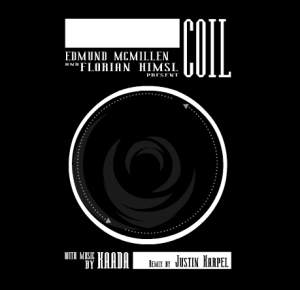
The first of two games by Edmund McMillen, Coil is a self-professed game with no instructions that requests you "keep an open mind while playing". It's presented in a rather abstract manner, with mouse-driven mini-games interspersed with Braid-style text interludes. The story of the game appears to be deliberately ambiguous to provoke discussion, but the consensus from many people seems to be that it is about a woman who was raped and the feelings she develops towards the child that is the product of that incident.

Like The Majesty of Colors, I believe this is a "game" that's somewhat open to interpretation, and another that will probably split opinion. The lack of instructions can make it challenging to progress, but it's worth persevering with the story to see what you think of it.

Aether
Aether
Aether

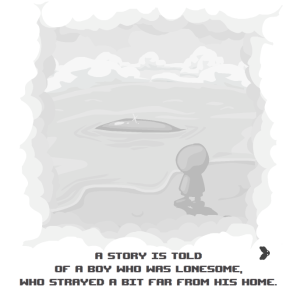
Another from McMillen, Aether seems to be a rather personal story about childhood feelings of inadequacy in the eyes of others. Players swing through space atop the back of a curious blob-like monster trying to solve simple puzzles on planets to restore colour to their lives. The game is a somewhat abstract "journey into imagination" that seems to represent an individual's struggle for validation and acceptance by others. It also has some fabulously hypnotic dynamically remixing music which really helps with the atmosphere.

So there you have them. Pretentious crap or an interesting method of displaying a work of art and telling a deeply personal story? I vote the latter, though I am more than prepared to hear people disagree, which they no doubt will!

Pile of Shame: Oct 08

I've had a personal pile of shame lingering for many years now of video games that I bought, played, loved and never got around to finishing. It seems to keep growing, and PC games seem to be ones that I am particularly guilty of leaving ignored for some time. So it was with that in mind that I started to delve into said pile of shame to actually finish some of them. Prior to this post, Divine Divinity was the game that kept me occupied. I remember when I first bought it, my PC wasn't quite up to the job of running it particularly quickly, so that put me off playing it a bit. When I bought a more powerful PC, it was left on the shelf in favour of more fancy-pants games that showed off my shiny new processor and graphics capabilities.

Now I've got my even-more-powerful-than-that Mac happily Boot Camped up to the gills, I find I've been returning to the older games more and more. I think the fact that I can run said older games at 60+fps at 1920×1200 is one of the somewhat attractive aspects of this arrangement – especially when I consider that the intro to The Witcher, which I also picked up recently, ran at approximately 1.5fps at 1920×1200. Ouch.

Anyway, now DD is out of the way I'm going to talk about one game in particular which I've always had genuine affection for because it's just so utterly charming. It's moderately well-known in certain circles for many reasons, but I think there's an equal or possibly even greater number of people out there who won't be familiar with it at all. So what is it?

No One Lives Forever

No One Lives Forever, of course; or, to give it its full title, The Operative: No One Lives Forever, hereafter referred to as NOLF for the sake of my sanity.

NOLF is a first-person perspective shooter from the era of games such as the original Deus Ex. DX is actually quite an apt comparison to this game as both proudly boast of the player's ability to approach situations in a manner of their choosing (normally boiling down to either bursting into a room making lots of noise and shooting everyone in the face, or sneaking into a room quietly and then shooting everyone in the face) and the then-trendy "stealth action" elements.

Where NOLF shines is in its characterisation – both of the game world and of the people in it. NOLF's world is a brightly-coloured Sixties-inspired caricature of the world of secret agents and acronym-based criminal organisations. Many have compared it to Austin Powers but NOLF's humour is in many places far more subtle and less slap-you-around-the-face-with-a-vaguely-phallic-object-whilst-shouting-"Laugh dammit!" than Myers' ouevre. The protagonist Cate Archer, for example, is far from being a wisecracking caricature. In fact, she's actually quite a realistically-portrayed character battling against the sexist tendencies and chauvinistic attitudes of many people from the Sixties who just happens to get into some spectacularly over-the-top scenarious, including, amongst other things, falling out of a plane without a parachute and having to steal one from an enemy goon on the way down.

This is one of the brilliant things about NOLF – juxtaposition. Cate's deadpan and sarcastic delivery of many of her lines (including some brilliantly cutting comebacks to aforementioned chauvinism) contrasts brilliantly with the absurdity of some of the situations she finds herself in. Couple this with the famous "overheard conversations" which few games have handled quite as brilliantly as this game, and you get a great spy tale with a wonderful sense of humour infused throughout.

One thing struck me while playing this game, and it was this: first-person shooters used to be fun. I don't know what it is about recent FPSes but I just don't enjoy the new ones. I've never been inclined to finish a Halo game since the first one, I have absolutely no interest in Crysis and don't even get me started on Gears of War. Yes, yes, I know, it's a third-person shooter but it might as well be in first-person for all the blood, gore, shooting, unimaginative gameplay and brown backdrops. (Yeah, you heard.)

NOLF and other games of its era (and earlier) were something else, though. I haven't been able to pin down exactly what it is I find so compelling about them, though. Maybe it's the fact that they're more colourful. Maybe it's the fact that the gameplay is more varied – for all the great set-pieces in Halo, you were still running around sci-fi themed areas for the duration, whereas NOLF sees you doing everything from diving out of aforementioned plane to doing a deep sea dive to heading to a brilliantly camp Sixties space station, with different gameplay conceits to take into account in each environment. Or maybe it's the fact that the protagonist is an interesting, compelling character that you feel inclined to stick around with for the duration of their journey. I know I couldn't give a crap about Master Chief as he's dull as ditchwater as a character, at least in the way he's represented in the Halo games – the books may be another matter but as Halo interests me so little I've never felt inclined to check it out. Cate, on the other hand, is intelligent, sexy, sarcastic and has a wonderfully dry sense of humour.

I think many modern developers and publishers could learn a lot from revisiting some games from five to ten years ago rather than churning out identikit shooters with pretty graphics. I'd love to see a modern sequel to NOLF. Who knows if it will ever happen?

Next on the Pile are the X-COM games and NOLF2, along with The Witcher, which I'll post some thoughts on soon.

SquadCast: Persona 3

It's the first of our irregular special side-mission podcasts today as we explore the world of teenagers pointing guns at their heads, the tarot and giant penises riding chariots. Yes, you read that correctly. Persona 3 is an incredibly long game – too long, perhaps, for a Squad main mission, so those of us who have played, finished (or "almost" finished) it decided to get together for a chat and a chin-stroke.

This podcast also features Beige and Pishu's report from PAX 08, our regular Personal Piles of Shame section and selections from the soundtrack of the game.

Featuring: Chris "RocGaude" Whittington, Mark "Beige" Whiting, Chris "Papapishu" Person and Pete "Angry_Jedi" Davison.

Subscribe using one of the links below:

M4A Enhanced version via iTunes
M4A Enhanced version via RSS

MP3 Standard version via iTunes
MP3 Standard version via RSS

Antiquity, Rarity, Hilarity

I've got three games to talk about today. Depending on my stamina and how long it takes dinner to be ready, this may take more than one post. But I'm sure you can cope with that, and I'll endeavour not to finish on a cliffhanger… unlike current DVD-du-jour Alias which is currently driving Jane nuts with the cliffhanger that every single episode ends on. Me? I love it, but then I'm a sucker for that sort of thing and could happily sit and watch a whole box set in one go. I'm that lazy.

But I digress. Let's begin this triptych.

The Antiquity

Divine Divinity
Divine Divinity

Antiquity in question is actually not that old, hailing from 2002, but it's actually been sitting on my shelf gathering dust almost since I bought it for full price back upon its release. I've started it several times but never played it in any great depth.

"What is it?" I hear you ask. Well, it's a game with a ridiculous name. Divine Divinity, to be precise, which I can only assume is more meaningful in the original Flemish. It's an RPG by Belgian developers Larian Studios, who remain relatively little-known to this day, but are currently working on a sequel to DD.

Why did I start playing this? Well, several reasons. When I'm between "big releases" on the consoles, I often think about picking this game up again and playing through it but inevitably something else distracts me. This is much the same reason I have never completed Baldur's Gate II, despite the fact that I would very much like to. The main reasons I've decided to stick with it this time include firstly a thread over on the Quarter to Three forums discussing "Diablolikes" in anticipation for the as-yet-undated release of Diablo III, where DD's name came up, and secondly remembering that DD was one of the earliest suggestions for the Squadron of Shame to cover, being a game that garnered considerable critical acclaim on its initial release but is still a relative unknown.

So what is it, and why did it gain such acclaim? At first glance, it appears very much to be a Diablolike, right down to having an interface lifted almost wholesale from Blizzard's classic. However, it's once you get into the gameplay that it becomes very apparent that it's an extremely well-thought out game with a lot more depth than the hack-and-slash of Diablo. If you must compare it to things, it's a curious blend of Diablo, Baldur's Gate and Fallout – taking, as it does, the real-time "twitch" combat and single-character focus from Diablo, the huge world, character interaction, quest systems and ability to strategically pause from Baldur's Gate and the interesting barter-based trading system from Fallout.

It's a blend that works well. What we end up with is a game with considerably more variety than Diablo (not that that game's purity works against it – on the contrary, it is probably one of the contributing factors that makes it so addictive) and the depth of story and interaction of Baldur's Gate without any of the scary intimidating (for some) cogs and gears of AD&D 2nd Edition.

Plus it's huge. We're talking Baldur's Gate II huge here. You spend a considerable amount of time in the first village and the dungeon underneath it before going out into the wider world. And said world is pretty huge – particularly due to the fact that what initially appears to be the "overworld" map is actually just a fraction of a much bigger game area filled with things to kill and quests to complete. Part of the joy of the game is just exploring this world and discovering what it has to offer, but there's a well-structured quest system in place to give you a bit of direction too.

In the foreword to the game manual, the game's designers note that they hope that people will find "their own way" to play the game, and while there are always obvious limitations on any RPG system to do EXACTLY what you want, I do get the impression that you could play DD quite happily as a Diablo clone, wandering around the wilderness and killing things for experience and only completing storyline-critical quests. On the other hand, the way I'm playing is more like a "traditional" (for want of a better word) RPG where I'm travelling between places and attempting to complete quests in an efficient manner.

It's a really excellent game, but I can see the size and length putting some people off. I'm certainly glad I've decided to give it a chance though, as I'm really enjoying it and fully intend to see it through to the end.

The Rarity

Ulala
Ulala

This is a game I actually didn't think existed. I remember reading about it before it came out and then it disappearing without trace. The game in question is Space Channel 5 Part 2. I adored the first game on the Dreamcast and then again on PS2 when it was re-released, despite it being absolutely 100% the most gay game on the planet. And I don't mean that in an Internet-Fuckwad-"Gay-means-crap" sort of way, I mean that this game is super-gay. Don't believe me? Watch this clip.

Convinced now? But didn't you find it utterly infectious? That's the charm of Space Channel 5, a game which is essentially Simple Simon in a camp 1960s sci-fi parallel universe. Part 2 is more of the same, but it has the dubious honour of being one of the rarest PS2 games ever, at least here in the UK.

The reasoning? It has Michael Jackson in it for a few minutes, and was released around the same time as the TV report that suggested that MJ might be… you know, a bit wrong in the head (like no-one knew that already). As a result, the game was hastily pulled, never to be seen again – so much so that boxed copies of the game now go for up to £100.00 apiece. Yes, US-based readers, that's about $200 for one game without any peripherals or anything.

Fortunately, I had a stroke of luck in a browse through Amazon and managed to locate a seller who had the game for considerably less than £100 because it wasn't brand new, but it was pretty much untouched. As a result, I scored the game for under £50 including shipping, and I didn't think it was going to get any cheaper than that to get my hands on a genuine rarity.

But enough about the hard-to-findness. What's it like?

Again, it's super-gay, and super-fun. The gameplay remains fundamentally unchanged, though it adds both a strange two-player mode where one player is in charge of directional inputs and the other is in charge of pressing X and O to "Chu!" and "Hey!" as appropriate along with a survival mode. There's something about it, though, that makes you want to play it again and again, even though the whole game can be beaten in about an hour, and I think it's the infectious cheerfulness of the damn thing.

With the number of damn games that have been predominantly brown ever since Quake came along, it's always refreshing to play a game with lots of bright colours and cheerful music, where even the villains are entertaining rather than threatening. It is impossible to play either Space Channel 5 game and not come out sporting a huge grin on your face. And that's worth a lot – to have something that's genuinely uplifting to play is always a pleasure, and it's something we seem to get a lot less these days as graphics improve to the point where the Holy Grail of "photo-realism" is getting closer and closer.

The Hilarity

Castle Crashers
Castle Crashers

Castle Crashers hit Xbox Live Arcade this week after three years of anticipation and I'm pleased to report that it's an excellent game bringing back memories of chugging 50p pieces into the Turtles, Simpsons and Asterix arcade games (and being inevitably frustrated by the shoddy home ports).

It's also, to tie in with what I said about Space Channel 5, genuinely funny. Developers The Behemoth make a point of creating visually appealing games, as Alien Hominid will attest, but CC is filled with so many laugh-out-loud funny visual jokes that again, it's a game that makes you smile, and a game best experienced with friends, while drunk.

I'm out of time. There may be more discussion of any or all of these titles later. For now, I hope that's given you a taste of my current gaming. Screw big releases, these three are keeping me more than busy enough for the moment!

The Squadron of Shame SquadCast #7: Okami

Released today is the seventh episode of The Squadron of Shame SquadCast focusing on Clover Studios' beautiful game (poncey as it sounds, there really is no other way to describe it) Okami. Along the way we take in a lengthy journey into the depths of Papapishu's mind (fueled by Dance Mania and ADD meds), discuss why good is boring and evil is awesome (and Braid is either a work of art or emo bullshit) and delve into the "this could go on for months" territory of Eastern vs Western game design philosophy.

We also, as usual, discuss our personal piles of shame, including comment on Geometry Wars 2, Braid (twice), Soul Calibur IV, Star Control 2 (hold on, haven't we done that one already?), Siren: Blood Curse and, much to Pishu's disgust, EVE Online.

This episode features a triumvirate of hot Chris action, with Chrises "RocGaude" Whittington, "Iscariot83" Hernandez and "Papapishu" Person making an appearance, along with myself, Mark "Beige" Whiting, Tom "sinfony" Haley and George "Regulus Loves EVE" Kokoris.

Grab the M4A file here, or the MP3 file here. Alternatively, subscribe in iTunes or via RSS.

Enjoy! Please feel free to post comments here or on the Squadron of Shame's club page on 1up.com.