1855: Redemption

Having Platinumed Akiba's Trip — and a lot of fun it was, too, thanks very much — I started on my next non-Final Fantasy XIV game, Criminal Girls.

Criminal Girls drew some attention when it was first announced due to some seriously lewd scenes in which the player character "motivates" the titular girls through some touchscreen-based S&M play. It then drew some further attention when it was revealed that the localisation would seemingly obscure these scenes with pink fog and cut out the somewhat… suggestive voice acting. (As it happens, the voice acting is indeed gone, but as you progress the pink fog does fade away, revealing what's underneath.)

As so often tends to be the case with games that draw attention for their pervier elements, however, Criminal Girls has plenty of interesting stuff going on that doesn't involve spanking. It's a 2D, retro-style RPG of the 16/32-bit mould, and thus far — I'm only an hour or two in so far — it seems to be most intriguing.

At the game's outset, you, as the participant narrator-protagonist, find yourself newly employed by the forces of Hell and presented with a selection of young female "delinquents" who have the opportunity to be redeemed and resurrected if they can successfully pass the "four trials" and climb the tower in which they're incarcerated. It's your job to escort them on this journey and see where things go from there. Along the way, you'll fight monsters, solve puzzles and, as previously mentioned, indulge in a bit of naughtiness in the name of "motivation".

So far so Japanese. Thus far it's an intriguing setup, with the four initial girls not immediately revealing why they have been incarcerated or what their "delinquency" involved. There's also a suggestion early on that things are not quite going as expected in Hell, with the "convict" monsters showing up in places where they're not supposed to. Doubtless all will be revealed — in narrative terms, pervert — as the story progresses, and I'm interested to see how it goes.

What's probably the most interesting thing about Criminal Girls is its combat system. While nothing particularly fancy presentation-wise — in fact, it's one of the most visually bland combat systems I've seen, although the chibi representations of the girls are cute — the execution is the intriguing thing here. Unlike most RPGs, where you have the opportunity to micromanage what every party member is doing, in Criminal Girls you only have four options each turn, and that determines what the whole party will be doing. The available options are determined by which abilities the girls have learned through "motivation" sessions, and simply what they feel like doing on any given turn. Initially, the girls will simply refuse to do anything, but as they're motivated they'll unlock more and more abilities, and each turn it's simply a case of deciding which of the four suggestions the girls offer you is the most appropriate: do you go for an all-out attack with multiple members, or do you allow an individual to do something a little more special? So far it's simple, but I anticipate it becoming a very interesting system as the game progresses and more abilities open up.

I can't say a lot more about it yet as I've only played the opening section. I'm looking forward to discovering more about it, though; perviness aside (which I have absolutely no problem with, as you know) it's shaping up to be one of the more unconventional takes on the RPG genre I've played for quite some time.

1846: Akiba's Tripped

Finished Akiba's Trip: Undead and Undressed this evening. Planning on posting some more detailed thoughts over at MoeGamer at some point in the coming week, but I thought I'd post some immediate impressions here while it's fresh in my mind — I literally beat it not five minutes ago. Well, one of its routes, anyway.

Akiba's Trip is quite an unusual game, although perhaps not by Japanese standards. Combining elements of dating sims, visual novels, RPGs, brawlers and open-world action adventures, it all adds up to a curiously satisfying experience that, while relatively brief compared to some other games — my first playthrough took me about 20 hours, and that was with doing pretty much all of the available sidequests as well as a bit of fiddling around trying to level my skills up and collect some collectable things — proved to be highly enjoyable.

A highlight, as with many Japanese games, is the care and attention which has been poured into characterisation, both visually and in terms of writing. The localisation team at Xseed has to take some of the credit for the amount of personality the game has, too; as translations go, this is absolutely exemplary, remaining (so far as I can make out with my limited knowledge of Japanese) reasonably true to the original script while simultaneously incorporating plenty of cultural elements that will be familiar to Westerners.

A particular highlight is the main character, who is handled somewhat like the player's character in the Persona series, in that he doesn't speak out loud all that much — although he does have a couple of lines here and there, they're mostly confined to inner monologue — but the player is frequently given the option of how to respond to a particular situation. In many cases, the options given all lead to the same outcome, but the available choices are frequently hilarious; there are some real crackers towards the end of the game in particular, with my favourites being "It's dangerous to go alone! Take thi– I mean me!" and "I'm going to turn his dark utopia into a dark u-nope-ia!". (You kind of have to be there.)

These dialogue options do occasionally have a purpose, however, and that's the choice of route and subsequent ending that you get. Partway through the game, the story splits in a few different directions according to the various different heroines you encounter. I haven't seen how different these routes are yet — and I'm disappointed that there isn't a route for Kati Raikonnen, an incredibly endearing member of the main cast who, being "foreign", has a tendency to speak in what is represented as "Engrish" by the translation — but I'm keen to find out. It appears that this will be a painless process, too, since after clearing the game once you can turn on the option to specifically mark the dialogue options that will change affection levels between you and the heroines. Not only that, but there's no real need to do sidequests after your first runthrough — indeed, there's no real need to do sidequests at all if you don't care about trophies, though the money they get you is nice — and so you can zip through subsequent playthroughs pretty quickly, especially if you've taken the time to upgrade your weapons and clothing and carry them over into your New Game Plus.

I really wasn't sure what to expect when I booted up Akiba's Trip. I think I was expecting some sort of fairly straightforward brawler set in Akihabara, but what I actually got was far more akin to something like Yakuza. A surprising amount of depth, in other words, and an extremely well-realised setting that makes a great backdrop for the various stories within.

I hope we get the opportunity to revisit Akihabara at some point in the future; given that this version is actually the second game to bear the Akiba's Trip title — the first never made it out of Japan — that's not beyond the realm of possibility. I'll be there if and when it happens!

1844: Back in the Game

I've started updating my Japanese gaming site MoeGamer again. I'd taken something of a break from it for a while, partly due to a general sense of disillusionment with the whole "writing about games" thing — the whole "getting unceremoniously ditched by the publication I'd loyally written for since its inception because I wasn't American" thing didn't help (and yes, that really was the reason I was given for my redundancy), and neither did my well-documented distaste for the way the mainstream games press at large tends to treat Japanese games — and partly simply due to the fact that I didn't feel I had a lot of time any more.

Having a "normal" job kind of sucks like that, in that it's a lot harder to find the time to do the things you want to do or that you know you enjoy. I always manage to find time to write this blog each day, of course — though sometimes it's late in the evening when I publish something, and sometimes that something is a barely coherent mess — but keeping MoeGamer up to date was proving to be somewhat more difficult, at least partly because of the expectation I'd set for myself that everything I put on there would be erring on the slightly more long-form side of things rather than quick, snappy posts. (I'm firmly of the belief that there are plenty of people on the Internet who are capable or reading more than 250 words at a time, and it saddens me to see so many sites dumbing themselves down to cater to people with some sort of attention-deficit disorder.)

That dumbass IGN JRPG article from the other day (which I think I've already linked to more than enough; check out my response on MoeGamer to find out more) spurred me into action, though; I wasn't going to let such an ill-informed piece slide, so I guess I should be thankful to Colin Moriarty for that if nothing else.

From writing that piece, though — which was actually, I must confess, adapted from something I'd written a few months back but never gotten around to publishing — I felt the old bug biting again. I enjoy writing about games; not necessarily for profit, pageviews or comments, but purely for the enjoyment of expressing myself about things that I love. I have no particular desire to be a professional games critic or journalist any more — not now I've experienced firsthand how shittily many of us get treated, and certainly not now that the whole GamerGate situation has put the games press as a whole under more intense scrutiny than ever before — but I do still like writing about games, and I enjoy it when people stumble across my sites for whatever reason, like what I've written and decide to say hi. A number of people have dropped by either here or MoeGamer recently and said that they miss my work on USgamer; I'm happy to hear that, because it means that what I was trying to do with my JPgamer column paid off in at least a small way: it gave an often-ignored, often-ostracised subsection of the gaming community something that they could feel like was written for them. And I can say that with some confidence, because I count myself among that subsection of the gaming community, and I wrote those pieces — and indeed everything on MoeGamer — for me.

Going forward, then, I hope to be able to post at least one or two things on MoeGamer a week. I'm not going to attempt to stick to any sort of schedule nor beat myself up if I don't manage to post something — I'm not trying to make it into a business or even make a bit of pocket money from it — but I am going to use it as a place to post my thoughts about games I've enjoyed or am currently enjoying. And I hope other people will continue to enjoy it in that respect, too.

1842: Soton's Trip

Playing Akiba's Trip as I have been for the past few days, I'm reminded of something I wrote about a while back: the fact that certain places in the world manage to become iconic, while others simply… exist.

Akihabara is a popular setting for a lot of visual novels, games and anime because it's directly relevant to those who are engaging with the medium in question. Akihabara is the spiritual home of Japanese games, anime, manga and all other aspects of moe and otaku culture. It perhaps makes sense to set a Japanese adventure-role-playing-beat-'em-up-type-thing (Akiba's Trip) there, much as it makes sense to set a visual novel about the Internet, urban legends and all manner of science fictiony goodness (Steins;Gate).

But what about other places? Big American cities get a lot of love — New York in particular, but we've also seen places like Chicago and San Francisco come up a few times. If a game ends up being (at least partially) set in England, it'll inevitably be in London, of course. But, as I'm fond of telling visitors to this fair isle (people I know, obviously; I don't just sit at the airport arrivals line and tell foreign strangers they should go outside the M25 once in a while), there's a lot going on in other places.

That, of course, got me thinking what something like Akiba's Trip might be like were it set in, say, sunny Southampton instead of Akihabara. Southampton is not, of course, quite the same sort of otaku Mecca as Akihabara, but there are plenty of nerdy hangouts, and the historical side of the city could make for some interesting situations.

The main street of Southampton is long and wide; ideal for large-scale battles against armies of Synthisters. It often features market stalls just ripe for flinging an assailant through in dramatic fashion, and plenty of opportunities for environmental attacks such as making inventive use of a slushie machine or a curry hotplate. Its centrepiece is the shopping centre WestQuay, which is large and interesting enough to form a good interior setting: there are plenty of shops to go in, many of which sell clothes (acquiring various outlandish — and not-so-outlandish — outfits is a key part of Akiba's Trip) and the multiple levels would seem ripe for some Resident Evil-style environmental puzzles as ways up and down are blocked off in various ways, and you're forced to brave the horrors of, say, John Lewis in order to make your way down into the depths of the underground car park where otherworldly horrors await you.

All right, yes, I have let my imagination run away with itself a little bit here — and I must confess, any time I've been into town on a Saturday I have fantasised on more than one occasion about slamming someone into a slushie machine, though never, I might add, acted on it — but it just goes to show, really, that you can make pretty much anywhere into an interesting setting to do something in. So why do we always find ourselves taken back to the same places over and over again?

Perhaps it's the fact that they're universally recognisable. Perhaps it's the aforementioned relevancy angle. Or perhaps it's just laziness.

1840: Further Tales from Akihabara

When I've not been playing Final Fantasy XIV or Final Fantasy II, my game of choice has been Final Fant– no, wait, Akiba's Trip: Undead and Undressed. I talked a little about this game a few days ago and, after a few more hours with it, I can confirm that I really, really like it a lot.

It's a very peculiar game by modern standards. Not quite RPG, not quite adventure, not quite dating sim, not quite open-world sandbox game, Akiba's Trip is a thoroughly interesting experience that seems to get more rewarding the longer I continue playing it.

One thing that sprang to mind while I was playing it the other day is something I also felt when playing games that are spiritually somewhat similar: Shenmue and Yakuza being the two that I think of immediately. The thing I thought about was how nice it is to have a game world that is small, but dense. Akiba's Trip unfolds in a single district of Tokyo, split (in the Vita version, anyway) into maybe ten or so different areas, all of which are interlinked in various ways. Yakuza was the same, unfolding in a single district, and Shenmue saw you progressing through just a few different areas of a town. (Shenmue II got a little more ambitious, but still split its story into several distinct "chapters", each of which unfolded in a relatively small geographic area.)

If you take this approach and do it well, it gives an extremely strong sense of place to the setting. The setting almost becomes a character in its own right, as you start to recognise distinctive landmarks in each area, and know that if you want [x] you need to go to [y]. It also encourages the player to wander round, explore and drink in the atmosphere: although Akiba's Trip features a fast-travel system, for example, I've found myself deliberately walking from one end of the map to the other just so I can get a stronger feel of this lovingly modelled setting.

Okay, Akiba's Trip in particular has some technical limitations holding it back — the poor old Vita can't cope with all that many people wandering down the streets at the same time as you, for example, and the shops that you can go "in" tend to amount to a simple buy/sell menu rather than a further environment you can explore — but the combination of visuals, sound and personality that the game boasts makes it an experience where it's fun to just wander around and see what you can see — particularly when unexpected things happen.

This isn't even getting into the meat of the game, though: there's a strong and interesting story surrounding the man-made vampire-like "Synthister" creatures; there's plenty of mystery surrounding several of the central characters; there's an entertaining series of sidequests involving the main character and his hikikomori (shut-in) little sister; and even the non-plot-related sidequests help to flesh out the world by bringing you into contact with a diverse and fun array of incidental, supporting characters.

Plus, why on Earth wouldn't you want to play a game where you defeat enemies by pulling off their trousers? 🙂

1837: A Trip to Akihabara

I've had a copy of Akiba's Trip: Undead and Undressed loitering in my backlog pretty much ever since it released over here, but I've never gotten around to playing it until recently. I'm not sure what convinced me to give it a go, but I decided that it was time, so I booted it up the other day.

Akiba's Trip is a game that proved to be notorious for two reasons: one, that supposedly, it was a game about beating up girls and pulling their clothes off; and two, it features the transphobic slur "trap" used for its intended purpose, i.e. to insult a transgender person.

Both of these things are accurate; however, as is usually the case with this sort of thing, the fact that they were focused on by loudmouthed critics almost to the exclusion of everything else about the game obscured the fact that the other 99% of Akiba's Trip is a very interesting, ambitious experience indeed, and a game very much worth playing. Not to mention the fact that both of the heavily criticised elements can be fully justified through the game's narrative context.

In Akiba's Trip, you play you, assuming you're a floppy-haired male anime protagonist. (After clearing the game once, you unlock the ability to play as other character models, so from that point onwards you can play as a lady if you so desire; canonically, however, the hero is male.) After answering a seriously sketchy-sounding job ad about taking part in a drug test in exchange for as many rare anime figures and other merchandise as you can handle, you find yourself turned into a Synthister, a man-made vampire with superhuman strength and the ability to absorb "life energy" from people around you. While Synthisters aren't vulnerable to crosses and garlic like "real" vampires, they are still extremely sensitive to sunlight, however, with something of a propensity for exploding into a cloud of dust if too much of their bare skin is exposed to the elements.

I'm sure you see where this is going.

In short order, you're rescued from your precarious situation by another Synthister called Shizuku, and you make your way back to your group of plucky gamer buddies who hang out in a cool bar run by an old dude everyone calls "Pops". From here, you're tasked with investigating the Synthister threat as well as helping out the locals of Akihabara, primarily by either finding things in the district or by beating up people until you can pull their trousers off: the game's combat system is primarily about damaging clothing until it's in a state where you can whip it off, rather than whittling down a more conventional health bar. In order to defeat most enemies, you need to remove their headgear along with their top and bottom clothing. Interestingly, in contrast to something like Senran Kagura, a game which also has a heavy emphasis on clothing damage, the "strip" mechanic in Akiba's Trip is unsexualised; it's simply part of combat, and is, frankly, hilarious. (Not only that, but you'll find yourself stripping men as well as women; I believe my session earlier is the first time ever in gaming that I have defeated a man in full motorcycle leathers by diving head-first into his crotch, grabbing his helmet and flinging it away, then whipping his trousers off and tearing his jacket from his chest.)

Stripping aside, the big hook in Akiba's Trip is that it features a lovingly detailed rendition of the real-world Akihabara district of Tokyo in Japan — a Mecca for otaku of all descriptions for sure. Featuring recreations of real-life shops, some excellently authentic-sounding ambient sound and a pleasingly diverse array of random people wandering the streets, it's an enormously atmospheric game that it's a pleasure to just wander around and explore — particularly when you start to notice interesting things happening without any intervention from you.

I was searching for some street thugs with Shizuku at one point, for example, and I decided to try and ask a suspicious-looking man in the street for directions. He responded that he "wasn't into dudes" and refused to talk to me. As I pondered what to do next, he then started to hit on Shizuku, who stood there patiently while he said his piece and then, marvellously, wound up one hell of a punch and socked him right in the face, flattening him. He then ran away crying. It was a beautiful moment that just happened to occur due to me being in the right place at the right time.

If there's one game that Akiba's Trip reminds me of so far, it's Yakuza. The lovingly crafted real-world environment; the blend of JRPG-style mechanics with action game brawling; the fact the game acknowledges the more unpleasant, seedier side of humanity without judgement. (The aforementioned "trap" comment, for example, comes in the context of a forum thread you read on your phone; said forum thread was clearly localised by someone who has spent a lot of time on real-world forums, since the text-based "dialogue" is some of the most convincing and realistic I've seen in an English localisation for a very long time — right down to the use, or lack thereof, of punctuation, and the way that anonymous people online are quite frequently complete shitheads to one another.) That and the endless stream of sidequests to complete that have nothing to do with the main story but provide a pleasing sense of "place" and "context" to the overall setting; the NPCs who are delighted to relieve you of your money through various scams; the strong characterisation.

I've only played a couple of hours so far, but already I like it a lot. I'm playing the Vita version, which has a few technological limitations, but is proving enjoyable regardless; I can imagine that the PlayStation 4 version would be a most enjoyable experience indeed, particularly with its additional features and enhancements.

1834: Rate Us Five Stars

I rarely leave user reviews on things, be they App Store/Google Play downloads, Amazon purchases, eBay sellers or Steam downloads. And I've realised that in not doing so, I'm being a bit of a fool.

Why? Because whenever I consider purchasing something, one of the first things I do is have a look at the user ratings and reviews and determine whether or not they're 1) genuine 2) worth listening to and 3) something that might need to make me reconsider or confirm my purchase.

Of course, user reviews are very much open to abuse. You only have to look at some of the more notorious examples on Amazon or Metacritic to see the system at its worst… although these incidents can often provide a certain degree of amusement. (There's at least one Twitter account devoted to amusing Amazon reviews alone.)

But when they work, they can be extremely useful — and every time I write one, I'm reminded how much I have always enjoyed reviewing things. Not necessarily critiquing them in depth or from any sort of theoretical perspective, but providing a simple, straightforward analysis of how much I liked something, how it made me feel, whether I think other people would like it and all that sort of good stuff.

It's also really fun to write a negative review, though it's also very easy to be extremely unfair when you're doing so, which is why I try and remain positive most of the time. (People are also more inclined to disagree with something negative than positive in my experience, too, and I really don't enjoy arguing with people.) I have made one fairly consistent exception over the years, though, and that's with mobile games that have been truly, truly awful, particularly those that have desecrated beloved franchises like Dungeon Keeper, Theme Park and SimCity. (Oh, hi, EA.)

But I've decided as a belated and rather lame resolution that I'm going to start making an effort to review things that I've bought, played, used, whatever. Because if I make use of user reviews for their intended purpose — to find out what the average Joe on the street thinks of something that I'm considering purchasing — then I'm sure other people will do too. And, not to blow my own trumpet too much, but I feel like I'm quite good at expressing myself about the things I do and don't like about something.

I give it a couple of weeks before I stop doing it, but for now it's a little something I can do to help make the Internet as a whole a slightly better place. I made a start this evening by reviewing HuniePop on Steam; see if you can spot my review if you're pondering whether to drop some cash on a pornographic puzzle game!

1833: Sexy Puzzle Skills

I spent a significant chunk of time playing some more HuniePop today, and I'm thoroughly enamoured with it. It's a game for which it's abundantly clear the development team had an absolute blast making it, and it's particularly refreshing to see a game put out without any regard for (or perhaps more likely, a wilful disregard for) the Professional Outrage Machine that perpetually whirs on the Internet.

huniepop1

HuniePop is rude. It's even rude in its "censored" incarnation on Steam, but the uncensored version (available via MangaGamer or the game's official website) is marginally ruder. (To be exact, the uncensored version features visible vaginas both with and without man-juice spooged all over them, while the censored version covers such disgraceful shame-holes with panties, but is more than happy to still depict women masturbating, boobs and posing in distinctly provocative manners.)

Naturally, the rude bits are what people have mostly been talking about with regard to HuniePop, but as with most games that happen to include sexual content, there's a lot more going on than just a few (admittedly well drawn and rather erotic) pornographic pictures. A few days I talked a little bit about my first impressions of the gameplay; since that time, I've played a whole bunch more and got a good feel for the game; all that I have left to do now is seduce the love goddess Venus and two additional "secret" characters before I have 100% completed it… just in time for a promised Valentine's Day update which is coming down the pipe.

HuniePop has evolved quite a bit over its development cycle. Originally pushed as a bit more of a "life sim" where you'd have to manage your time effectively, make money from part-time jobs and take part in numerous activities, it was gradually simplified into its current form. Part of me is a little sorry that the full-on life sim incarnation never saw the light of day, but having spent over 6 hours now playing the final release, I can say that I think they made the right decision. The gameplay is kept simple and enjoyable, and that is, at least in part, what makes it so addictive.

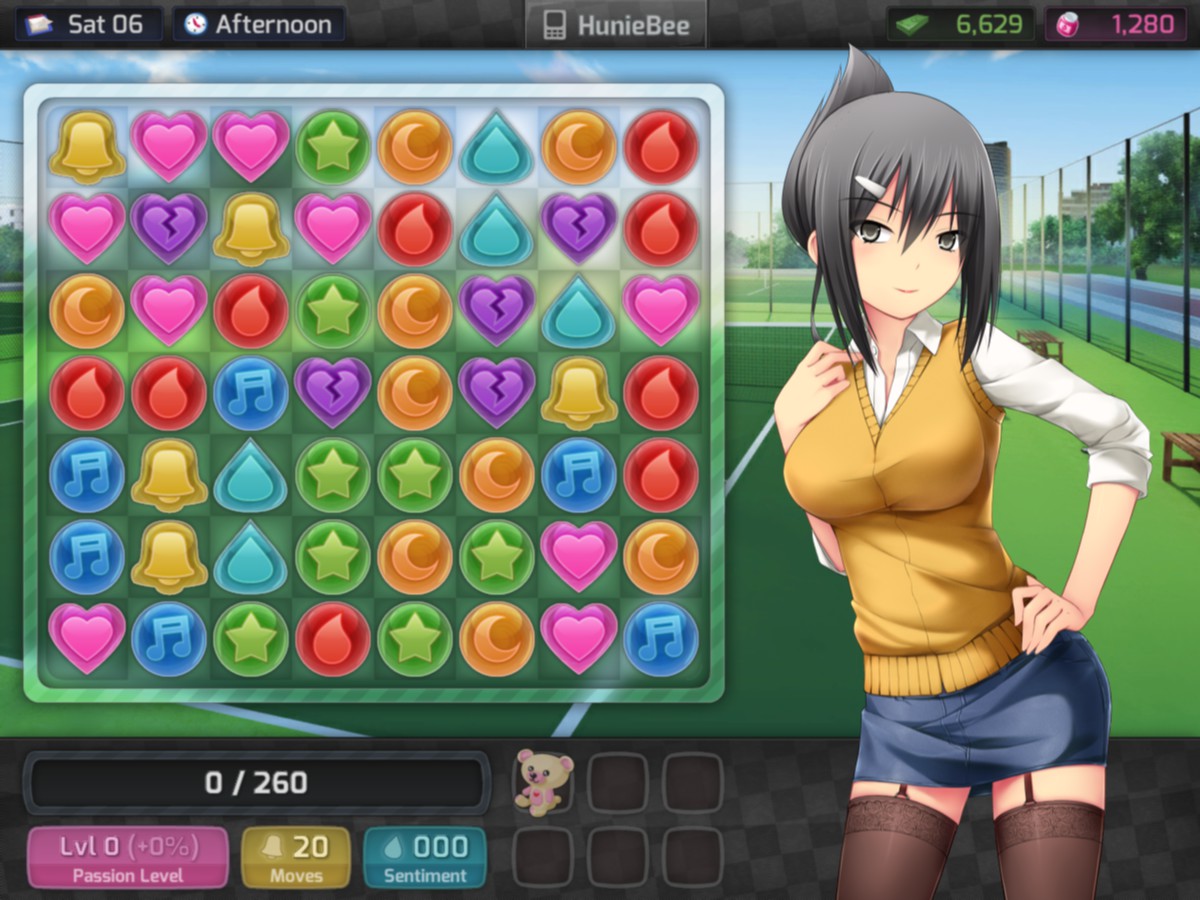
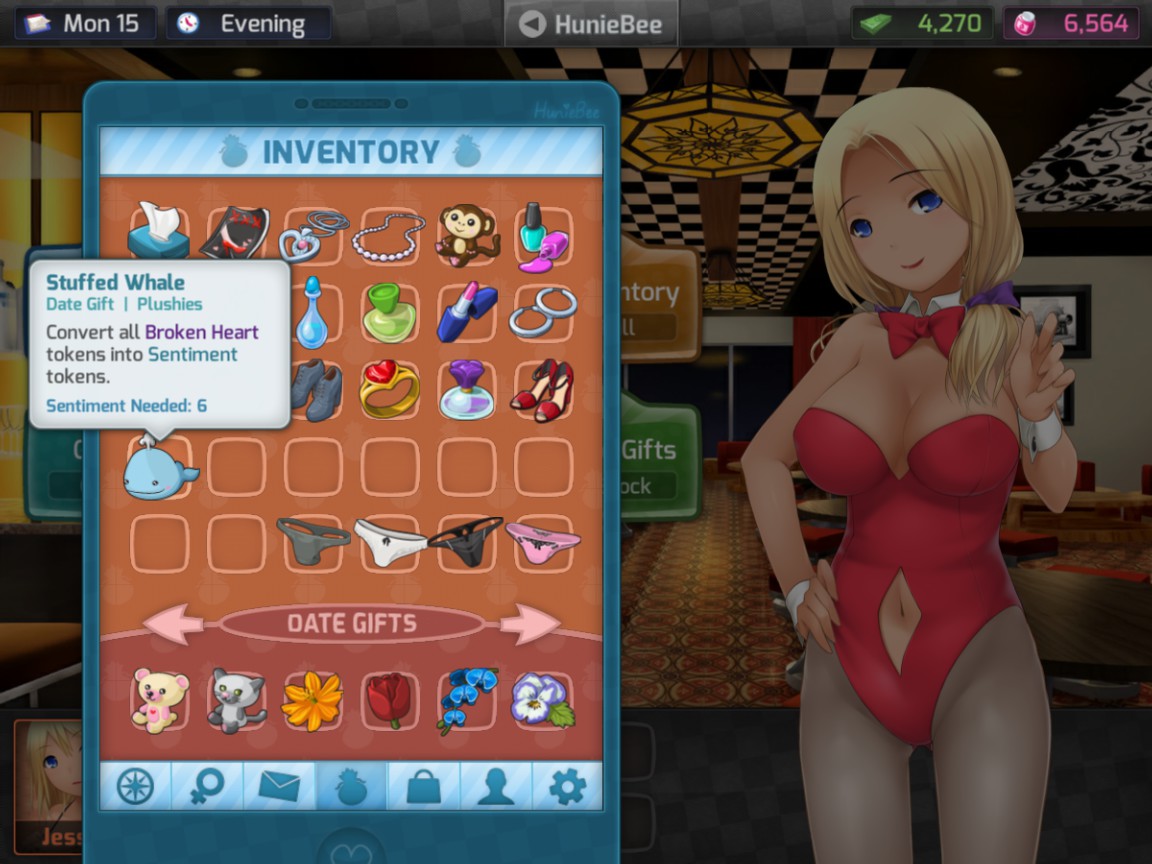
Even the match-3 puzzle gameplay has a surprising amount of depth to it. Match-3 is a hugely overused genre, but HuniePop puts enough twists on it to keep things interesting. There's the need to avoid harmful tokens, for example, and the fact that each girl in the game has a "favourite" token that is worth considerably more points than others. The main depth comes from the items you can take into a "date" puzzle, though; these range from increasing the likelihood that a specific colour or type of tokens will fall when you clear space on the grid, to immediately consuming tokens of a specific type or in a particular area. Given that each girl has her own preferences — and according to how you play the game, your character will have their own strengths and weaknesses, too — it's very important to take the right items in to a date, particularly when you're attempting to win over the somewhat more hesitant girls, who require a much higher score in the puzzle game to advance to the next relationship level.

Huniepop2

There's another enjoyable twist on the match-3 puzzle gameplay once you get the girls up to 4 or 5 "hearts" of affection and take them out at night, too: they'll demand to come home with you and that you give them a right old good seeing to. At this point, all nuance goes out of the window, and all you have to do is simply match as many tokens as you can as quickly as possible — no items, no preferences, no harmful tokens — while your partner for the evening moans and groans in what is, frankly, an exceedingly erotic manner through your speakers. It's a complete shift in pace from the cerebral, strategic gameplay in the normal dates, and oddly, it actually does a pretty good job of reflecting the intensity and passion of a sexual encounter through pure gameplay. It's difficult to describe; it's something that will be very clear if you experience it, however.

I'm developing a real soft spot for the characters, too. As I noted in my previous post, there's not a lot of plot development, though the developers have taken the time to give each character a distinct personality and relationship to the rest of the world. Porn star Jessie, for example, turns out to be the mother of college student Tiffany, though they don't speak and they never mention each other by name; it's something you'll figure out by yourself as you learn the various pieces of information you can pick up about each girl. And while the game is essentially about making sure you say what each girl wants to hear rather than necessarily what you really feel, there is nothing stopping you deciding to pursue a monogamous relationship with your virtual waifu and shun all the others — or at least try and remain consistent in your responses. (Okay, you won't get far and you're arguably missing the point of the game, but the option is there.)

Huniepop3

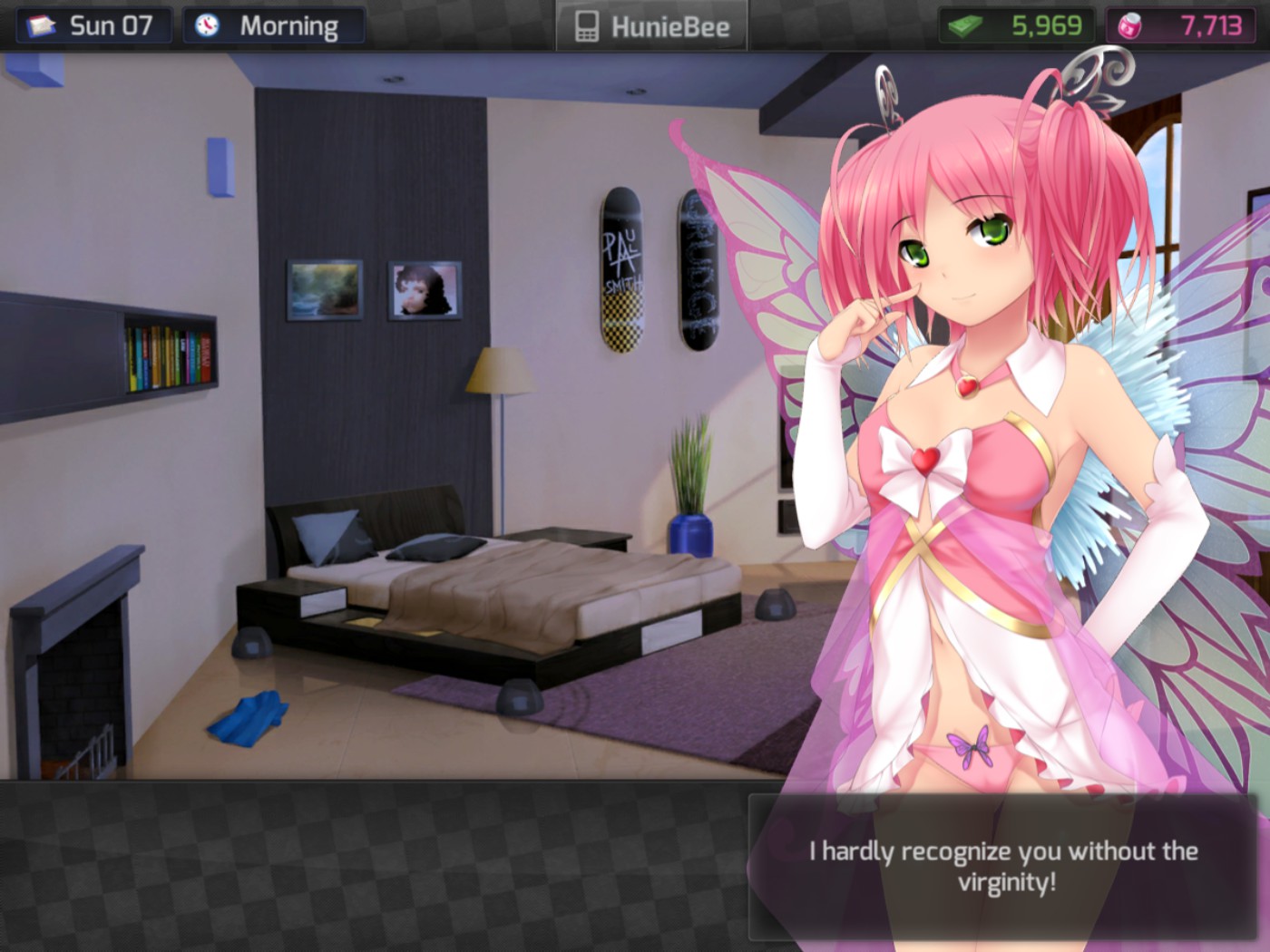
One particular highlight of the game is the love fairy Kyu, who introduces the game concepts to you at the outset of the game, and eventually becomes a dateable character in her own right once you successfully bed one of the other characters. Kyu is hilarious. She's the main source of the game's self-aware humour, since she's written to be fully conscious of the fact that she's a character in a dating sim, and that the whole situation is ridiculous. She also comes out with some brilliant one-liners over the course of the game and sounds a bit like Pinkie Pie, which makes it all the more adorable and amusing when she not-particularly-seriously berates you for buying her gifts "just because you want to fuck [her]".

I've enjoyed the game a lot and, having come this far, fully intend to 100% complete it in the next day or two. Politically incorrect it may be, but it's a whole lot more fun than getting mad about stuff on the Internet.

1831: Second Fantasy

When I've had a free moment to sit down with the Vita, I've been continuing my Final Fantasy marathon with the second game, the imaginatively titled Final Fantasy II.

Final Fantasy II came to Western shores considerably after its original release; it wasn't until the PlayStation release of Final Fantasy Origins that we'd get to play it in English for the first time, but, like its predecessor, it's subsequently been enhanced and ported to a variety of different platforms. I've been playing the PSP version via the Vita, which, again like its predecessor, incorporates a bunch of extra content, though I'm yet to encounter any of it aside from the entrance to an ominous-sounding (and huge-looking) optional dungeon.

Final Fantasy II is thought of in somewhat mixed terms by many people, to put it politely. It's absolutely hated by others, and those who like it are in something of a minority. I'm one of them, though; it's an interesting game, and while its mechanics don't quite work as well as they could, it was a bold experiment whose systems we can still see at work today in games like The Elder Scrolls and its ilk.

Final Fantasy II's unique selling point was that it had no experience points and no levels. Instead, you levelled up individual skills and stats by making use of them. Want to get stronger? Hit things. Want to get better at casting spells? Cast more spells. Want to be able to take more damage? Take some damage. It's quite logical when you think about it, though it does tend to encourage a certain degree of gaming the system, and there's a number of glaring flaws in it, too, such as the fact that characters in the back row of your party (which one of them is in by default at the start of the game) will never take any damage except from things that affect the whole party, and thus their HP counts will be left trailing considerably behind the rest of the group. The game is also somewhat notorious for seemingly encouraging players to attack their own party members in the name of boosting their HP quickly.

The PSP version maintains this peculiar levelling system, but so far I haven't really encountered a major issue with it, and like the PSP version of Final Fantasy I, the pacing feels like it may have been tweaked slightly, though this is only my gut feeling rather than being based on any research. But it certainly feels like the game's been made to push you onwards rather than force you to grind; fight a number of battles, and your characters' HP totals will increase naturally, for example, even if they haven't taken any damage recently. You still need to make use of appropriate actions to build up your stats, but there's a certain degree of natural progression that comes from just playing the game.

The interesting thing about Final Fantasy II's system is that it essentially allows you to build your own characters — something that wasn't really possible in its predecessor aside from choosing which three of the four available spells for each magic level your White and Black Mages got to choose from — by naturally moulding them to fit your play style. Because of the flexibility of the system, this also means that you can create unstoppable, multi-talented characters who are strong, tough and capable of flinging devastating magic spells around when required. (In fact, the game's ultimate magic requires that your character has advanced in as many different areas as possible in order to power itself up.) In practice, though, you'll probably tend to find that the characters naturally evolve according to how you use them.

In my party, for example, I have protagonist Firion as a fighter/white mage type character, or probably a Paladin in Final Fantasy terms. He is good at fighting with swords and using shields, but is also able to cast White Magic spells such as Cure, Life and Protect. Several of these spells start off being next to useless — Protect often "misses", for example — so you need to get him to "practice" them in the field to make them worthwhile additions to your arsenal. Taking the time to do that is eminently worth it, however.

The other interesting thing about Final Fantasy II that is unrelated to its unusual progression system is the fact that it's so story-heavy compared to its predecessor. Final Fantasy I was essentially a case of "Bad shit is happening in the world! Go explore and stop it!" and little else; Final Fantasy II, meanwhile, has named characters, events, cutscenes and a genuinely interesting ongoing plot. It's not what you might expect from your typical NES-era game, in other words; and with its new coat of paint in its more recent PlayStation and PSP incarnations, it actually stands up pretty well as a modern RPG.

I'm enjoying it, in other words, but I still have a long way to go yet!

1829: Life with the Hunies

I took a gamble a while back and Kickstarted a game that looked potentially interesting. Dubbed HuniePop, it promised a Western take on dating sims combined with an anime-inspired aesthetic, and the team behind it appeared to be taking it seriously as a project. I tossed them my money and watched the development with interest as the team provided regular updates on what was going on and how development was going.

HuniePop finally released this week, and I've been playing it a bit. And, although it's the sort of thing that will make the social justice dickparade froth at the mouth (and indeed already has been, from what I've heard) it is, in fact, a whole lot of fun.

This is Kyu, the magic fairy who's going to make you better at talking to girls.

Unlike many "dating sims", which typically go down the visual novel route, HuniePop is a combination of mechanics from Dead or Alive Xtreme and Puzzle and Dragons. In other words, you move from place to place, buy gifts for characters and interact with them in order to build up your relationship values and other stats, then play an enjoyable little match-3 puzzle game to determine how successful your date with the girl you've been interacting with was.

It's a simple idea, but it's handled quite nicely. There's not a lot of ongoing plot throughout the game, but the girls have all been given their own distinct personalities, and are all introduced through a short, amusing scene where they interact with one of the other cast members. The "Western" angle comes in when these distinctly anime-esque characters open their mouths: rather than adopting the usual anime tropes seen in this sort of thing (tsundere, imouto, kuudere and so forth) the characters are… well, very Western. And very human. And not necessarily immediately likeable.

Take the character Audrey as an example. Audrey is quickly set up to be the Queen Bitch of the cast when you're introduced to her by witnessing her yelling at her hairdresser (also one of the game's dateable girls) with a string of obscenities and frankly rather unreasonable behaviour. Then once you start chatting to her she continually puts you down as some sort of colossal douchebag that won't get out of her way (largely because, well, you're pestering her with inane questions, so it's sort of justified) and threatens to "punch you in the dick" any time she gets too hungry to even think about doing anything else.

HuniePop's characterisation gives its characters some very human, relatable flaws without exaggerating too much.
HuniePop's writing gives its characters some very human, relatable flaws without exaggerating too much.

The other girls are a little more approachable than the rather abrasive Audrey, but they each have their own interesting quirks, and their personality traits affect the puzzle part of the game to a degree, too. The coloured tiles you're matching in the puzzle sequences represent different character traits such as sexuality, flirtatiousness, talent and romance, and each girl responds particularly well to one and not particularly well to another, with bonuses to matches made in those colours you've spent some "Hunie" (acquired by talking to the girls and saying the "right" things) building up the relevant stats for. Later "dates" with the girls — the ones that have the potential to lead to naughty picture shenanigans — have very difficult target scores to obtain, so you'll have to take full advantage of these systems to be successful.

HuniePop is charming, cheeky, lewd, rude and a whole lot of fun. It doesn't give a fuck what people think of it, and I think that's great — although in a pleasing nod to inclusiveness, you can play the game with your character as either male or female, with the girls becoming homosexual if you choose the latter option. While it may not have the narrative depth or character development of a more visual novel-style approach to the dating game, it's a solid and enjoyable game in its own right, and I'm glad I Kickstarted it. I can see it providing a good few hours of entertainment yet.