#oneaday Day 755: WHY CAN'T I HOLD ALL THESE FEELS

20120213-001733.jpg

I properly broke down and cried at a video game tonight. That's never, ever happened before. I've had games that have brought a tear to my eye, games that have profoundly affected me emotionally and made me think about them long after I've finished playing them, but I can usually hold back the tears and prevent myself from looking too foolish and/or compromising my hairy, manly exterior.

This was not the case with Freebird Games' To The Moon, an independently-developed, narrative-heavy game created with popular game making software RPG Maker XP, whose final scenes utterly destroyed me. (In a good way.)

To call To The Moon an RPG is to do it a complete injustice, as it's not one, despite appearances, not to mention the software with which it was created. It most closely resembles a point and click adventure with Chrono Trigger-style top-down 16-bitesque visuals, but that, too does the game an injustice. In fact, discussing game mechanics with regard to To The Moon is almost irrelevant — it is a story first and foremost, albeit an interactive one in which you, the player, participate.

I shall try and minimise spoilers in this post, but in order to understand some of the things that are interesting about this game, you at least need to know the basic concept. So here it is.

It's the future. Exactly when is never specified, nor does it matter. What does matter is the existence of a technology which allows for the rewriting of memories. This is used by our heroes of the hour, Drs. Watts and Rosalene, in order to grant the last wishes of the dying — at least, so far as they remember in their final moments. Their patient in To The Moon is an old man named Johnny, who is slowly losing his grip on life. He wants to go to the moon. It sounds like an impossible, inexplicable wish, and much of the story revolves around understanding this desire and attempting to make it come true — at least so far as his memories are concerned. That's all I'll say on the plot.

Unlike the "sit back and read" nature of Katawa Shoujo, To The Moon sees you directly controlling the game's two protagonists. The nature of the game's story, however, sees additional layers being added on top of the traditional "player-protagonist" relationship. Drs. Watts and Rosalene work their way through Johnny's memories largely as invisible, relatively passive observers. Meanwhile, the player is sitting another layer back from these two, observing their reactions to everything that is going on, and reaching their own understanding of the events that are unfolding. It's a really interesting narrative technique, and the doctors' glib comments throughout are a perpetual source of dry amusement in an otherwise fairly serious narrative.

It's not a difficult game to play — there are a few puzzles, but they're relatively incidental — nor is it a long one. But that doesn't matter — the important thing is the story and how it is presented. And somehow, through some sort of magical combination of 2D pixel art and a gorgeous, melancholy soundtrack, To The Moon manages to provide an incredibly intense emotional experience.

If you're anything like me, you may not feel it at the beginning, but by golly you will feel it at the end. If you have taken the time to invest yourself in the setting, characters and narrative, you will likely find it a profoundly powerful experience. You may not find yourself full-on weeping at it as I did, but it would take a hard-hearted soul to be completely unaffected.

It's for experiences like this that I, personally, play games.
#oneaday Day 753: I Love You, Katawa Shoujo

20120211-015059.jpg

This is the sixth (and definitely final… for now) of several posts regarding the notorious amateur-developed visual novel Katawa Shoujo. If you are intending to play this game and would like to avoid spoilers, this post is somewhat less spoilery than the recent character-specific ones, but might still spoil a few bits and pieces. All spoilery discussion is below the break.

If you’re still reading this, it’s highly likely you already know what Katawa Shoujo is but just in case you aren’t and/or you haven’t read the previous posts where I included this exact same paragraph, it’s a visual novel developed by 4 Leaf Studios, made up of members of the much- (and usually justifiably-) maligned 4chan community along with other itinerant creative types from around the Internet. It was developed following extended discussion over a sketch by Japanese doujinshi artist Raita, and is the very definition of a “labour of love”, having come from discussions on 4chan all the way to a full-fledged, professional-quality game between the years of 2007 and 2012. It’s been described by some as “eroge” or an erotic game, but I feel this does it an injustice; there are sexual scenes in the game, yes, but the point of the game is not to get to these scenes — rather, they are part of the plot, and not necessarily a “victory” for the player. They are also not terribly frequent compared to the rest of the game, which focuses on interpersonal interactions and psychological issues.

If you want to check out Katawa Shoujo for yourself, take a peek at the official website. My previous post regarding Emi’s path can be found here, and if you’re too lazy to scroll down, yesterday’s post on Rin can be found here, the previous day's post on Shizune can be found here, the previous previous day’s post on Hanako can be found here, and the day before that’s post on Lilly can be found here. I've now finished the game 100%, so perhaps I'll shut up about it now.

Continue reading "#oneaday Day 753: I Love You, Katawa Shoujo"

#oneaday Day 752: I Love You, Rin

20120210-015401.jpg

This is the fifth (and possibly final… maybe) of several posts regarding the notorious amateur-developed visual novel Katawa Shoujo. If you are intending to play this game and proceed down the “Rin” path and would like to avoid spoilers, I recommend you skip this post. I’ve even put the spoilery discussion below the break. Aren’t I nice?

If you’re still reading this, it’s highly likely you already know what Katawa Shoujo is but just in case you aren’t and/or you haven’t read the previous posts where I included this exact same paragraph, it’s a visual novel developed by 4 Leaf Studios, made up of members of the much- (and usually justifiably-) maligned 4chan community along with other itinerant creative types from around the Internet. It was developed following extended discussion over a sketch by Japanese doujinshi artist Raita, and is the very definition of a “labour of love”, having come from discussions on 4chan all the way to a full-fledged, professional-quality game between the years of 2007 and 2012. It’s been described by some as “eroge” or an erotic game, but I feel this does it an injustice; there are sexual scenes in the game, yes, but the point of the game is not to get to these scenes — rather, they are part of the plot, and not necessarily a “victory” for the player. They are also not terribly frequent compared to the rest of the game, which focuses on interpersonal interactions and psychological issues.

If you want to check out Katawa Shoujo for yourself, take a peek at the official website. My previous post regarding Emi’s path can be found here, and if you’re too lazy to scroll down, yesterday’s post on Shizune can be found here, the previous day's post on Hanako can be found here, and the day before that's post on Lilly can be found here. I'm at 96% completion as of tonight, with only a few scenes and endings left to clear up. In for a penny, in for a pound…

Continue reading "#oneaday Day 752: I Love You, Rin"

#oneaday Day 751: I Love You, Shizune

20120208-154652.jpg

This is the fourth of several posts regarding the notorious amateur-developed visual novel Katawa Shoujo. If you are intending to play this game and proceed down the “Shizune” path and would like to avoid spoilers, I recommend you skip this post. I’ve even put the spoilery discussion below the break. Aren’t I nice?

If you’re still reading this, it’s highly likely you already know what Katawa Shoujo is but just in case you aren’t and/or you haven’t read the previous posts where I included this exact same paragraph, it’s a visual novel developed by 4 Leaf Studios, made up of members of the much- (and usually justifiably-) maligned 4chan community along with other itinerant creative types from around the Internet. It was developed following extended discussion over a sketch by Japanese doujinshi artist Raita, and is the very definition of a “labour of love”, having come from discussions on 4chan all the way to a full-fledged, professional-quality game between the years of 2007 and 2012. It’s been described by some as “eroge” or an erotic game, but I feel this does it an injustice; there are sexual scenes in the game, yes, but the point of the game is not to get to these scenes — rather, they are part of the plot, and not necessarily a “victory” for the player. They are also not terribly frequent compared to the rest of the game, which focuses on interpersonal interactions and psychological issues.

If you want to check out Katawa Shoujo for yourself, take a peek at the official website. My previous post regarding Emi’s path can be found here, and if you’re too lazy to scroll down, yesterday’s post on Hanako can be found here, and the previous day's post on Lilly can be found here. Following this, there's only Rin left to go.

Continue reading "#oneaday Day 751: I Love You, Shizune"

#oneaday Day 750: I Love You, Hanako

20120207-172300.jpg

This is the third of several posts regarding the notorious amateur-developed visual novel Katawa Shoujo. If you are intending to play this game and proceed down the “Hanako” path and would like to avoid spoilers, I recommend you skip this post. I’ve even put the spoilery discussion below the break. Aren’t I nice?

If you’re still reading this, it’s highly likely you already know what Katawa Shoujo is but just in case you aren’t and/or you haven't read the previous posts where I included this exact same paragraph, it’s a visual novel developed by 4 Leaf Studios, made up of members of the much- (and usually justifiably-) maligned 4chan community along with other itinerant creative types from around the Internet. It was developed following extended discussion over a sketch by Japanese doujinshi artist Raita, and is the very definition of a “labour of love”, having come from discussions on 4chan all the way to a full-fledged, professional-quality game between the years of 2007 and 2012. It’s been described by some as “eroge” or an erotic game, but I feel this does it an injustice; there are sexual scenes in the game, yes, but the point of the game is not to get to these scenes — rather, they are part of the plot, and not necessarily a “victory” for the player. They are also not terribly frequent compared to the rest of the game, which focuses on interpersonal interactions and psychological issues.

If you want to check out Katawa Shoujo for yourself, take a peek at the official website. My previous post regarding Emi’s path can be found here, and if you're too lazy to scroll down, yesterday's post on Lilly can be found here.

Continue reading "#oneaday Day 750: I Love You, Hanako"

#oneaday Day 749: I Love You, Lilly

20120206-150446.jpg

This is the second of several posts regarding the notorious amateur-developed visual novel Katawa Shoujo. If you are intending to play this game and proceed down the “Lilly” path and would like to avoid spoilers, I recommend you skip this post. I’ve even put the spoilery discussion below the break. Aren’t I nice?

If you’re still reading this, it’s highly likely you already know what Katawa Shoujo is but just in case you aren’t, it’s a visual novel developed by 4 Leaf Studios, made up of members of the much- (and usually justifiably-) maligned 4chan community along with other itinerant creative types from around the Internet. It was developed following extended discussion over a sketch by Japanese doujinshi artist Raita, and is the very definition of a “labour of love”, having come from discussions on 4chan all the way to a full-fledged, professional-quality game between the years of 2007 and 2012. It’s been described by some as “eroge” or an erotic game, but I feel this does it an injustice; there are sexual scenes in the game, yes, but the point of the game is not to get to these scenes — rather, they are part of the plot, and not necessarily a “victory” for the player. They are also not terribly frequent compared to the rest of the game, which focuses on interpersonal interactions and psychological issues.

If you want to check out Katawa Shoujo for yourself, take a peek at the official website. My previous post regarding Emi's path can be found here.

Continue reading "#oneaday Day 749: I Love You, Lilly"

#oneaday Day 746: I Love You, Emi

20120204-020606.jpg

This post regards the notorious amateur-developed visual novel Katawa Shoujo. If you are intending to play this game and proceed down the "Emi" path and would like to avoid spoilers, I recommend you skip this post. I've even put the spoilery discussion below the break. Aren't I nice?

If you're still reading this, it's highly likely you already know what Katawa Shoujo is but just in case you aren't, it's a visual novel developed by 4 Leaf Studios, made up of members of the much- (and usually justifiably-) maligned 4chan community along with other itinerant creative types from around the Internet. It was developed following extended discussion over a sketch by Japanese doujinshi artist Raita, and is the very definition of a "labour of love", having come from discussions on 4chan all the way to a full-fledged, professional-quality game between the years of 2007 and 2012. It's been described by some as "eroge" or an erotic game, but I feel this does it an injustice; there are sexual scenes in the game, yes, but the point of the game is not to get to these scenes — rather, they are part of the plot, and not necessarily a "victory" for the player. They are also not terribly frequent compared to the rest of the game, which focuses on interpersonal interactions and psychological issues.

If you want to check out Katawa Shoujo for yourself, take a peek at the official website.

Continue reading "#oneaday Day 746: I Love You, Emi"

#oneaday Day 744: Being a Sidebar to That Interminable Games and Art Discussion, Regarding Visual Novels

20120202-010015.jpg

Games are art, games aren't art, games can never be art. Who gives a toss? Actually, judging by the amount of discussion this topic has been generating over the years, quite a few people. For me and my friends, it was Final Fantasy VII that first made us even consider it. Nowadays, of course, Final Fantasy VII and the JRPG genre in general is regarded as something of a cliche, but that's not what I'm going to get into here.

Instead, inspired by finally getting around to downloading, installing and starting Katawa Shoujo, I wanted to say a few words about the visual novel genre of interactive entertainment, and its tangential relevance to the "games as art" issue.

For the uninitiated (and those too lazy to click on the link above), Katawa Shoujo, which apparently literally translates to Cripple Girls, is a visual novel-cum-dating sim developed by members of notorious Internet cesspit 4Chan. It casts the players in the role of a teenage boy struggling to come to terms with his own condition — arrhythmia. As part of his rehabilitation and treatment, he's transferred to a special school that specifically caters to students with disabilities, and from here he comes to know a variety of strange and wonderful characters, most of whom each have some sort of disability. After the first act, the game then proceeds down one of several paths depending on which girl in the cast the player decides our protagonist is going to pursue.

I shan't talk any more about Katawa Shoujo specifically at this time, as I'm still partway through my first playthrough and don't want to draw any conclusions just yet. But what playing it is reminding me is that visual novels are one of my favourite styles of games — and yet, ironically, they're barely games at all by the traditional definition.

I know I said I wouldn't talk any more about Katawa Shoujo yet, but in Katawa Shoujo so far, I have pressed the "continue" button a whole lot and made approximately four choices in about two and a half hours of gameplay. I do not feel short-changed by this, as the stuff for which I am pressing "continue" is interesting, compelling and utterly addictive in exactly the same way that a good book is.

The situation is pretty much the same with titles like the Ace Attorney series, arguably my favourite series of all time. The vast majority of your time in these games is spent pressing a large "continue" button, with the occasional choice of where to go next, what to examine and, in the series' iconic courtroom scenes, using what you have discovered at the appropriate time to prove your case. In these games, there's one set solution and no deviating from it — but again, I don't feel short-changed at all.

Why? Well, the technical limitations of the genre mean that you find yourself filling in the blanks with your imagination a lot more than you might if the game were fully-voiced, fully-animated and provided complete freedom of interactivity. Instead, you're presented with static backdrops; character stills overlaid with maybe three or four different frames of animation to represent different emotions; and text. Lots of text.

The latter part is what puts a lot of people off visual novel titles — the "it's too much reading" argument — but it's from all the text that these titles gain all their power. Typically involving the player getting inside the head of the protagonist and playing things from a first-person narrative perspective, the use of text throughout allows for a far more in-depth exploration of the character than we get in even the lengthiest of RPG. We know what the protagonist is feeling; how he reacts to events; what his attitudes towards the other characters are; and any conflicts he might be feeling. It's a curiously intimate relationship that the player of a visual novel has with the character they're ostensibly "controlling", but this intimacy is oddly often amplified by how infrequently you get to make choices or speak for the protagonist. The choices you make, in many cases, are extremely important, and in some cases can cause the entire plot to veer off in a completely different direction. Their relative infrequence makes them powerful moments to mull over.

But what of the relevance to the "games and art" debate? Well, visual novels present an interesting medium for a variety of artists to express themselves. A novel is typically the work of one person — the writer, perhaps with an illustrator in tow depending on what type of book it is. A painting is the work of a visual artist. A piece of music is the work of a composer. But a visual novel requires all of these things — art, music, sound, writing and in some cases, animation and acting — making it a distinctively collaborative, cross-disciplinary medium. Alongside this, it's one of the most accessible forms of game there is — if you can read, you can play, understand and enjoy a visual novel even if you've never, ever picked up a controller before — meaning it has an inherently larger potential audience than the relatively specialised "gamey games" markets. It distinguishes itself from movies, animation and TV shows by providing a middle ground between the "show, don't tell" of moving pictures and the pure imaginative effort required when reading a novel.

In short, it allows for stories to be told in a way that is unique to its own medium. These stories, while often following similar patterns and very often involving big-eyed anime girls, are no less valid and worthy of study, interpretation and criticism than those presented in more "traditional" media. In fact, if anything, the fact that the visual novel is a relatively new and emergent art form merits more attention than it actually gets.

And sure, while many visual novels descend into Japanese absurdity, titles like Katawa Shoujo; Digital: A Love Story; Don't Take It Personally, Babe, It Just Ain't Your Story; and numerous others all push the boundaries of what it's possible to make interesting interactive entertainment from, along with taking on subject matter I can't recall ever being dealt with (tastefully, anyway) in other types of game.

Consider how simple early movies were and how sophisticated they are now in comparison. Given visual novels' relative infancy compared to other media, imagine what the possibilities might hold in the future. Will we ever see a title like this regarded as "interactive literature" or equivalent?

Who knows. All I know right now is this: if your primary motivation for playing interactive entertainment is to be told a story that draws you into its world and characters, you'd do well to check out titles like those that I've mentioned above.

#oneaday Day 733: The Greatest iOS Game You've Never Played

20120121-201751.jpg

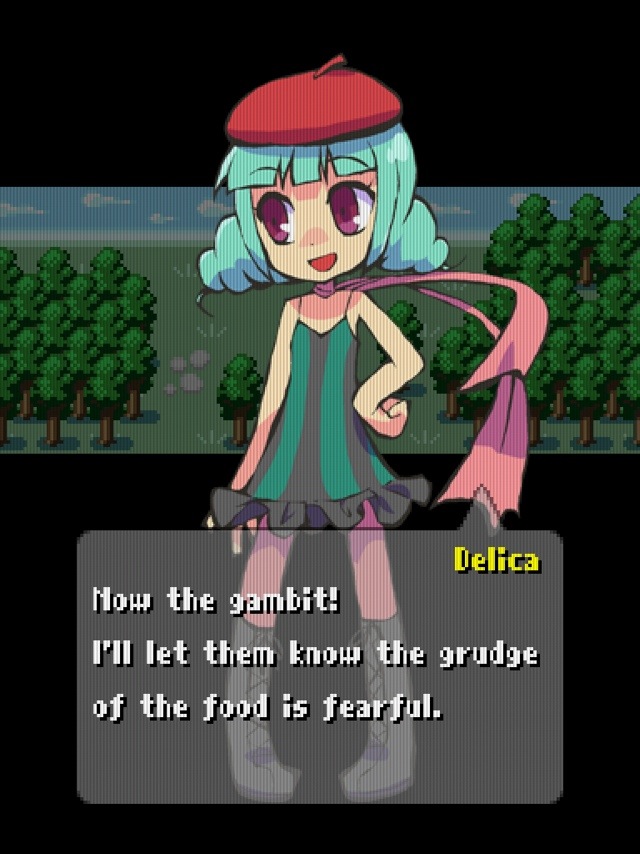
Oh boy do I have a treat for you iOS owners out there. A free game that is brilliant, doesn't try to con you out of any money and doesn't have a single ad in it anywhere. Not only that, but it also features the most spectacular Engrish you will ever see, as evidenced by the screenshot which accompanies this post.

The game in question is HungryMaster by xionchannel. I found it completely by chance while browsing titles related to Square Enix's catalogue on iPad, and downloaded it out of sheer curiosity. I was expecting it to be a five minute novelty, to be deleted immediately afterward.

What I instead found was a wonderfully silly, addictive little game whose use of touch controls puts big-name developers to shame.

The premise is simple and insane. Delica is hungry and walking in the woods one day when she comes across a talking white cat called Saten [sic]. Saten offers to give Delica magical powers for some reason I feel is somewhat lost in translation. Said magical powers allow Delica to defeat monsters by turning them into food, which kills two birds with one stone.

In gameplay terms, the player controls Delica by touching on the screen anywhere, and she follows. In order to use her new-found magical girl powers, the player must draw a line starting from her and running through enemies. The player can lock on to as many enemies as they can draw a line through while a brief timer is running, then they explode and turn into food when the player releases their finger. Delica can then collect the food by running over it. Collecting more food in rapid succession gives a combo bonus, and the main objective of most levels is to collect enough food to deliver to houses scattered around the map. There are occasional boss fights, too, where twenty pieces of food can inexplicably be used to set off a bomb.

It's as gloriously ridiculous as it sounds, but the gameplay is very solid thanks to the excellent touch controls. The whole thing is presented on the iPad or iPhone screen in portraitwise orientation, features 80s-style pixel art and scanlines. It's like holding a forgotten 80s arcade machine in your hand — the sort you only ever found at that one arcade at that one seaside resort, but would always insist on going to whenever possible because that hidden gem of a game was just so good.

I'm very happy that I've found such a hidden gem on iOS. Check it out for yourself here.

#oneaday Day 694: BUNNNNNNDLE

There's been some discussion recently over whether or not superdeals like the Humble Indie Bundle and IndieRoyale are beneficial or detrimental to the industry at large — particularly the independent developers whose work is featured in the packages.

For consumers, it's pretty much an unquestionable win. To be able to pick up substantial packages of games for a fraction of their normal cost (the latest Humble Bundle offers 7 titles, a value of approximately $100) is brilliant, and in both cases, those who want to pay more can if they desire. Likewise, those on a budget can pay the minimum without guilt. The Humble Bundle also has the added karmic bonus of an optional charity donation, too, so you can justify filling your Steam library with stuff you might not get around to for a few months on the grounds of it being "for the children".

For developers, though, you can see how it might be something of a mixed blessing. On the one hand, these bundles often take on a higher public profile than the individual component games themselves. This exposes a variety of quality, unknown titles to the world, encouraging consumers to step out of the comfort zone of triple-A titles to explore the wider world of gaming. Sick of hearing about Call of Duty all the time? Don't play it — check out the rapidly-expanding indie market and you'll never need to even think about Activision ever again.

On the other hand, all the time these bundles are selling games for a fraction of their normal price, developers are losing out on those sweet, sweet monies. And unlike publishing behemoths like EA and Activision, these developers are often counting on the income from their creations to ensure their continued existence as studios. In the case of some developers, your buying their game might even be helping to put food on their table.

You might be feeling a bit guilty for putting in that bare minimum donation now. However, you probably shouldn't — many developers, including Robert Boyd of Cthulhu Saves the World developer Zeboyd Games, report that strong sales actually continue for some time after a Steam sale or bundle deal — and the cheapest sale isn't necessarily the one where a title will sell the most. It's all about visibility — during Steam's Halloween sale, during which Zeboyd's titles were 33% off, the developer sold more copies than during the larger Thanksgiving sale, where they were 66% off. The difference? The Halloween sale was small enough that customers could see all of the titles on offer, while the Thanksgiving offering was a traditionally huge Steam sale, with a huge variety of content on offer for a fraction of its usual price.

Valve have often reported that sales of titles like Team Fortress 2 (before it went free to play, obviously) and Left 4 Dead took an upward turn after a sale in which they had been reduced by a considerable margin. The most likely explanation for this is related to the "visibility" issue that Boyd mentioned — once a sale is over and done with, players are going to be trying out all these weird and wonderful games that they took a chance on, and Steam being an inherently social platform, their friends are going to see what they're up to. Cue a number of conversations about "what on earth is that you're playing?" coupled with enthusiastic gibbering about how awesome Recettear: An Item Shop's Tale is and you can see how this "word of mouth" effect could have a powerful impact on sales, even after special offers are long gone.

So in summary, no, I don't think these indie bundles are bad for the industry. I'm happy they exist because they've certainly introduced me to a variety of wonderful games over the years — and proven that even if you find the way the triple-A sector does business to be somewhat distasteful, there's always something to play.

So if you haven't already, go pick up a copy of the latest Humble and IndieRoyale bundles now — links at the top of this post.