1622: Another Turn in the Coil

The Binding Coil of Bahamut is — or at least was — the most daunting challenge in Final Fantasy XIV. Originally designed as an 8-player multi-part raid to challenge the very best of the best players, Coil, as it tends to be known by the denizens of Eorzea, is now something of a shadow of its former self, with the toughest challenge now being posed by the imaginatively named The Second Coil of Bahamut.

The reason why it's a shadow of its former self is twofold: firstly, the average equipment level of most endgame players in Final Fantasy XIV is now considerably higher than it was when it first launched and Coil was the hardest thing in the game; secondly, you're now provided with a buff called "The Echo" upon entering, which boosts your HP, damage, healing and a few other bits and pieces by 15%. Second Coil has no such buff, but it will have one in the future, when Third Coil, or whatever comes next, is released — and so on as the game gradually ups the stakes time and time again.

This is a clever and sensible move on the part of producer Naoki Yoshida and his team. The Binding Coil of Bahamut, despite still being a very challenging set of mini-dungeons and boss fights even with the Echo buff, is part of Final Fantasy XIV's overarching story. Working your way through it provides you with information about the ancient Allagan civilisation, whom you keep discovering artifacts of throughout your travels, and also what the main recurring villains of the piece — the Ascians — are up to. It also provides a tantalising glimpse at what really happened to the dragon-like god Bahamut as part of the Calamity — the in-game, in-lore justification for the shutdown of Final Fantasy XIV's version 1.0 incarnation in 2012 — and what the artificial moon Dalamud was actually hiding inside itself besides Bahamut.

All interesting stuff, I'm sure you'll agree — well, you might not, but humour me. To put it another way, it's all stuff that people who are interested in the detailed lore and worldbuilding of Final Fantasy XIV will probably want to experience. And through the gradual "nerfing" of it as new content arrives, eventually everyone will be able to make it through Coil and see what's what — just some people will do it sooner than others.

Anyway, the reason I bring this up tonight is that I've been doing a bit of Coil myself this evening. This is something of a big step for me, as I've previously only ever set foot inside that place in the company of my comrades from my Free Company. With a lot of high-level content in any MMO — not just Final Fantasy XIV — it's assumed that you know what you're doing when you step inside, and that you won't mess things up, because in many cases one mistake can bring an entire eight-person team crashing to its knees.

This is, I'm sure you'll appreciate, an enormously daunting prospect, particularly for someone like me, who sometimes lacks confidence in himself. But tonight I not only voluntarily went into Coil "solo" (to be automatically matched up with seven other random players), I also did so on White Mage, a healer class, rather than my "comfort zone" (and main) class Black Mage. And while there were a couple of aborted attempts — largely due to poor party makeup rather than anyone making any horrendous mistakes — there was none of the rage, none of the aggression, none of the elitism that can make playing through difficult content even more daunting than it already is. On the whole, it was actually quite a pleasant experience, despite being challenging — and I was rewarded for my efforts, too, with a new ring for my Paladin and some new boots for my White Mage. Score!

I'm always secretly pleased with myself when I overcome a fear like that. Because although Final Fantasy XIV is just a game, and I understand that, the anxiety and fear I feel from social situations is as real online as it is when I'm getting tongue-tied trying to make small talk with someone I don't really know. My ticking that box in Duty Finder, queueing up and then repeatedly going back into Coil this evening might not sound like much, but believe me when I say it was actually quite a big step for me in terms of self-confidence.

And who says games can't do any good?
1621: Requiem for a Dead Game

Pour one out, if you will, for Blur.

Longtime readers may recall that I was rather enthusiastic about Blur when it first came out — largely for what I thought at the time was a good example of how to use "social features" effectively. Of course now, in 2014, "social features" are everywhere in games and have a habit of getting in the way more often than not, so I'm not entirely sure I still feel the same way, but Blur certainly had a lot going for it.

Looking back on my past entries, I realise that I never really waxed lyrical about what a remarkable game Blur truly was, though. I talked a bit about its developer Bizarre Creations — Blur was to be one of its last games — but not about what made Blur special.

For the unfamiliar, Blur was a racing game. Nothing unusual for Bizarre Creations, who had previously given us the wonderful Metropolis Street Racer on Dreamcast, which was succeeded by the Project Gotham Racing series on Xbox platforms. Both Metropolis Street Racer and Project Gotham Racing struck a good balance between the realism of "driving simulator" games such as Gran Turismo and Forza Motorsport, and the more arcadey thrills of titles like Ridge Racer and its ilk. Stuffed full of real-world cars screeching around beautifully depicted real-world locations mapped in what was considered for the time to be almost "photo-realistic" detail, both Metropolis Street Racer and Project Gotham in its various incarnations places a strong focus on driving stylishly in order to gain "kudos". Powersliding around corners, overtaking your rivals, getting air off the crest of hills — all of it would add to your kudos bank, and there was an extremely addictive high score-chasing thrill to it all.

Blur, meanwhile, took the Project Gotham formula and added a twist that took it further from sim territory and well into the realms of arcade silliness. Although still involving real-life cars screeching around real-world locations, Blur went that extra step and incorporated power-ups too. Powerups that let you shoot homing missiles at your opponents, or rapid-fire bullets, or send out devastating shockwaves, or simply boost past your rivals while flipping them off.

Sound familiar? Sound a bit like Mario Kart? That's because Blur pretty much was Mario Kart, albeit with much more realistic visuals and less fantastic tracks. It was genuinely something that hadn't really been done before — there had been automotive combat games, but they tended to focus on destruction derby-style gameplay rather than racing with powerups — and thus it was immediately memorable.

And the multiplayer! My goodness, what a fantastic experience that was. Shamelessly lifting Call of Duty's system of experience levels and unlocks, Blur's multiplayer rewarded repeat play by providing you with all manner of ways to customise the way you play, as well as a selection of new cars to enjoy. The game was well-balanced, though, in that having a high rank didn't necessarily confer you an advantage as such, just more options from which to choose. It was enormously addictive and, for someone like me who generally doesn't enjoy competitive multiplayer games all that much, enjoyable for a surprisingly long time.

I booted the PC version up today after having a bit of a hankering to play again, and out of curiosity I fired up the multiplayer mode. There were four people online. Not four hundred, not four thousand; four. These people appeared to be actively playing, mind you, but it was certainly a far cry from the hundreds of people who used to populate the game. I admire their dedication to the game, but I also feel a bit sad that here we have an unfortunate aspect of the fast-moving nature of the modern games biz: Blur is unlikely to ever see a great deal of action as a multiplayer game again, making one of its best features now almost worthless. It's a crying shame; Blur was sent out to die by Activision rather than being promoted properly — conspiracy theories have it that the company wanted an excuse to get rid of Bizarre Creations — and consequently never really had a chance to develop an active, long-life multiplayer community.

If I had a tad more influence, I'd do my best to try and gather people together for one last race around the game's courses. But given that the PC version no longer appears to be available anywhere and the Xbox version requires an Xbox Live Gold subscription — which I no longer have — that's something easier said than done.

I guess, then, that the good experiences of playing Blur multiplayer will have to live in my memory. The single-player is good — and still playable — but nothing quite compared to the thrill of taking on human opponents. It's a pity very few people will have the opportunity to enjoy that, and I'm glad I had the chance to do so when the game was most active.

1620: Community Matters

The Squadron of Shame, the "gaming book club" that was born on the 1up Radio message boards and has subsequently lived in several places across the Internet, has moved house again. We now have our own forum here — though if Squad co-founder "Beige" gets things sorted, we'll have either that forum or a variation thereof on our own domain before long, which will be nice.

Forums aren't all that fashionable these days, though they are still used somewhat, particularly for communities relating to specific software companies or even individual games. I can't say I've used one for a very long time indeed now, but having gotten back into the swing of posting on one thanks to the new Squadron of Shame boards, I can honestly say I've missed them.

The reason? They're completely different to the way modern social media works. While you may think that social media would be the ideal place to begin discussions and have in-depth conversations, in actuality modern social media is not at all well-suited for this task. Whereas many forums have long-life conversational threads that stick around for months or even years, the very nature of social media means that posts are transient — they're there one moment, gone the next, replaced by a cat picture, some vapid meme or One Of Those Clickbait Headlines That Makes Poor Use Of Headline Case And You Just Won't Believe. And while certain social media posts can attract a long string of comments and stick around for a while due to consistent interest — the reason why Facebook steadfastly refuses to organise posts in chronological order is because of this, if you were wondering — they'll still fall away far quicker than an equivalent topic on a forum.

This is fine for the sort of vapid nonsense that people post on Facebook and Twitter on a daily basis, but less ideal for more long-form discussion on more specific topics — such as the sort of thing we like to stroke our collective chins over at the Squadron of Shame. Now I know that many existing, well-established forums in 2014 — long-standing gaming forum NeoGAF is a good example — have proportions of the community that do not like seeing "walls of text" (even when they use paragraphs and punctuation and everything), but the fact is that forums are ideally suited to long-form discussion and thoughtful discourse. They're not instant messages, they're not time-sensitive, they're not places to post "fire and forget" comments that you never look at the responses to — they're places for asynchronous communication between people of similar interests, and an excellent means of having far more detailed discussions than is possible on social media in its current form.

Social media is crowded. Social media is noisy. Social media is like stumbling into the middle of a party, slightly drunk, and shouting whatever you feel like and hoping someone hears it. And, sometimes, that's fine, and can lead to beautiful interactions, friendships and even relationships. (I'm sitting in this house with the person I own it with because of Twitter.)

But a forum is like getting together a group of people with common interests — depending on the number of participants, it can be like a book club, a seminar or a large-scale gathering — and having a civilised, peaceful, thoughtful discussion on a particular topic. (Usually, anyway. This isn't to say forums are drama-free, but there's a lot less of the attention-seeking passive-aggression that's often seen on social media for the most part in my experience.)

As I said above, I'm not sure whether the Squadron of Shame will be staying on that free forum software for now or whether we'll be moving to our own site. But either way, the shift — or should I say shift back, since that's where the group was born — to a forum-based means of discussion has so far proven popular, and I think it will be good for the group in the long term.

If you're interested in joining us to talk about underappreciated and overlooked games, both new and old, drop by our new home and say hello.

1618: The End of a World

I've never been present at the end of a massively multiplayer online RPG. I've never even been present at the end of a beta testing period, which is usually marked by some sort of special event that, thematically, wipes the world "clean" and ensures that everyone starts on a level playing field when active service starts.

So, given Final Fantasy XIV's curious development history — for those who don't know, it originally launched in 2010, was heavily criticised for its numerous flaws, then closed in 2012, only to reopen as its current, completely revamped and considerably better-received form A Realm Reborn last August — I was curious to see exactly what the shutdown of the original version looked like. The shutdown of version 1.0 is crafted into the narrative of A Realm Reborn as an event in the game world known as The Calamity. During the events of The Calamity, there was a large-scale battle between the Eorzean Alliance (the three nations that player characters represent) and the Garlean Empire (the villains of the piece, who reprise their role in the main scenario of A Realm Reborn) and the moon Dalamud — actually a weapon created by the ancient Allagan Empire — was pulled down from the sky by dark magic. Dalamud broke open and revealed Bahamut, the giant and extremely pissed-off dragon god. Bahamut's rage pretty much obliterated most of Eorzea, forever changing the landscape, but not before the heroes of Eorzea — the players of version 1.0 — were pulled into "The Rift" outside space and time, to be released only once peace had returned to the realm… or once A Realm Reborn had been released.

With that in mind, then, here's how it went down from the perspective of several friends who apparently decided to see the apocalypse through together.

Although a simple event — it's just players standing around with some haunting music playing in the background for much of the video above — it genuinely feels like something momentous is coming to an end; like the world is really ending. The players know there's nothing they can do about it; they know that their (virtual) lives are shortly coming to an end, so all there is to do is to spend their final moments in the company of people that are important to them.

Watching the video made me want to shed a few tears, even though I didn't know the people involved. The quiet melancholy of the scene was surprisingly touching; as the time until the end of the world ticked down, the gathered friends started using their emotes and aesthetic items — fireworks and the like — to mark the end of their time together as a celebration, not a tragedy. Strange server messages started punctuating the chat log, and someone in the area was counting down the minutes until the switch was flipped and Eorzea would cease to be — at least temporarily.

Then, eventually, it happened; the world ended. It was marked not with a huge cataclysm in the game world, but with a simple change to a tiny element of the on-screen interface: the data transfer meter in the top-right corner of the screen changed from green to red, and the "R" number, indicating the rate at which data was being received by the player's client software from the game servers, dropped to zero. There was a moment of quiet as nothing happened — nothing could happen, as client and server were no longer communicating with one another — and then a black screen and a loading break, followed by the spectacular cutscene that closed Final Fantasy XIV's initial incarnation once and for all — and which also opened A Realm Reborn.

Prior to last August, I couldn't even begin to imagine what sitting through an event like this must be like for people who have been actively playing the game which it concluded — flawed or otherwise. Now, I can't help but think the whole thing would be an absolutely heartbreaking experience; although true friendships will persist outside of the game in which they were, in many cases, forged, the next time you see those people — whether it's in reality or in a new game altogether — they'll likely be very different. And those elusive moments you had together in your previous forms will be forever be trapped in the past — but they'll live on in your memories, as trite as that might sound.

I hope A Realm Reborn stays healthy and lively for many years to come yet — at its current rate, things are going to be fine for quite some time, I'd say, thankfully — but when it eventually does come to an end, I hope I have the opportunity to see its final moments through with those whom I've come to know through playing. We'll laugh, we'll cry, we'll perform the Manderville, we'll set off fireworks — whatever we do, I can see it being a special but sad moment that will live with each of us in a way that very few other video games will be able to replicate. (Unless they're another long-running MMO, of course.)

Still, let's not be melancholy; patch 2.3 of A Realm Reborn is coming early next month, and it's bringing with it a continuation to the game's excellent and enjoyable story plus a whole host of other content. I and my Free Company are really looking forward to it — and if you're interested in joining, may I point out that it's currently available at a discount on PC as part of the Steam Sale?

I'll see you on the Ultros server, non?

1617: Uninformed Hate

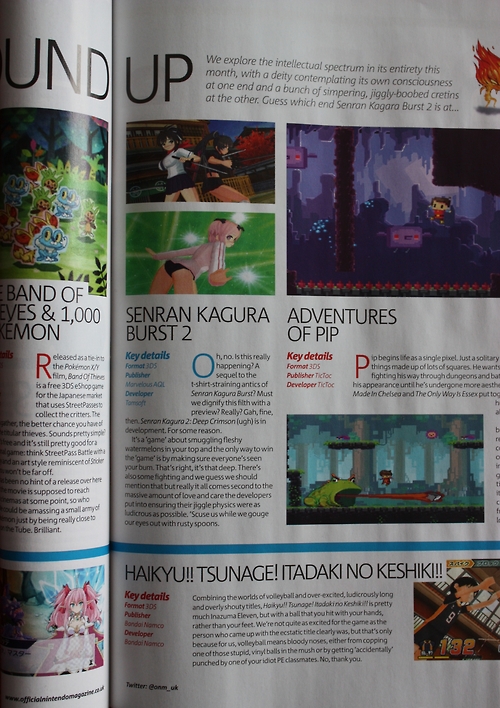
This photo of a copy of the UK's Official Nintendo Magazine did the rounds earlier.

tumblr_n7li4auQH41smnt4ao1_500

Take a look at the small preview for Senran Kagura 2 in the middle. Now imagine that you work for Xseed Games, the company that did an excellent job on the localisation of Senran Kagura Burst for 3DS a while back, and that looks likely to bring Senran Kagura 2 to Western audiences in the near future.

Well, you don't have to imagine; Xseed's outspoken Production Coordinator Brittany "Hatsuu" Avery had a few choice words to say on the subject:

https://twitter.com/Hatsuu/statuses/480921145445609472

https://twitter.com/Hatsuu/status/480921515215437824

https://twitter.com/Hatsuu/status/480922219652972544

(Yes, it was; here's the piece in question, itself a needlessly inflammatory and ill-informed rant.)

https://twitter.com/Hatsuu/status/480923786846289920

https://twitter.com/Hatsuu/status/480923975682252802

https://twitter.com/Hatsuu/status/481109395963936768

https://twitter.com/Hatsuu/status/481110060555575296

Senran Kagura, lest you're unfamiliar, is a series of games that centre around the exploits of some rival schools that train ninjas. In the first game, released as Senran Kagura Burst in the West, the story followed both the "good" ninjas and their rivals at the "evil" ninja academy, in the process delving into the personalities and histories of characters in a far deeper manner than many other games. The all-female cast is made up of distinct characters, none of whom are downtrodden or defined by the way men have treated them in the past, as some Western critics have complained of games as a whole recently. The story itself sees these characters grow, develop and change, and by the end you have a very good idea of who these girls are, how they relate to one another and their place in the world.

Senran Kagura is also somewhat notorious for its costume damage system, that can leave player characters and bosses alike battling in increasingly tattered (and revealing) clothing as their fights progress. There's also a magical girl-esque "transformation" system whereby the girls can unleash their full hidden ninja skills by stripping down to their swimsuits, then magically re-robing themselves in a new costume. The transformation sequences are cheeky and sexy — unashamedly so — but the girls are, throughout the whole game, depicted as individuals who are firmly in control of the way they choose to present themselves  to the world. As anyone who has played and enjoyed Senran Kagura will tell you, there isn't a single piece of maliciousness in the game towards the characters; it simply revels in its sexy elements, and is rather refreshing as a result.

Now, as Avery says in her tweets above, people are free to dislike Senran Kagura for whatever reasons they like. But the Official Nintendo Magazine preview — and the editorial linked above — come across as not only needlessly spiteful, but also completely ill-informed. It focuses entirely on the fanservice element of the game — one of the most visible aspects, sure, and one deliberately played up in some of the game's marketing — and completely ignores the rest, writing off the enormously fun Streets of Rage-style brawling as "there's also some fighting and we guess we should mention that."

This is a problem — regardless of the intention with which the piece was written, whether it was intended to be "satirical", as some people have argued, or not — and not just for fans of Senran Kagura and its ilk. Writers for publications are tastemakers, and are in positions of power to dictate what their audience's opinions might veer towards. This is a simplification of how things actually work, of course — there are usually a lot more steps in the flow rather than a straightforward "hypodermic" model — but the fact remains that people who write things for high-profile publications have a lot of influence on how certain things are perceived. And when pieces like this get published, they cement popular perceptions — even if those perceptions are unfair or wrong.

Because ultimately Senran Kagura is pretty tame, when it comes down to it. As Avery writes on her personal blog in response to a fan question, Senran Kagura Burst was only rated "T for Teen" by the ESRB in America because there's really nothing in there that warrants a Mature 17+ rating. To suggest that having pretty girls with large breasts in a game makes it somehow unsuitable for younger players is to be exceedingly prudish — not to mention the fact that the game takes considerable care to depict all these characters as far more than simply large-breasted women.

Why are these popular perceptions a problem? Because they stop people from discovering cool games. I've lost count of the number of times I've seen people dismiss colourful Japanese titles as being "creepy" or "for paedos" simply due to their aesthetic, when in many cases these games address many of the most common things that people complain about in the games industry today. Not enough female protagonists in games? May I point you to Hyperdimension Neptunia, Atelier, Tales of Xillia and numerous other Japanese games with fantastically memorable female leads? Too much brown, grey and dark blue? May I point you to the vibrant, bright colours of most modern Japanese role-playing games? Juvenile attempts at being "mature" ultimately boiling down to people saying "fuck" a lot and being able to peep in on people having sex? May I point you to the Ar Tonelico series, which features some of the most in-depth explorations of characters' personalities — including respectful treatments of their dark sides and sexual fantasies — that I've ever seen? Or if that doesn't appeal, may I point you to the piece that prompted this post in the first place, Senran Kagura Burst?

Fun fact: I reviewed the wonderful Atelier Rorona Plus this week. I was the only one who volunteered to do so. In the email thread discussing who wanted to take it on, one reason for turning it down included the fact that one person had looked at Google Image Search and it "didn't take long to find the creepiness". Atelier Rorona, for those who don't know, is one of the most charming, sweet and overwhelmingly nice games you'll ever play — it's not a fanservicey game by any means, yet the perception from someone who doesn't know about it is that there's "creepiness" involved. That's what we're dealing with. That's where these ill-informed rants by people who don't know what they're talking about lead to. That's why the games press could really do with specialist writers… and that's why I'm pissed off that I, someone who could more than ably step into that specialist role — and indeed have been doing so up until now — am shortly to be out on my ear.

Thankfully for people like Avery and companies like Xseed doing their best to bring niche titles to the West, there are plenty of people out there — fans — who do treat these games with the respect they deserve. It's just a shame so few of them are part of the professional games press in 2014.

Humour or not, I'm extremely disappointed in the UK Official Nintendo Magazine for the pieces mentioned above, but at least ignorance like that won't stop me from enjoying the games I enjoy. The frustrating thing, however, is that pieces like those mentioned above make it considerably more difficult to attract new people to these games; stigma is a powerful thing, and it's tragic to see it applied unnecessarily.

1610: Titan Falls

Just wanted to share my enthusiasm for what I felt was a significant (gaming) achievement this evening: finally successfully toppling Titan's Hard Mode incarnation in Final Fantasy XIV without dying, without being blown up by bombs, without getting hit by Weight of the Land (too many times) and without doing anything stupid. The secret? Zoom out the camera.

For those unfamiliar with Final Fantasy XIV's endgame, Titan Hard Mode was formerly one of the hardest encounters in the game, taking the form of an 8-player variation on one of the main story's 4-player bosses. Mastering (or at least clearing) the fight is an important part of endgame play, since acquiring your class's "Relic" weapon requires you to beat him along with the other two Hard Mode primal fights and two original bosses Dhorme Chimera and Hydra.

The actual battle against Titan bears some resemblance to its story mode counterpart in that Titan makes use of many of the same abilities throughout. The main difference is that the fight is overall a lot longer and incorporates a few new mechanics — most notably the addition of "Bomb Boulders" that drop down from the sky in set patterns and then explode in sequence, requiring the party to quickly and carefully manoeuvre from position to position in order to avoid damage — and while avoiding Titan's other abilities such as Landslide, which can knock you off the arena and out of the fight completely if you're not sharp enough.

Like the other Hard and Extreme mode Primal fights in Final Fantasy XIV, Titan Hard is quite a "choreographed" fight that requires the party be in the right place at the right time, and respond quickly to prompts on the screen. Titan always uses the same abilities in the same order, so there's very much a sequence and timing you can learn, though there will be slight variations on exactly what you need to do each time you play owing to people standing in different places.

It may sound odd to say, but it's a strangely beautiful sight to see a party pulling off a fight like Titan Hard efficiently and effectively. The group moving as one from place to place in response to the incoming threats is a very satisfying thing to watch, particularly when you're part of it. It's a hard thing to convey to anyone who hasn't experienced it for themselves, but in many ways it's like pulling off an impressive "dance" as a group — eight people working as one (for the most part… there's usually at least one person who falls off remarkably quickly, and up until tonight it's usually been me) to achieve a common goal.

I must confess to feeling pumped up and happy about my victory this evening — and, now, much more willing to jump into the Trials Roulette mode of the Duty Finder, which I'd previously been extremely hesitant about making use of despite the helpful rewards on offer. The Extreme Mode primals may still be a while off before I can confidently tackle them — same for Twintania, the notorious boss that guards the end of the first super-tough endgame dungeon The Binding Coil of Bahamut — but for now, I feel I have conquered Titan Hard and can move on to stiffer challenges.

Oh, and I should give a shout-out to Andie, too, who has been playing Final Fantasy XIV and has just got her first character to level 50, putting my friend James — who has been playing a lot longer — to shame. Nice job, W'khebica (an authentic Miqo'te name, apparently) — I look forward to enduring the endless Myth grind with you at my side.

1609: In Custody

Finished Murdered: Soul Suspect this evening. It's not a long game, which may cause consternation among some people wondering whether to splash their hard-earned cash on it, but I found it didn't outstay its welcome, and it was an eminently satisfying experience. (I am also of the age when I remember paying £30-40 for titles like Resident Evil and Silent Hill, which are about 2-3 hours long apiece, so I don't mind too much when something clocks in at 10 hours or less. In fact, given the number of absolute behemoths I play on a regular basis, it can be quite refreshing to play something short.)

I won't spoil the story here, but I was pleased to see that it didn't end up being quite as predictable as I initially believed it would be. Those with a better mind for this sort of thing than I — I'm thinking mainly of my friend Lynette here, who can spot a plot twist coming a mile off, however well the author might have obfuscated it — may still find it to be predictable, but I found that there were a few interesting surprises along the way, and the conclusion was satisfying and, well, conclusive.

I stand very much by my feeling that it had the atmosphere of a 1990s PC game, and I've been trying to figure out quite what I mean by that. It's a combination of things, I think: the use of "real world" settings with various obstacles in the way so they don't end up having to render the entire interior of a building; the way that NPCs sort of mill around and occasionally have conversations with one another that occasionally give you little hints about the plot; collectible bits and pieces that help flesh out the world; and gameplay that is less concerned about being overly "cinematic" or based on spectacle than it is about using its mechanics to make the player feel involved in what is going on.

It is not a hard game, and since the protagonist is already dead at the outset, there are relatively few situations in which you find yourself in peril, making it a mostly fairly cerebral experience. Even the few instances in which you find yourself threatened by angry spirits (known in the game as demons) are more environmental puzzles than fast-action combat — you don't actually "fight" the demons as such; instead, the only way to defeat them is to sneak up behind them and "execute" them. Alternatively, in pretty much any situation where you're threatened by them, you can just sneak past, too, which is nice.

This latter aspect of the game called to mind a slightly more recent game: Silent Hill: Shatered Memories, a retelling of the first Silent Hill game that replaced the PS1-era "survival horror" gameplay with something a bit different, a bit more modern, and entirely combat-free. In Shattered Memories, the most you can do with the monsters that inhabit the dark world of Silent Hill is to block their path with something heavy — for the most part, you're simply fleeing from them, attempting to make your way back to the exit as quickly as possible. Murdered: Soul Suspect isn't quite that non-violent — you can defeat the demons through the aforementioned sneak attacks, after all — but playing a game that doesn't have a straight "attack" button that causes you to flail wildly at enemies is always a pleasant surprise.

It may sound contradictory to compare Murdered: Soul Suspect to late-'90s PC games and Shattered Memories, a title I described above as being "modern", but there are certainly elements of both in there — the atmosphere and structure of a '90s game; the unconventional approach to gameplay of Shattered Memories.

Ultimately, the whole thing ended up being a game that I'm very glad I played, and one which I have absolutely no hesitation recommending to anyone who enjoys a good ghost story, a good detective story or a bit of both. It's an enjoyable tale told well, and a worthwhile investment of 10 hours or so of your life.

1608: Soul Suspect

I've been playing a game called Murdered: Soul Suspect today. It's a game that immediately intrigued me back at the Eurogamer Expo last year when I attended a hands-off gameplay demo and developer talk about it.

For the uninitiated, the premise is this: You play the role of Detective Ronan O'Connor, a sharp-eyed investigator in the traditional sense, complete with perpetual smoking habit and the dress sense of someone from the 1940s. Ronan is investigating a murder. Nothing unusual for a detective, you might think, until you discover that the murder he's investigating is his own. He's dead, you see, and not altogether happy about the situation in which he finds himself. And, in traditional ghost story fashion, he can't fully shuffle off this mortal coil until he unravels the mystery keeping him chained to existence.

Murdered: Soul Suspect has received rather poor reviews to date, with its Metacritic rating varying anywhere between the low 60s and the 40s depending on which platform you look at. And yet, as I've found in so many cases recently, these numbers do not paint an at all accurate picture of what the experience of playing the game is like.

It's enormously enjoyable. It's engrossing, well-written, well-acted and intriguing. Its blend of noir-style detective fiction and ghost stories is excellently handled, and the main storyline is backed up by some truly excellent supporting material, ranging from an exploration of setting Salem's history to some entertaining, authentically "campfire-style" ghost stories that you can unlock by discovering collectibles around the various environments in which you find yourself.

Gameplay-wise, it's rather simplistic: you wander around, you uncover clues — occasionally using your ghostly abilities to do so — and every so often you're quizzed on what you've discovered in order to progress. These quizzes may involve putting a sequence of events in the right order, deciding on the right piece of information to use to get a witness to do something, or simply making deductions based on the evidence you've found. Some of the questions and answers throughout are a little obtuse — and some are deceptively obvious — but the game never feels like it's punishing you for picking the wrong choice. Story is king here, and in this sort of game that's exactly how it should be.

In many ways, the game feels like a late '90s PC game, with its open, non-linear environments, lack of minimap and objective markers and… I don't know, there's just something about the general atmosphere of the whole thing that calls to mind titles like the original Deus Ex, Kingpin, Thief and any number of other titles from that similar era. It feels like a game out of its own time — and I kind of like that. (Oh, the PC version is also a tad buggy, too; I had to tweak an .ini file to get it running above 30 frames per second, and it works better with keyboard and mouse than it does with gamepad, but neither of these issues are something that has particularly hampered my enjoyment.)

There's an interesting cast of characters to explore, and some enjoyable banter between Ronan and Joy, a young medium who becomes his "sidekick" and pair of physical hands as his investigation progresses. The story itself — which I'm yet to finish — is looking like it might end up being fairly predictable overall, but that's not necessarily a bad thing; plenty of hardboiled and noir fiction is, in itself, predictable and formulaic, but that doesn't make it any less enjoyable.

In fact, I'd go so far as to say that Murdered: Soul Suspect has been unjustly lambasted by much of the press. I'm not entirely sure what people were expecting from it going in to it; I'm really enjoying it so far, and its simplistic gameplay certainly doesn't detract from the fact that it tells an enjoyable, interesting and unusual story. And that's what I want; I don't need fast action sequences, sprawling open worlds or a story that drags itself out unnecessarily over the course of 40+ hours. With Murdered: Soul Suspect what I've got is a good, concise, enjoyable interactive story that doesn't overcomplicate itself with unnecessary mechanics and irrelevant content.

It's a game worth playing, in other words, and another nail in the coffin for the usefulness of most modern reviews, so far as I'm concerned.

1605: Let's Have Another Word About Vita

I got a bit annoyed earlier, prompted primarily by a tweet from Kotaku's Stephen Totilo depicting a "neglected" (his words) Vita stand in Sony's booth at E3. Indeed, in his photograph, no-one was playing the Vitas in the picture — one of which was proudly displaying the excellent upcoming rhythm game Hatsune Miku Project Diva f 2nd — but that's not really the point: the point is that his wasn't the only tweet I saw like this today, and all of them had something in common.

None of them appeared to be making any effort to rectify the situation.

Vita has been a self-fulfilling prophecy for some time now so far as the games press is concerned. It's an astonishingly good games system with backwards compatibility for PSP titles — enhanced backwards compatibility, more to the point, due to the fact you can map the right stick and touchscreen to PSP functions, allowing you more control flexibility than the original games offered — as well as a ton of its own interesting exclusives, ranging from the engaging and unusual 3D action-adventure Gravity Rush to the fantastic cartoonish golf game Everybody's Golf (aka Hot Shots Golf in the States) and a ton of Japanese role-playing games like Demon Gaze, Conception II, Persona 4 Golden and numerous others. On top of all that, it's rapidly becoming the de facto handheld for independent developers to deploy handheld versions of their games, so we're starting to see portable versions of indie classics previously confined to PC and TV-connected console: titles like Spelunky, Fez, Thomas Was Alone and, again, numerous others.

Still it goes without coverage. Still the narrative continues that Vita is "doomed" — or, in some cases, the system is ignored altogether. Is it any surprise that it's not selling particularly well if none of the tastemakers in the industry — and, like it or not, games journos, that's what you are — are celebrating the things it's doing well, or even acknowledging its existence in some cases?

Sony could be doing a better job, of course. Vita didn't get a lot of stage time at the company's E3 press conference, Japan's Vita TV has been rebranded PlayStation TV for the West and it's rare to see the Vita in promotional artwork by itself — it's more commonly depicted as a GamePad-like accessory for the PlayStation 4 — but at least they're trying, and representatives such as Shahid Ahmad are doing their best to keep the profile of the system high and solicit regular feedback from the people who do own it.

But I place the blame squarely on the shoulders of the press here, who initially set unrealistic expectations for the platform — do you really want to play a triple-A experience on a small, handheld device? I certainly don't — and then followed this up with the aforementioned dismissal or lack of acknowledgement mentioned above. It's a sorry state of affairs, to be sure, made all the more tragic by the fact that Vita has a genuinely great library of games.

The situation mirrors Nintendo's struggles with Wii U somewhat, where the narrative has again been that the system is "dying" which has, in turn, made people more hesitant to pick it up. There's a slight difference with Wii U this time around, however, because Nintendo wisely chose to focus on Wii U with its E3 presentation. This year, 3DS — a system which is doing just fine — was hardly touched on in Nintendo's main presentation, while the bulk of the company's livestream was focused on Wii U and its upcoming games. It was a successful decision; people came away from Nintendo's presentation excited about the future of Wii U, even though a significant number of the games shown wouldn't be with us until next year.

I don't know what the answer is for Vita, or even if there is one. But what I would like to see, as my days in the games press draw to a close, is journalists taking a stab at not following the herd, at not perpetuating the established narrative, and instead attempting to explore what makes this wonderful little machine tick — and why it makes people like me so happy.

Will it happen? No idea. Regardless of whether people start giving Vita a fair chance, I'm extremely happy with it — and if you're at all interested in any of the types of games I mentioned above, I strongly recommend grabbing one as soon as you can.

1599: Through the Maelstrom Again

Final Fantasy XIV patch day! If you don't play an MMO, it's probably difficult for you to understand why people get excited about patches, but we really do.

The reason for this is that, more so than any other type of game out there, MMO patches can considerably improve the experience of the game for everyone playing as well as adding new content to enjoy. And Final Fantasy XIV has definitely been delivering on that front since it launched.

Since launch, the game has, so far, enjoyed two major content patches and a few smaller patches along the way. These smaller ones are arguably the most interesting ones in many ways, because they tend to be the ones that improve the players' "quality of life" in various ways — perhaps through interface refinements, perhaps through balancing tweaks, perhaps through adjustments to the way the game works based on the community's feedback.

So far, we've seen all of the above. We've seen the easy to miss red targeting markers for enemy attacks replaced with more brightly coloured, pulsing markers. We've seen the addition of the Challenge and Sightseeing logs to give people more things to do and ways to earn rewards. We've seen adjustments to the endgame currencies as the average "item level" of endgame players gradually increases. And we've seen much-appreciated little usability tweaks, like the fact you can now get off a chocobo you're riding by pressing the shoulder buttons on your controller rather than having to twat about with hotbars and icons.

The game is still recognisable as what it was when it launched — it was already a solid game then, after all — but the refinements it has enjoyed ever since mean that it has been consistently, constantly improving — and, more importantly, it's proof that the development team is both willing to listen to players and implement some of their best ideas.

The game is going from strength to strength, in other words. And they said subscription-based MMOs were dead.