2180: Action Unleashed

0180_001

I had a sudden and irrepressible urge for some Neptunia today, so I fired up the Neptunia game I was last working on: Hyperdimension Neptunia U: Action Unleashed. Having figured out that yes, it is indeed possible to stop the PlayStation TV from recognising accidental clicking of L3 or R3 as simulated touchscreen touches (which had previously made getting overexcited in this game somewhat hazardous, since I have a habit of clicking one or both of the sticks in when gripping the controller tightly) I decided to play it on the big screen. And I was reminded what an enjoyable game it is.

For those unfamiliar, Neptunia U, as I shall refer to it hereafter, is a collaborative, non-canonical entry in the Neptunia series (inasmuch as Neptunia even has a coherent canon, which is perhaps questionable) developed by both series creators Compile Heart and Senran Kagura developers Tamsoft. The latter's influence is very much evident in the game, since it plays rather like their other Vita game, Senran Kagura Estival Versus, right down to the characters' clothes getting ripped as they take damage.

Much like Senran Kagura, Neptunia U presents you with a series of missions to undertake, some of which are purely designed to challenge you and/or allow you to level up your characters, while others advance the plot. Neptunia U also throws a spanner in the works in its second chapter with "Irregular Quests", which generally have some sort of condition to you beating them rather than simply killing everything. The twist is that the game doesn't tell you what this objective is outright; you're expected to figure it out for yourself, though starting and quitting the mission does trigger a scene where the characters give you a few hints as to what you might want to do. Irregular objectives range from killing all of a specific type of enemy (while others respawn infinitely) to swapping characters in order to temporarily be able to deal damage to otherwise-invincible enemies.

Neptunia U's systems are fairly simple — like Senran Kagura, each character has both a fast, weak attack and a strong, slow attack as well as a couple of limited-use special moves. And, again, like its titty-ninja counterpart, the challenge is not necessarily in being able to perform these moves and combos — pretty much all of the combos in question run Square 4 or 5 times followed by Triangle — but in understanding the animations and movements involved in the abilities in order to deal damage most efficiently and clear levels quickly. Efficient performance results in bigger experience rewards at the conclusion of the level, as well as providing you with more Medals that drop from monsters. Collecting medals unlocks permanent stat boosts for the entire cast as well as new equippable items to boost (or, in some cases, deliberately penalise) their abilities.

Neptunia U is a game made for people who love the grind. It's not a particularly difficult game for the most part — at least its rather short, sub-6 hour story mode isn't; I'm yet to get into the substantial endgame involving the Neptral Tower dungeon — but in order to unlock everything and see everything, you'll need to grind a fair bit in various ways. You'll need to grind missions to gain enough experience to level up the characters. You'll need to grind specific missions in order to collect the enemy medals you need to unlock all the equipment. You'll need to grind specific partnerships of characters in order to raise everyone's Lily Rank to maximum — always the most time-consuming part of any Neptunia game, but pretty much everyone who calls themselves a fan somehow cannot resist this task every time it comes up — and you'll need to make sure said partnerships are levelled enough to clear the few character-specific missions throughout the game. In other words, if you're not up for a bit of grinding, this game will last you about 6 hours; if you are, however, it will push into substantial double-digit territory at the very least.

Mostly, I just like it because it's an enjoyable, simple brawler with quick, snappy levels and my favourite characters in the world smacking the shit out of all manner of different enemies. Of particular note is the game's implementation of the series' iconic "HDD" forms for the characters: in some of the mainline installments, these transformations didn't feel substantially more powerful than the characters' "human" counterparts, but here, their new movesets, animations and massively increased damage potential makes them feel as they should: earth-shatteringly powerful, cutting through enemies like butter. They are goddesses, after all.

I'm going to try and bash out the rest of the story mode in the next few days and then investigate the endgame. Whether it will crush my soul like the Lily Rank grind in Hyperdevotion Noire remains to be seen, but it's Nep-Nep, so of course I'm going to see it through to the bitter end; spending some time away from my favourite goddesses has only reminded me how much I love them. Absence makes the heart grow fonder and all that.

2179: Warhammer Quest: The Adventure Card Game Blind Tutorial Playthrough

0179_001

Longtime readers will know that I'm a fan of Games Workshop's wonderful but out-of-print dungeon crawler games, including Hero Quest, Advanced Heroquest and Warhammer Quest. Unfortunately, these don't hit the table nearly as often as I'd like, since they're quite time-consuming to play and fiddly to set up due to their sheer number of components and pen-and-paper RPG-style necessity to prepare adventures beforehand.

I was, as you might expect, quite excited to hear that Fantasy Flight Games, who have been leveraging a whole bunch of Games Workshop properties recently, had released an official card game adaptation of Warhammer Quest which promised to play in 30-60 minutes, and which many claimed offered a fun dungeon-crawling experience without the need for festooning your table in thousands of miniatures and cardboard tiles.

The game is extremely well-regarded on legendary boardgaming community site Boardgamegeek, so I was keen to give it a go. One of the most common complaints, however, was that neither the Learn to Play manual nor the Rules Reference guide were particularly well laid out, meaning it took a little while to get your head around how to actually play. This is nothing unusual for Fantasy Flight Games, however, who, although they produce absolutely beautiful components and cards, aren't particularly well-regarded when it comes to writing instruction manuals. (Hey. If anyone from FFG is reading, I am very much available for freelance manual and tutorial writing. Please get in touch.)

With that in mind, I decided to try the game's tutorial scenario and record my experiences for the benefit of anyone else considering this game. So let's jump right in.

image

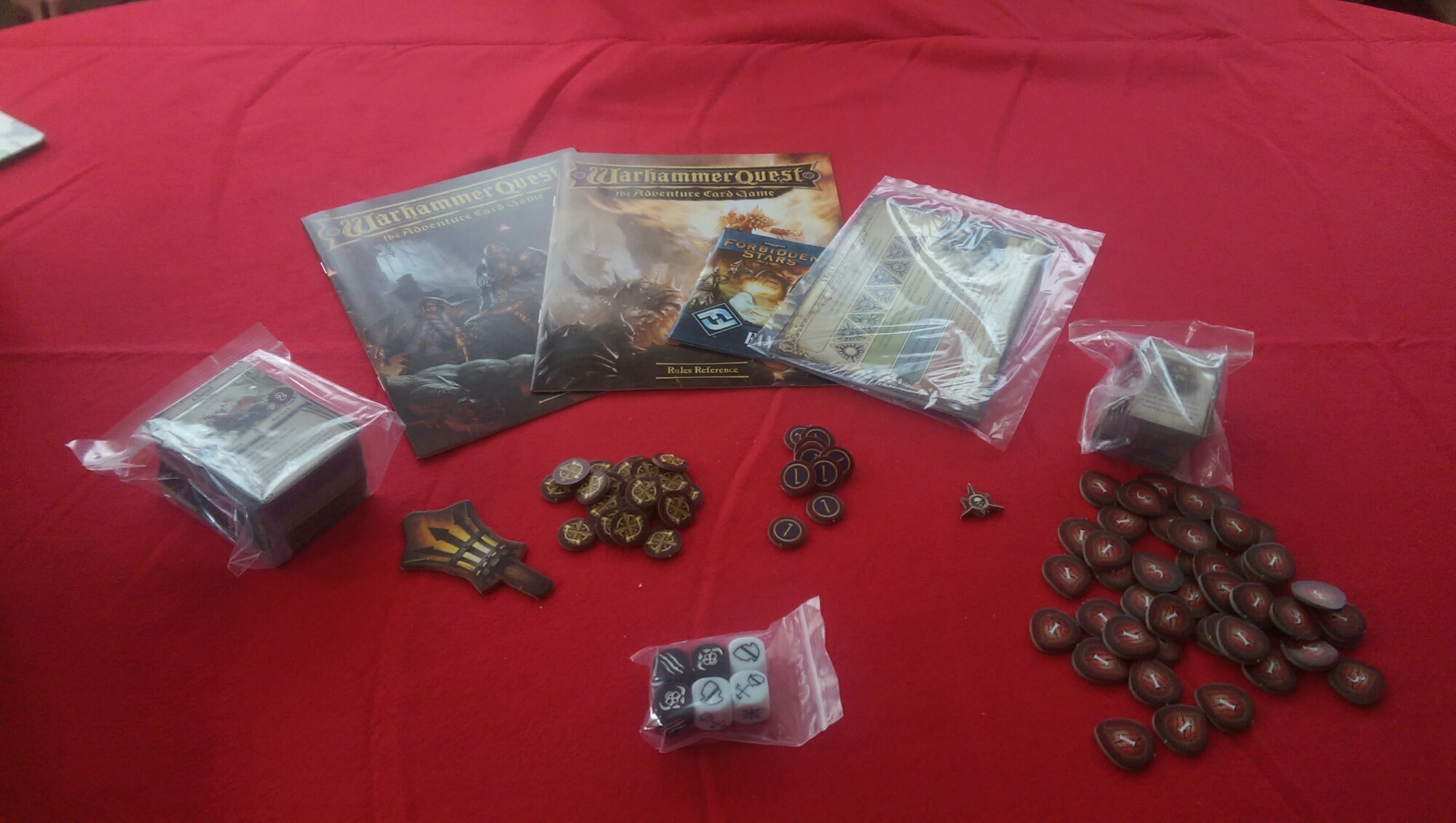
This is all the stuff you get in the box. Two rulebooks — a "learn to play" guide and a reference manual — plus a selection of quest sheets, a deck of large cards, a deck of small cards, six dice and a selection of tokens. Numbered tokens are double-sided so can be used to denote a value of either 1 or 3.

Let's get set up! I'll be trying out the Tutorial solo. The Tutorial isn't a full quest, rather just an opportunity to try out all the main mechanics before jumping in to a full session. I'm going into this pretty much blind, so I may get things wrong along the way. As such, do not take this post as a definitive How to Play guide for now!

image

First thing to do is pick two heroes to play. There must be at least two heroes in the party, even if you're playing solo. There are variations on each hero card according to how many party members you have. Generally speaking, the fewer party members you have, the more life each individual character has. If playing with two heroes, each hero gets two turns. If playing with three heroes, one hero per round gets an extra turn.

I'm going to go with the Ironbreaker dwarf and the Bright Wizard for this playthrough, because a tank/wizard combo sounds sensible, and also they're the two characters I've played most in Warhammer End Times: Vermintide on PC.

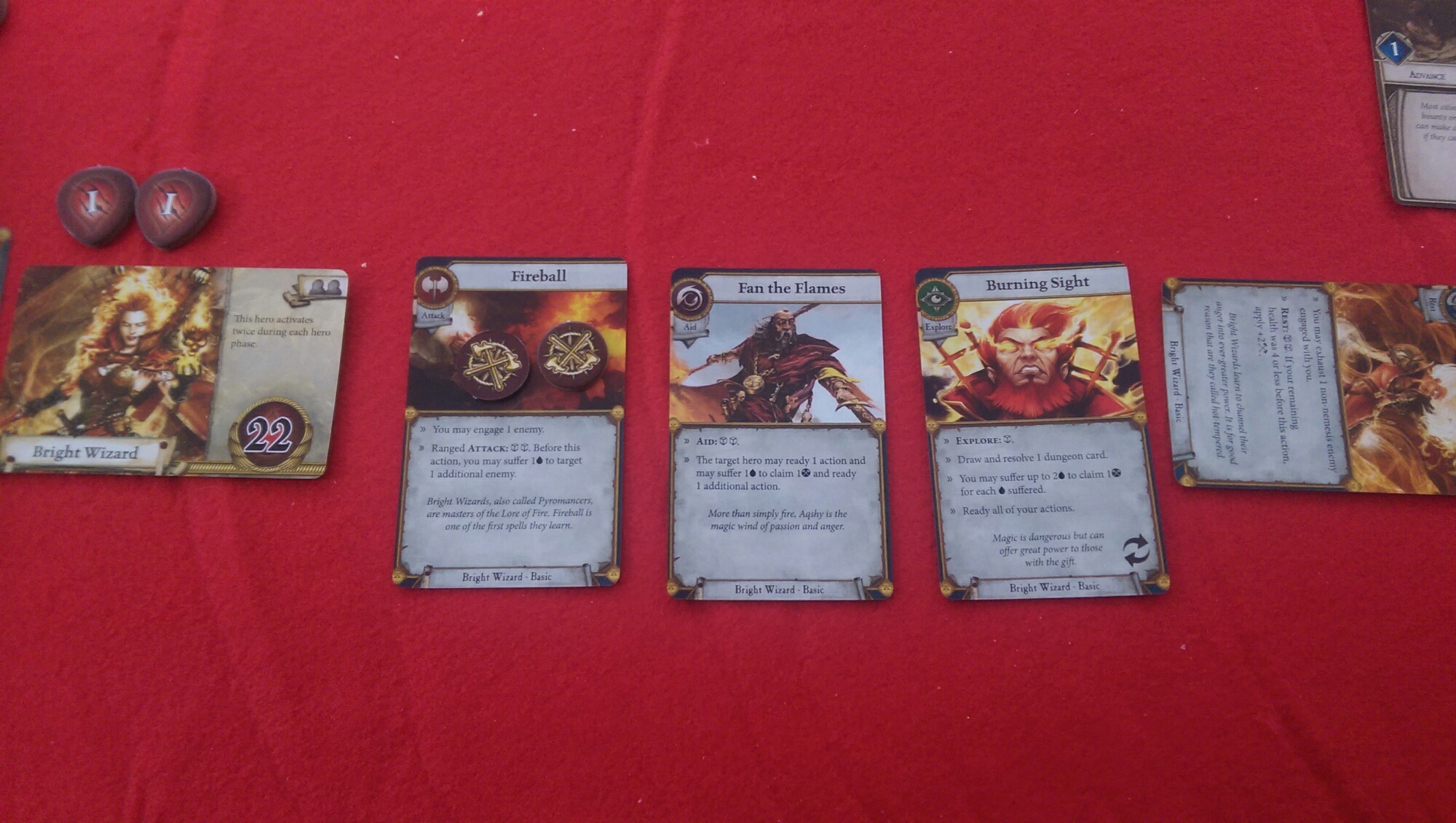
Each hero starts with four basic action cards that allow them to Attack, Aid, Explore or Rest. During a Campaign or Delve quest, these can be upgraded to Advanced versions later. Here are the Bright Wizard's basic actions:
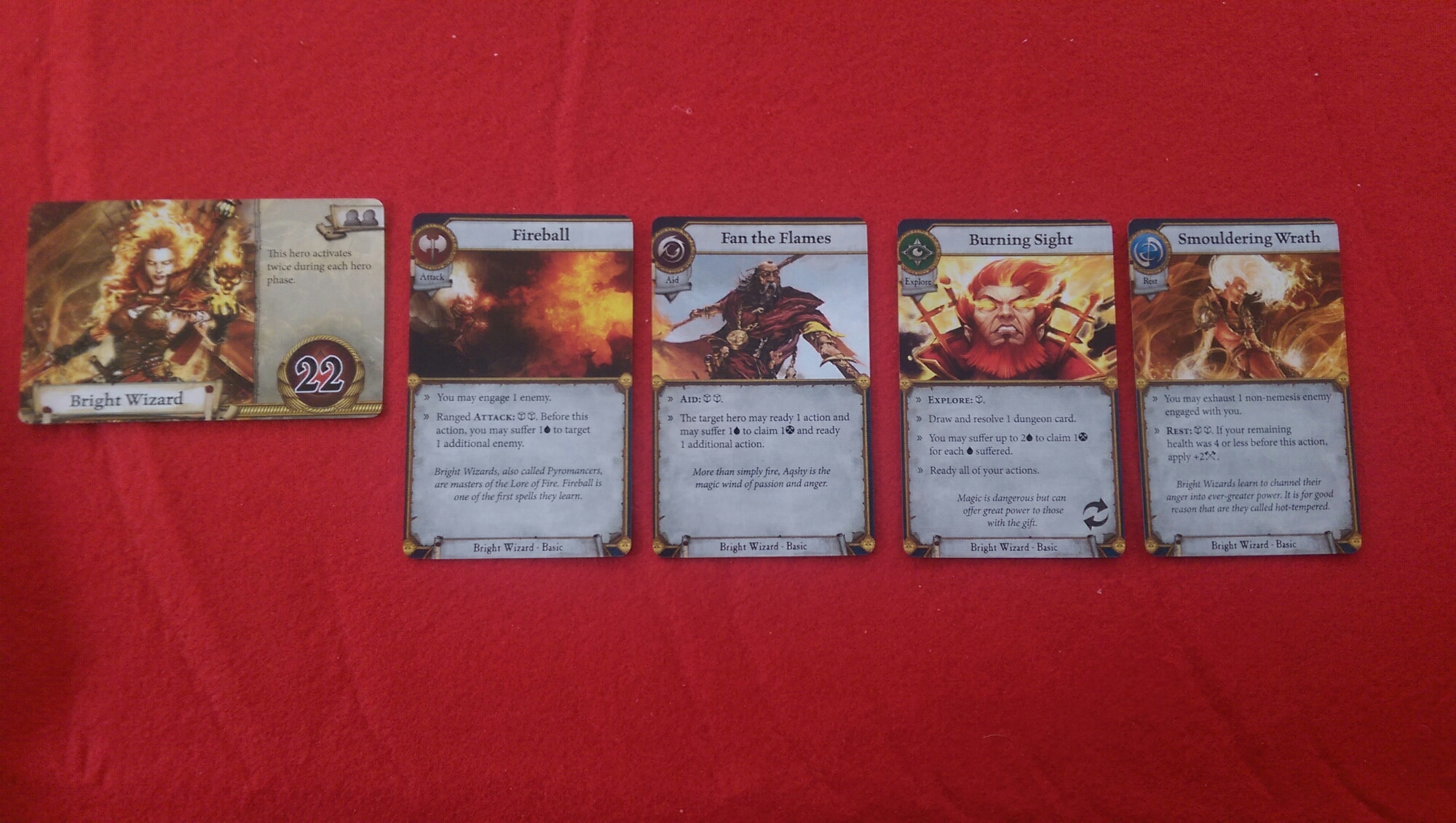
image

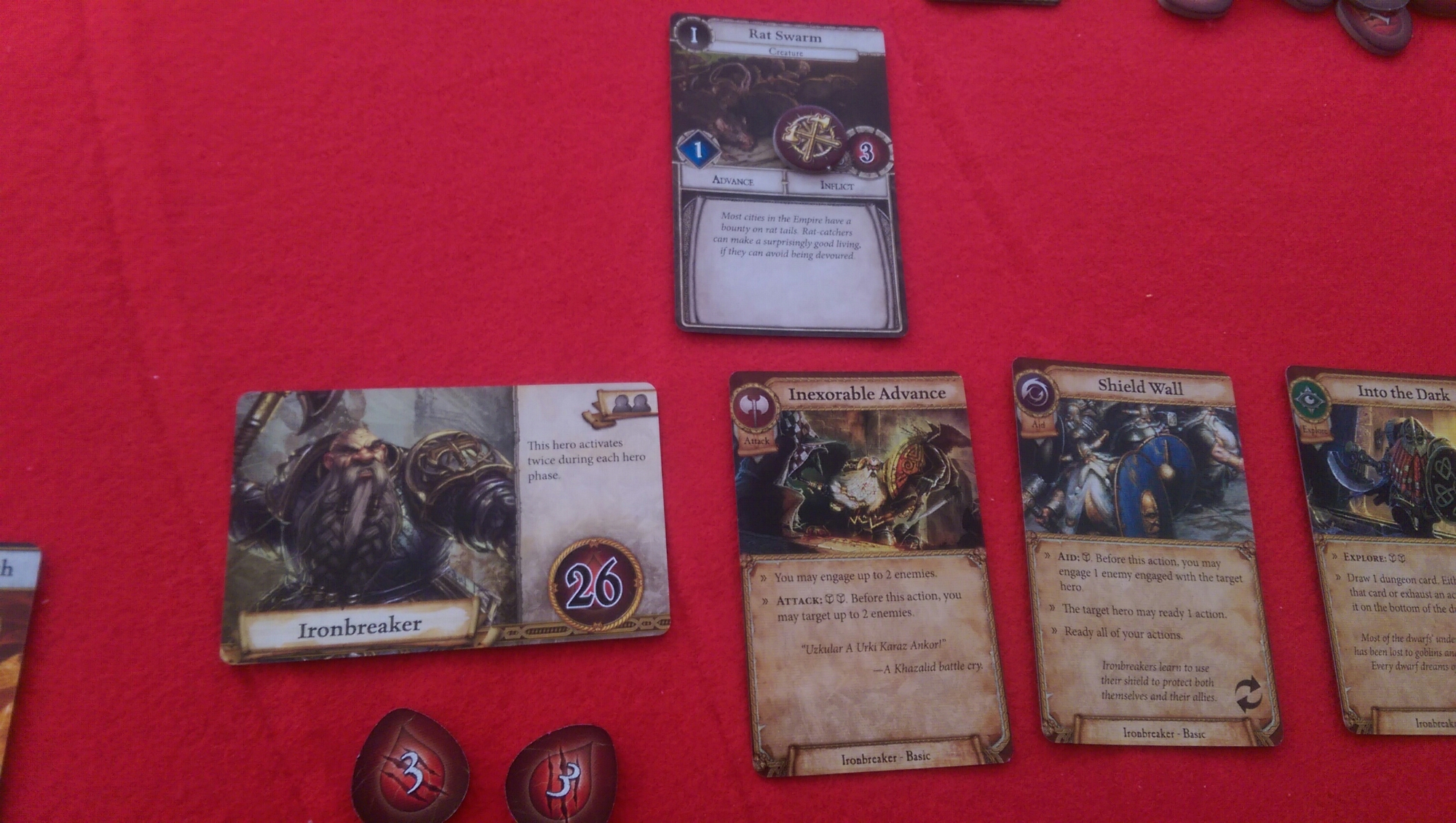
And here are the Ironbreaker's:

image

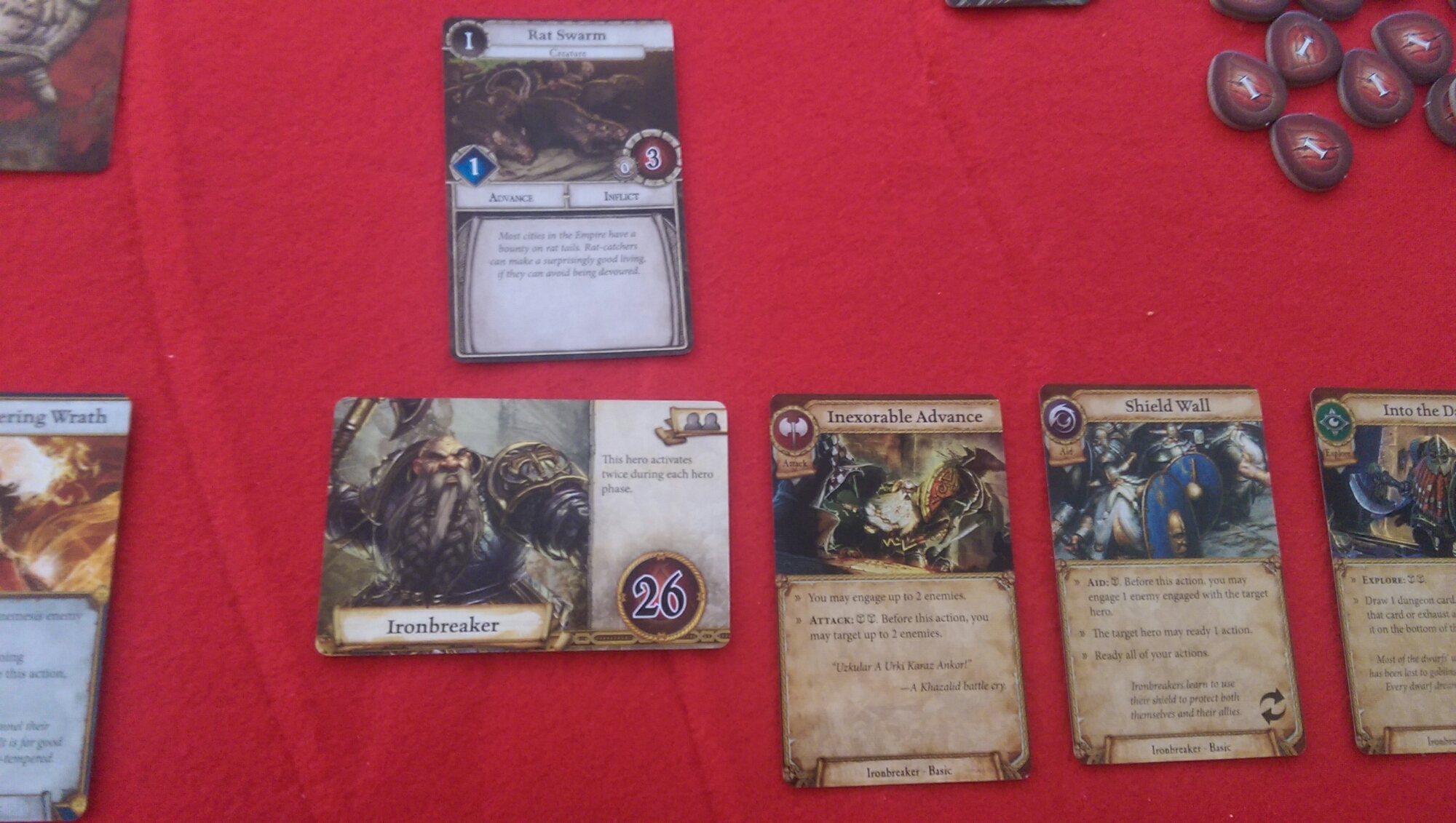
The Bright Wizard begins the Tutorial engaged in combat with a Night Goblin Archer, while the Ironbreaker has been set upon by a Rat Swarm. There are also two face-down enemies in the middle of the table, considered to be "in the shadows" for now.

image

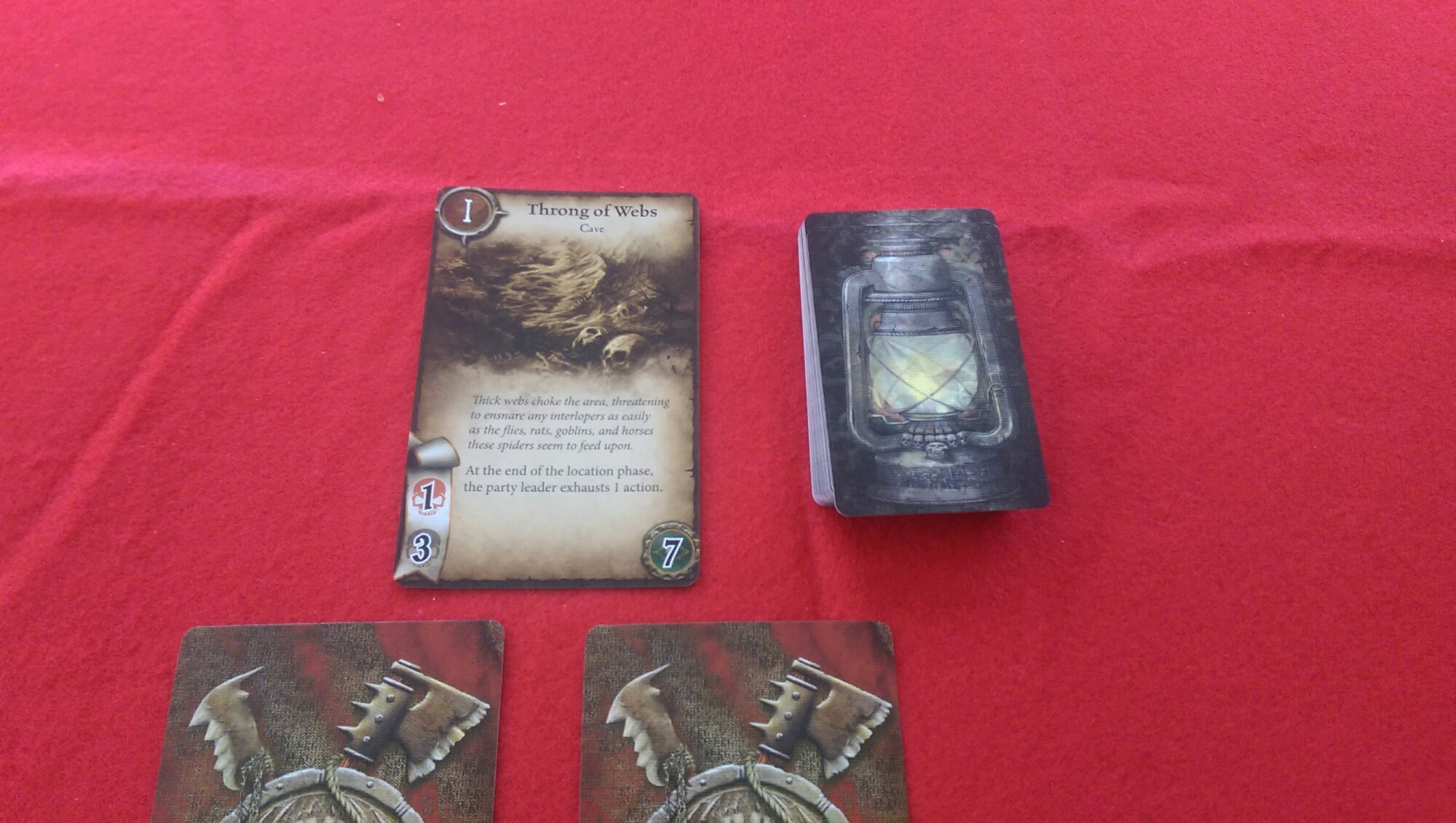
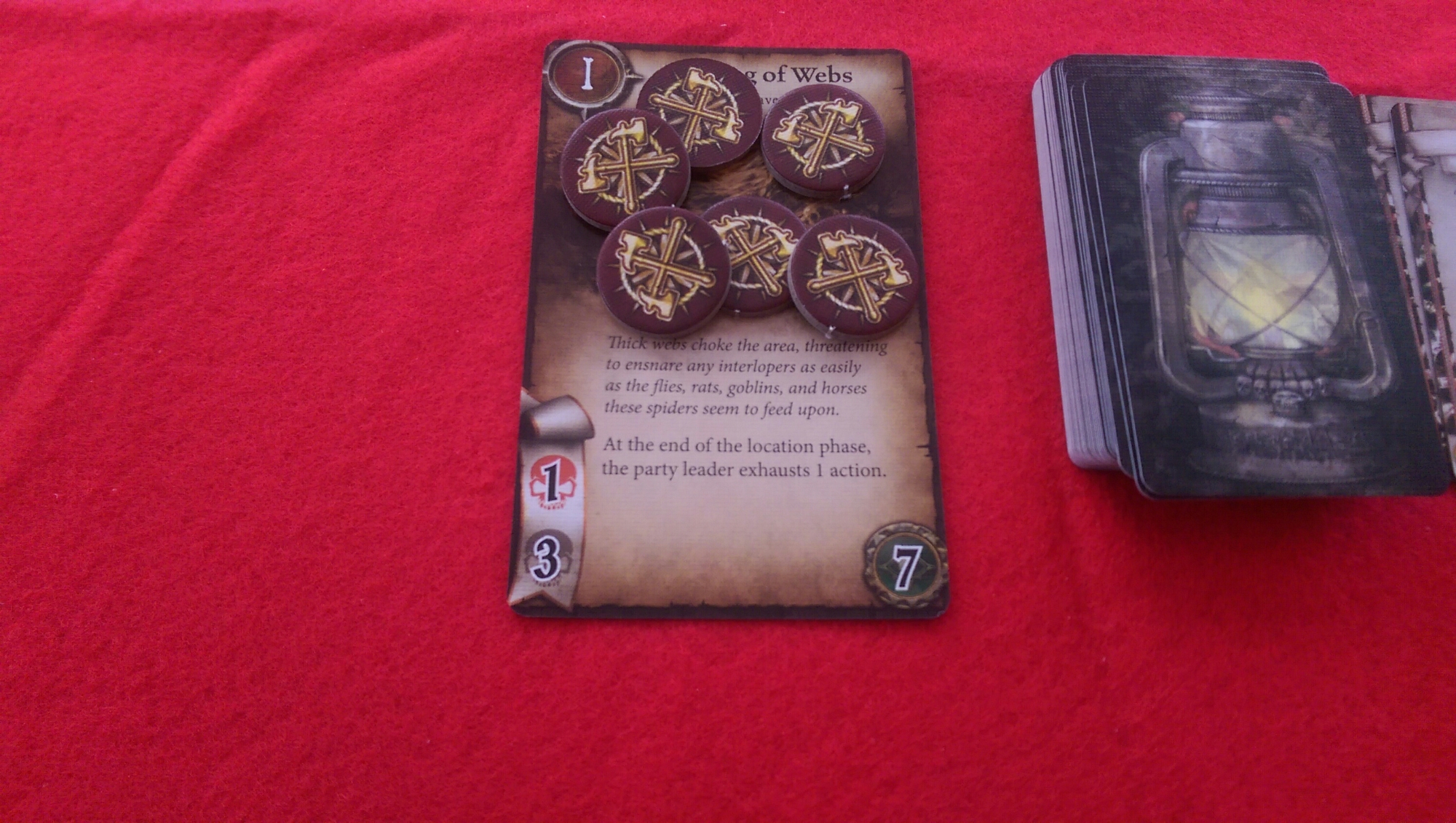
The Tutorial also specifies that we'll be exploring the Throng of Webs location for now, so this card goes in the middle of the table along with the shuffled Dungeon deck.

image

We're now ready to start. We begin with the Hero Activation phase, during which each hero activates in turn, beginning with the current Party Leader, and performs an action. The relevant card is exhausted once it is used, unless it has a Prepare symbol in the corner, in which case all action cards can be readied for the next round.

image

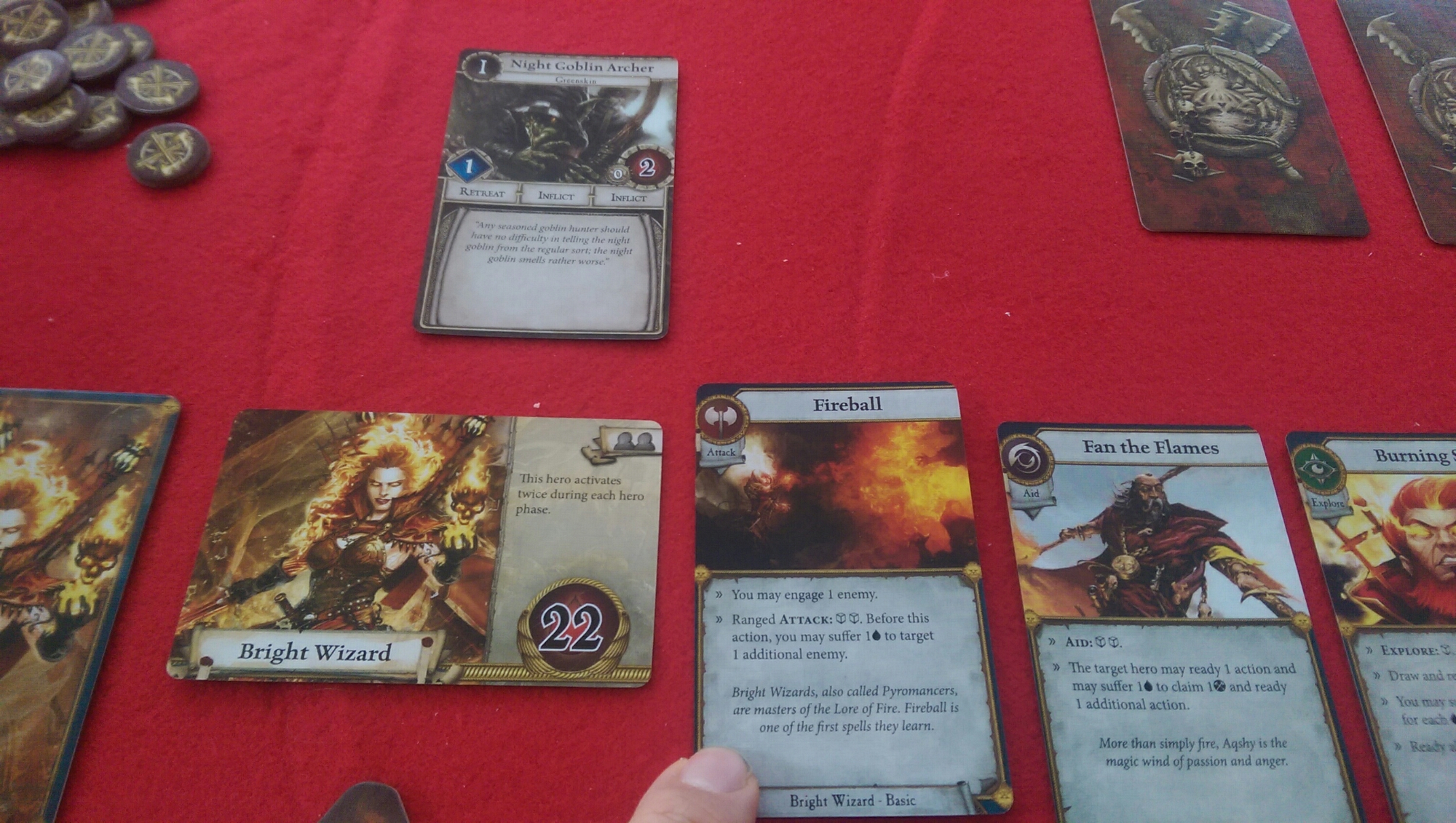
The Bright Wizard is first to play. Let's play her in an appropriately hot-tempered manner by immediately flinging a fireball at that pesky Night Goblin Archer in front of her.
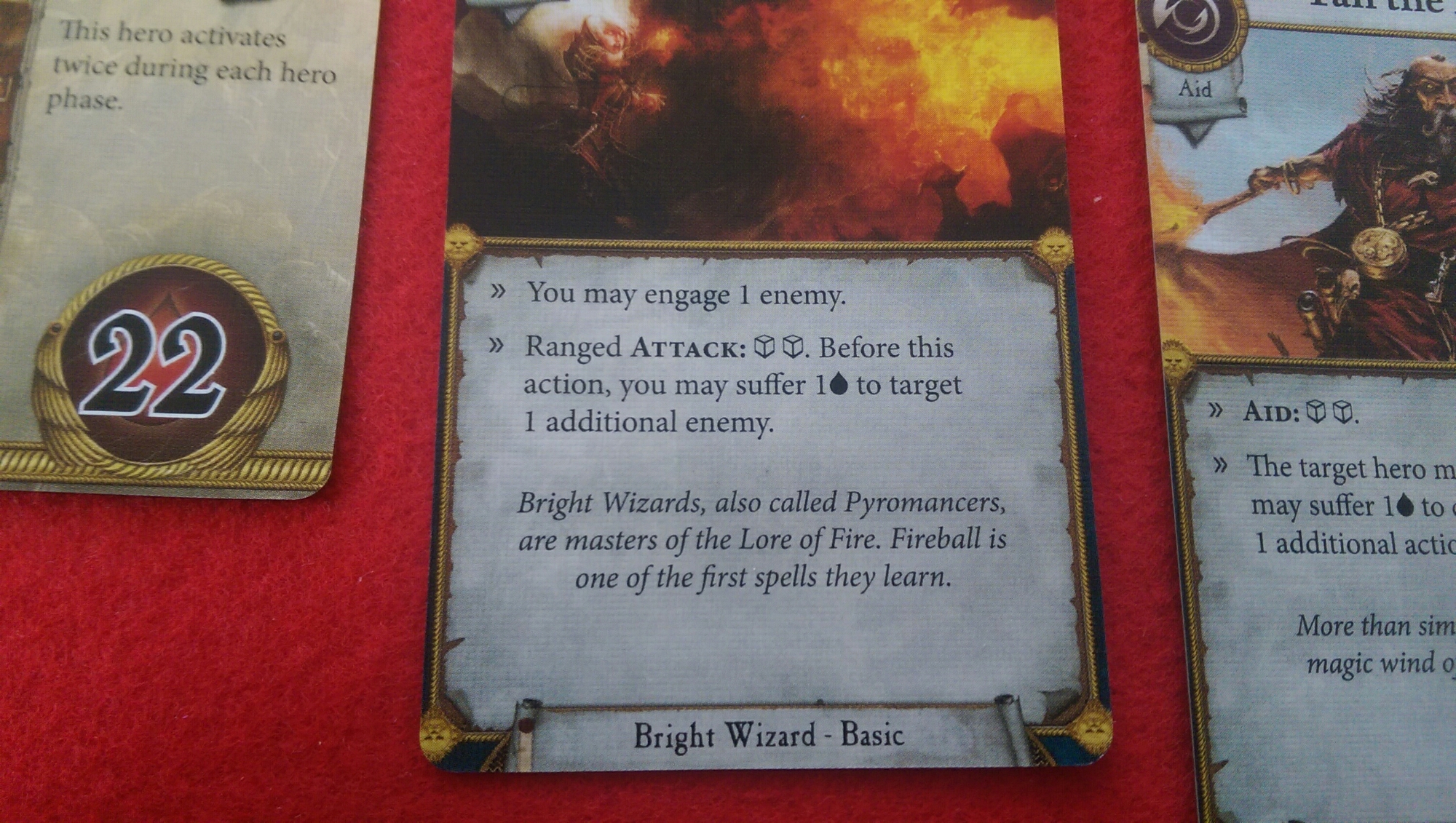
image

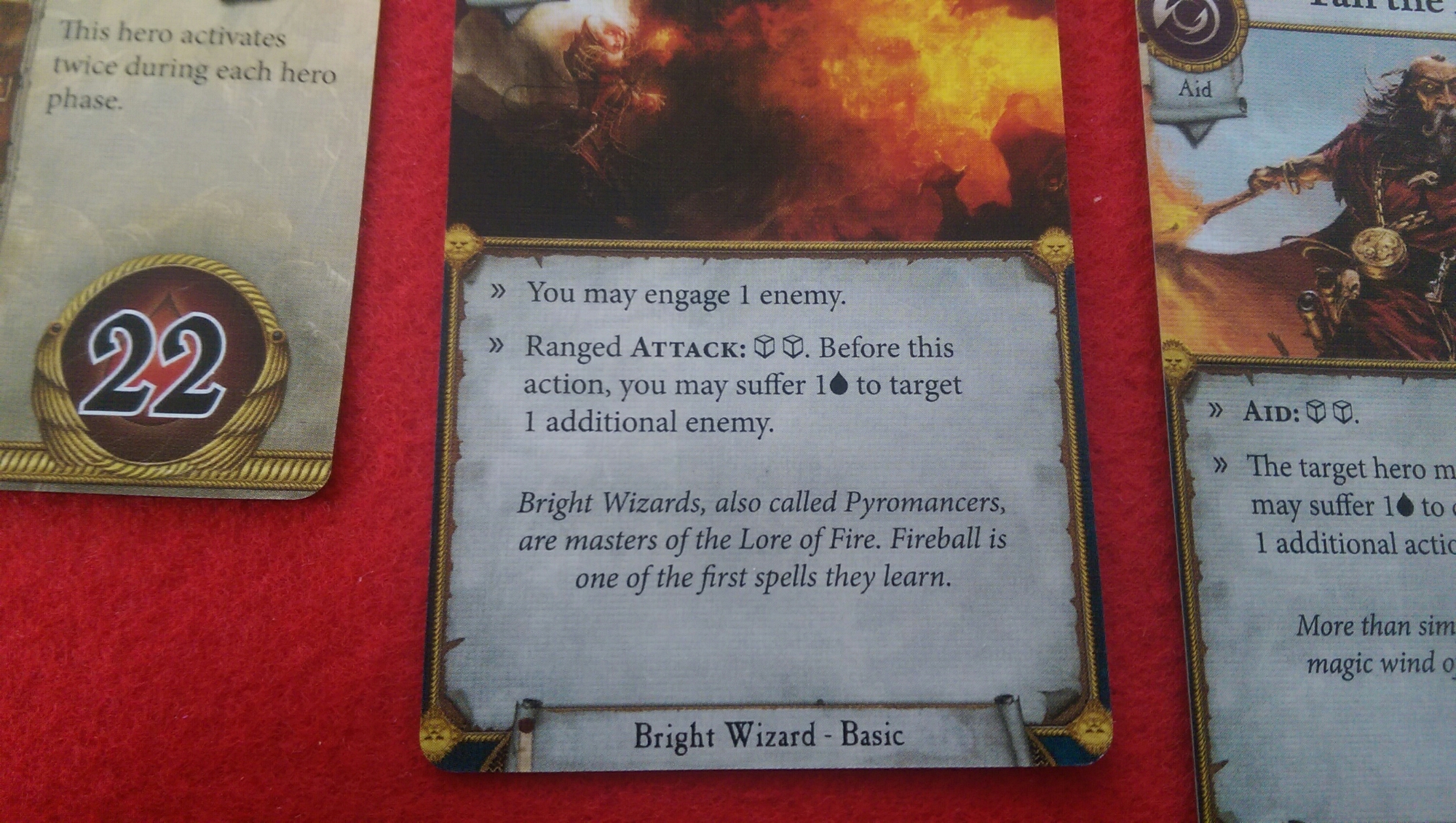
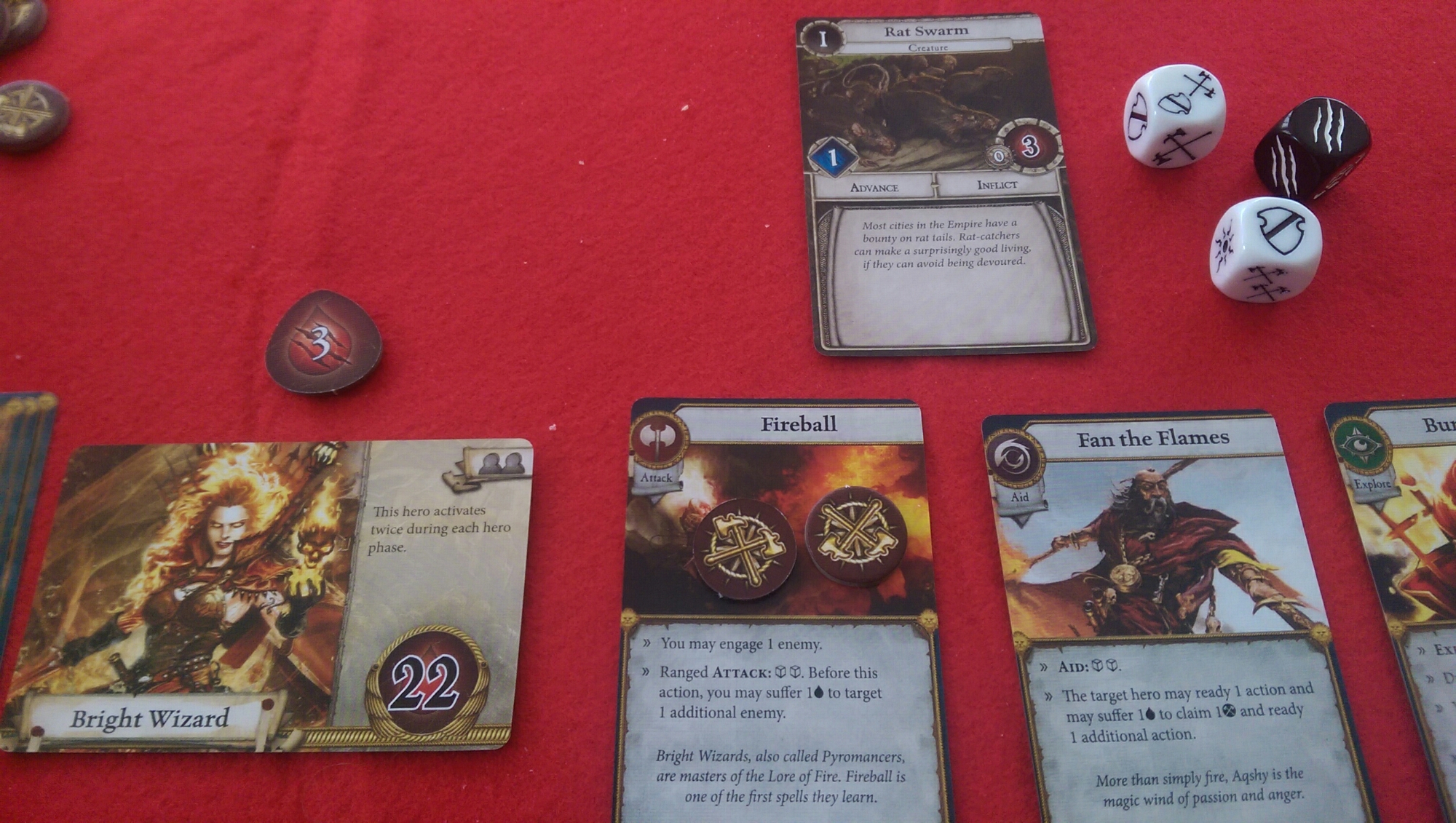
Fireball is the Bright Wizard's Attack action, and it allows her two white dice with which to attempt to deal damage. It's also a ranged attack, so she can fling fireballs at enemies in the shadows or engaged with other heroes and even target more than one enemy in exchange for taking a point of damage, but for now let's concentrate on the immediate threat.

image

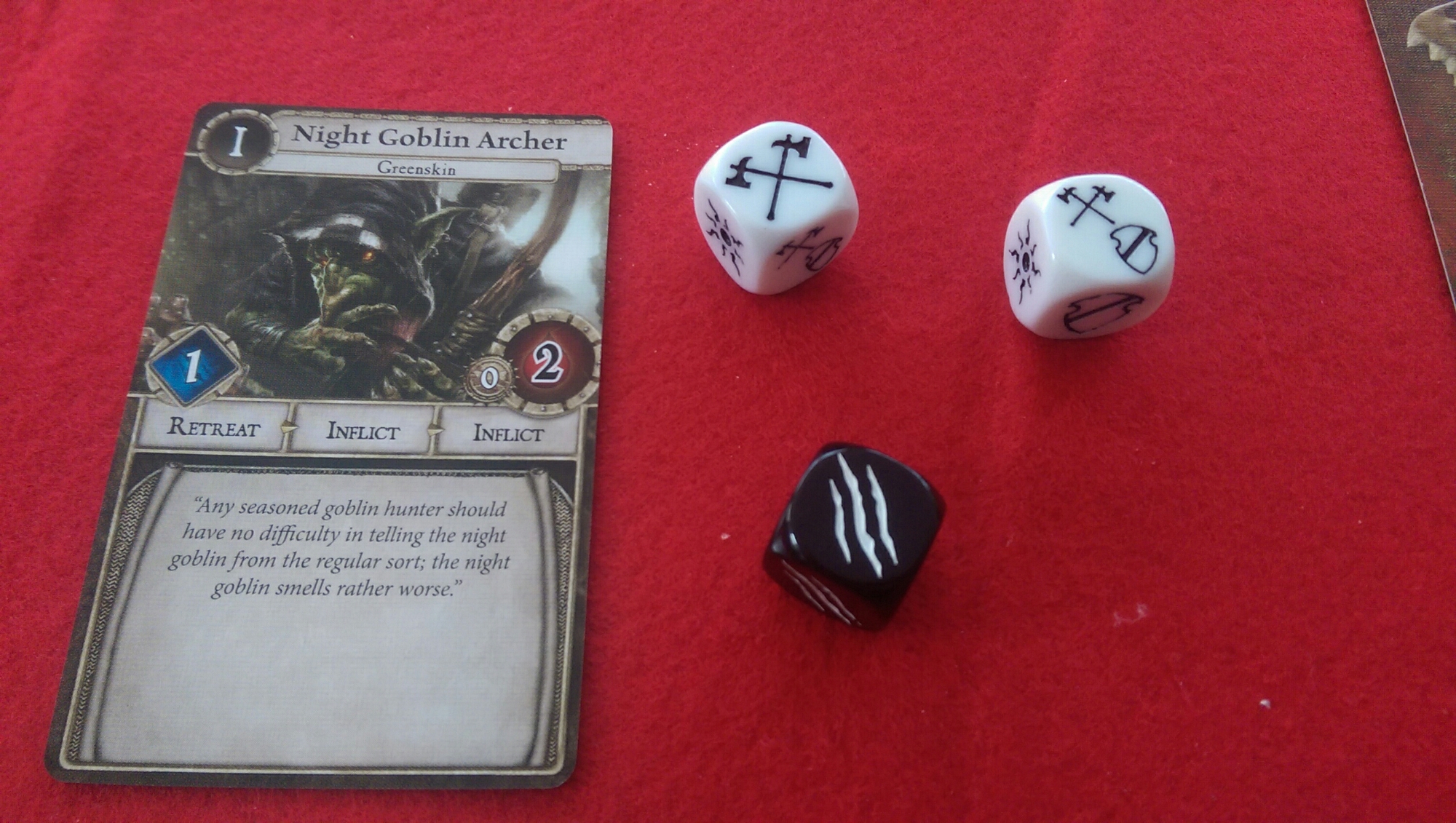
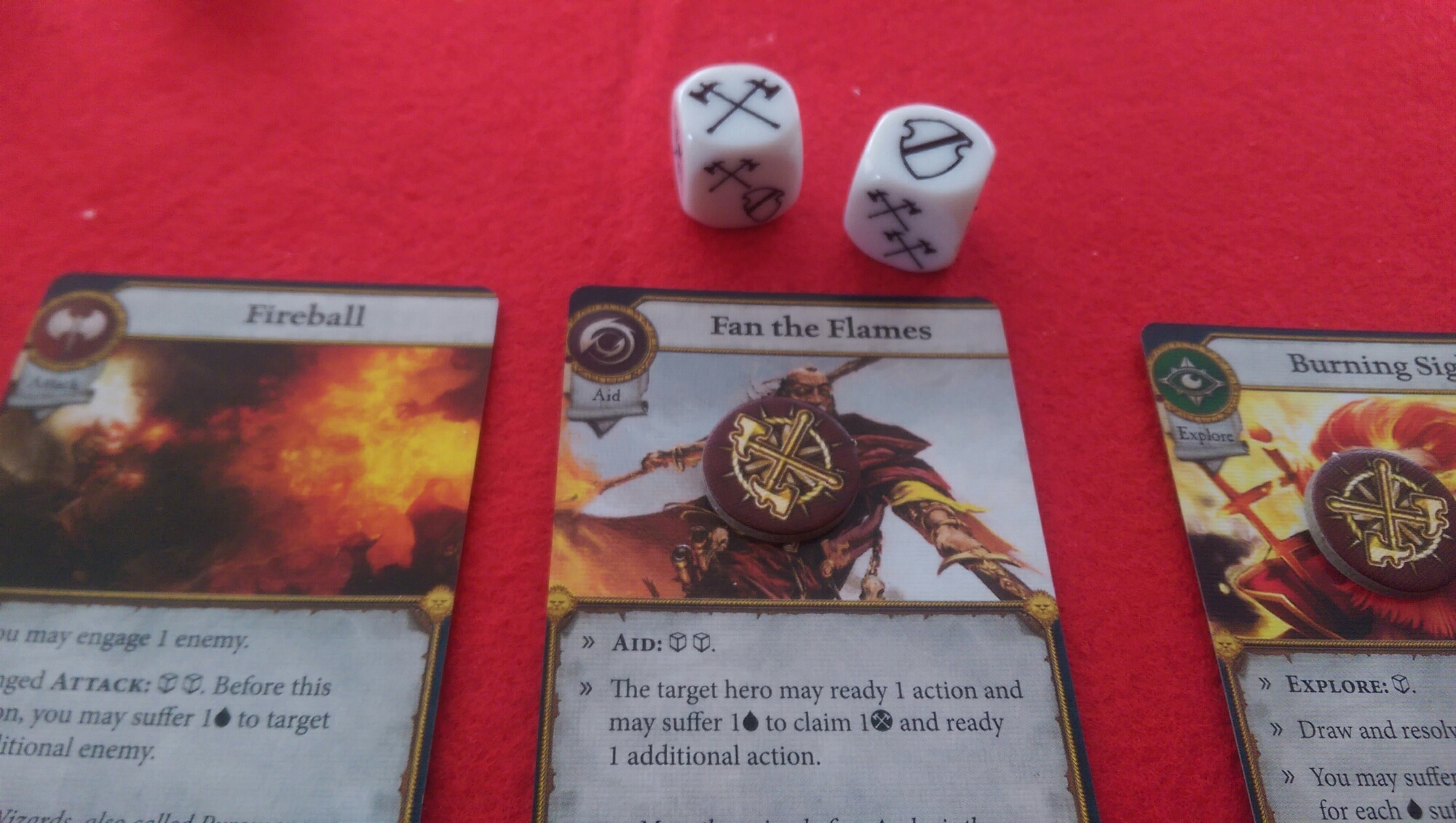
The Bright Wizard gets two white dice for her attack, and rolls against one black die because she's engaged with one enemy. She rolls two success symbols (the crossed axes) plus a defence shield, while the goblin rolls an attack for one point of damage. Since the Bright Wizard rolled a shield, she successfully defends against this damage, and since the goblin only has two hit points in the first place, she defeats it with an appropriately explosive flourish.

image

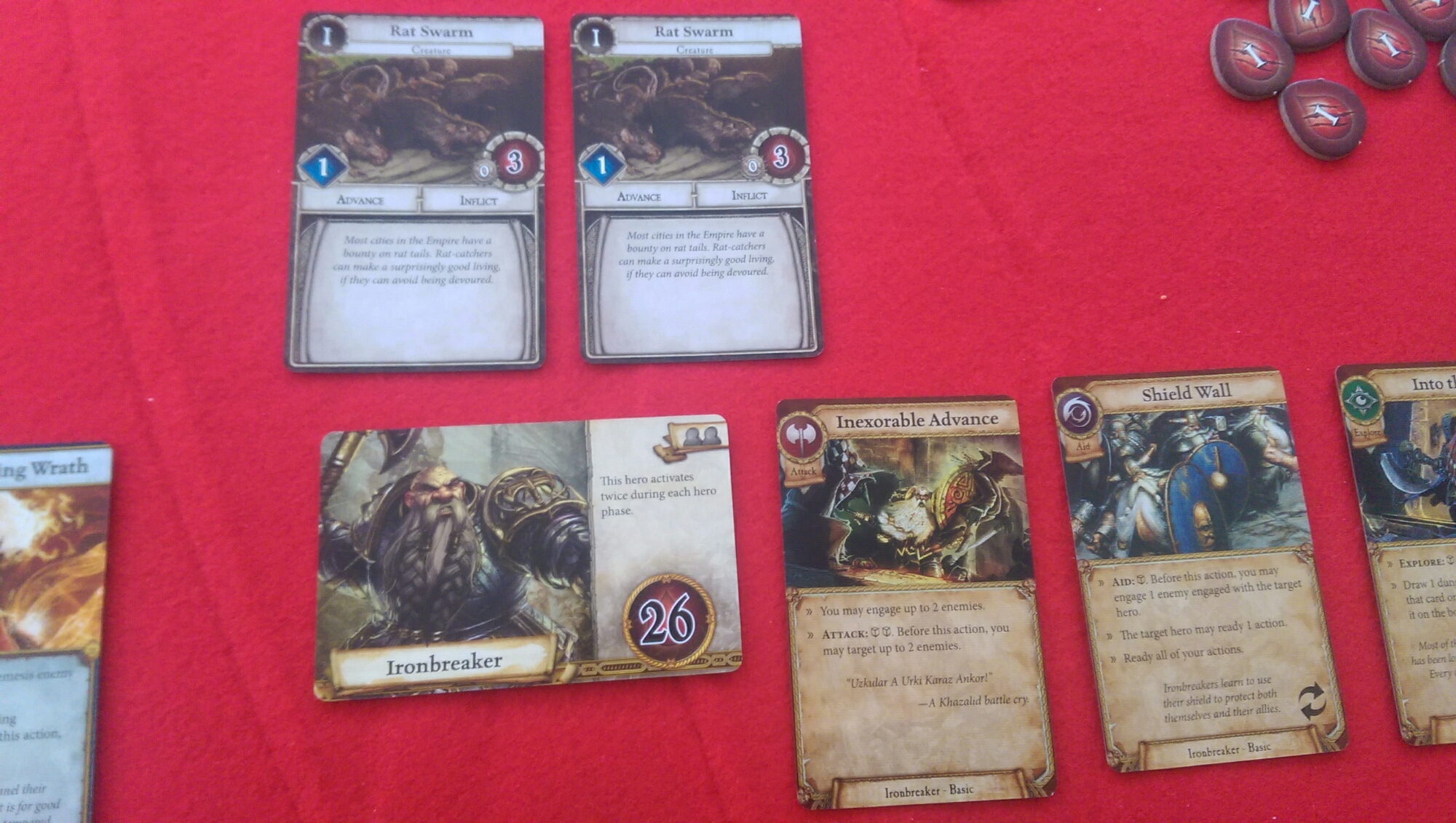
Now it's the Ironbreaker's turn. He, too, is going to attack. His attack allows him to engage up to two enemies. He's already engaged with one, but he's feeling cocky, so he also chooses to engage one of the enemies in the shadows. This flips the card face-up and places it in his engagement area in front of him.

image

It's a second Rat Swarm. They don't do much damage, but they do have 3HP each so it's unlikely either of them are going down this turn. Regardless, the intrepid Ironbreaker pushes on, rolling two white dice against two black dice.

image

He rolls one point of damage, which he applies to the enemy of his choice, and successfully defends against one incoming point of damage thanks to the two shields he rolled.

image

Now it's the Bright Wizard's turn again. Since her Fireball is exhausted, she can't use it again against the enemies engaged with the Ironbreaker or the one remaining in the shadows. She instead takes the opportunity to explore the location by rolling one white die against no black dice, since there are no enemies engaged with her right now.

image

She rolls a success, which puts the party 1/7 of the way to completing this location. She finds some Cool Waters, which allows her to recover 2HP or ready an action, but since she has taken no damage and her Explore action allows her to ready all her actions anyway, it's not much use right now. Since she's flush with life right now, she then chooses to take two points of damage to claim two success tokens and put them in her play area. These can be used next turn for two automatic successes on the Explore action if she uses it.

That's the end of the Bright Wizard's actions this round.

image

The Ironbreaker, meanwhile, is still engaged with the two Rat Swarms. He chooses to use his Stubborn Resolve ability to exhaust one enemy in front of him and automatically defend against up to two points of damage. He then gets to rest, which allows him to recover HP by rolling white dice against black dice, but since he hasn't taken any damage and there's no way for the single remaining readied Rat Swarm to do enough damage to get through that monstrous 2 defence, there's no need to roll any dice.

That's the end of all the Hero turns this round, which brings us to the enemies.

image

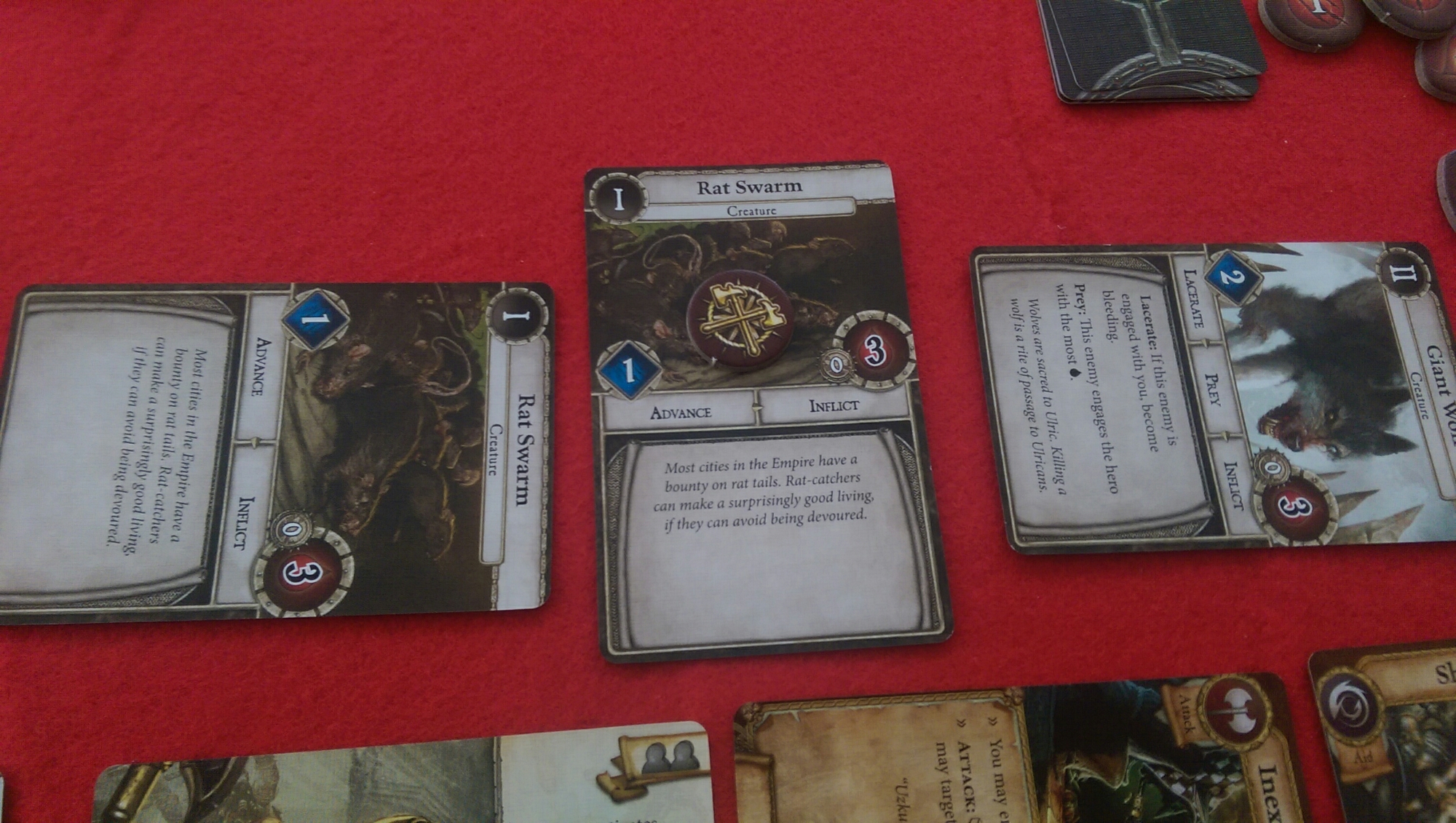
The Bright Wizard is first to activate an enemy. Since she is not engaged with any enemies right now, she must activate one of the enemies in the shadows, and since there is only one face-down enemy left in the shadows, she flips it face-up to reveal a Giant Wolf.

The Giant Wolf then resolves its three actions in turn. First is Lacerate, which causes whoever it is engaged with to be afflicted with the Bleeding status. Since it is not yet engaged with anyone, however, it does nothing.

Next, its Prey ability causes it to engage the Hero with the most HP, which is the Ironbreaker. It moves into his engagement area. Since the Ironbreaker is now engaged with the maximum three enemies, any additional engagements will simply cause him to take automatic damage, but since there are no other enemies on the table right now, that probably won't be an issue.

Finally, the Giant Wolf's Inflict ability deals two damage to the Ironbreaker. This can't be defended against. The Giant Wolf is then exhausted.

image

That leaves just the injured Rat Swarm for the Ironbreaker to activate. First it would Advance to engage the Hero activating it if it was in the shadows, but since it's already engaged with the Ironbreaker, nothing happens. It then deals another point of damage to the Ironbreaker.

At the end of the enemy phase, the Bright Wizard is on 20/22HP, while the Ironbreaker is on 23/26HP. Of the enemies, one of the Rat Swarms and the Giant Wolf are on 3/3HP, while the other Rat Swarm is on 2/3HP. All the enemies are now re-readied for the next round.

image

Before the round ends, the location's effects are resolved. In this case, the party leader (currently the Bright Wizard) must exhaust one of her four actions, though it can't be her Explore action, which has the Prepare icon on it — if this was exhausted, she would eventually be completely unable to act! She instead chooses to exhaust her Rest action Smouldering Wrath, since she's fairly hale and hearty right now.

Now the round ends, and the party leader token passes to the Ironbreaker.

image

The Ironbreaker is in a slightly sticky situation, since he's engaged with three enemies and two of his actions are exhausted. He chooses to offer his Aid to the Bright Wizard, since he has the HP to spare right now. He throws up a Shield Wall, rolling one white die against three black dice.

image

He rolls two successes, which the Bright Wizard chooses to "bank" on her Fireball action. He also rolls two attacks, causing him to take three points of damage — two from the Giant Wolf and one from one of the Rat Swarms, since higher attack value enemies are always prioritised in situations where not all enemies are attacking. He's now down to 20/26HP, but those two banked successes for the Bright Wizard will be useful.

Shield Wall also allows the Ironbreaker to re-ready all his actions, so he does so.

image

The Bright Wizard is up. She chooses to cast Fireball and engage the uninjured Rat Swarm, pulling it off the Ironbreaker. She then voluntarily takes a point of damage to target a second enemy. She then rolls two white dice against one black die.

image

She rolls one success and two defence, the latter of which allows her to shrug off the Rat Swarm's counterattack of a single point of damage. With the two banked successes from the Ironbreaker's Aid action, she has a total of three successes to assign between up to two enemies as she pleases, and since her Fireball is ranged she doesn't even have to attack the enemy she's engaged with. She chooses to assign all three points of damage to the Giant Wolf in front of the Ironbreaker, killing it instantly and levelling the playing field somewhat.

image

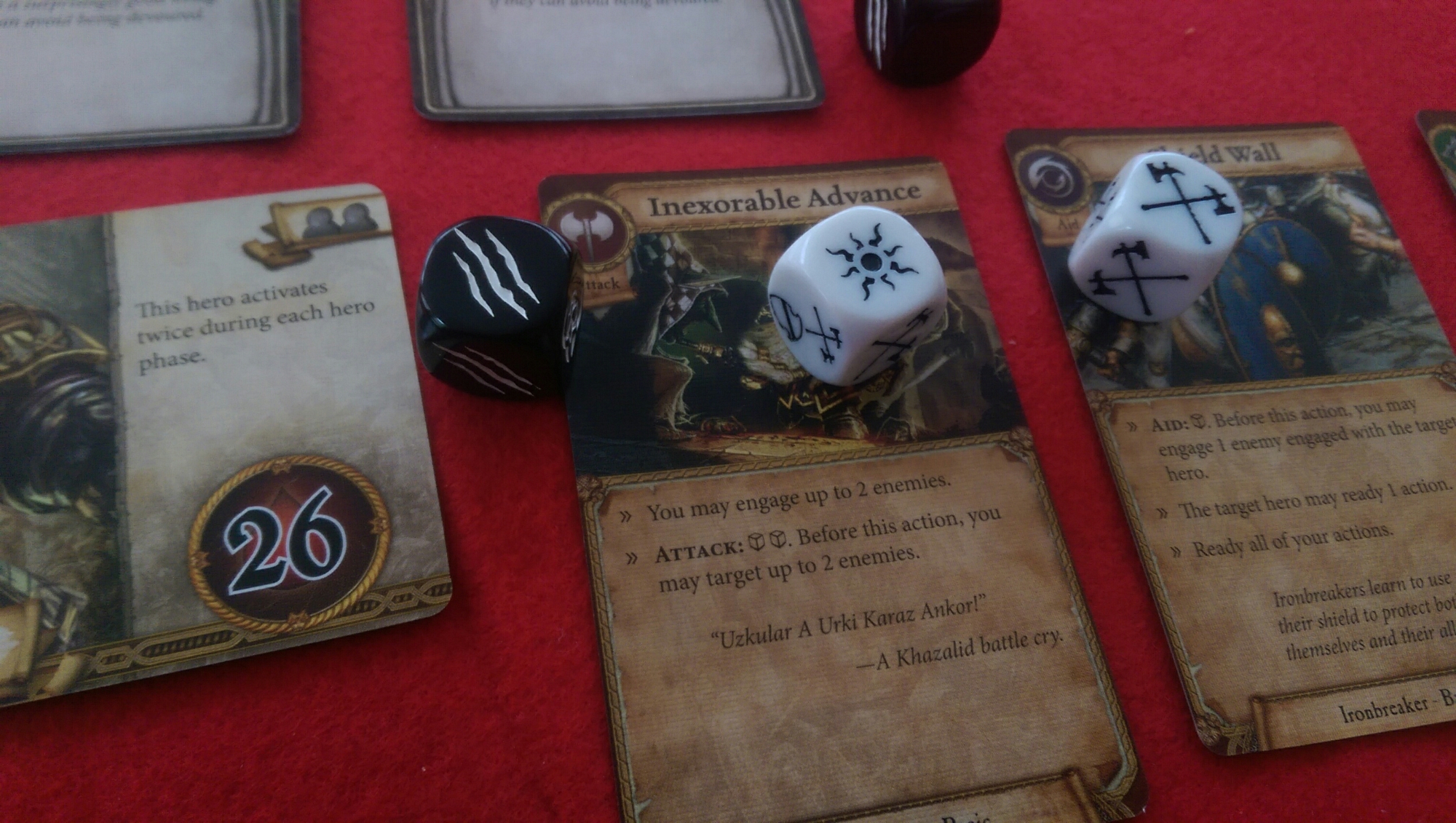
Next it's the Ironbreaker's turn again. Since he readied all his actions last turn, he is free to use his Attack skill Inexorable Advance. Since this allows him to engage two enemies, he pulls the Rat Swarm back off the Bright Wizard with a mind to cleaving both remaining enemies with a lucky roll. He rolls two white dice against two black dice.

image

He rolls a normal success, a critical success and an attack. The critical success counts as a normal success but also allows an additional roll of that white die.

image

Impressively, he rolls another critical success, which means another reroll. That's a total of three successes so far.

image

His final roll is a shield, allowing him to shrug off the single point of incoming damage. He assigns two of the successes to the injured Rat Swarm, killing it, while the remainder goes on the last enemy. This round is now over for the Ironbreaker.

image

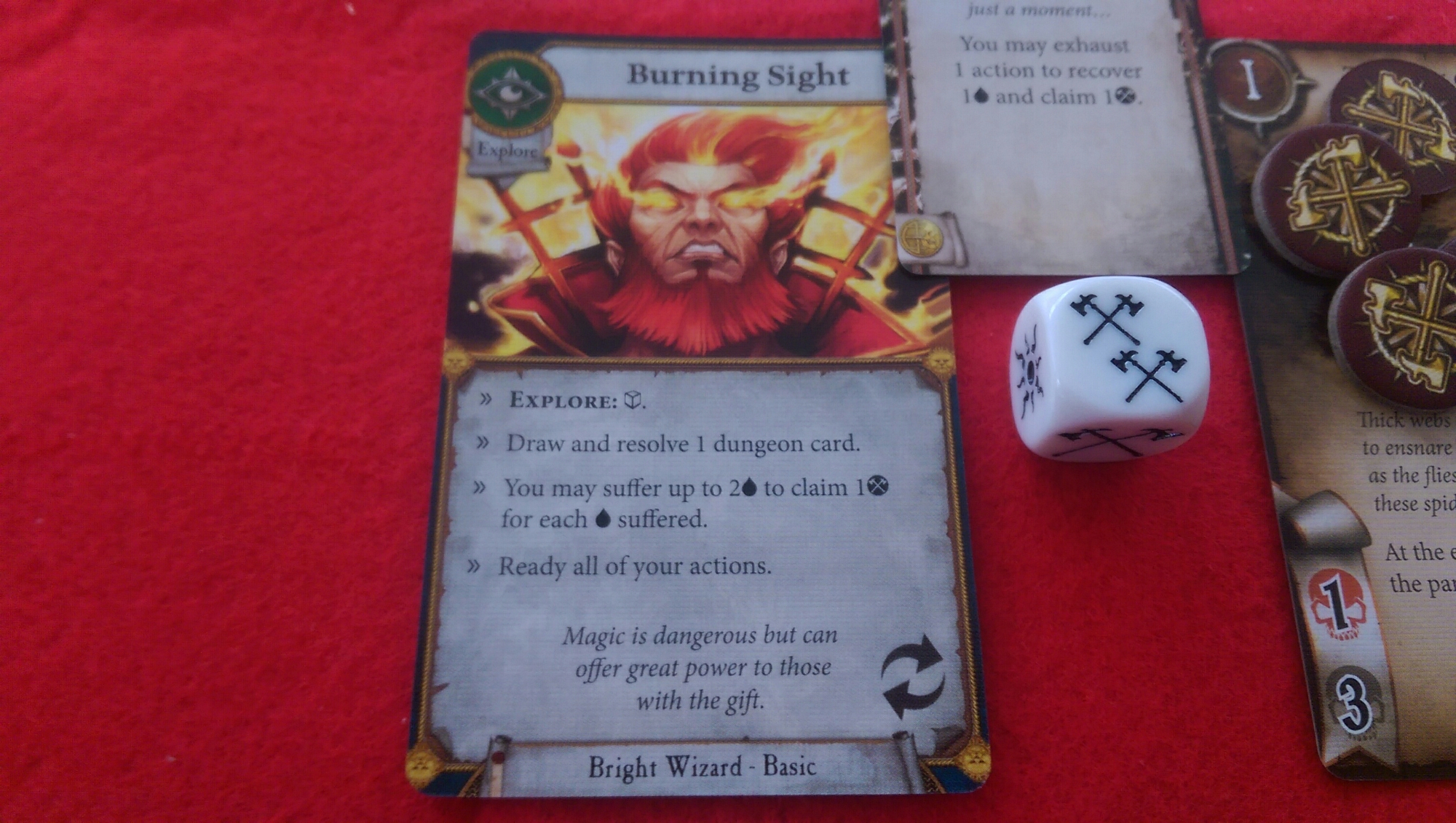
That leaves one action for the Bright Wizard. She chooses to use her Burning Sight ability to explore, using her two banked success tokens from the previous turn — these must be declared and used before rolling dice — and rolling a critical success.

image

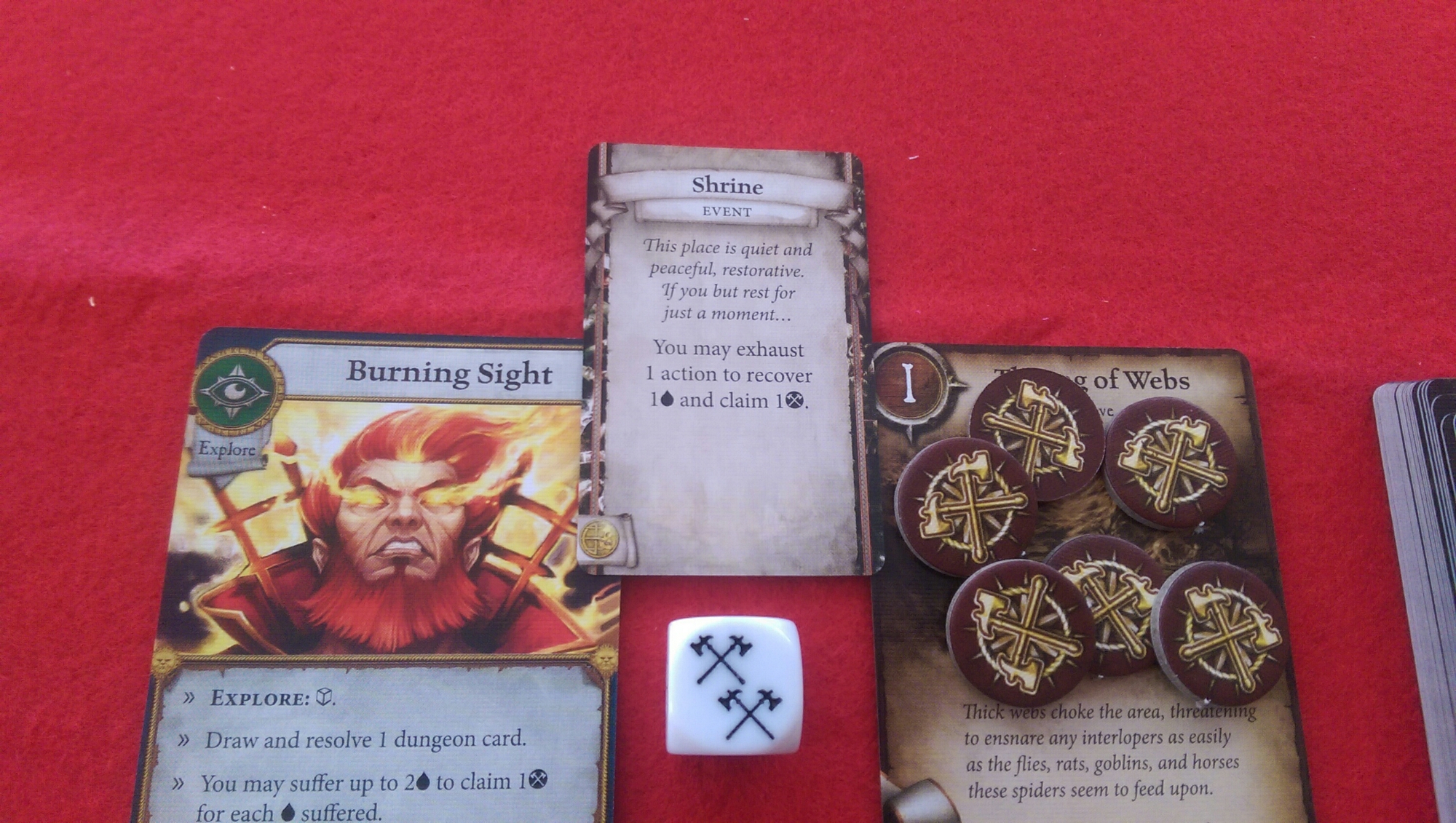
She then rolls another two successes, bringing her to a total of five, including the banked tokens she used. This brings the overall progress on the location to 6/7. She then draws a Dungeon card.
image

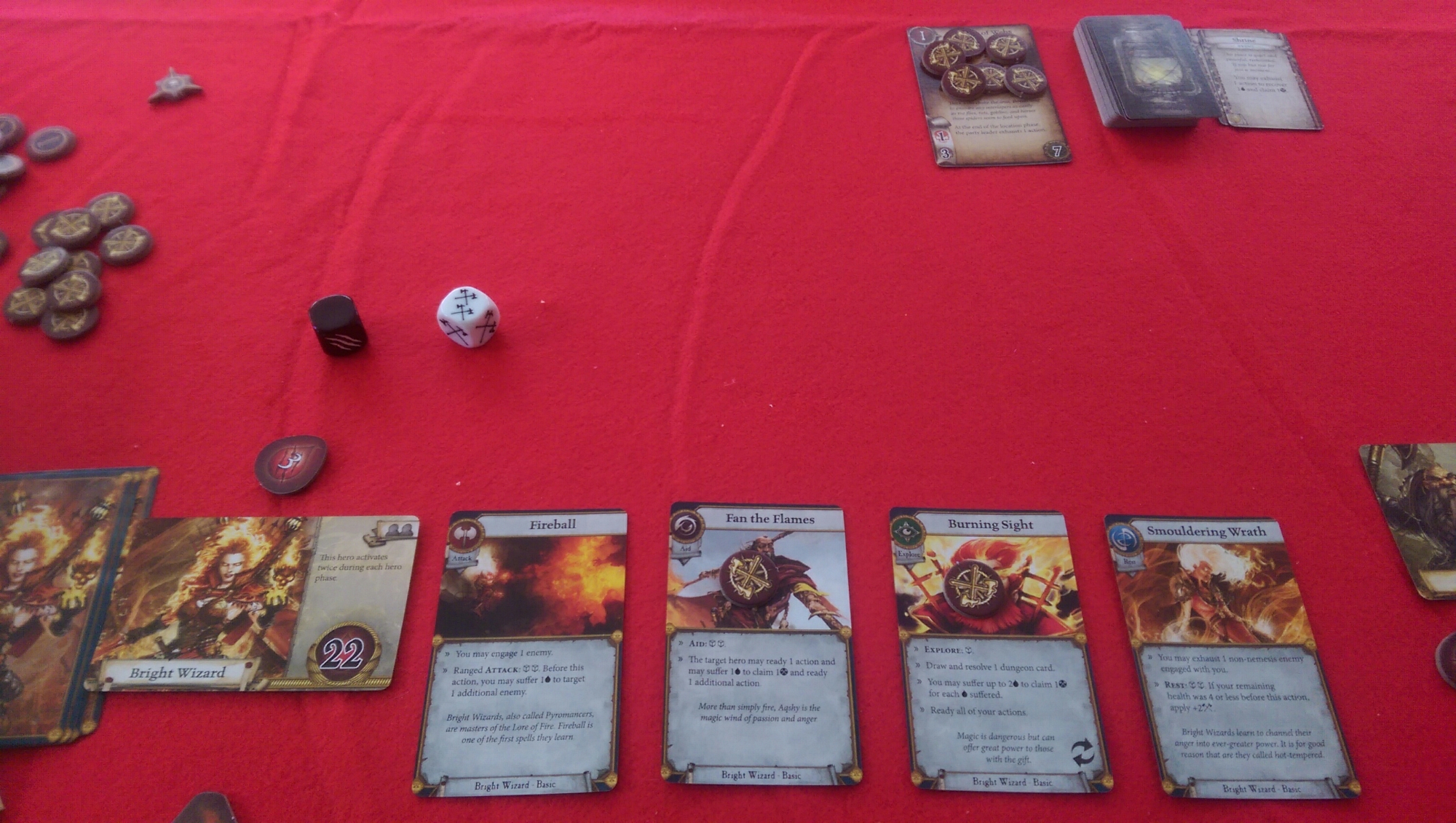
The Shrine she discovers gives her the option of exhausting an action to recover 1HP and claim a success token. Since the Explore action allows her to re-ready all her actions anyway, there's no reason for her not to do this. She heals 1HP, exhausts her Aid ability Fan the Flames and banks a success token on it.

image

The Bright Wizard cannot finish the exploration this turn by burning HP, but she can bank one token for next turn. She takes the 1HP damage she just healed and claims a success token. She then re-readies all her actions, and that's the end of the Hero phase.

image

The only remaining enemy on the table is engaged with the Ironbreaker, who takes one point of damage.

image

The location effect then causes the party leader (currently the Ironbreaker) to exhaust one action dealing with sticky webbing. He chooses to exhaust his Explore action. Leadership of the party then passes to the Bright Wizard for what will probably be the final round.

image

To clear the Tutorial, the party must fully explore the Throng of Webs location (which requires just one more Explore success to do so) and defeat all the enemies. With that in mind, the Bright Wizard uses her first action to Aid the Ironbreaker for two dice plus the success token she banked earlier.

image

She rolls a success and a critical success…

image

…followed by a defence, which isn't much good right now, but three success tokens is still plenty. In fact, you can only bank up to two success tokens per card, so the Ironbreaker banks two on his Inexorable Advance card and a third on his Shield Wall card. He also readies his Into the Dark action to explore if necessary, since the Bright Wizard's Aid action allows him to ready one action.

image

The Ironbreaker uses Inexorable Advance and rolls two defence, which is more than enough to shrug off the incoming damage from the Rat Swarm. He uses his two banked success tokens from the Bright Wizard's Aid to defeat the Rat Swarm without the need for rolling further successes. Now the area is clear of enemies, which just leaves the exploration.

image

The Bright Wizard has a banked success token, so rolling the die is just a formality at this point, but she rolls a critical success anyway. That brings the location to 7/7 progress, completing it and clearing the Tutorial. Full quests would require the exploration of other locations and perhaps the completion of other objectives, but for now… victory!

2178: Some Love for Marvelous Europe

0178_001

I received a package from Marvelous Europe today, containing five adorable chibi Senran Kagura figurines depicting Homura's Crimson Squad at play (or, in Hikage's case, as close to "play" as she could probably figure out). I was the lucky recipient of these figures because I retweeted or favourited something they posted on Twitter a short while ago, and I was fortunate enough to be selected as a "winner" of one of the prizes that was up for grabs at the time.

To be honest, I'd completely forgotten about it, since "RT to win!" Twitter posts are ten-a-penny, and also I very rarely win anything that involves the luck of the draw. I was delighted that Marvelous made good on their original offer, though, since I really like the figures a lot, even if they were a bit fiddly to put together. (There's a teeny-tiny accessory for Yomi that I have no idea where to put, for example.)

This pleasant little interlude got me thinking about Marvelous Europe and how they appeared out of nowhere a little while back. Previously, games such as Senran Kagura made it over to Europe via a convoluted string of people and companies — Senran Kagura Burst, for example, was localised by XSEED and then brought to Europe by, if I remember correctly, PQube Games. Senran Kagura Burst actually got a physical release in Europe through this convoluted process, however, which made Americans super-salty because it only got a digital eShop release over there. They got their revenge with Vita follow-up Senran Kagura Shinovi Versus, though, since this was digital-only in Europe but had a special edition physical version in the states. Vita games are region-free, though, so fans such as myself simply imported.

Anyway, I recall being particularly aware of Marvelous Europe once Senran Kagura 2: Deep Crimson was first announced for Western release. Preorders for some ambitious-looking limited editions went up early, and I decided what the hell, I'll jump in. After all, the limited editions put out by Idea Factory International — a very similar operation, bringing niche Japanese games to the West and giving them plenty of love and attention — had proven themselves to be rather lovely, so I had a good feeling about Marvelous Europe's offerings.

So much so, in fact, that I also preordered both Corpse Party: Book of Shadows and Senran Kagura Estival Versus when they became available. Estival Versus is yet to be released, but both the Senran Kagura 2 and Corpse Party special editions were gorgeous, and both are releases I'm very happy to have in my collection.

The main reason I feel Marvelous Europe sets a great example for other publishers is that they clearly know their audience well. Their Twitter account is very "human", often sharing irreverent, dry humour — particularly when the prudes of the games journalism business start whingeing about boobs, as they are so often wont to do these days — and interacting with fans rather than acting purely as a news outlet. Their positive attitude towards the games they release, their pride in their work and their total lack of shame in bringing controversial titles to an eager Western audience means that I'm more than happy to keep supporting them for as long as they keep releasing quality games for me to enjoy.

Keep it up, Marvelous Europe. You're doing a marvellous job.

2177: Black Screen of Death

0177_001

I've noticed something annoying about technology, particularly entertainment technology: the moment you want to revisit something you haven't played/watched/listened to for a while, the technology that makes doing so possible is almost certainly going to fail somehow.

This has happened to me on numerous occasions ever since I was a youngling. From games that refused to boot on our old Atari 8-bit to… well, today, games that refuse to boot on my Windows PC, it's an inordinately frustrating experience.

It's more frustrating than something just normally not working, because the fact that you haven't indulged in the thing in question for a while means that you build up a certain degree of anticipation in your mind for the first time revisiting it in weeks, months, perhaps even years. As such, it's extremely disappointing when you find yourself unable to satisfy your hunger for the thing you were craving.

Today, I had an extremely strong desire to play Bizarre Creations' swansong Blur, one of my favourite racing games of all time. I own both the Xbox 360 and PC versions of this game — the PC version being something that I'm actually seemingly rather lucky to own, since it has been pulled from the Steam store at some point in the last few years — but I was keen to play the PC version, since it runs at a superior framerate and resolution to the 360 version. Plus I'd been having idle thoughts about doing a "racing games supertest" series of videos, and Blur was one of the games I particularly wanted to highlight.

Blur has run fine on my machine before and I don't think I've made any significant changes to it since the last time I ran it. I've perhaps replaced the graphics card in that period — which may be the issue, though I don't see why — but that's about it. But no; I was to be denied. I fired up Blur via Steam, saw the familiar noisy Activision logo followed by the now somewhat forlorn-seeming Bizarre Creations logo… and then the menu music started.

And then nothing happened. No spinny thing in the corner saying the game was loading. No main menu. No prompt to login. Just the menu music, and a Steam popup with the CD key that I was unable to dismiss.

I tried again on the offchance it was a random crash; no luck. I took to Google in an attempt to find the cause of the problem, or indeed if anyone else had had it — note to game developers: if you name your game a single word, please don't name it after a common graphical setting, because it really makes situations like this a lot more difficult than they need to be — but I was ultimately disappointed, since this was, inevitably, one of those situations where lots of people in the last five years have had this problem, but none of them have come up with an adequate solution.

I tried the few solutions that were offered, and swore silently at Yahoo! Answers commenters making inane, generic comments about Windows updates and checking video drivers, but none seemed to work. As I type this, I'm restarting my PC — a rare treat for that machine, which tends to stay on most of the time — in a last-ditch attempt to see whether or not that works. If it doesn't, I guess I'll have to be satisfied with the 360 version; no great loss, since that's the version I originally "discovered" the game with, but it would be nice to run it at 60fps and 1080p.

Oh well. It's getting late now, anyway, so probably no Blur for me this evening. Fingers crossed I can get it working eventually though…

EDIT: Restarted computer. Game now works. Maybe those Yahoo! Answers idiots weren't such idiots after all.

2176: Life on Mira

0176_001

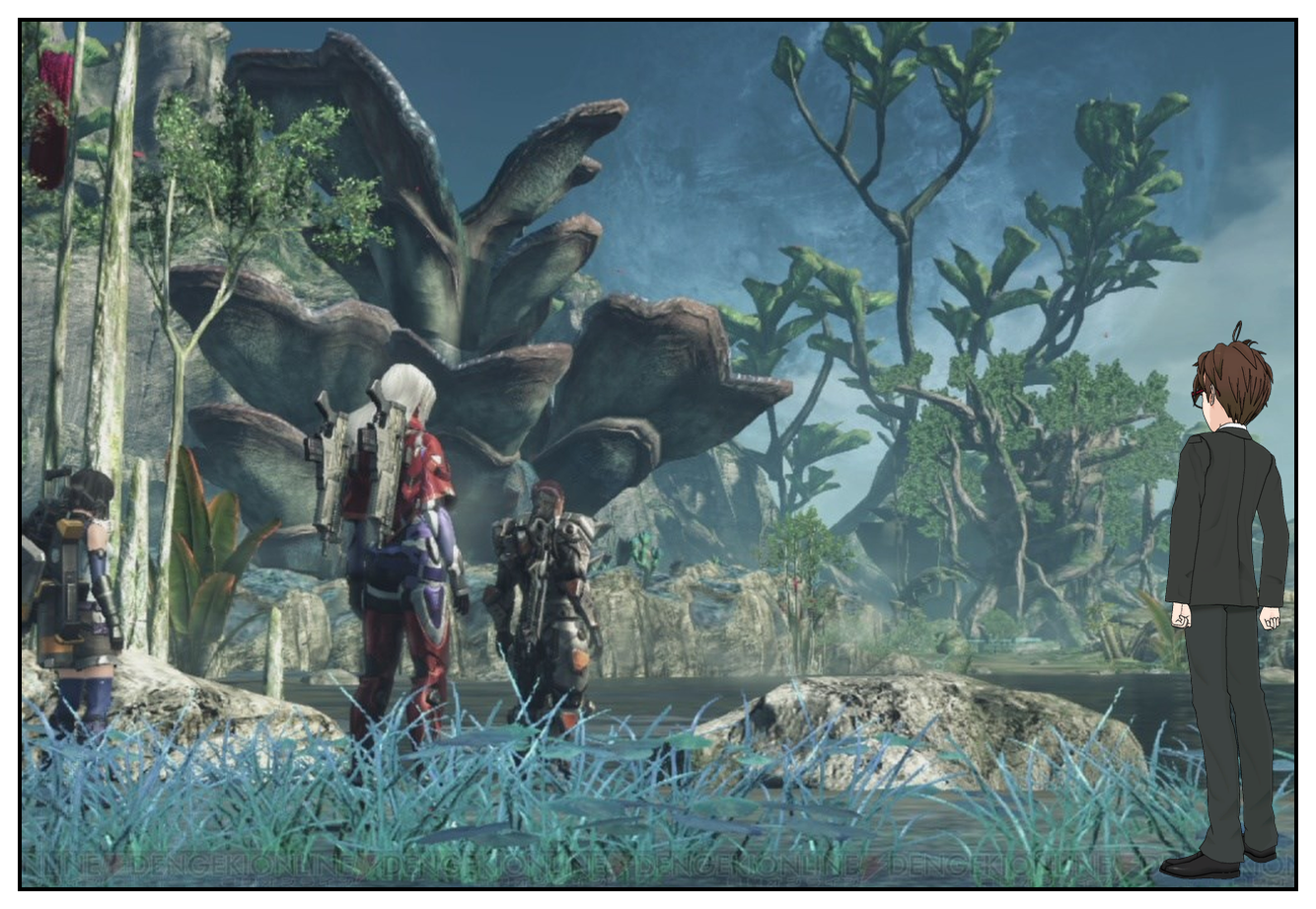
I finished the main story of Xenoblade Chronicles X today, but my time with the game is far from over, since there's still a whole lot to do once you clear the story.

I wanted to reflect a little on my experience with the game so far — 100 hours' worth — and reiterate that I think it was absolutely the best game released last year that I had the good fortune to play. There may be some spoilers ahead, but I'll try and keep them to a minimum.

The most common criticism I've read of Xenoblade Chronicles X is that its story is "weak" or "not as good as Xenoblade Chronicles". While I don't disagree that its manner of storytelling is an acquired taste, I don't agree at all that its story is weak or of poor quality — nor do I agree with the assertion that the characters aren't particularly well-defined.

Let's take the first point first. I've already commented on this in depth in this post, but it bears mentioning again: Xenoblade Chronicles X's storytelling is about more than the main scenario quests and the cutscenes. It's an immersive storytelling experience in which you are part of the world of Mira, and things unfold around you, both with and without your intervention. The world changes and evolves as you complete missions and develop your relationships with characters, though the impact of your actions may not necessarily be immediately apparent. As you spend time in New Los Angeles and interact with its populace — initially all human, but later integrating several different xenoform cultures — you start to get a very strong sense of time and place from the people of Mira. It's ultimately one of the most well-realised worlds I've come across since the Final Fantasy MMOs — and, from me, that's high praise indeed, since these have previously been some of my favourite game worlds to hang out in.

Xenoblade Chronicles X's main story is a relatively straightforward affair, though its final act gets into some intriguing philosophical territory. But in many respects, the main story is the least important part of the overall narrative experience: the "true" Xenoblade Chronicles X, if you like, is in going about your day-to-day life as a BLADE, completing missions, interacting with others and developing your understanding of the world as a whole. Sidequests happen in the strangest of places at times, and you'll encounter a huge cast of weird and wonderful characters, many of whom have "affinity" links with one another just waiting to be discovered. Each of these sidequests is crafted with care, attention and meaning, and many of them tell their own compelling little "short stories" in their own right; others still form part of a larger ongoing narrative proceeding in the background alongside the main scenario. As a complete package, it's hard to think of an RPG with quite such a comprehensive narrative that you can explore in as much depth as you like.

Now, on to the second point: that of the characters. It's true that the main scenario largely focuses on the characters of Elma, Lin and Tatsu, with even your avatar not getting a lot in the way of development — though it's worth noting that in stark contrast to many JRPGs, you can play your character's personality in a lot of different ways, and there are often consequences for the choices you make — but to say that the other characters don't get explored is nonsense. For one, all the playable characters have their own chain of affinity missions and heart-to-heart events to explore as you develop your relationships with them, and some of these are even prerequisites for proceeding through the story. Plus, all of them have their own unique things to say during and after battle, with certain character pairings even having unique conversations with one another. Pleasingly, this even includes your avatar (who has a voice in combat despite being a silent protagonist for most of the game) — many of the things he/she says are responded to by other party members, which makes you feel like a more important part of the team than you might do otherwise.

Again, you're free to explore this side of the narrative in as much or as little depth as you please, since most of the affinity missions are optional affairs. The content is there, though — like most things in Xenoblade Chronicles X, though, it simply isn't handed to you on a plate. I like that, though; it gives a feeling of achievement when you discover something.

Final-ish thoughts for now, then? Xenoblade Chronicles X is a masterpiece of sci-fi, and the sci-fi game I've wanted to play since I was very young. It's not perfect by any means — the Wii U hardware arguably holds it back a little at times, though not as much as the original Wii held back titles like the original Xenoblade Chronicles and The Last Story — but it really is an astoundingly good game, and a truly impressive achievement. It deserves to be celebrated a whole lot more than I've seen, and I shall continue to bang my drum about it for as long as anyone will listen.

2175: Nail'd It

0175_001

My good friend Mr Alex Connolly was kind enough to donate me a copy of Nail'd on Steam over the Christmas period. This is a game he's mentioned to me before, but I'd never gotten around to trying it. Now I'm regretting not checking it out sooner!

Nail'd is an offroad racing game from Techland and Deep Silver, the developer-publisher combo perhaps best known in recent years for the Dead Island series and its not-really-but-sort-of follow-up Dying Light. It's an unshamed arcade racer experience, with no pretensions towards having a plot or any reason for existing beyond simply being fun — nor, it must be said, is it making any attempt whatsoever to be the slightest bit realistic.

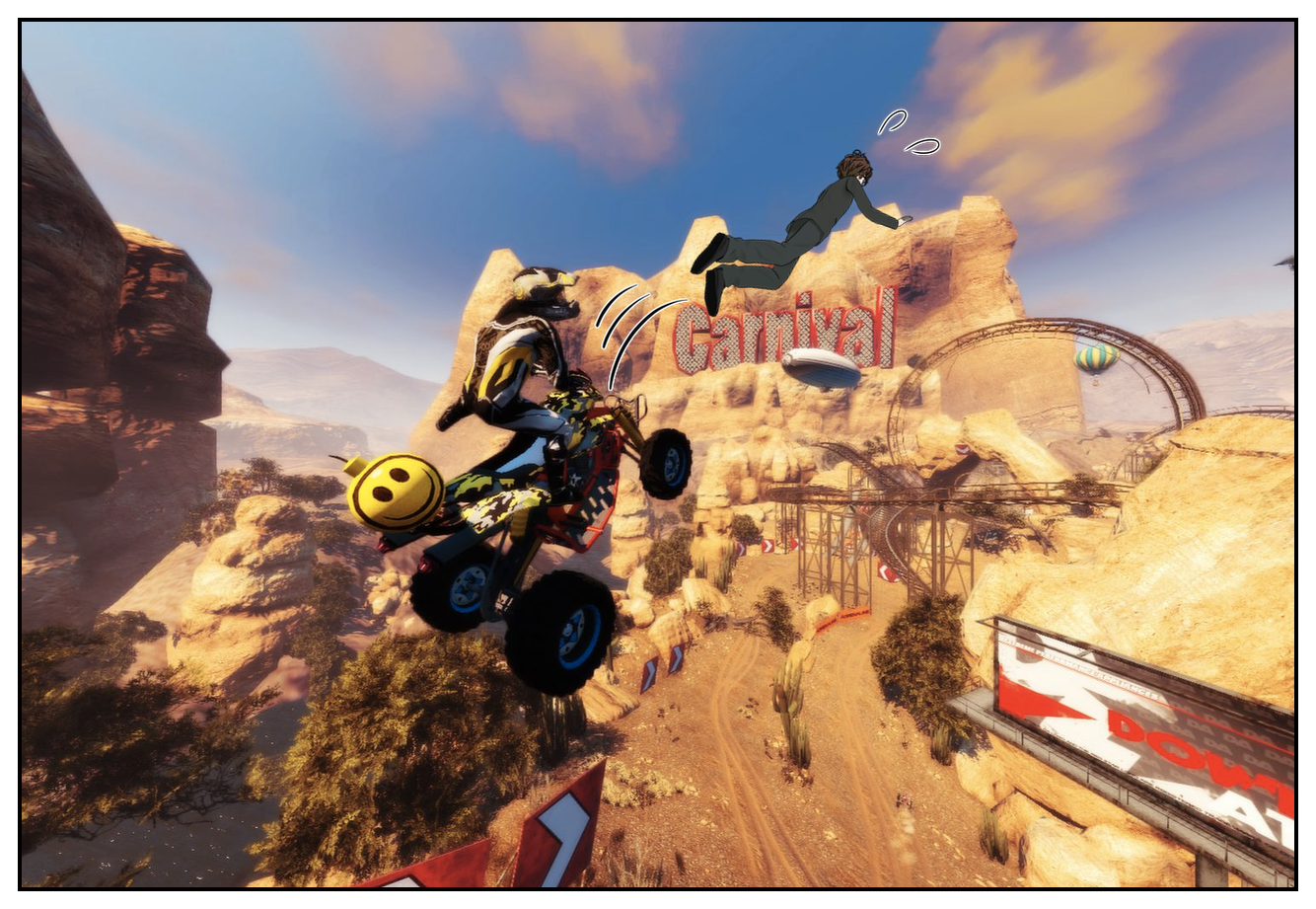
Nail'd is ridiculous. There's no other word for it, really. From the moment you squeeze the accelerator and you immediately ramp up to approximately three thousand miles per hour in less than a tenth of a second, it's clear that this is not a game intended to be taken seriously. This feeling is further cemented when you take your first jump and spend a good ten seconds airborne before landing with no ill effects, and set in diamond when you crash for the first time and your quad-bike explodes into fragments, while your driver goes spinning off into the distance with exaggerated ragdoll physics.

Taking part in a race in Nail'd is a rollercoaster ride. There's dips and undulations, huge jumps, banked corners, environmental hazards, narrow gaps to traverse and stunts to perform. Pleasingly, there are multiple routes through each track, too, bringing the races a feel somewhat akin to EA's classic SSX series back in its heyday, particularly as many of Nail'd's races are downhill point-to-point affairs rather than circuit races.

I hadn't previously been particularly interested in motocross or ATV racing games before, and I don't know how many of them are like Nail'd. But I do feel I've been missing out on some crazy offroad fun with this game, at least; it's an absolute pleasure to play, it's a challenge while keeping its mechanics extremely simple, and it's one of the most thrilling, exciting racers I've come across, ever. It's just a pity that the multiplayer servers are no longer active, so it's not currently possible to share the ridiculousness of a Nail'd race with other people, except by doing some jiggery-pokery with the LAN mode and external software.

My arcade racing renaissance continues, then; Nail'd has been a delight to discover, and it's inspiring me to check out some other racers I haven't spent all that much time with — or haven't tried at all — with a mind to doing a full roundup at some point in the future, either here on the blog or in video format, or perhaps even both!

Now I think I'll go hurl myself off a few cliffs before bedtime…

2174: Souls

0174_001

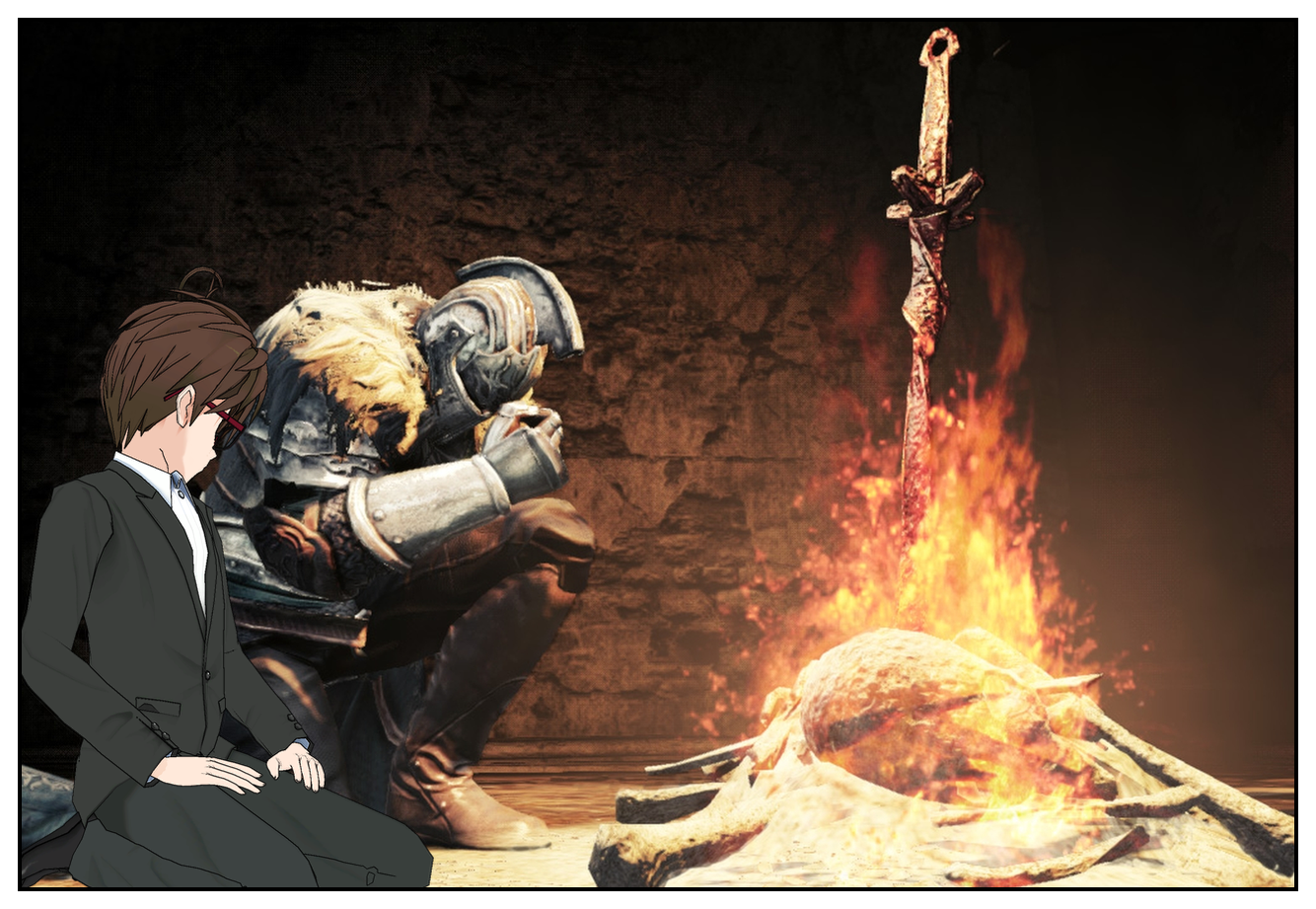
I've tried on several occasions to get into the Souls series from From Software, and have never quite succeeded, despite liking the overall atmosphere of the whole thing. This time around, though, I feel I'm finally starting to Get It. Kind of.

I'm playing Dark Souls II: Scholar of the First Sin, the rejigged and enhanced version of Dark Souls II that was released for PC and next-gen platforms a while back. It was a Steam sale acquisition; for its low price, I was willing to give it another chance, so I jumped in on the understanding that Dark Souls II is, on the whole, perhaps a little easier to get into than the other games of the series. I'm not sure if I believe that yet, but I feel like I'm starting to get a feel for it all.

There are several things to get into your mind when you start playing Dark Souls. Firstly, it's a good idea to think of it a bit like a "single-player raid". You need to learn things: develop a strategy and execute it, preferably flawlessly. This is particularly apparent when fighting the game's bosses, but it also applies to regular enemies: most of the time they spawn in the same places, so you can prepare for ambushes where they got the jump on you the first time you went down that particular corridor, and instead slice them to ribbons before they can even touch you.

On a related note, Dark Souls' combat, while initially appearing to be relatively straightforward, is very "Japanese" in nature in that it has a heavy reliance on pattern recognition. When fighting everything from the most lowly of crap enemy to the biggest of bosses, you need to recognise the patterns of their attacks and counter them accordingly: dodge them to avoid taking damage, and take advantage of an opening to attack, while simultaneously being aware of your own stamina so you leave a bit left over to dodge out of the way when the next attack comes.

Yes, Dark Souls is not a game where you can flail wildly and hope for success. My early encounters with the Souls series saw me hating that Stamina bar and how quickly it gets used up, but this time around, again, I feel like I'm getting more of a feel for it. You can almost relate it to a turn-based sort of system in a strange sort of way — or perhaps it would be more accurate to compare it to the "cooldown" system used by most MMO combat systems. In other words, you can't just spam the attack button and hope an enemy is dumb enough to walk into your swing; most attacks are slow and ponderous enough to leave openings wide enough for enemies to hit you, even while you're mid-attack. As such, timing is crucial.

So far, I'm playing a mage-type character, since it allows me to deliver some decent damage from afar, which in turn helps me to develop my confidence to fight the more difficult opponents a bit more. I'm getting a feel for the hand-to-hand combat too, though; I can now pretty confidently dispatch lowly opponents with a dagger rather than a couple of spells to the face, though it remains to be seen if my overall play style will change too dramatically by the time I get to the end of the game… if I get to the end, of course.

So, then, I think I finally sort of "get it". I'm not sure I love it quite as much as some people do yet — I don't think I'm far enough in to feel that way — but I'm interested enough to keep going and find out more. Which is, you know, nice.

2173: Three Swords

0173_001

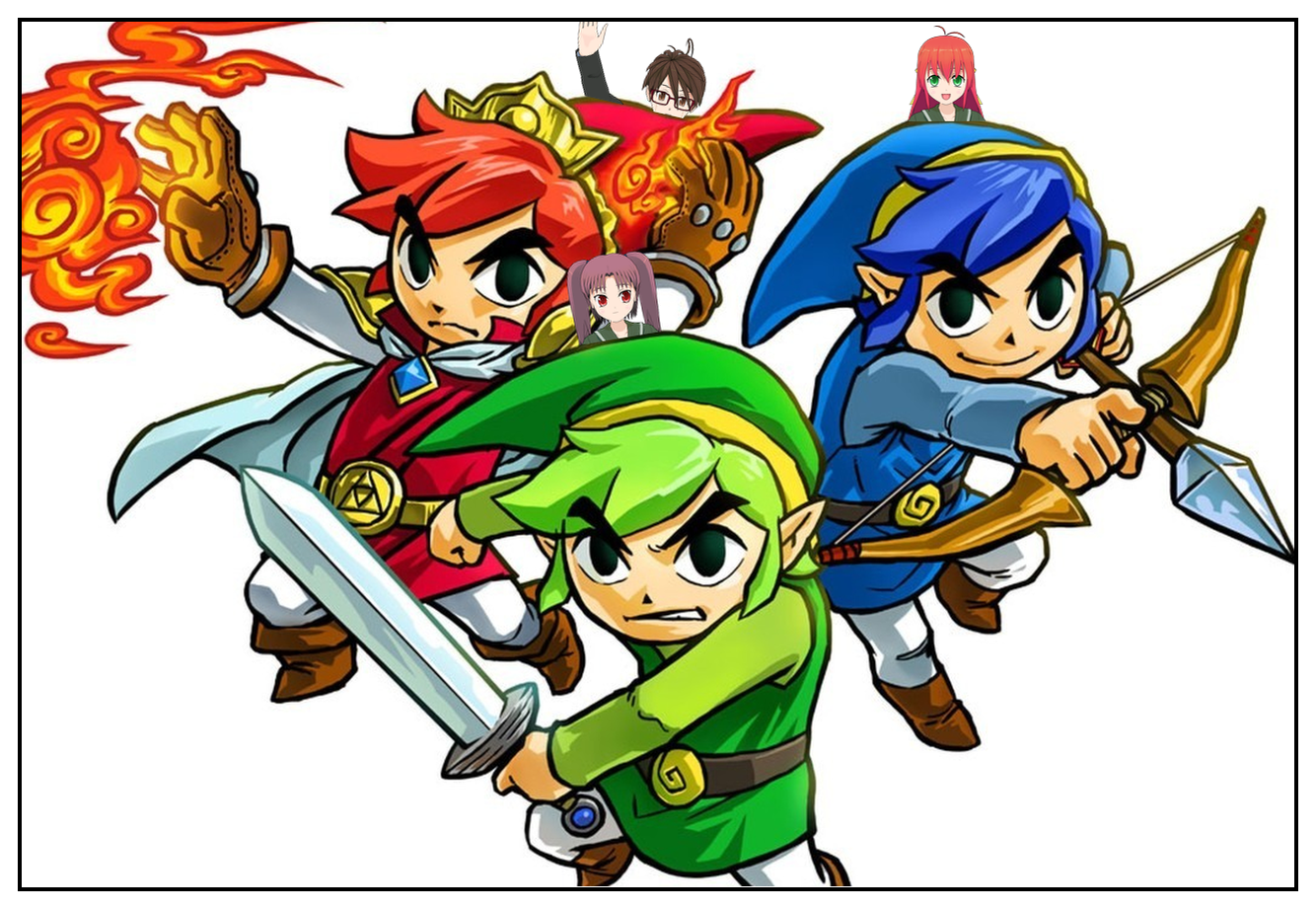
Been playing a little bit of one of my Christmas acquisitions recently: the intriguing The Legend of Zelda: Triforce Heroes. This isn't a "mainline" Zelda game in that it's not particularly narrative focused and is instead a largely cooperative multiplayer affair, but I've been very pleasantly surprised quite how playable it is — and how it very recognisably has that Nintendo "magic" about it.

Triforce Heroes casts you in the role of a Toon Link who may or may not actually be Link and throws you into the town of Hytopia, which is currently undergoing something of a crisis: the local evil witch is apparently cursing everyone who is getting a bit too fashionable, and thus it's up to the local heroes (for whom the populace have very specific requirements) to sort things out once and for all.

It's an eminently stupid premise, obviously, but in a way that works in the game's favour, because the lack of focus on a coherent narrative allows the game to instead concentrate on gameplay, and in a multiplayer-centric affair, this is by far the best approach.

Triforce Heroes unfolds over a series of discrete levels, each of which makes up a number of different regions in the Drablands, the area the witch calls home. As you complete the various levels, you'll acquire materials and Rupees, both of which can be used to create new costumes for maybe-Link and confer special abilities and bonuses — or, in some cases, penalties. You then repeat the process, gradually increasing your completion and/or grinding levels you've already done for more materials. That is, so far as I can determine, it. But rather than being a throwaway affair, it's actually rather compelling.

It helps that the levels are well designed to necessitate cooperation. Unlike, say, Super Mario 3D World, where additional players were more of a distraction than anything else, Triforce Heroes' levels are specifically designed with three players in mind. Most of the cooperation involves picking up and throwing around the other two players to reach out-of-reach platforms — not-Link, as ever, can't jump — but also making use of the "totem" ability to create a stack of up to three people in order to shoot at/smack/bomb/collect things that are too high off the ground for a single player.

One particularly charming aspect of the game is that as with most Nintendo online games, Triforce Heroes has no means of directly chatting with other players. Instead, you're given a set of endearing emotes ranging from "Over here!" to "Noooo!" that you can spam at will. Most players have already developed a means of "communicating" using these emotes creatively — and, indeed, it's a heartwarming moment when you come together with two strangers all spamming the "cheerleader" emote to signal your joy at having completed a particularly difficult area of the dungeon you're in.

Perhaps best of all for those who have friends with 3DSes, though, is the fact that the game supports Download Play, meaning that only one person needs to actually own a game cartridge for a group of three to be able to enjoy some cooperative fun. Obviously this doesn't apply when it comes to online play, but for local multiplayer sessions I can see it being a riot — I'm looking forward to trying it sometime.

It's not the sort of game I see being a thing you'd spend hours on at a time. But as something to while away a few minutes with at a time, Triforce Heroes is an impressive achievement: a cooperative game where yelling at each other is kept to a minimum, and where the whole experience just feels so delightfully wholesome that you can't help but enjoy it with a big smile on your face.

2170: The Slowest Racing Game You'll Ever Play

0170_001

My good friend Mr Alex Connolly saw that I had been investigating various racing games recently, and recommended something of an oddball curiosity to me: the rather literally named Off-Road Drive, a charming, clunky mess of a game from Russian publisher 1C Company.

Off-Road Drive is a game about offroading. Not offroading in the usual video game sense — that is to say, racing like you're playing Ridge Racer, only with mud textures — but rather a more realistic(ish) take on offroading in heavy duty vehicles more suited to chores on the farm than barreling around courses at high speed.

The interesting thing about Off-Road Drive is that it goes into a lot more detail than many other racing games, yet at the same time manages to do so without making itself completely obtuse to the non-petrolheads among us. The game features not only the usual accelerate and brake buttons, but also switches to toggle between two- and four-wheel drive, do something or other with your differential, hoist yourself up with a winch, downshift into a low gear and let the air out of your tyres.

You may wonder why on Earth you would want to do any of those things and it's initially baffling. However, a good tutorial mode gives you an introduction to the most common hazards you'll face while offroading — and the appropriate tool from your arsenal to make use of when attempting to traverse it. By the end of a couple of laps of the tutorial circuit, you should have a pretty good idea of how things work and what you should do when. It's perhaps best thought of as a racing game in which you're required to use various special abilities at specific points on the track; thinking of it this way rather than trying to get your head around what the "differential" does is the way to go, it seems.

Off-Road Drive is not a particularly polished product. It doesn't support VSync in full-screen mode, leading to screen tearing; its menus are clunky and don't work properly with a controller (despite the game itself supporting controller); controller buttons are labelled the wrong way around (LT instead of RT and vice-versa); and its collision detection is occasionally a little questionable, but there's little doubt that the developers set out to create something different to the norm and have succeeded in producing something that's actually rather interesting and fun to play.

One of the greatest things about gaming is that it gives us the opportunity to try things we'd never do in real life. I don't see myself ever flinging a Land Rover around a muddy course in Thailand, so Off-Road Drive acts as an eminently suitable substitute for now, at least.

Now, to go and look up what the fuck a "differential" is.

2169: Starting GRID (2)

0169_001

One of my acquisitions in this year's Steam sale was Codemasters racing game GRID 2. I already owned the previous GRID game and had enjoyed what I played of its multi-discipline racing, but hadn't delved into it in depth. The price that GRID 2 and its more recent sequel GRID Autosport were going for was too much to resist, however, so I snagged copies of both and have been putting the former through its paces over the last few days.

GRID 2 was a bit of a controversial release when it originally came out, since it's a distinctly more "arcadey" affair than its predecessor. That's not to say that the original GRID was particularly sim-like in the first place, but the true petrolheads of the Internet appreciated things like its lavishly detailed first-person cockpits and semi-realistic handling. In contrast, GRID 2's emphasis on drift-heavy driving and the removal of the cockpit view led to a bit of an uproar among the racing enthusiast community, who saw it as a step backwards from its well-regarded predecessor.

Me, though, I love it; GRID 2's slidey handling is exactly the sort of thing I love in a racing game, and to be honest, while I love the way a cockpit view looks, I find it extremely difficult to race from that perspective, since visibility is so limited in most cases, and you don't have the peripheral vision you'd have in reality. Consequently, I much prefer racing from a bumper or bonnet cam (preferably the latter) since I find it much easier to judge my own position and have a feeling of spatial awareness during a race.

I also appreciate GRID 2 for its attempt to spin a story throughout its single-player game. All too often, racing games are rather dry affairs in which you navigate boring-looking menus to get to the actual racing, and there's often very little in the way of personality. GRID 2 doesn't go so far as to be Wing Commander with cars — although man, I would so play that game — but it does feature voiceovers and a sense of narrative progression as you play through the game. It's not a complex narrative — you're an up-and-coming driver headhunted by an eccentric rich dude who has decided he really wants to set up a new worldwide multi-discipline racing league, and your efforts as the face of the series allow you to build up the fanbase required for the WSR to become a success — but it works well in context, and it's punctuated nicely with infrequent cutscenes, including authentic-looking TV broadcasts featuring full-motion video rather than in-engine characters.

This sense of narrative progression and personality carries over into the actual racing gameplay, too. You're constantly getting advice and feedback over your radio while you race, and most race series highlight a named rival for you to try and beat. While the personalities of these rivals aren't developed all that much outside of text messages and social media posts in the menu screens, it's a nice touch that gives you more of an incentive to do your best than simply trying to get into first place.

The game also makes minimal but cinematic use of music: most races don't have background music, instead featuring some impressive sound effects that allow you to hear not only the roar of the car's engine, but the rumbling of the tyres on different surfaces, the sound of the crowds as you whizz past them, and other environmental sounds according to where you're racing today. There's an exception to this, though: when you get into the final races of each season, the final lap or sector of each race is accompanied by some electro-orchestral music that lends a real sense of drama to proceedings, making some already butthole-puckeringly tense finishes even more exciting. Good job there.

There's a good variety of events, too, with both circuit races and point to point races — a subject that I was talking about wanting to see more of just a few weeks ago — as well as time attacks, overtaking challenges, endurance races and all manner of other disciplines. The aforementioned petrolheads don't seem to like the fact that the game's career mode insists that you participate in all the disciplines, since most seem to prefer picking and choosing their favourites, but I really like the amount of variety this brings to the campaign: it, again, gives a good sense of progression as each new season presents you with new disciplines to conquer and new types of car to get to grips with. By the time you reach the end of the career mode, you'll most likely be a well-rounded driver able to turn your hand to all manner of different events — ideal for jumping online and taking on all-comers.

So I like it a lot so far, then. I'd go so far as to say that it's shaping up to be one of my favourite arcadey racers for quite some time, and I'm very interested to explore it in more detail over the coming weeks.