2458: Who Wanta Some Wang?

0458_001

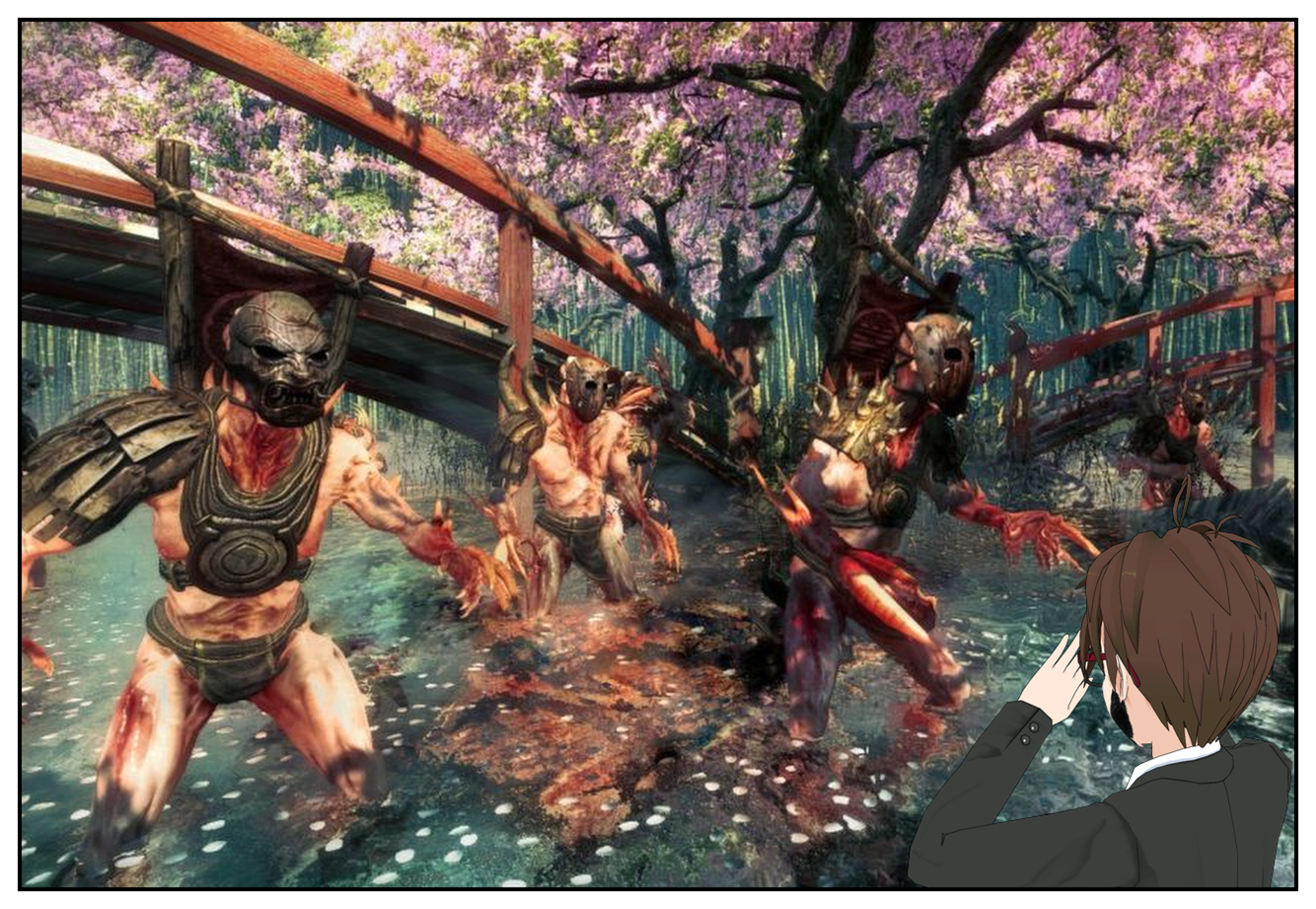
I finished the recent reboot of Shadow Warrior this evening, and I'm pretty astonished by quite how good that game was.

I really liked the original Shadow Warrior. A contemporary of Duke Nukem 3D and running on the same engine, it followed the mould for first-person shooters of the time by having varied levels, lots of enemies, a formidable difficulty level and a 3D engine that wasn't quite up to what the designers wanted to do at times. And, of course, a protagonist that spouted silly one liners at every opportunity.

The new Shadow Warrior is an interesting blend of old and new. There's clearly some old-school level design DNA in there, because the levels are all far from being Call of Duty-style linear corridors. The main route through each level is usually pretty obvious (and if it isn't, the game makes the next door you should go through glow) but, unusually for a modern shooter, there are plenty of opportunities to explore, leaving the main path of the level to "go and see what's over there". The game is packed with secrets of this type and is immensely rewarding for those who like to explore. There are even a number of "retro" secret areas that make use of the low-res textures from the original Shadow Warrior and flat lighting — not only do these provide pleasant fanservice for fans of the original, they also allow you to see immediately how far we've come in terms of graphics.

And boy, new Shadow Warrior is one hell of a looker. It's absolutely gorgeous from start to finish, with beautiful lighting, excellent texture work, interesting level designs and a variety of different environments. Plus it pays homage to the original Shadow Warrior and its other Build-engine contemporaries by setting the majority of its action in "realistic", relatable locations like city streets and parks, much as Shadow Warrior, Duke Nukem 3D and Blood all did.

The biggest surprise to me was how much I became invested in the story. In the original Shadow Warrior, again like its contemporaries, the story was largely throwaway, delivered mostly through the game's help text and short ending sequences at the conclusion of each episode. New Shadow Warrior, meanwhile, not only spins some convincing original Japanese-style mythology, it also converts protagonist Lo Wang from the admittedly amusing dirty old man he was in the original to a convincing (and younger) hero who has a genuine journey of development and self-discovery over the course of the narrative. He still spouts cheesy one-liners at every opportunity, but he does so with a certain degree of self-awareness, even giving up halfway through one at one point in the game and choosing instead to just say "fuck your mother" to the demon hordes he is attempting to dispatch at that moment.

Gameplay-wise, new Shadow Warrior is solid, too. Here it diverges a little from old-school Shadow Warrior's formula in that you don't encounter a trickle of enemies constantly as you explore the level. Rather, new Shadow Warrior adopts a somewhat Painkiller-esque approach, splitting each level into discrete encounters that sometimes consist of several waves of enemies in succession. They're monster arenas, basically, but the level design ensures that this structure doesn't become overly tiresome; it's pretty rare you'll just be dumped in a big room with a bunch of monsters. Instead, there will usually be plenty of cover to dodge around, destructible objects with which you can do additional damage and perhaps even some secret hidey-holes where you can get an advantageous position.

New Shadow Warrior's combat is exemplary for the genre. It doesn't overburden the player with a ton of possible weapons that all do basically the same thing (hi, Call of Duty) — instead, much like its old-school inspiration, it gradually introduces each weapon to the player one at a time over the course of several levels, until by the end of the game you're the sort of walking arsenal you were in '90s shooters, with each and every weapon having a situation in which it is useful. And the weapons feel great, to use; the shotgun is a particular highlight, having not only a satisfyingly loud noise, but the potential to blast pretty much anything into a fine paste.

Also worthy of note is the melee combat, which plays quite a central role for much of the game. First-person melee combat is often a bit crap, consisting of flailing wildly until someone falls over — indeed, the original Shadow Warrior's swordplay was rather like this. New Shadow Warrior, meanwhile, has a convincing feel of impact to its melee combat. When fighting melee-capable enemies, they'll block and parry your attacks convincingly, forcing you to outwit them. And with the game's various skill trees that you can unlock as you progress through the game, a double tap in a direction followed by holding one of the mouse buttons will unleash one of a number of different special attacks ranging from a simple powerful sword thrust to magic-like abilities that can control crowds, heal you, send out shockwaves or protect you from damage.

The reason the "monster arena" structure works is that it gives you time to appreciate the game's wonderful scenery and excellent level design in between fights. If the action was relentless, you wouldn't have much of an opportunity to do this, and developer Flying Wild Hog clearly knows that they've made a very pretty game. Not only that, but keeping the action to predictable "spikes" allows the player to take their time over combing the level for secrets without worrying about being attacked and potentially losing a ton of progress.

On the whole, I'm really impressed with new Shadow Warrior. It's one of the very best single-player first-person shooters (perhaps I should say first-person action game, due to the strong focus on melee combat) I've played recently — possibly one of the best I've ever had the pleasure of playing. And in a world where the bigger budget FPS titles are increasingly bland and dull, Shadow Warrior is a breath of fresh air.

2456: Miku in the Clouds

I've been playing some of Hatsune Miku Project Diva X recently. I opted for the Vita version because I enjoyed the previous installments in this series the most in handheld form, and when I tried the PS4 demo version, the timing calibration was so far off that it was borderline impossible to play.

So far I've been enjoying it a great deal. It's an interesting new structure compared to previous installments in the series in that it… well, has a structure. Previous games in the Project Diva series were all business, presenting you with a list of songs and a selection of difficulty levels to try them on, gradually unlocking new songs as you completed previous ones but never really having a sense of overall "coherence" — they were pure arcade rhythm action experiences, in other words.

Project Diva X, meanwhile, takes a much more formal structure from the outset, in effect acting as an interactive tutorial to concepts important to the game as a whole and locking off things that the player isn't "ready" for yet. Series veterans may find this a bit frustrating — though the Free Play option unlocks quite early — but newcomers to the series in particular will doubtless find it a lot more accessible, plus there's a rather charming story to tie it all together, giving the whole experience a significant injection of personality between the songs. (During the songs, one can never say that Project Diva lacked personality; in between them, however, was another matter.)

The basic structure for Project Diva X's early game sees you (as "you") collaborating with Miku in an attempt to restore power to the various "clouds" and consequently enable Miku and her friends to remember how to perform. It's lightweight fluff, of course, but it does a good job of tying things together, and also has the added benefit of grouping songs into categories according to their overall character.

New to Project Diva X is a gear system, where you can equip Miku or one of the other Vocaloids in various costumes and accessories, with a suitably coordinated outfit gracing you with an "aura bonus" and consequent increase to the "voltage" (score) you generate during a song. New gear is unlocked in several ways: accessories can be gained after a song if you filled the voltage bar at least once, while "modules" (full-on costumes) are acquired by successfully completing the "Chance Time" section of a song — this is accompanied by a satisfying magical girl-style transformation sequence.

This gear system is, I imagine, what will give Project Diva X a lot of its longevity along with the addictive high-score chasing of previous installments. There's something very satisfying about unlocking new items and producing new ensembles for Miku and the gang, and there's an element of loot-whoring gameplay about the whole thing thanks to varying degrees of rarity on the items.

On top of all this, there's a relationship-building metagame with Miku and the other Vocaloids where you can provide them with gifts and build up your affinity with each of them. This is a bit pared back from previous Project Diva games, in which you effectively hung out with the characters in their rooms and triggered various events according to what you put where, but there are still numerous special events to discover by providing the right gifts to the right Vocaloids.

Overall, I've been enjoying Project Diva X a lot. It remains to be seen if it has the same "legs" as its enormously addictive predecessors — whether it has a decent "endgame", in other words — but so far it's been a blast, and I can confidently recommend it to any fans of rhythm action games.

2455: Not-So-Super Max

0455_001

I finally got around to finishing the last episode of Life is Strange yesterday. My final feelings about the whole thing were… overall positive, but a little mixed in a number of areas. Personally speaking, I didn't feel it was the utter masterpiece most critics made it out to be; in fact, there were a number of aspects in the final episode that I found fundamentally unsatisfying and downright awkward. More on those in a moment; let's talk more generally.

SIGNIFICANT SPOILERS FOR LIFE IS STRANGE AHEAD. YOU HAVE BEEN WARNED!

Continue reading "2455: Not-So-Super Max" →

2454: Spooks and Spectres

0454_001

I finally got around to starting the Blackwell miniseries of adventure games this evening. These are some games that I've had in my GOG.com library for quite a while now, but have never gotten around to playing before.

So far as I'm concerned, the Blackwell games have a good pedigree, as they come from Dave Gilbert's Wadjet Eye Games, who produced the subject of the very first Squadron of Shame SquadCast, The Shivah. While The Shivah was a little lacking in production values (as, too, is Blackwell — at least, its first episode is, anyway; I can't yet speak for the subsequent ones) it told an interesting story and was a good adventure game to boot.

The Blackwell series centres around protagonist Rosangela Blackwell, last of her family line. Both her aunt and her grandmother succumbed to a mysterious mental illness, and Rosa discovers that she may be at risk too. What the psychiatrists didn't know, however, is that the Blackwell family has a legacy: a ghost named Joey, who has been stuck in between this life and the next for the last forty years, and who has found himself "attached" to each generation of Blackwell women to fulfil some sort of greater purpose. Rosa is the latest to discover the existence of Joey, and is determined to get to the bottom of who he is and why he has been haunting her family.

The Blackwell Legacy, the first installment in the series, is largely concerned with establishing the characters and the setting. Joey isn't present until a good halfway through the storyline; prior to that, we simply see life through Rosa's eyes as she learns what little there is to know of her family's mysterious apparent mental illness. Once Joey shows up, however, the story becomes much more supernatural in nature: he and Rosa team up to help restless spirits move on to the next world.

The Blackwell Legacy opens with Rosa investigating the suicide of an NYU student. It gradually comes to light that she and two of her friends had been meddling in the occult — did these people not pay any attention to horror movies? — and consequently, two out of the group of three had ended up dead. The girl Rosa was originally sent to investigate passed on with no regrets, it seems, but one of her friends finds herself stuck between realities, unable to accept that she is dead, while the third attempted suicide and failed, ending up in the same psychiatric hospital where Rosa's aunt spent her twilight years.

The story strikes a good balance between "real world" investigation and the supernatural; in order to help the restless spirit move on, Rosa has to research the people involved and what they were up to. The game features a cool "clues" system where Rosa makes notes of important people, places and things in her notebook, and these can then all be brought up as topics of conversation when questioning witnesses. There's also an Ace Attorney Investigations-style system whereby Rosa can "connect" pairs of these clues to produce a third clue based on her conclusion, and indeed most of the puzzles in the game revolve around doing this, then asking someone about it.

The Blackwell Legacy was a short but enjoyable adventure that I enjoyed a lot — it certainly made me curious to see where the story goes in its subsequent installments. Its low-res pixel art with jerky scrolling brings to mind the old LucasArts games, it had some good, atmospheric music throughout and the voice acting was decent — albeit done with poor equipment and software, a criticism which could also be levelled at The Shivah. Joey is particularly prone to shouting into the mic and performing with particularly plosive plosives, for example, while other voiceovers have a great deal of background noise, presumably as a result of boosting quieter voices up in volume a bit too much.

The game was also a bit prone to crashing to desktop — I'm not sure what it is about adventure games that make them some of the most crashy games on the planet, but I swear, of all the games that have crashed on my PC in the last few years, most of them have been adventure games — but fortunately there's an autosave system that prevents losing too much progress.

Overall, I enjoyed The Blackwell Legacy a lot and I'm looking forward to playing its sequels. If you're a fan of classic late '90s-era point-and-clickers, you could do far worse than check it out.

2453: A Meeting of Generations

0453_001

After a bit of fiddling around and faffing (and eventually giving up on the OSX side of things) I managed to get a 35-year old Atari 800XL talking to a modern-day Windows computer. Not only talking, but even reading and writing files back and forth.

The secret to this black magic is twofold. Firstly, you need a bit of kit called an SIO2PC module, which converts the signal from the Atari computer's SIO hardware — used for communicating with peripherals such as disk drives and cassette decks — into something which can be interpreted by modern systems, since SIO was a proprietary format and cable type. The SIO2PC module I had was serial-based, so I then had to run it into a modern computer using an RS232 to USB converter cable, since many computers these days don't come with serial COM ports as standard. The cable effectively sets up a "virtual" COM port via USB, tricking the serial device into thinking it's plugged into an actual serial port on the PC.

Once you've got that bit sorted, you need some software. There are three pieces of software I've experimented with today. Firstly, SIO2OSX just didn't work at all. I don't know if I didn't set it up correctly or if the Mac simply didn't have the appropriate drivers to set up the virtual serial port — though said virtual port certainly appeared for selection — but eventually I gave up and switched to my laptop PC, which has been gathering dust for a little while now.

Second up was Atari Peripheral Emulator, or APE for short. This Windows-based tool emulates a stack of Atari disk drives, printers and modems, allowing you to mount disk images and (theoretically, anyway) boot from them. I had trouble getting this part of the program to function correctly, but what did work was a separate application distributed as part of the APE package called ProSystem. This is a much simpler tool that allows you to either "rip" Atari disks to .ATR disk image files, or take an .ATR disk image and write it to a physical 5.25" disk to use in the Atari disk drive. While APE failed to do what it was supposed to, ProSystem had no problems whatsoever, reading from and writing to my ageing Atari 1050 disk drive with no problems whatsoever.

The final tool I tried was AspeQt, which is still in active development. AspeQt is pretty much an open-source tool that does most of the things APE does — APE is shareware — but I found it to work much more reliably than APE for simply mounting disk images and using the PC as a "virtual disk drive" for the Atari. AspeQt also has an excellent feature that I was specifically looking for: the ability to extract individual files from .ATR disk images and save them as standalone files on the PC filesystem. It even automatically converts from ATASCII — Atari's proprietary take on the now-standard ASCII character set — to standard ASCII, meaning that files such as AtariWriter documents can be easily transferred to PC for dumping into other applications with all the requisite line breaks and suchlike intact rather than being replaced with special characters.

My current Atari setup, then, is a bit of a kludgey mess, using ProSystem to rip and write complete disk images and AspeQt to mount and use individual files on a disk or image — ideally APE would act as an integrated solution for all of this — but it works, by God. And, boy, was it exciting to hear the 1050 snark into life when I clicked a button on my Windows PC. Just to prove it really worked, I downloaded a disk image for the AtariAge forums' current High Score Club games and wrote it to a blank disk. A few minutes later, I had a bootable floppy disk that you'd never know I'd downloaded from the Internet running on original Atari hardware. Black magic, I tell ye.

Getting all this working opens up all manner of exciting possibilities, and I'm sure I'll be exploring them more in the coming weeks.

2452: Dark Cloud, Revisited

0452_001

I first played Level-5's Dark Cloud midway through the PlayStation 2's lifecycle. I recall enjoying it enough to finish it, but finding it lacking in a few areas compared to some other role-playing games that were around at the time. Most of the criticisms I had of Dark Cloud were addressed by its sequel (known as Dark Chronicle here in Europe for some reason) but, regardless, I still have fond memories of the original.

Looking for something to fill the gap between now and Final Fantasy XV at the end of next month, I remembered that I'd bought several PS4 revamps of Level-5 games when they were part of a sale ages ago, but never booted them up. (Specifically, I got Dark Cloud, Dark Chronicle and Rogue Galaxy, the latter of which I've never played at all.) Since I played the demo of Dragon Quest Builders earlier in the week and heard it compared favourably to Dark Cloud and its sequel, I decided to fire up Dark Cloud and take another look, a good (probably) ten years or more after I played the original.

Interestingly, having played it for a couple of hours this evening, I'm finding myself liking it a lot more than when I played it the first time around. I'm not sure if it's a matter of my tastes changing (which, although I know they have a bit, haven't drifted that far away from what I enjoyed 10+ years ago) or if Dark Cloud has just aged very gracefully, but either way, I like it a lot.

For those who weren't around for Dark Cloud first time around for one reason or another, here's the gist. You play a teenage boy who looks a bit like a non-elfin Link in a poncho, who is a silent protagonist for the course of the adventure. In the opening moments of the game, your village is destroyed by a Dark Genie which, moments before, we saw had been unleashed on the world by an obviously evil gentleman in an M.Bison uniform and sporting a spectacular moustache. Somehow, you manage to survive through a windmill falling on top of you as you rescue your childhood friend and obvious love interest Paige from certain death.

Awakening to find your village nothing more than a bare patch of land, you start hearing voices. Specifically, the Fairy King decides you are his chosen one, and blesses you with the magical gem Atlamillia, which apparently will enable you to rebuild the world. Conveniently, the Fairy King explains, he managed to seal away all the people and buildings of the world in magical spheres called Atla to prevent them from certain annihilation at the hands of the Dark Genie, but unfortunately this wasn't enough to stop them from being scattered all over the place, with most of them rather inconveniently rolling in to local dungeons.

What then unfolds is a rather unusual adventure that alternates between action-RPG dungeon crawling in randomly generated maps, and a top-down building arrangement game called the Georama. The latter is sometimes described as a "sim", but it's not anything like as deep as something like ActRaiser or Dragon Quest Builders — all you have to do is find the component parts of each building, plop them down on the map, talk to the residents to figure out the right part of the map to put their building in (and which direction to face, in some cases) and then your job is done. In other words, there's no actual "management" required beyond making sure everything is in the right place, making it more of a puzzle than a simulation.

The Georama does give the dungeon crawling a unique twist, however — as well as finding treasures that your own character can use, you're also finding people and places, and in turn these can unlock new facilities for you to make use of when you return to the surface. Once you rebuild the Odd Gaffer's Buggy, for example, he'll start selling you items. Rebuild Paige's house and her father will teach you to fish. Even seemingly incidental houses will reward you with special events and items when you complete and place them correctly.

The Georama gameplay gives Dark Cloud an interesting sense of personality. Because you're quite literally rebuilding these people's lives from nothing, you get to know them quite well; far from being the random, anonymous NPCs you get wandering around towns in more conventional role-playing games, Dark Cloud's characters all have names and personalities. Some of them get along with one another; some of them don't (in which case you'll need to make sure their houses are far apart!).

Meanwhile, the dungeon crawling, although action-based, has plenty of aspects to get your teeth into. Your main concern, at least early in the game, is the game of "press your luck" you play with your supplies, because not only do you have to make sure your HP don't run out, you also have to keep yourself watered and ensure that your weapon doesn't break. This latter aspect is of particularly key importance, because weapons can be customised and level up through use, meaning if you break one it can potentially be absolutely heartbreaking.

The weapon growth and customisation system takes the place of a traditional experience and levels system. Instead, each weapon has its own level, with most capping at 5. Once they've capped, however, you can turn them into a gem that can be attached to another weapon in order to transfer some of the capped weapon's statistics and attributes. When the new weapon is upgraded, it absorbs the gem and becomes far more powerful than it would have been through just upgrading alone. Ultimately it becomes possible to construct some formidable weapons, making it all the more important that you don't inadvertently snap the blade on a passing rock monster.

Dark Cloud is charming and enjoyable, and there are still relatively few games quite like it; even Dragon Quest Builders itself is a distinct experience, focusing more on the town-building and crafting side of things than dungeon crawling. I think I made a good choice in revisiting it, and I'm looking forward to playing some more soon.

2451: GTA Online: Simultaneously Amazing and Shit

0450_001

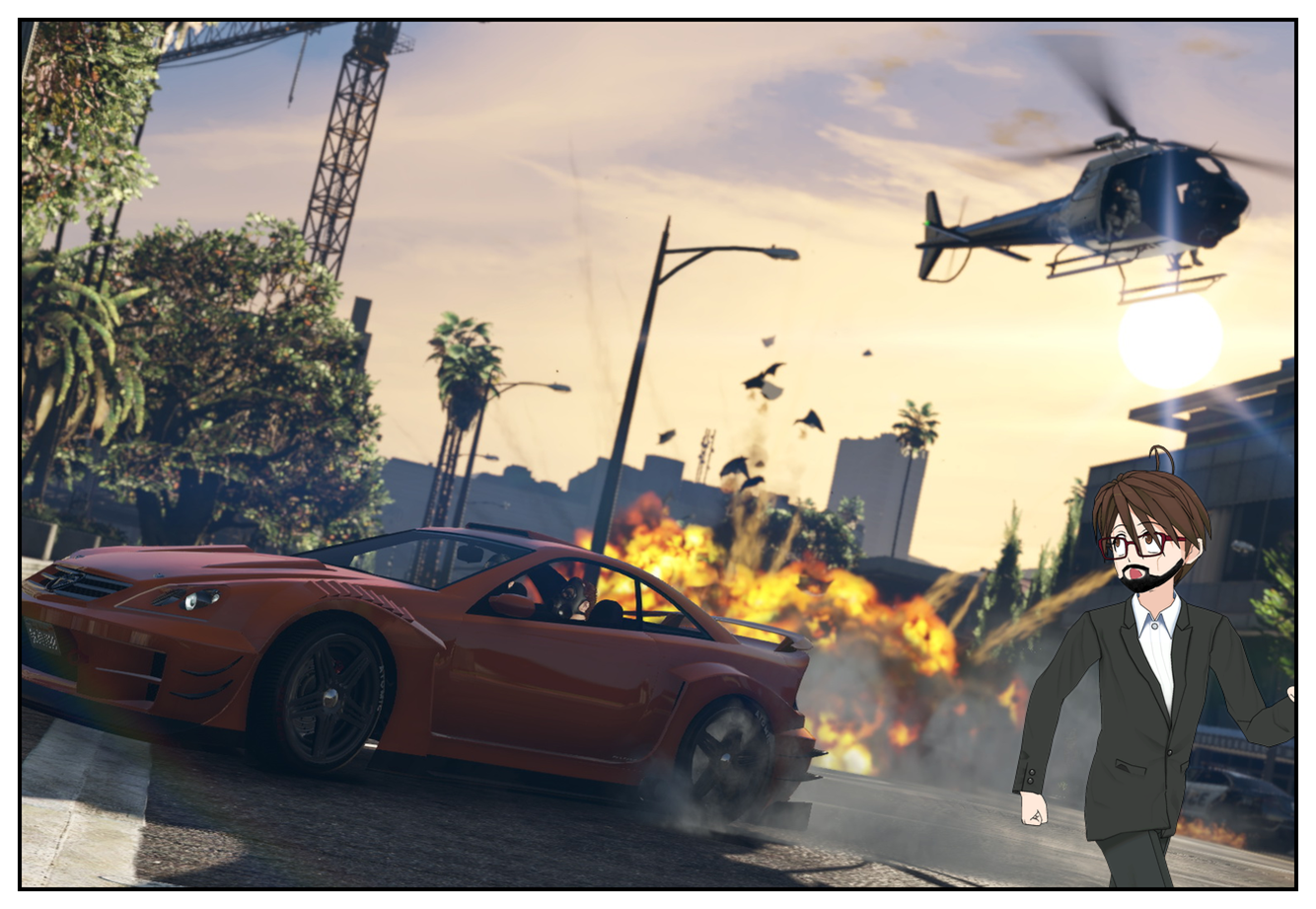
There are few things in this world that are simultaneously quite as amazing and quite as shit as Rockstar's Grand Theft Auto Online.

Every few months, I boot it up to see what's been added, and there's always been some pretty significant new content bolted on for free since I last tried. I get excited to try it, maybe even actually get to try it… and then before long I remember why I'm not playing Grand Theft Auto Online all day every day.

The most recent additions to the game — or new to me, anyway — are the Stunt races and the Motorcycle Clubs. The former provides a series of TrackMania-esque building blocks for track designers to construct physically improbable/impossible tracks using the game world as a backdrop, while the latter offers a new means of progression for small groups of up to eight players.

I haven't yet raised enough money to purchase a hideout for a Motorcycle Club yet, which is why I was doing the Stunt Races — conveniently, there's a trigger point for one right outside my in-game apartment. And I've been having an absolute blast participating in these races, which make the best of Grand Theft Auto's exaggerated vehicle physics with lots of jumps, switchbacks, corkscrews and all manner of other funtimes — plus, of course, the inevitable playing dirty that tends to come with the territory.

This was all absolutely great until the "host" of the session either went away from their keyboard or crashed, leaving their game logged in but not responding. Not only did this mean that we had to wait a long time between every event because the host wasn't there to manually press the "start event" button, but it also meant that at the end of one session in particular, everyone was left stuck as the results screen with no means of leaving the event or quitting back to the free-roaming mode short of completely quitting the game altogether then logging back in again. And with Grand Theft Auto V's astronomical initial load time, this is not a particularly appealing prospect.

I've run into this problem before, and I'm surprised it hasn't been fixed. Actually, no I'm not, because Grand Theft Auto Online is still missing a variety of features that a lot of other online games have had for a very long time.

Chief among the missing features is a "party" system whereby you and other players can form a group that sticks together, regardless of whether you're doing events or free-roam stuff. The game does keep people from the same event together if they vote to continue on to a new map, but if anyone chooses to exit to free-roam mode, they're immediately separated from all of the people they were just playing with.

Couple this with the fact that setting up a "friends only" game is a faff and a half, involving booting up Grand Theft Auto V's single-player game, then entering Grand Theft Auto Online from there — there's no means of starting a "friends only" session once you're already in Grand Theft Auto Online — and you have an online experience that is a real mess, particularly if you want to play with friends. And for those who think what I just described isn't a particular faff, you obviously haven't endured GTAV's load times.

It's kind of baffling how these features simply haven't been added to the game since it was launched, because I can't be the only one keenly feeling their absence. And it's frustrating, because the activities on offer in Grand Theft Auto Online are many, varied and a whole lot of fun. It's just such a monumental pain to get it working properly that I often give up out of sheer exasperation rather than wanting to stick with it.

GTA Online should be an absolute masterpiece. And it has the potential to be just that. But short of a fundamental revamp of how the whole online functionality works, it's doomed to remain an admirably fun and varied, yet ultimately frustrating and irritating experience that, for my money at least, often ends up feeling like more trouble than it's worth.

2450: Original Hardware

0449_001

Emulators are great and all, but there's something indescribably wonderful about playing old games — or using old applications — on their original hardware.

I hooked up my Atari 800XL to an old-fashioned CRT TV/monitor today, attached the 1050 disk drive and booted up a few old favourites from my childhood. And it's been marvellous.

One thing that's struck me with the retro scene of today is that you often hear the same game names coming up time after time, and they're more often than not console titles. For my money, while the consoles of the '80s were technologically superior — most notably with regard to scrolling and sprite work, which were done in hardware as opposed to the home computers, which required extensive poking around in RAM to accomplish the same goal — the games were far, far more creative.

I guess this is kind of a reflection of the situation we have today, where all the blockbusters come out on consoles, but the truly creative, weird indie games tend to hit PC first and perhaps consoles a bit later if we're lucky and/or the developers feel like jumping through Microsoft, Sony or Nintendo's respective hoops to publish their titles. The only difference is that home computers of today are regarded as the pinnacle of gaming technology, while the consoles represent the "affordable" option.

One thing I find especially interesting about the Atari 8-Bit scene in particular — and I'm sure it's the same for the Spectrum and Commodore 64; I just don't know those systems nearly as well — is that some of the most creative, interesting games were put out for free(ish) as type-in listings for magazines. All Atari systems could run the programming language Atari BASIC: early models had it on a ROM cartridge, while later models had it built in so that you'd just turn the machine on and it was ready to obey your every command.

The fact that absolutely everyone had access to this easy to learn (albeit not very efficient or speedy) programming language meant that magazines were able to publish complete programs sent in by readers or composed by staff members. Type the program listings into your computer using BASIC, save them to disk or cassette and voila: a free game or application for you!

Because these games weren't beholden to the fickle whims of publishers — not that even commercial games were particularly restricted in this regard at the time — the authors were free to be as batshit crazy as they wanted with them. And oh, they were: some of the greatest games on the Atari are some of the most abstract, in which the answer to the question "why does that happen?" is simply "because it's more fun and interesting that way".

Take a game called Duck Dash, published by renowned Database publication Atari User in July of 1987. This is a game in which you play a farmer (inexplicably represented by a green diamond) as he runs around his farmyard trying to gather up his ducks in preparation for Hurricane Harriet. A simple enough concept, you might think. But there are two farmer-eating spiders wandering around the farmyard. And the ground is so muddy that you dig out bottomless pits behind you with every step you take, meaning you can't retrace your steps.

Or how about Doctor Boris, from the same publication a few months later? So confident was Atari User in the quality of this game — written entirely in BASIC — that they declared it "Game of the Year" on their front cover, promising "the ultimate challenge". In Doctor Boris you play the eponymous doctor, a recent graduate from medical school who has come to his new hospital in the North of England only to find that it's still a building site, so it's up to the good doctor to finish the building work himself. Also there are unexploded bombs scattered around the area. And your supervisor has skin so bad it is fatal to the touch. And there are radioactive skulls buried everywhere.

Ridiculous and insane-sounding, right? Obviously. But the thing is, these games play really well. They're simple, they have clear goals, they're well designed and their rules are self-explanatory. Above all, they've been designed with fun and challenge in mind, not realism, and for this reason they've aged better than a lot of other games I could mention, even with their primitive graphics and sound, not to mention their slow initialisation routines thanks to them being written in BASIC.

We have games that are this silly these days, of course, but when it happens today it always feels very much like they're being designed as wacky YouTube-bait — that they're trying a bit too hard to be funny. Neither Duck Dash nor Doctor Boris are trying to be funny or ridiculous; their premises and setup are pretty much irrelevant once you start playing, and the focus is entirely on providing a satisfying, enjoyable and challenging experience for the player. To put it another way, they "play it straight" rather than the whole thing being infused with the feeling that the game is going "HEY! HEY! LOOK AT ME! I'M HILARIOUS!" that you get with modern "creative" titles like, say, Shower With Your Dad Simulator and suchlike.

Anyway. So far it's been an absolute pleasure to boot up these games — many of which are often neglected and forgotten by the broader retro scene thanks to them not being commercial releases — and I anticipate there are plenty more treasures hiding in the disk boxes full of not-at-all-pirated-games-honest that I happen to have standing by. You can probably count on hearing about a few more in the near future!

2446: We've Reached Peak Idiot

0445_001

At least, I hope this is peak idiot: I present to you an actual article that appeared in the actual business section of the Washington Post, which sported the headline "Is your dog's Halloween costume sexist?"

No. No, your dog's Halloween costume is not sexist. It is a costume for a dog.

Between this and Vice's recent monstrosity of an article about Forza Horizon 3, in which the writer proceeds to spend 1,500 words using the Australian setting of Forza Horizon 3 (a game about nothing more than driving pretty cars very fast around pretty scenery) as an excuse to go off on a tirade against Australian politics in general (actual specific references to the game come in just two out of the article's 13 paragraphs), it's hard to imagine if online journalism can get any worse. It's even harder to imagine exactly why there are people out there who still defend this kind of garbage.

I've been continuing to read old back issues of Page 6, Atari User, ANALOG, Antic and ACE recently, and one thing that repeatedly strikes me whenever I read any of these magazines is that the writers know their audience because they are part of that audience. And in the case of all those magazines, that audience is computer enthusiasts; who better to write for them than fellow enthusiasts? Should be a no-brainer, surely.

Nope; instead we get dross that reads like it was written by a recent Social Sciences graduate and which inevitably takes a negative tone of some description — usually of the "Here Are All The Reasons You Should Feel Bad for Liking the Things You Do" variety — rather than performing what, I believe, is a much more valuable function: bringing people together under the banner of the things they love, celebrating those things and perhaps teaching them some intricate, specialist details.

Take the old Atari magazines. Every single one of these, without fail, opened its first issue with a comment from the editor about how Atari computers are far more than just the games machines that people at the time apparently assumed they were. The stated aim of Page 6, ANALOG, Antic and Atari User alike was to explore the length and breadth of titles available for the Atari computer, teaching enthusiasts new things along the way. These old magazines had type-in BASIC listings with full breakdowns of what was happening where in the program, memory maps of the computers so you could learn to program in machine code, special techniques that could elevate your programming from "eh" to "wow!" and all manner of other stuff.

The most negative things ever got was in the editorial section, where editors would occasionally vent their spleen about Atari's repeated failures to market their own products, or about how they had been let down by industry contacts. This was always framed as an explanation of why, say, the issue didn't have a feature that readers might expect, rather than being the sole point of the article. The articles themselves were all positive in tone, often educational and far less frustrating to read than the daily garbage modern online journalists seem to be expected to churn out to order.

Times have changed, of course. Magazines used to be published monthly or, in some cases, bi-monthly. Internet publications are expected to be updated on a daily basis, otherwise they are seen as "irrelevant" and "not up to date". With the amount of pressure on Internet writers, it's little surprise that they pluck something out of their arse that they know will "get people talking" (i.e. is contentious for one reason or another) rather than spending the time to do proper research or to enthuse about the things they are passionate about.

There's too much negativity in the world as it is, and it's coming from all angles: both traditional media and social media. Negativity begets negativity, and the longer it goes on, the more cynical we get. We're at a stage now where many people simply don't trust the online press to cover things as an enthusiast would, and that's going to be hard to recover from. Meanwhile, the Men In Suits see outrage-bait like the articles linked above as "successes" because they bring in the clicks and consequent advertising revenue.

Advertising impressions lie, however. An impression on an article in the commercial press doesn't mean someone liked what the author had to say. More often than not, it's the result of someone having a look at an article out of sheer disbelief that someone really wrote an article about dogs' Halloween costumes being sexist, or about how Forza Horizon 3 depicts a "better Australia than [Australians] deserve".

I wish it were possible to just make this mess stop, and for us all to go back to a world where enthusiasts write about the things they are knowledgeable about rather than everyone, everywhere trying to make everything somehow "political". There's a time and a place for politics, and, unless you are reviewing a game that deals with political issues — either through its narrative or its mechanics — then that place is emphatically not in the games press. Certainly not in an article about a driving game; and certainly not in an article about a driving game that exists solely to revel in the sheer joy of driving.

Also, you can dress your dog up however the fuck you like so long as you're not hurting it. Make it extra slutty, take loads of photos for Facebook and immediately unfriend anyone who whines about sexism. You don't need dickholes like that in your life.

2445: The Best Music of Final Fantasy XIV

Since I appear to be on a Final Fantasy XIV roll at the moment thanks to the excellent new patch, I thought I'd devote today to some of my favourite tunes from the game as a whole.

I respond very strongly to music that I enjoy — so much so that any time I think about hanging up my Eorzean adventurer's shoes for good, it's pretty much always the music that gets me coming back time after time. Or, if it's not the only reason, then it's certainly a leading reason as to why I keep coming back.

So let's look at some great tracks from the game.

"Patch 3.4 boss theme"

I don't know if anyone knows the actual name for this theme yet, but it's an excellent one. It seemingly became tradition with A Realm Reborn that the last couple of patches in a cycle would use different boss music from the ones we had been enjoying previously, and Heavensward is continuing — or, perhaps more accurately, confirming — this tradition.

This boss theme mixes two important themes from the game as a whole: Heroes, which we'll come to in a moment, and Penitus, which we'll also come to in a moment. To put it another way, it mashes together one of the most recognisable musical motifs from Heavensward with one of the most recognisable musical motifs from A Realm Reborn to produce a track that very much feels like a "reward" for people who have at least been playing since 2.0.

Heroes

This theme, played during vanilla Heavensward's final boss fight against King Thordan and Knights of the Round, brought the already exciting story of FFXIV's first expansion to a climactic head. While the fight was a bit easy even when it first launched, people still enjoy running it today just to enjoy this music and the spectacular graphical effects throughout the battle.

Penitus

I was already thoroughly wrapped around this game's little finger by the time I got to level 50 and was faced with the two 8-player story dungeons that wrap up vanilla A Realm Reborn's storyline, but getting into Praetorium and hearing this wonderful piece of music — snatches of which had been heard in a variety of different styles right the way through from level 1 all the way to 50 — got me absolutely hyped to see the story through to the end.

Ultima

And then the game goes and throws this incredible track on you for the Absolutely Definitely Last Boss, Yessirree (Not). I'll let this one speak for itself.

Thunderer

Ultima is followed by this little wonder featuring one of the best key changes ever. Sadly the first time you hear it, it doesn't last anywhere near long enough because everyone absolutely obliterates the Real Final Boss, Definitely Totally For Real This Time in a matter of seconds these days.

Thankfully, Square Enix clearly knew they were on to a good thing with Thunderer, as it was reused in a couple of places — most notably in the Chrysalis trial which was added in one of the content patches, and, for many people, its most iconic appearance in Turn 5 of the Binding Coil of Bahamut, in which you fought the dread dragon Twintania, and which in the game's vanilla release acted as the "true" final boss. (Of course, this later all changed with Second and Final Coil, but still.)

Footsteps in the Snow

Shiva was one of my favourite Trials to be added to the game almost entirely because of this excellent piece of music that opened the fight and ran until the phase change. This music was first heard in the trailer for patch 2.4, Dreams of Ice, and got everyone well and truly hyped.

From the Ashes

Raid dungeon The Final Coil of Bahamut was, for many players, a highlight of the game due to its fascinating story — which, unlike the narrative of A Realm Reborn itself, which span off in a different direction, followed up on how Final Fantasy XIV 1.0 ended. Turn 12, the penultimate turn, is often cited as a particular favourite by many players simply due to this unique music, which was a highly dramatic, spine-tingling take on A Realm Reborn's main theme song Answers. The whole of The Binding Coil of Bahamut had featured music based on Answers, and this track felt like it was bringing everything to a dramatic conclusion.

Answers

And, having mentioned Turn 12, it would be remiss of me not to mention the way Answers was used in Turn 13, the absolutely definitely positively totally final boss of the game, or at least of the raids. I present it here in context, including battle sound effects, to show how it is used in the fight itself. The incredible crescendo during Teraflare is made of goosebumps.

I'm yet to do the new Alexander raid — my item level isn't quite high enough yet — but I understand the grand finale is suitably spectacular. T13 is going to take some topping, though.