2470: The Not-Games

0470_001

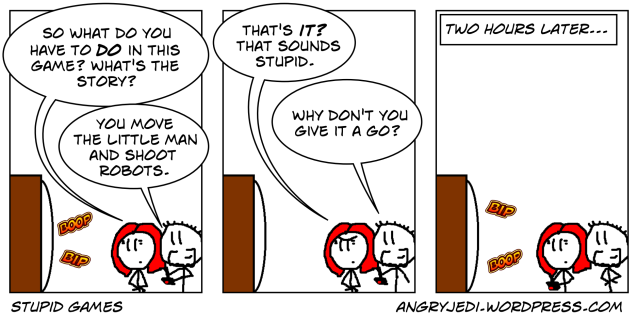
There seems to be a perpetual struggle in the world of video game enthusiasts to define exactly what is and is not a game.

At the head of this nontroversy is Fullbright Studios' Gone Home, a first-person interactive story where you walk around a house sans its inhabitants, piecing together a number of different plot threads scattered around the place, some of which are more explicit than others — and some of which are handled better than others. I liked Gone Home, but I felt like its "main" story — the one that lets you "finish" the game when you reach its ultimately rather mundane conclusion, despite what it has built you up to expect — was by far its weakest aspect, with much more interesting things going on through the "unspoken" stories: the bottle of whiskey hidden on top of a bookcase; the condoms in a drawer; the documents lying around the place.

To some people, Gone Home isn't a game, much as similar games in the genre that has become semi-derisively known as "walking simulator" aren't considered games either. Dear Esther, The Stanley Parable, Everybody's Gone to the Rapture, and others like them: all too many people are far too hung up on the rather dull question of whether or not they are actually a game rather than unpacking the dense, interesting narratives that each of these experiences feature.

For some reason, visual novels appear to largely escape this sort of discussion, despite being less interactive than a walking simulator. In your average visual novel, you click through reams of text for hours and hours and hours and occasionally make a choice. In a particular subset of the visual novel called the kinetic novel, you don't even make any choices: you just read and read and read, and then it's over with you not having actually done anything.

Even these almost entirely non-interactive affairs don't seem to get lambasted in the same way as Gone Home and its ilk, though, despite arguably being less of a "game" than something that has a 3D engine, WSAD movement controls and mouselook. In fact, even some of the most well-regarded games in the genre — The Fruit of Grisaia is the most prominent that springs to mind — only have maybe one or two meaningful choices to make in the whole game, with each acting as a fairly transparent means of setting a flag as to which character's route you're going to follow, and whether your get their Good or Bad ending.

I wonder why this is? Is it subject matter? No, I don't think so, because while, say, Gone Home has its narrow-minded detractors for being "progressive" — I think the statute of limitations is probably up on it by now and we can say its main story is actually about a young lesbian couple running away together — there are certainly plenty of well-regarded visual novels out there that deal sensitively with homosexuality, both male-male and female-female.

Is it about artistic intent and the overall "honesty" of the work? Perhaps. Titles such as Everybody's Gone to the Rapture often draw ire for being "pretentious" and, while I enjoyed all of the titles I've mentioned thus far, it's kind of hard to argue with that label. Everybody's Gone to the Rapture in particular feels very much like a case of "let's make this as arty and confusing as possible" before kind of running out of steam in its final moments and getting just a bit too silly and implausible. Dear Esther suffers from a similar problem, deliberately mixing a number of different narratives together — with some randomisation in the mix, too — to try and obfuscate what the whole damn thing is actually about for as long as possible. The Stanley Parable, meanwhile, completely runs with this and knows exactly what it is doing, laughing along with the player at every opportunity, too.

Contrast with a visual novel, such as the one I'm currently reading/playing: Supipara, by minori. Supipara is a kinetic novel: there are no choices whatsoever. Yet it's charming, compelling and addictive purely by virtue of its beautiful presentation, likeable and mysterious characters and intriguing premise that blends the mundanity of a slice-of-life tale with elements of the supernatural.

At no point does Supipara let any part of itself run away or overwhelm the rest of it. Its supernatural elements are incorporated honestly and without attempts to obfuscate or explain them away as quickly as possible, hoping we won't notice — Life is Strange, I'm looking at you. It just is what it is, and it invites you to judge it on that basis. There's no need to critically analyse it just to understand what the fuck happened in it — though this isn't to say there isn't value in applying some literary theory to unpack the various subtexts and themes in it — and thus it can be enjoyed on a number of different levels without Dear Esther's implicit suggestion that "you must be this smart to enjoy this ride".

I don't have an answer to the question "is [x] actually a game?" because your definition of "game" will doubtless be different from mine. Ultimately it doesn't really matter, anyway; the only thing you should be asking yourself when engaging with a piece of interactive entertainment — regardless of how interactive — is, quite simply, "is this a good use of my time?" If yes, great. If no, maybe put it down and try something else instead, while acknowledging the fact that some people might enjoy it more than you. There's really no need for the bitter arguments that have ensued since technology has allowed developers to get a bit more "artsy" with their creations.

Supipara is great, by the way. I'm going to do a full write-up on MoeGamer in the near future once I've read the whole thing, but for now I'll say it's one of the most beautifully presented visual novels I've ever seen, has a compelling, if low-key story, and some grade-A waifus. And what more, really, do you need to have a good time of an evening?


2467: Encylopaedia Eorzea

0467_001

I'm going to do a more detailed write-up on this over on MoeGamer when I've read and thoroughly digested everything in this massive tome, but I thought I'd give some initial thoughts here.

Encylopaedia Eorzea is here! Yes, for a long time the Final Fantasy XIV team had been suggesting that a lore book might be on the cards, and at FanFest last week, it was finally revealed. It was put up for sale at the start of this week and seemed to develop a waiting list very quickly; fortunately, I managed to get in early and snag a copy.

£34.99 gets you a formidable hard-backed book over 300 pages in length, printed on gorgeous thick, parchmenty paper and presented in full colour. The book is heavy enough that it would probably do some damage if you smacked someone with it — and you all laughed at Arcanist, Summoner and Scholar's auto-attack!

The tome as a whole is split into eight different "books", each dealing with a different aspect of Eorzean lore.

The first, and shortest, concerns "the basics" of the planet Hydaelyn and what makes Her tick, including geography, the relationship between Hydaelyn's light and Zodiark's darkness, the Twelve gods in the Eorzean pantheon, and the basics of "aetherology" — the underlying (fictional) science of how the elements interact with one another to create life, magic and other effects.

The second, and one of the longest, concerns Hydaelyn's history, reflecting on the world's cycle of Astral and Umbral eras, with the latter's arrival being heralded by a Calamity of some description — each elementally themed in the case of the first six, and the seventh (used as the initial story catalyst for A Realm Reborn) covering all elements in the sheer magnitude of its disaster. This book is particularly interesting because it gives some background reading on the mysterious ancient civilisations of the Amdapori, the Mhachi and the Allagans, all of whom are explored to a certain degree in the game itself. It also provides a good primer of the storyline for Final Fantasy XIV 1.0, which is no longer playable, but which is concluded through A Realm Reborn's cycle of raid dungeons, The Binding Coil of Bahamut, The Second Coil of Bahamut and The Final Coil of Bahamut.

The third book provides a primer on the different people of Eorzea and where they came from. It only explores the playable races of Hyur, Elezen, Lalafell, Miqo'te, Roegadyn and Au Ra — those hoping for some information about the Padjali or a hint as to whether or not we'll ever see Viera in the game will have to keep theorycrafting.

The fourth book is the longest and concerns the geography of Eorzea, including all the zones from A Realm Reborn and Heavensward as well as short look at Ala Mhigo (subject of the upcoming expansion Stormblood) and the Garlean Empire (recurring villains).

The fifth book concerns Hydaelyn's "servants", and explores the various characters that you come into contact with throughout the game, right from the main "protagonists" the Scions of the Seventh Dawn to the recently introduced Warriors of Darkness. This section also includes information about groups involved in sidequests in the game, too, such as Hildibrand's Agents of Inquiry, the organisation NOAH who spearheaded the investigation into the Crystal Tower and a section entirely devoted to more minor NPCs such as those who served as the face of the Relic quests, and poor old Edda, who has had a rough ol' time of it both during life and in death.

The sixth book looks at Hydaelyn's "disciplines" — in other words, the playable classes in the game. Interestingly, the book makes no mention of the base classes on which the more familiar "Jobs" are based; the focus is entirely on the higher-level incarnations of the Jobs.

The seventh book concerns Hydaelyn's "burdens" — the various beast tribes of the realm, and the Primals associated with each of them. This section also looks a little at as-yet underexplored groups such as the gigants, as well as the eikons of the Warring Triad, which we're halfway through the story for in the game at the time of writing.

The eighth and final book is a bestiary of monsters from around the realm, divided into the various "-kin" categories. It also incluides a look at voidsent, elementals and chimeras.

There is a lot of information in this book, and it's presented in a clear, enjoyable to read manner. The thing I've found most beneficial about it is that it provides a good summary of the various storylines that have unfolded during the game since its launch; this is several years ago now, so it's not surprising that some details may have slipped many players' memories! The lore book acts as a good reference guide for those who may have forgotten some of the finer details.

Above all, though, Encyclopaedia Eorzea is clear evidence that the team behind Final Fantasy XIV have built more than just a game. They've truly built a world for people to inhabit, which has its own history leading up to today, as well as many more stories yet to tell. And if you flip through it's pages, you'll understand just why so many people still like to call Eorzea home.

2464: The Palace of the Dead (Savage)

0464_001

Final Fantasy XIV's patch 3.45 is coming in early November, and bringing with it an additional 150 floors to the game's current Deep Dungeon, The Palace of the Dead. I am excited.

Palace of the Dead is a great piece of content that I'm pleased has remained popular since its launch. It flips most of the conventions of MMOs on their head and provides something different for people to do, with meaningful rewards and a decent shot of experience points for those levelling alt classes.

Palace of the Dead, in case you're unfamiliar, is a 50-floor dungeon that you tackle in blocks of 10 floors at a time, with a boss on each 10th floor. Each floor consists of a number of rooms arranged in a randomised layout, with an exit portal in one room and a resurrection gizmo in another for if things happen to go south and you don't have a healer. Both of these things are inactive at the start of a floor, so you have to kill enough enemies to turn them on before they can be used.

Some rooms have treasure chests and occasionally monsters drop them too. These come in three different varieties: bronze chests hold consumable items such as Phoenix Downs to resurrect fallen comrades and potions to heal HP; silver chests have a chance to upgrade either your weapon or armour (with the chance getting smaller as they get more powerful) up to a maximum of +30; gold chests reward you with "Pomanders", which are items that have immediate beneficial effects such as increasing your damage, turning all enemies in the nearby vicinity into chickens or frogs, temporarily transforming you into a manticore or removing all the hidden traps on the current floor.

In the last major patch, the Accursed Hoard was also added to Palace of the Dead; these are hidden treasures that have a chance of spawning on each floor. Standing on a spot where a Hoard is hidden reveals it, and if you successfully clear the block of 10 floors, you get one sack per Hoard you found, each of which contains a randomly drawn item from what seems like quite a large selection, ranging from the useless (fireworks) to the very useful (grade V materia) via formerly expensive glamour items.

The thing I like about Palace of the Dead is it takes almost everything the rest of Final Fantasy XIV established in terms of gameplay and throws it out of the window. Item level doesn't matter, stats don't matter and even conventional party composition (one tank, one healer, two damage-dealers) doesn't matter. There's some variation in individual performance according to the upgrade level of your aetherpool gear (which you can only use in Palace of the Dead until it reaches its fully upgraded level of +30, at which point it can be exchanged for a level 60, item level 235 weapon that you can use in the rest of the game) and your character level in Palace of the Dead (which is different to your character level in the rest of the game; you level up at a considerably accelerated rate in the dungeon, but have to reset to 1 every time you restart from floor 1) but otherwise, how well you do in there is entirely down to how well you know how to play your class.

It's interesting to see people realising this for the first time. You can't just ignore mechanics in Palace of the Dead because it's literally impossible to outgear it. You can't stand in area-effect attacks and soak the damage because, again, you can't outgear it. And you can't pull 30 enemies at once and hope to survive because, you guessed it, you can't outgear them. It's all about careful use of your abilities, consumable items and the Pomanders; you have to be constantly aware of the situation of both yourself and your party members, as an unfortunate mistake could lead to a wipe — and if you wipe in Palace of the Dead, you fail that set of floors immediately and have to start again from the last "checkpoint" you reached. (This is particularly heartbreaking if you reach the final boss on floor 50 with 5 Accursed Hoards in your pocket and then wipe because you forgot to pay attention to mechanics.)

The reason I'm looking forward to Patch 3.45 is that it promises not just more of Palace of the Dead, but that its last 100 floors in particular will be very difficult. And not "very difficult" in the sense that the current Savage raids are very difficult — i.e. they get quite a bit easier if you take the time to buff up your gear level — straight up difficult in that you'll have to pay attention, dodge shit and play your class effectively, perhaps in an unconventional party formation.

I'm interested to see quite how they're going to make it difficult. People have been clamouring for difficult ("Savage") four-player content for quite some time now, and Yoshi-P and the team specifically said during the last Live Letter that the lower 100 floors of Palace of the Dead were designed to be just that. What I find particularly interesting is that this is (hopefully) super-difficult content that you don't need to have spent ages preparing to be ready for, because your gear level when you go in doesn't matter; everyone in the entire game, assuming they have Palace of the Dead unlocked (which they can do as early as level 17 rather than having to reach the current cap of 60), has the potential to be a "world first" clear, which is something that has never happened before. Previous "world firsts" in the game were by raiders who were at the absolute top of their game with the best possible gear available, so in most cases it was fairly predictable who the acclaim would go to. With this, however, the title is anyone's.

I'm also intrigued by the proposed ranking system and how it works, since that hasn't been explained in much detail before. We know that there will be rankings for both individuals and parties, and that rankings are stratified by class/job, but we don't know exactly what causes you to score the "points" that determine your place on the rankings. Progress through the floors is a given — the mockup leaderboards we saw during the Live Letter displayed both the floor the characters had got to and their score — but what else will contribute to it? Clear time? Damage done? Kills? Accursed Hoard finds? Treasure chests looted? All of the above?

If they handle this properly, Palace of the Dead has the potential to become an enormously compelling metagame in its own right within the wider context of Final Fantasy XIV, not to mention a great way to learn and level alt classes that you perhaps haven't used much before. I'm very much looking forward to challenging the lower floors of this Deep Dungeon, and hope that it provides a suitable alternative to raiding for those who seek a challenge but perhaps don't have a group, have difficulty getting everyone together at the same time, or simply aren't geared enough.

I guess we'll see soon enough! (Also, I really want to see what happens when you sit on that bench…)

2463: You Can't Win Them All

0463_001

"You can't win them all" is one of those platitudes we hear numerous times throughout our lives. In childhood, it's used as a means of attempting to stop the inevitable crying after we lose a game against a sibling or fail to achieve something we really wanted to achieve. And in adulthood, it's used in circumstances ranging from the loss of a job to the end of a relationship.

And yet I feel it's a saying that a lot of people these days seem to have forgotten.

Today I've been playing a game called Delicious! Pretty Girls Mahjong Solitaire which, as I said in my writeup on MoeGamer earlier, is exactly what it sounds like. I've been having a lot of fun with it; mahjong solitaire is one of those simple-but-challenging things that I find enormously addictive, and Delicious! certainly likes to slap you around a bit with its various tile layouts. But that's all part of the fun, as is the case with pretty much any non-free-to-play-garbage puzzle game produced since the dawn of computing: the fact that victory always seems attainable, yet is often just beyond your grasp is what makes these experiences so enjoyable, exciting and addictive.

And yet, glancing at the Steam reviews and discussion pages, the most common complaint people seem to have about the game is that "it's too hard". The timer's too quick. The game gives you too many "unwinnable" layouts. In other words, it doesn't let you win every time. (A similar swathe of criticism was levelled at Frontwing's excellent ecchi puzzler Purino Party.)

"Victory" is something that people the world over seem to think they have become entitled to, with the fact that whenever you're doing anything competitive, the possibility of losing is what makes it competitive in the first place. You see it everywhere: in the Delicious! forums, where players complain that they have to keep trying levels until they get it right; in Final Fantasy XIV, where people vote to abandon a duty after the first party wipe rather than helping newcomers or people who aren't as familiar with the fights; in Overwatch, where someone will rant and rave at their team if they lose, completely ignoring the fact that there's always the possibility that you are, you know, simply outmatched.

It's hard to say exactly where this attitude comes from, but it seems firmly ingrained in society now, and repeatedly reinforced by lots of things that we do, particularly online with the growth of "gamification". "Well done!" everything seems to say, showering you with points, levels and achievements and inevitably begging you to "share" everything on social media. "You used this thing for the thing it was designed to do!"

People often joke about school sports days that don't have winners any more, but I've seen it happen: kids getting "participation trophies" even if they did the bare minimum. I've also seen "Celebration Assemblies", in which children get certificates for everything from getting 100% on a spelling test to — I'm not joking about this — sitting still in their chair for a whole lesson. This continues into adult life, too; at work Christmas parties, there's the inevitable cringeworthy "awards" ceremony, where whatever "lol, so random" douchebag who organised the whole debacle dishes out a series of completely arbitrary awards to ensure that everyone gets recognised for something, even if that thing is "drinking lots of coffee" or "being able to spell".

Failure is what makes experiences like games fun and exciting. If you win every time, you devalue the concept of winning until it is completely meaningless, and nothing feels worthwhile any more, which means you start to crave — or expect — more and more positive reinforcement with every passing day, and get annoyed or upset when your every whim isn't catered to, or things don't go the way you expect them to.

Me, I've had my fair share of failure, but every time I get a TIME'S UP or NO MORE PICK [sic] I just hit the Retry button, give it my best shot and eventually I might actually succeed.

Now, if only it were that easy to pick yourself up and start again after a repeated series of failures in life as well as games.

2461: Gratuitous Self-Promotion

0461_001

Hey, you. If you're reading this, chances are you know me in some capacity or another, either online, offline or perhaps both. You may even follow this blog on a semi-regular basis, in which case thank you very much for enduring my directionless rambling.

Some of you may not be aware that I have another site, however; one with a bit more "structure" to its content, but also with a regular posting schedule. Some of you may already be aware of it, but perhaps haven't checked it out for a while. And some of you may already be loyal readers, in which case, again, thank you very much.

My other site is called MoeGamer and you can find it at http://moegamer.net.

MoeGamer has a pretty straightforward mission: to provide detailed and in-depth coverage of Japanese and Japanese-inspired games that often don't get the attention they deserve in the mainstream press — or, in the worst cases, get written off for one reason or another, usually on the grounds that they're "pervy".

I started it as a continuation of a regular, weekly column I had when I worked as USgamer; dubbed JPgamer, the column built up an audience of regular readers who appreciated what I did for these games, which was something that many other sites didn't bother with, particularly in this age of growing and obnoxious political correctness that seems inclined to brand anything with pretty girls in as "problematic". After I was laid off from USgamer, I decided to start MoeGamer simply to continue what I was doing with JPgamer, but over the course of the last few months I've been building it into something bigger.

Back in March of this year, I decided to reboot MoeGamer into something with a bit more structure; prior to this point, I had simply posted content on it whenever I felt like it and about whatever topics I saw fit. This meant that there were often long periods of time when I didn't post anything, and I wasn't happy with that.

As such, my reboot of the site sees me posting on a weekly basis, with a specific focus on a "cover game" for a month-long period. Over the course of four articles, I explore these cover games from a variety of perspectives: a look at their historical context; an exploration of their mechanics; a deep-dive into their narrative, themes and characterisation; and a look at their audio-visual aesthetics. This has proven to be a good way for me to talk about each of these games in as much detail as I'd like without overwhelming readers with a single, insanely long article. (Make no mistake, this is still long-form writing, however, because I believe there's plenty of people out there still hungry for detailed writing even as the collective attention span of Internet denizens has gone right down the toilet in the last few years.)

MoeGamer is primarily intended for existing enthusiasts of Japanese (and Japan-inspired) gaming and entertainment, but I make a conscious effort with each piece to keep things accessible to everyone without any assumed knowledge. The order in which I chose to post the articles about each "cover game" was deliberate, too: talking about a game's history gives you the opportunity to introduce it in general terms to those who aren't familiar with it, then a discussion of its mechanics gives most people an idea of whether they'd enjoy playing it. After that, an analysis of its narrative is "taking things to the next level", as it were, and finally exploring its audio-visual aesthetic provides a good opportunity to provide "further reading" with regard to its art, music and inspirations.

In other words, don't feel like there's nothing for you on MoeGamer if you're not an existing fan of Japanese popular entertainment. I strive to make the site an informative, knowledgeable resource about some of the most interesting and underappreciated games on the market, from both yesterday and today, and hope that over the course of my articles, I can do my part to help dispel some of the unhelpful preconceptions that mainstream media perpetuates with regard to Japanese popular entertainment.

I'm doing this as a passion project at present, but a number of readers have been generous enough to pledge their support to my work via Patreon. At present, it's a much-appreciated trickle of money each month that perhaps pays for a new game or piece of equipment, but it would be a dream come true to make enough money from MoeGamer to call it an actual job. I'm skeptical as to whether that will ever happen, but in the meantime I'm eternally grateful for each and every person who has shown their support to the site. If you like the sound of what I'm doing, please do consider pledging a small amount per month and help me keep doing what I love doing — you can do so here.

If you can't spare any cash, that's fine, too; you can also show your support by paying the site a visit and sharing the articles you particularly enjoy with friends and family on social media. MoeGamer is not ad-supported (any ads which do appear are WordPress' work, not mine) and so remains clickbait-free, 100% guaranteed — share with confidence!

Thanks for your time and support. I hope you enjoy the content currently on MoeGamer, and which I've got planned for the coming months.

Here are some quick links you might be interested in:

October 2016's Cover Game: Gal*Gun Double Peace

Previous Cover Games

One Way Heroics (September 2016)
RPG Maker MV (August 2016)
Ys (July 2016)
Dungeon Travelers 2 (June 2016)
Megadimension Neptunia V-II (May 2016)
Senran Kagura Estival Versus (April 2016)

All games covered by MoeGamer to date (including one-off articles and content from before the revamp)

More about MoeGamer

Moe 101: the beginner's guide

2460: The Continuing Adventures of Rosangela Blackwell

I've now completed four out of the five Blackwell games from Wadjet Eye Games, and I'm a big fan.

It's been particularly interesting to come to this series so soon after playing through Life is Strange's disappointing conclusion, because although they are technically inferior, the Blackwell games' scripts are light-years ahead of Life is Strange's relatively mediocre writing. A true case of substance over style if ever there was one, with Blackwell's simple pixel-art graphics thoroughly winning out over Life is Strange's beautiful stylised visuals.

The two aren't directly comparable, of course, dealing with rather different subject matter, so that's the last comparison I'm going to draw; I simply wanted to make the point that you don't necessarily need a big budget to showcase some excellent writing.

I'm going to refrain from spoiling the plots of the Blackwell games here because I thoroughly believe that any adventure game enthusiast worth their salt should play through all five of them. I will, however, talk about the series as a whole, and how it is constructed.

Blackwell isn't marketed as an episodic game, but it effectively is one. However, each of its five installments is completely self-contained in its own right — you simply get more out of the whole thing if you've played them in order, particularly in the case of Blackwell Deception, which features numerous callbacks to all the previous installments.

One of the things that is interesting about the series is how it has expanded in scope and ambition as time has gone on. First game The Blackwell Legacy was relatively low-key, with only a few environments to explore, and all of them represented in rather simplistic graphics. Then as the series progressed, the scale of the stories being told expanded to more diverse locations, rendered in greater detail, though still maintaining the old VGA-resolution pixel art look.

Alongside the growing production values for each episode, a real effort has been made to make them feel distinct from one another. Most notably, the passage of time between the episodes is handled extremely well, acknowledging advances in technology over the time period of the setting. In the first game, for example, Rosa only uses her computer for word processing. In the third (the second is set in the '60s and stars Rosa's aunt rather than Rosa herself) she can use it to check her email (and other people's email!), search the Internet and browse her perpetually "under construction" homepage. By the fourth game, she has a smartphone that can do Internet and email without having to return to her apartment.

What's nice about this is that it has a gameplay impact as well as making the setting feel convincingly "alive". It's noticeably more convenient to do everything through Rosa's smartphone in the fourth game, compared to the combination of her notebook and apartment-bound computer in the previous installments. And in the second episode, set in the past, you have to think about things in terms of how you would have gone about them in the '60s, without the conveniences of the modern age.

Each of the stories — and the overall "super-narrative" that they contribute to — is excellent, with Rosa and her perpetual ghostly companion Joey growing as characters significantly over the course of the games, and their relationship with one another deepening. Both of them are still masters of spitting acid at one another by the end, of course, but by then it's done with affection rather than the combination of distrust, curiosity and fear seen in the first episode.

The games also manage to spin convincing supernatural tales without going overboard. They're believable, well-crafted and clearly have had plenty of thought put into them, with explanations for the strange goings-on trickled tantalisingly through the various stories while still maintaining some mysteries for the grand finale. And a clear effort has been made to ensure the series as a whole has a consistent mythology and setting: characters from previous games show up in subsequent ones — or perhaps their descendants in some cases — and the attentive will notice a lot of the same company names cropping up over time. Not everything is explicitly told to the player, either; many of these connections are left for the player to infer and interpret, making it all the more satisfying.

As you can tell, I'm thoroughly enamoured by the Blackwell series, and very much looking forward to playing through the final installment in the very near future. If you're a fan of classic adventure games, I can highly recommend picking them all up. They're well worth your time and money, and Wadjet Eye Games should be commended for keeping the point-and-click adventure flag flying high and proud.

2459: Double Wang

0459_001

Having finished Shadow Warrior yesterday, I was considering picking up its sequel, which released today. Then someone said some magic words that stopped all consideration and caused me to hit the "buy" button immediately.

But let's rewind a moment to yesterday evening, while I was playing through the rest of the first game.

Shadow Warrior has a skill system whereby double-tapping a direction and using either the left or right mouse button will perform different special moves. There's a powerful thrust attack, a "sword beam" type affair, a spin attack, a crowd-controlling stun, a healing spell and a protection spell. Because they're mapped to controls you're already using for movement and attacking, weaving them in while you're avoiding and attacking enemies is pretty straightforward.

Hmm, I thought to myself while I was playing, contemplating the fact that Shadow Warrior had a rudimentary levelling system in place, whereby you could upgrade passive and active skills as well as your weapons by expending various currencies that you acquire through play. I wonder if a first-person Diablo would work?

Some of you may, at this point, wish to raise Borderlands as evidence that yes, a first-person Diablo would indeed work, but I was thinking more focused on the melee angle, since that was a key part of Shadow Warrior's appeal.

Oh well, I thought. I doubt it'll ever happen, even if it would probably be really good.

This morning, I Googled Shadow Warrior 2 to see what press and public alike thought of it. One of the first things I saw was "Shadow Warrior 2 is first-person Diablo."

Magic words. Bought. (And with a nice discount for owning some of developer Flying Wild Hog's other work!)

It's not an exaggeration to call Shadow Warrior 2 first-person Diablo, either. It has loot, colour-coded by rarity. It has a variety of different weapons. It has clear ways to "build" your character. It has skill trees that you can beef up as you gain levels. It has quests. It has four-player co-op. It even has a small amount of procedural generation, but it wisely limits this to just parts of levels, so there's still very much a hand-crafted feel to the whole experience.

So far, I actually think I like it better than Borderlands, for one very simple reason: all your level does is provide you with skill points that you can pump into your various active and passive skills. Enemies don't level up, and your stats don't scale with your level, either. This helps prevent the ridiculous situation you sometimes find yourself in in Borderlands where you fire a rocket into someone's face and it does a miniscule amount of damage. It also prevents "overlevelling", where you find yourself in a situation where enemies are providing you with so little XP that it's barely worth killing them.

I'm undecided as to whether I like it more than the first new Shadow Warrior as yet. I'm pretty sure I do. I certainly like it very much indeed — to the degree that if I don't see it on some Game of the Year lists at year's end I'll be very disappointed — but it has quite a different structure that takes a little adjusting to coming from the previous game's tightly designed "explore, monster arena, repeat" loop, and I can see this being a bit jarring to staunch fans of the original. The levels are sprawling, open affairs more akin to something like a Deus Ex zone, with plenty to explore — and plenty of incentive to wander around even once you've completed your mission objective. This means that the pacing is a bit more variable and less controlled by design than in the previous game, though with all that said, there's still a feeling that you're moving from encounter to encounter with pressure-free time to explore in between, so that's good.

There's also a new hub area with a couple of shops and some questgivers around, giving you a feeling of "coming home" back to base after a successful mission. There are also plenty of sidequests as well as the main story missions, so I get the impression there's a whole lot to do here.

The game promises 70 weapons, which is more than enough, but each can be further customised by inserting up to three upgrades into them. These have many and varied effects ranging from simply increasing damage to providing elemental affinities to your shots. This is fortunate, as in true Diablo tradition, you'll often come across Superior and Elite versions of enemies throughout the levels, many of whom have specific strengths and weaknesses with regard to elemental affinities. You can equip up to eight weapons at a time, and there's nothing stopping you having eight different swords for different purposes if you want to play that way.

Besides the weapons, you can "build" your character through attaching upgrades to your armour and powers, too. These might provide specific buffs to particular types of damage, or increased effectiveness of skills. Pleasingly for the co-op enthusiasts, there's even a multiplayer-specific equipment slot whose occupants generally buff you and your teammates with an "aura" emanating from your position. These auras can be damage increases, healing over time or defensive in nature, meaning if you really want to get into it, you can build yourself a well-balanced team that minimises its weaknesses — or simply pump as much damage as possible into each other to obliterate enemies in a matter of seconds.

Like the first game, the weapons are solid and satisfying to use, and most of them can be used in dual-wield "akimbo" fashion with the use of an upgrade. They make good noises and they rip through enemies in satisfying fashion; of particular note here are the chainsaws and chainswords, clearly inspired by Warhammer 40,000 — they cut into enemies with such precision it feels like you could carve your name into their guts.

Lo Wang's wit is present and correct, too, and in the same way as the previous game his jokes occasionally fall flat, and the character he has "riding along with him", much like in the first game, has some good chemistry with him, making for some amusing bickering. Plus all the usual "wang" jokes are present and correct.

Shadow Warrior 2 is very good indeed. If you've been considering picking it up, stop. Buy it. Play it. Love it. Who wanta some Wang?

2458: Who Wanta Some Wang?

0458_001

I finished the recent reboot of Shadow Warrior this evening, and I'm pretty astonished by quite how good that game was.

I really liked the original Shadow Warrior. A contemporary of Duke Nukem 3D and running on the same engine, it followed the mould for first-person shooters of the time by having varied levels, lots of enemies, a formidable difficulty level and a 3D engine that wasn't quite up to what the designers wanted to do at times. And, of course, a protagonist that spouted silly one liners at every opportunity.

The new Shadow Warrior is an interesting blend of old and new. There's clearly some old-school level design DNA in there, because the levels are all far from being Call of Duty-style linear corridors. The main route through each level is usually pretty obvious (and if it isn't, the game makes the next door you should go through glow) but, unusually for a modern shooter, there are plenty of opportunities to explore, leaving the main path of the level to "go and see what's over there". The game is packed with secrets of this type and is immensely rewarding for those who like to explore. There are even a number of "retro" secret areas that make use of the low-res textures from the original Shadow Warrior and flat lighting — not only do these provide pleasant fanservice for fans of the original, they also allow you to see immediately how far we've come in terms of graphics.

And boy, new Shadow Warrior is one hell of a looker. It's absolutely gorgeous from start to finish, with beautiful lighting, excellent texture work, interesting level designs and a variety of different environments. Plus it pays homage to the original Shadow Warrior and its other Build-engine contemporaries by setting the majority of its action in "realistic", relatable locations like city streets and parks, much as Shadow Warrior, Duke Nukem 3D and Blood all did.

The biggest surprise to me was how much I became invested in the story. In the original Shadow Warrior, again like its contemporaries, the story was largely throwaway, delivered mostly through the game's help text and short ending sequences at the conclusion of each episode. New Shadow Warrior, meanwhile, not only spins some convincing original Japanese-style mythology, it also converts protagonist Lo Wang from the admittedly amusing dirty old man he was in the original to a convincing (and younger) hero who has a genuine journey of development and self-discovery over the course of the narrative. He still spouts cheesy one-liners at every opportunity, but he does so with a certain degree of self-awareness, even giving up halfway through one at one point in the game and choosing instead to just say "fuck your mother" to the demon hordes he is attempting to dispatch at that moment.

Gameplay-wise, new Shadow Warrior is solid, too. Here it diverges a little from old-school Shadow Warrior's formula in that you don't encounter a trickle of enemies constantly as you explore the level. Rather, new Shadow Warrior adopts a somewhat Painkiller-esque approach, splitting each level into discrete encounters that sometimes consist of several waves of enemies in succession. They're monster arenas, basically, but the level design ensures that this structure doesn't become overly tiresome; it's pretty rare you'll just be dumped in a big room with a bunch of monsters. Instead, there will usually be plenty of cover to dodge around, destructible objects with which you can do additional damage and perhaps even some secret hidey-holes where you can get an advantageous position.

New Shadow Warrior's combat is exemplary for the genre. It doesn't overburden the player with a ton of possible weapons that all do basically the same thing (hi, Call of Duty) — instead, much like its old-school inspiration, it gradually introduces each weapon to the player one at a time over the course of several levels, until by the end of the game you're the sort of walking arsenal you were in '90s shooters, with each and every weapon having a situation in which it is useful. And the weapons feel great, to use; the shotgun is a particular highlight, having not only a satisfyingly loud noise, but the potential to blast pretty much anything into a fine paste.

Also worthy of note is the melee combat, which plays quite a central role for much of the game. First-person melee combat is often a bit crap, consisting of flailing wildly until someone falls over — indeed, the original Shadow Warrior's swordplay was rather like this. New Shadow Warrior, meanwhile, has a convincing feel of impact to its melee combat. When fighting melee-capable enemies, they'll block and parry your attacks convincingly, forcing you to outwit them. And with the game's various skill trees that you can unlock as you progress through the game, a double tap in a direction followed by holding one of the mouse buttons will unleash one of a number of different special attacks ranging from a simple powerful sword thrust to magic-like abilities that can control crowds, heal you, send out shockwaves or protect you from damage.

The reason the "monster arena" structure works is that it gives you time to appreciate the game's wonderful scenery and excellent level design in between fights. If the action was relentless, you wouldn't have much of an opportunity to do this, and developer Flying Wild Hog clearly knows that they've made a very pretty game. Not only that, but keeping the action to predictable "spikes" allows the player to take their time over combing the level for secrets without worrying about being attacked and potentially losing a ton of progress.

On the whole, I'm really impressed with new Shadow Warrior. It's one of the very best single-player first-person shooters (perhaps I should say first-person action game, due to the strong focus on melee combat) I've played recently — possibly one of the best I've ever had the pleasure of playing. And in a world where the bigger budget FPS titles are increasingly bland and dull, Shadow Warrior is a breath of fresh air.

2456: Miku in the Clouds

I've been playing some of Hatsune Miku Project Diva X recently. I opted for the Vita version because I enjoyed the previous installments in this series the most in handheld form, and when I tried the PS4 demo version, the timing calibration was so far off that it was borderline impossible to play.

So far I've been enjoying it a great deal. It's an interesting new structure compared to previous installments in the series in that it… well, has a structure. Previous games in the Project Diva series were all business, presenting you with a list of songs and a selection of difficulty levels to try them on, gradually unlocking new songs as you completed previous ones but never really having a sense of overall "coherence" — they were pure arcade rhythm action experiences, in other words.

Project Diva X, meanwhile, takes a much more formal structure from the outset, in effect acting as an interactive tutorial to concepts important to the game as a whole and locking off things that the player isn't "ready" for yet. Series veterans may find this a bit frustrating — though the Free Play option unlocks quite early — but newcomers to the series in particular will doubtless find it a lot more accessible, plus there's a rather charming story to tie it all together, giving the whole experience a significant injection of personality between the songs. (During the songs, one can never say that Project Diva lacked personality; in between them, however, was another matter.)

The basic structure for Project Diva X's early game sees you (as "you") collaborating with Miku in an attempt to restore power to the various "clouds" and consequently enable Miku and her friends to remember how to perform. It's lightweight fluff, of course, but it does a good job of tying things together, and also has the added benefit of grouping songs into categories according to their overall character.

New to Project Diva X is a gear system, where you can equip Miku or one of the other Vocaloids in various costumes and accessories, with a suitably coordinated outfit gracing you with an "aura bonus" and consequent increase to the "voltage" (score) you generate during a song. New gear is unlocked in several ways: accessories can be gained after a song if you filled the voltage bar at least once, while "modules" (full-on costumes) are acquired by successfully completing the "Chance Time" section of a song — this is accompanied by a satisfying magical girl-style transformation sequence.

This gear system is, I imagine, what will give Project Diva X a lot of its longevity along with the addictive high-score chasing of previous installments. There's something very satisfying about unlocking new items and producing new ensembles for Miku and the gang, and there's an element of loot-whoring gameplay about the whole thing thanks to varying degrees of rarity on the items.

On top of all this, there's a relationship-building metagame with Miku and the other Vocaloids where you can provide them with gifts and build up your affinity with each of them. This is a bit pared back from previous Project Diva games, in which you effectively hung out with the characters in their rooms and triggered various events according to what you put where, but there are still numerous special events to discover by providing the right gifts to the right Vocaloids.

Overall, I've been enjoying Project Diva X a lot. It remains to be seen if it has the same "legs" as its enormously addictive predecessors — whether it has a decent "endgame", in other words — but so far it's been a blast, and I can confidently recommend it to any fans of rhythm action games.

2455: Not-So-Super Max

0455_001

I finally got around to finishing the last episode of Life is Strange yesterday. My final feelings about the whole thing were… overall positive, but a little mixed in a number of areas. Personally speaking, I didn't feel it was the utter masterpiece most critics made it out to be; in fact, there were a number of aspects in the final episode that I found fundamentally unsatisfying and downright awkward. More on those in a moment; let's talk more generally.

SIGNIFICANT SPOILERS FOR LIFE IS STRANGE AHEAD. YOU HAVE BEEN WARNED!

Continue reading "2455: Not-So-Super Max"