1133: Board Game List of If Not Wishes, then Certainly Mild-to-Moderate Interest

I really like board games and relish the opportunity to play them with my friends — an opportunity I get much more often now that I live in the same place as them.

One of my favourite things about board gaming as a hobby is getting a new game, punching out all the bits and learning to play it for the first time — though arguably it's your second or third game where a new title really starts to hit its stride, as you generally know the rules reasonably well by then.

The trouble with getting new games is that often if they don't prove an immediate "hit" with the group, then they can be relegated to the shelf for quite a long time, with old favourites instead hitting the table much more frequently. Our group is a little prone to this, tending to fall back on stuff like Agricola and Ticket to Ride, though my (relatively) recent acquisition of Descent: Journeys in the Dark 2nd Edition proved to be pretty popular with everyone thanks to its excellent balance of strategic ("hmm, if I use this ability, then move here, I'll be able to win in two turns…") and thematic ("I AM A WIZARD! BOOOOOOOOM!!") gameplay.

As well as player tastes — our group is split roughly 50/50 on people who prefer strategic/mechanic-focused games and thematic-focused offerings — there's also things like player count to consider. Some games only work with three or more people — fine if you have a regular group — while some are for two players only. All of these things can conspire to ensure that something doesn't necessarily hit the table as often as you might like.

With absolutely none of that in mind, here are some board games that have caught my eye recently that I am somewhat interested in acquiring and playing with someone. If any of you, dear readers, happen to have played any of them, please feel free to tell me whether they're actually any good or not.

In no particular order…

Cadwallon: City of Thieves

pic715841_lg

(Image credit: BGG user bretteur)

I was unaware of this game prior to today, as it happens, but when I wandered into Forbidden Planet in town and saw it on the shelf, it caught my attention.

From the sound of things, it's a competitive game between up to four teams of "thieves guilds" vying for control of a small city district. A number of different scenarios challenges the 2-4 players to, in most cases, nick as much stuff as possible while attempting to ensure the other players get royally screwed over. According to reviews on Boardgamegeek, it's a relatively simple game with an element of strategy to it.

I'm actually fine with it being simple — we have plenty of complex games like Agricola and Power Grid, so it's nice to bust out something simple once in a while. That certainly explains why stuff like Ticket to Ride hit our table so often. The other nice thing about it being simple is that if everyone can remember the rules, everyone's likely to want to play it again in the future — especially if it's a relatively short game, which is sounds like this is.

So chalk this one up as a "very interesting" for me.

RuneWars

pic717838_lg

(Image credit: BGG user brainst0rm)

I'm primarily interested in this one because it's from the same team as made Descent, and Descent is a popular choice among our group for reasons already outlined above. Rather than being a small-scale strategy RPG type thing with asymmetrical competitive multiplayer like Descent, however, RuneWars is a larger-scale strategy game between up to four players vying for control of an overall world map. I don't know a great deal about how the game works but simply from reading descriptions of it, it sounds like it could potentially prove popular with our group for similar reasons to Descent. Tim and I (the players who favour theme-heavy and co-op titles) will be happy going "DRAGONS! ROOOOOAR!" while Sam and Tom (the players who favour more strategic, mechanics-focused experiences) will be happy planning out elaborate strategies to flatten everyone and declare themselves Overlord of Everything.

The only thing stopping me from immediately picking up a copy of this is the fact that a game takes about 3-4 hours, which means it probably wouldn't hit the table too often. The only other game we have of that length is Arkham Horror, which everyone seems to like, but which everyone is also reluctant to play due to the sheer amount of time it takes to do so.

Carcassonne Expansions

pic78106_lg

(Image credit: BGG user j0ran)

I like Carcassonne. It's a nice simple game that anyone can pick up the rules of very quickly. It's fun, strategic, has plenty of scope for screwing over your opponents and has the potential to be very different every time you play due to its heavily-randomised nature.

One thing I've not explored, however, is the wealth of expansions available for it. There are loads of them, and I have no idea which ones are actually any good or not. I think the thing to do will be to just pick up one or two and give them a shot to see how they are.

See also: Catan expansions.

BattleLore

pic403596_lg

(Image credit: BGG user jtspecial)

BattleLore itself is apparently out of print now, which means that new copies of it will set you back £80 or more — that's only about £20 more than it was when it was readily available, but it's still quite a lot. BattleLore is a two-player skirmish game in which two players face off against one another in an attempt to kick the snot out of each other using their armies. Apparently the game system for this works very well, with a nice combination of luck and strategy making it both accessible and deep.

A new version of BattleLore has been released, based on the Game of Thrones universe. I don't know the setting well — the limit of my knowledge is playing the surprisingly good Facebook game (seriously, try it — you'll be pleasantly surprised, especially if you like stuff like King of Dragon Pass) — but it certainly seems like the ideal setting for armies to kick the snot out of each other.

Two things have stopped me picking this up — one, it's two-player only (though the original BattleLore had an "epic" variant allowing additional players) and two, it apparently involves a bit of faffing around to get all the miniatures sorted out and ready to play. I don't have anything against that per se, but I'd need to know I'd be able to play it semi-regularly before committing to a campaign of supergluing tiny men to plastic bases.

Various "Living Card Games"

pic1066934_lg

(Image credit: BGG user FortyOne)

There's a few of these that look interesting — particularly the Call of CthulhuWarhammer and Lord of the Rings ones. Again, I don't know a huge amount about them, but I'm assured that they're good fun, offering the enjoyment of deckbuilding without having to repeatedly shell out ridiculous amounts of money for booster packs that contain cards you've probably already got.

The main thing stopping me checking these out further is that deckbuilding games have had a relatively mixed reception at our gaming table to date — Dominion doesn't come out that often, though I like it a lot, but Ascension proved to be a lot more popular. Again, I'd need to know I'd be able to play them reasonably regularly before investing in one of these.

Elder Sign

pic1099165_lg

(Image credit: BGG user ckirkman)

I'm a fan of Cthulhu-themed stuff, which partly explains why I enjoy Arkham Horror so much. From what I understand from playing the iOS version, Elder Sign has a fair amount in common with Arkham Horror in thematic terms — it even uses the same characters and artwork — but has much simpler mechanics and a playtime that doesn't extend into the days. I believe it's rather more luck-based, though, being primarily based around dice rolls, though Arkham Horror certainly isn't without its share of dice-based randomness, either.

Perhaps I'll play the iOS version a few more times before I consider looking into this one.

____

As with so many things in life, there are hundreds of examples of great games that I'd love to try, but not enough time and/or opportunities to do so. If nothing else, though, building up a collection of board games certainly looks impressive — even if it is a pain in the arse to move the bloody things from one house to another!
1127: The Stench of Manure

Page_1There are a few games that our gaming group plays on a regular rotation. One of them is Days of Wonder's Ticket to Ride, which is a fantastically accessible game that pretty much anyone can pick up and enjoy. The other is Z-Man Games' Agricola, which is still relatively easy to understand, but which I find immensely difficult. (And, judging by a few comments I received on Facebook earlier, I'm not alone in that!)

Agricola, for the uninitiated, is a game based on the thrilling world of 16th century German farming. As experienced board gamers will know, however, fairly tedious-sounding themes like this are actually ideal for adaptation into a board game. You have a variety of different tasks to perform and inevitably not quite enough time in which to perform them. You have the opportunity for expansion and building. And you need to think ahead in order to enjoy success.

My trouble with Agricola has always been that I get overwhelmed by all the possible courses of action and end up picking just one, following it to the exclusion of all else. While this is a valid strategy if no-one else is doing the same thing as you, the second someone takes an action that you were planning to do, your whole plan falls apart, since in the cutthroat world of 16th century German farming, only one person may plough a field at any one time.

Such was the difficulty I've had with Agricola in the past that I had convinced myself that I don't like it very much, and found myself generally resisting requests to play it in our group. (I like to play something I can win every so often!) However, in an attempt to better myself and also allow my friends to play the games they want to play a bit more often, I picked up my own copy of Agricola recently in the hopes of getting in a bit of practice and improving my own skills.

The nice thing about Agricola is that it's eminently suitable for solo play. Sure, it takes a bit of time to set up and it has a tendency to sprawl across the entire table, but as a solitaire game it's relatively quick and straightforward to play, and the nature of its mechanics mean that there aren't too many difficult-to-remember rules adaptations for solo players. Consequently, it's an experience fairly similar to playing with others, only without people getting in your way — and as such, it's a good means of trying out a few different strategies.

I've played a couple of solitaire games so far, and my score improved between the two of them. I'm not sure if I was actually playing better or if I simply had better "luck" the second time around, but I did feel a bit more confident and comfortable with my choice of actions in the second game. Rather than feeling like I was "wasting" certain turns, as I was in my first solo game, I felt like each turn achieved something. In an attempt to study my own way of playing, I even made a note of how each turn unfolded — what I did and how it affected my score. I'm not sure how helpful those notes will be, though I will say that writing things down as I played actually helped me to think a bit harder about what I was doing. It's not always easy to organise complex, abstract mechanics in your head — let alone plan several moves ahead and take into account the fact that anyone might scupper your plans at any minute.

The net result of me playing a few solo games of Agricola, though — plus introducing Andie to it earlier (she liked it! Yay!) — is that I feel a bit better about the prospect of playing it again in the future. I have no doubt my score will still be demolished by my companions, who have all played it much more than I have and thus know the good strategies and cards to look out for, but at least I'll feel like I have a bit more of a fighting chance.

We'll see, I guess. To the farm!

1088: Shadows Over Camelot

Page_1I had some friends over tonight. (I'm still reeling from the novelty of being able to invite my friends over and them actually coming because I'm not a two-hour drive away from them, but I digress.) We played some Wii U (Nintendo Land is still great) and then settled down for a board game.

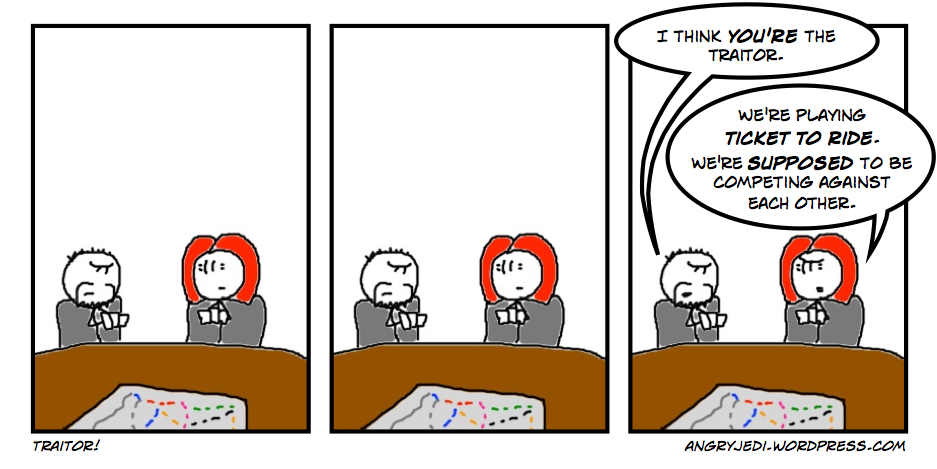
Tonight, it was the turn of Shadows Over Camelot, a new acquisition that I got for Christmas. It's a game that we've had on our collective radar as a board gaming group for quite some time, but none of us knew that much about it. All we really knew is that it had a mechanic similar to that found in the Battlestar Galactica board game (which is absolutely excellent, even for those unfamiliar with the show) in that there was a chance with every game that one player would be a secret traitor tasked with foiling the group's otherwise cooperative attempts to beat the game at its own… you know.

Shadows Over Camelot is a Days of Wonder production, and anyone who is into board games will know what that means — a nice hefty box with quality artwork, decent components, lovely thick gameboards and nice stiff cards that are easy to handle and shuffle. The only slight letdown with Shadows Over Camelot's components is with some of the miniatures provided — a few of them have unnecessarily "bendy" bits — swords in particular are very soft and bendy, though I suppose it's better that than them be rigid and easily breakable — or, for that matter, sharp and easy to poke into bits of delicate skin and make yourself bleed. (I speak from experience — Games Workshop's dungeon crawlers mauled me more than a few times in the past.)

I'd read through the instructions when I first got the game, but it didn't make a ton of sense without sitting down and actually trying it out for ourselves. We nearly didn't try it at all because as a group, we're generally terrible with new games — they tend to take twice as long as the suggested amount of time given on the game box, and we inevitably mess something up along the way. It had already got to 9pm by the time we'd eaten, so the worry was that we'd be there until the early hours of the morning playing.

Fortunately, there was no such problem, as Shadows Over Camelot actually has pleasantly simple, elegant mechanics that give it a nice, fast pace that constantly keeps flowing around the table — again, much like many other Days of Wonder titles.

Essentially, the aim of the game is twofold: firstly, do not allow any of the "defeat" conditions to come to pass, and secondly, ensure that victory is achieved. The players (except the traitor, if there is one) lose if there are twelve siege engines outside Camelot, if all the player characters die, or if the Round Table fills up and there are more black swords than white ones. Or if there are seven or more black swords, which amounts to much the same thing.

White and black swords are attained by going on quests, each of which are represented by small boards, and all of which are takes on Arthurian legends. You have the tournament against the Black Knight, the quest for the Holy Grail, fending off invasions, fighting dragons and claiming Excalibur.

Each quest has its own specific mechanics, but most involve playing cards in various arrangements. The Grail quest, for example, demands that players, between them, play a total of seven Grail cards onto the quest area — though if various "anti-Grail" cards appear, additional Grail cards must be played to remove these, too. Combat-focused quests, meanwhile, involve playing various poker-style hands one card per turn in an attempt to accumulate a high enough value to defeat the value of the black cards the game mechanics have been putting on the quest in the meantime. It's difficult to describe in words, but when playing, it makes sense very quickly.

A turn is simple and snappy. First of all, you do a "bad thing" — either take a point of damage, add a siege engine outside Camelot or draw a black card, which has one of a variety of bad effects. Later in the game, black cards that would normally be played on a quest that has now been completed summon additional siege engines, so the late game involves fending back the tides of darkness while attempting to push the game into a victory state.

Once your "bad thing" has been done, you get to do a "good thing". This can be as simple as moving, or performing an action unique to the quest you're currently standing on — playing a card, for example. Alternatively, there are some special cards you can play with specific useful effects, or you can even heal yourself by discarding a set of three identical cards. It's cooperative in that you are working together to defeat the game, but each player maintains their own independence to do as they please. Meanwhile, the traitor is doing their best to remain hidden while screwing everyone over as much as possible.

We were surprised when the game was over within an hour and a half — that's absolutely a new record for us when trying out a new game for the first time, and testament to Shadows Over Camelot's simple but elegant mechanics. I'm impressed, in short, and looking forward to trying it again, this time with a traitor — we followed the game's recommendation and played without one this time. Hopefully that will be pretty soon!

#oneaday Day 950: It's a Small World After All

Board game night (well, whole day, really) today and the star of the show was very much Days of Wonder's excellent lightweight strategy game Small World.

For the uninitiated, Small World casts players in the role of some sort of omniscient entity guiding the development of several different races struggling for supremacy in a world that isn't big enough for all of them. Players must capture territory and make use of their various peoples' special abilities to score as many points as possible after a set number of turns have elapsed.

To begin with, a variety of random civilisations are created by matching a race with a trait. This determines two things: that people's combination of special abilities, and the initial number of tokens the player will be able to take into their hand. Each race has a special characteristic and so does the trait, making for a very wide array of possible civilisations.

You might be in control of a bunch of seafaring dwarves, for example, meaning that you get score bonuses for every mine you capture, and are also the only people able to capture aquatic territories. Or you could have control of a band of pillaging giants, who find it easier to attack enemies near mountains, and who gain additional bonuses if they captured an occupied territory rather than an empty one.

If a people is no longer proving efficient at scoring points — perhaps a few conquests from the other players left their numbers a little depleted, for example — it's possible to spend a run putting them "in decline", which means they continue to score points so long as they are not obliterated from the map, and are unable to move or attack. The player then gets a brand new race to play with on the next turn.

The game is fast-paced, fun and exciting. Relatively little of it is dependent on luck, but the strategy isn't so hardcore that it is inaccessible to newcomers. It has a fair bit in common with Risk, but is immediately superior due to the fact it doesn't take three hours to play and inevitably end in a stalemate. The built-in time limit keeps play pacy, and the very design of the game ensures players are at each other's throats as often as possible.

In short, its good reputation as a quality board game is well deserved. It's straightforward and accessible enough for board gaming newcomers to be able to pick up right away, while its strategy has enough depth to keep things interesting — and pleasingly different each time you play.

There's also an iPad version available, but this unfortunately only supports two players, while the physical version will take up to five.

#oneaday Day 939: Deeper Into the Dark

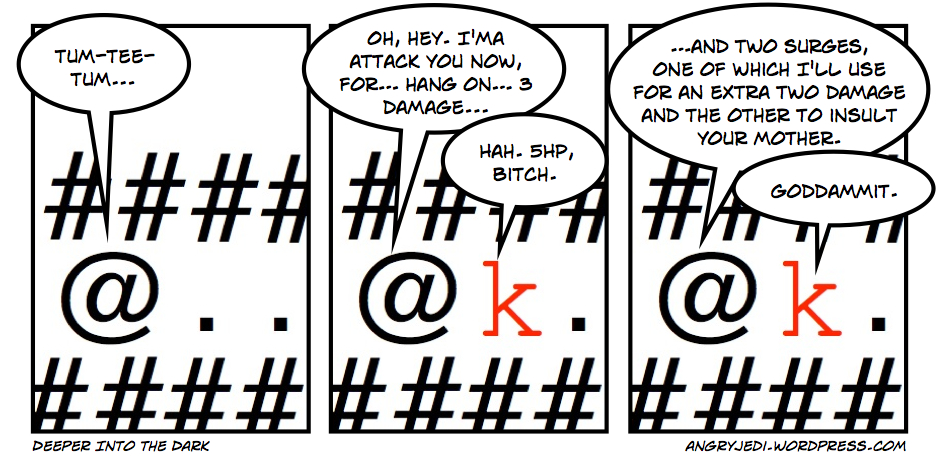
Last night, I had the good fortune of being able to spend some more time with my friends playing Descent: Journeys in the Dark Second Edition (hereafter, once again, referred to as Descent 2). The game has been a big hit so far, which is pleasing, as there's a hell of a lot to it and a significant amount of replay value even once your group plays through the 20+ hour campaign once.

This time we had a full complement of five players — me as the Overlord and four hero characters, two of whom we "boosted" up to an equivalent level to the two who played the first quests in our first session. We took on a new quest and played it through to completion. It took significantly longer with five people as this (1) meant that there were four people to argue about the best way through which to eviscerate my monster minions and (2) I had more monster minions with which to attempt to eviscerate my four opponents. Overall, I found it a much more satisfying experience with five players total, which perhaps explains why the game's BoardGameGeek page rates it as "best with 5 players".

The game has so far appeared to be weighted quite heavily in favour of the heroes in that they have won every quest so far. I'm not complaining about this, mind — it's quite fun to struggle against these difficult odds, and I'm assuming (hoping, really) that the odds will even or perhaps tip in my favour as the campaign progresses to more difficult challenges. Or, of course, I could just be rubbish at being the Overlord. (I know for a fact on more than one occasion I screwed myself out of a potentially significant advantage by forgetting to play Overlord cards such as "pit trap" and "tripwire" that could have stopped players from moving and thus blocking me off from completing objectives — but this is entirely my fault, so I didn't ask for a "do-over" as that wouldn't really be in the spirit of things. I have learned my lesson.)

There are a ton of things to like about the game, though. Unlike many "dungeon crawlers" (which, as I've previously said, Descent 2 really isn't) the rules are relatively lightweight, but pretty flexible, and the custom dice used for combat allow for a large amount of variety. For the unfamiliar, every attack roll uses a blue "attack" die, which has a 1 in 6 chance of missing and does varying degrees of damage on its other faces. Each weapon or special attack then uses one or more of the red and yellow dice — red ones offer the potential for more damage, while yellow ones offer more in the way of "surges" — little lightning-bolt symbols that can be spent to perform a weapon's special actions — some might be able to "pierce" the enemy's defensive dice, for example, while others might do additional damage, apply an effect or knock the unfortunate victim backwards. Combine the various weapon, skill and item cards with the pool of dice available and you have a wide variety of possibilities that keeps combat constantly interesting.

And that's just within a single encounter. Pulling back to look at the bigger picture, the entire campaign can play out completely differently according to how the heroes and Overlord perform, and the quest choices that the hero players make. Rather smartly, the game only requires players to complete three out of five possible "Act I" quests before an "interlude", followed by three out a possible ten "Act II" quests, each of which is presented as part of a pair according to whether the heroes or Overlord won the corresponding act I quest. I didn't explain that very well. Basically, Act II's available quests change according to who won various quests in Act I. There, that's better.

On top of that, the Descent 2 Conversion Kit allows content from the original Descent: Journeys in the Dark to be used with Descent 2, opening up a whole swathe of possibilities. And then you can guarantee that Descent 2 will also have its own expansions ready to roll before long, meaning that this is a game with a potentially very long lifespan — which is why I'm so very pleased that my group has taken to it so well. Anything that puts off yet another humiliating, crushing (and bewildering) defeat in Agricola is just fine with me.

#oneaday Day 925: Journeys in the Dark

I remember catching a glimpse of the first Descent: Journeys in the Dark a good few years back now. It was when my friends and I were just starting to discover the joy of board gaming, and had been experimenting with everything from Risk to Space Crusade via Catan and several others. Descent was noteworthy for 1) coming in a massive box and 2) costing £60, which put it slightly out of "impulse purchase" territory. I mean, if it sucked, that was a lot of money and shelf space to have wasted.

I did some reading up on it, though, and found that it seemed to be a well-regarded game, and one of the favourite "dungeon crawlers" among the community. I kept an eye on it with interest, but never got around to picking up a copy.

A month or two back, I decided that I really actually quite did want to give it a try, so I paid a visit to a couple of online UK board game distributors that I knew of and tried to order a copy. It was, as Sod's Law tends to have it, nowhere to be seen.

A little research, and I discovered that the reason it was no longer available was because publisher Fantasy Flight Games was beavering away on a brand new edition. Descent: Journeys in the Dark Second Edition to give it its full, and rather grandiose title, in fact — hereafter referred to as Descent 2 to save my sanity. (Not to be confused with the video game Descent 2, however, which is something entirely different.)

Descent 2, it seemed, was to be a complete reimagining of the original game. The core mechanics had been overhauled entirely, a variation on the "campaign" rules from the original game's Road to Legend expansion were to be included as standard and a whole new series of quests was produced. And the whole thing somehow came in a box half the size of the original while still cramming in a ridiculous amount of cardboard and plastic.

I haven't played the original Descent so I can't comment with any authority on the differences between it and the follow-up. But I can comment on how Descent 2 plays, because we gave it a try last night.

I honestly wasn't quite sure what to expect. From reading the rules, it was clear that Descent 2 would be a little different from the other "dungeon crawlers" I've played in the past. It didn't appear to have the sheer brutality of DungeonQuest, the heavily random nature of Advanced Heroquest and Warhammer Quest, or the purely cooperative "GM-free" gameplay of Legend of Drizzt. And it was considerably more complex than Hero Quest, a game which brought many people to the genre in the first place — and one which they should really rerelease for the modern world.

In fact, I'd argue that calling Descent 2 a "dungeon crawler" is actually rather inaccurate. It's a competitive scenario-based strategy game in which a team of players (the "heroes") take on a single opponent (the "overlord") over a series of quests, with both sides gradually growing in strength as the campaign proceeds. (It's also possible to play the game's quests as "one-shot" adventures, but one would argue some of the satisfaction of watching your characters grow and evolve over time would be lost.)

Each of Descent 2's quests is actually made up of two separate encounters, with a couple of exceptions. Each encounter takes place on a prebuilt map, the entirety of which is visible to both sides from the start. Both sides are also fully aware of the victory conditions for the map, rather than the heroes having to explore and uncover the mysteries of the quest for themselves. And once play begins, it is full-on competition between the overlord and the heroes for supremacy.

That latter aspect right there is the key difference between Descent 2 and the previously-mentioned dungeon crawlers. In most cases, the "evil" player (the respective games' overlord-equivalent) acted as a facilitator, pushing the story forward and occasionally bending the rules in the player's favour if things looked like they might be getting out of control. (After all, where's the fun in composing an epic five-act quest if the heroes just get killed by goblins in the first dungeon?) In Descent 2, meanwhile, the overlord is trying their best to accomplish their own victory conditions, rather than simply trying to stop the heroes from accomplishing theirs. Notably, knocking a hero's health down to zero does not kill them off (unless the group is playing the final battle of the campaign) — it simply causes them to spend a turn knocked to the ground, hopefully allowing the overlord time to gain an advantage.

The campaign unfolds over the course of two three-quest Acts, with additional shorter introduction, interlude and finale quests at appropriate points. For each quest, the victor (be it overlord or heroes) is recorded, with the available quests in Act 2 being determined by who won corresponding quests in the first Act. It all comes down to the final battle in the end, though, because victory for the entire campaign can be secured by either side in both of the two finale quests, regardless of how well (or badly) they have done up until that point. A poor performance could put one side or the other at a disadvantage come this final battle, however, so it is in the interests of everyone to give each quest their all.

In terms of base mechanics during play, they are relatively simple but very flexible. Weapons and skills provide players with varying numbers of dice to roll in combat, with some dice having the potential to deal more damage, others specialising in "surges" (which can trigger special abilities) or ranged combat. There's a heavy degree of tactical play during each scenario, particularly in those where the heroes are accompanied by civilian characters and are also able to use them to their advantage. Should they get a civilian to close the door, forcing the slobbering monster outside to waste one of its two actions opening it again? Should they run away? Should they hide behind a hero or get as far away from the action as possible? Should the heroes defeat the monsters, or focus on the objectives? Is there time to pick up the hidden treasures scattered around the map? A Descent 2 encounter is a series of decisions like this, culminating in a charge for the finish.

So far we've played the introduction quest (which is very short and simple) and one of the Act 1 quests. Both seemed to be slightly weighted in favour of the hero players (though I may just be saying that because Overlord Pete lost both quests) but I'll be interested to see how the game evolves over time — both heroes and the overlord have the opportunity to spend experience points on new skills between quests, and the overlord's forces get an appropriate jump in power between Act 1 and 2. The game is also pretty well balanced according to the number of hero players, and from next session onwards we'll have an extra hero in play, so it will be interesting to see what effect that has, too.

The game was a big hit with the two other participants I played it with last night, and I'd only describe one of them as a particular enthusiast of the dungeon crawl genre. But there's the point, really — despite Descent 2 featuring a variety of dungeons, and quests, and equipment, and monsters, and experience points — all things readily associated with "dungeon crawling" — it's really more of a scenario-based battle game. And it's all the better for it. It's easy to understand, surprisingly quick to play, and very satisfying. Also, the dynamic nature of the campaign means that it has a lot of replay value, too. A single campaign playthrough is supposed to take about 20 hours in total — multiply that by all the possible combinations of quests that you can play throughout and there's an impressive amount of content in that box. And, if Descent 2 is anything like its predecessor, it will enjoy a healthy amount of official expansions and fan-created content, making it all but certain to keep a regular place in gaming groups' rotations for months and years to come.

#oneaday Day 911: Drizzt's Big Adventure

As promised at some point in the near past, we got to play The Legend of Drizzt as a larger group tonight, and it was fun.

The thing with a lot of dungeon-crawlers is that they often take a long time to set up, a long time to play and only tend to become especially rewarding if you have a group of players who can commit to a long-term campaign with player characters gradually increasing in strength through acquired treasures and levelling up.

The thing with The Legend of Drizzt is that it ignores all that, creating an experience very friendly to a board game group more normally accustomed to self-contained experiences. Each adventure in the Legend of Drizzt book is playable within an hour or two (less if you mess up particularly badly!) and is constantly moving forward thanks to mechanics that minimise "downtime" and help prevent the age-old Advanced Heroquest problem of a randomly-generated dungeon becoming so sprawling it covers the entire table.

Play is much more strategic than I was expecting, too. With multiple players, positioning and turn order becomes much more important as you carefully consider how to tackle the situations you face. Do you kill every monster you come across? Do you spread out and push "forward" in as many directions as possible or focus your efforts? When victory is in sight, do you race for the goal or play it safe?

The high level of difficulty in the game helps matters enormously. Because it's highly likely you'll get to each scenario's "endgame" with a sliver of health and a selection of depleted abilities, securing victory becomes a matter of making some very difficult choices as a team and determining whether or not taking big risks is going to pay off. In the case of the adventure we played this evening, we scraped victory by the narrowest of margins — one of our number was down for the count, and if the turns had come around to him one more time, we would have lost with the finish line in sight. Fortunately, we prevailed.

I'm very pleased with how the play session went this evening and look forward to playing it again in the near future. It's a great game that I can highly recommend to anyone who enjoys the dungeon-crawling experience but who doesn't have the time (or inclination) to commit to a lengthy campaign. I'm curious to try the other two games in the series — Castle Ravenloft and Wrath of Ashardalon — and see how it's possible to link the games' various components together, as the core system seems very much designed to be expanded and experimented with.

For now, though, bed, and dreams of being able to play games with friends on a more regular basis in the near future…

#oneaday Day 907: A Party Game for Horrible People

I had my first chance to try out Cards Against Humanity tonight. If you're unfamiliar with Cards Against Humanity, you can find out more and even print your own copy here.

Cards Against Humanity is a project that was initially funded through Kickstarter last year, but which has since gone on to make its money via direct sales of its core set and expansion. Unusually, though, the game is distributed under a Creative Commons licence, which means you're free to download and print a copy yourself if you have the appropriate equipment to do so. It also means that you're free to tweak, change and otherwise mangle it as you see fit so long as you don't then decide to sell your modified version as an original work. Which is nice.

Cards Against Humanity is a very simple concept. The Onion AV Club described it as "Apples to Apples for the crass and jaded" and indeed the concept is almost identical: each turn, the "card czar" player (which changes every turn) draws a single black card that features a question or fill-in-the-blank phrase — this is the equivalent of Apples to Apples' green cards — and players then submit a white card, each of which contains a word or phrase that could potentially fit whatever is printed on the black card. The card czar then shuffles them around so they have no idea who submitted what, and then reads them all aloud. After this, they choose which one is "best" by whatever arbitrary criteria they wish, and give the black card to the winning player as an "Awesome Point". Play then continues until… whatever you like, really. You could play to a score limit, a certain number of cards or, as the game suggests, until the "Make a Haiku" card comes up. The exact rules are deliberately open-ended to encourage experimentation and a feeling of simply having stupid fun rather than rules lawyering. It's a party game, not SRS BIZNZ.

It's extremely simple and easy to play, and works with groups of four or more people. While the rules that determine who "wins" a hand are deliberately vague and arbitrary, after a few turns it becomes clear that there is a degree of psychology in play rather than simply everyone rushing to put down whichever card has the word "penis" on it. Does the current card czar find dick jokes funny, or would they rather you tried to do something clever? Would a surreal and incongruous answer make them laugh? Assuring victory is much more than simple luck, and sometimes you need to know when to give up on a hand and just submit your "worst" card for consideration in the hope of getting something better next time.

Cards Against Humanity is gloriously politically incorrect, but only occasionally explicitly obscene. A lot of the dark humour in the game comes from certain combinations of cards and the interpretations thereof rather than cards that are simply outright offensive. That said, there are plenty of white cards that are deliberately provocative — "Firing a rifle into the air while balls-deep in a squealing hog" is one particular favourite — but these are spread throughout more "mundane" offerings to balance things out rather than making the game a tiring journey through everything taboo. There are plenty of amusing pop culture references in the cards, too, though a few are a little too American for international audiences.

Cards Against Humanity is a great party game, then, that deserves to sit alongside titles like Balderdash and Eat Poop, You Cat! as a Fun Thing To Do After (or perhaps Before, depending on how late your host cooks) Dinner. I recommend getting some friends together and giving it a shot yourself as soon as possible, as there was plenty of mirth and merriment tonight, to the extent that one participant (whose blushes I shall spare) laughed so hard their drink came out of their nose.

#oneaday Day 906: Drizzle Bizzle

I recently acquired a copy of one of the Dungeons & Dragons boardgames: The Legend of Drizzt, a game based on everyone's favourite Dark Elf and the one character from D&D lore that most people can remember.

I've given the game a couple of goes so far — twice solo and once with Andie. I'll be playing it with a larger group next week, all being well, too.

If you've not seen the game before, here's the deal. It's not really a conventional dungeon crawler in the mould of Hero Quest and its various expansions and sequels. It is, however, a challenging cooperative game that I anticipate will require at least a small degree of working together to survive.

Basically the flow of play goes like this. Each hero may move and attack, attack and move or move twice on their turn. If they end their turn on the edge of a dungeon tile, a new one is drawn and a monster appears on the tile more often than not. Some tiles also cause an "encounter" to occur, which more often than not is detrimental to the players. After that, any monsters that the current player "controls" (i.e. revealed on their turn) make their moves and attacks according to the logic on their cards, then play passes to the next player and continues until either the players have completed the objective for their chosen quest or a single hero is defeated without any remaining "healing surges" to restore them.

Combat uses a loose interpretation of D&D 4th Edition's "Powers"-based system. Each character has a hand of "Powers" to use when they attack — some are "At Will", meaning they may always be used, some are "Daily" meaning they may only be used once, and some are "Utility", some of which may only be used once and others of which provide supporting abilities. Combat results are determined by dice rolls with bonuses according to the Power chosen — some have a greater chance to hit, some hit more monsters simultaneously and some do more damage.

It's a simple, elegant system that keeps the game flowing well at a good pace. It captures the feel of D&D 4e's excellent combat system without getting bogged down in scenario design — or the requirement to have a human "dungeon master". And it's considerably more accessible to non roleplayers than even a basic D&D module. At the same time, it doesn't have the complexity of a lot of dungeon crawlers, doesn't take nearly as long to play and encourages cooperation between players.

I'll be very interested to see what the dynamic is like with more people as I feel it has a lot of potential. As a cooperative game, it looks set to have plenty of the usual brutal difficulty factor without the Byzantine rules of a title like Arkham Horror — much as I love the ol' Lovecraft-em-up, I think pretty much every time we've played we've forgotten at least one rule.

It also comes in an absolutely humongous box and is packed with cool figures and lots and lots of cardboard tokens of various kinds. It's a veritable nerdgasm to open up that box, and closing it makes the best "box fart" I've heard for a long time. So kudos for that.

I'll offer a full report on the game following our play session next Tuesday; for now rest assured that if you're the slightest but interested in low-maintenance dungeon crawling and monster bashing, you could certainly do far worse than check out any of the three D&D Adventures games.

#oneaday Day 897: Dungeon Crawling

20120704-013250.jpg

I'm a big fan of board games, as regular readers will know. And I have fairly diverse tastes, too — I like everything from Eurogames such as Catan to theme-heavy Ameritrash like Last Night on Earth. Exactly what I want to play at any given moment is largely determined by my mood at the time, but I can pretty much always muster up enthusiasm to play a dungeon-crawling game.

I own several dungeon crawlers, but I'm planning on picking up the very interesting-looking Descent: Journeys in the Dark Second Edition when it releases, as it sounds like just the sort of game I want to play. It also sounds like it's been improved significantly over the original edition, which could take up to 4 or 5 hours to complete a single quest. The new version reportedly keeps play sessions down to much more manageable lengths while incorporating a solid "campaign" system for character advancement and a branching narrative. I'm looking forward to it a lot.

As for the ones I already own, each of them have their pros and cons, and I like them all.

Starting at one end of the spectrum we have Games Workshop's Dungeonquest, which saw a rerelease by Fantasy Flight Games recently. Dungeonquest is gloriously random and is best left on the shelf if you like to plan out what you're doing well in advance, because progression is determined largely by the luck of the draw. Consequently, it is a very difficult game to "succeed" in — even the instruction manual helpfully informs you that players have approximately a 34% chance of survival in any given playthrough.

In Dungeonquest, players take it in turns to draw dungeon tiles from a pool in order to build the dungeon as they go. If it's a corridor, they get to move again. If it's a room, things happen, determined largely by drawing cards and making skill checks. If it's a special room, super-special things (usually bad for the player) happen. Many of these things end in instant death for the player, meaning games can be over relatively quickly if you're unlucky.

The aim of Dungeonquest is to make it to the middle of the board to raid the slumbering dragon's massive treasure pile, then make it out again before the sun rises — the time limit in question being represented by an ever-advancing "track" at the side of the board. If players don't get out before sunrise, they die. If they run out of health, they die. If the fall down a bottomless pit, they die. Hilarity (and, usually, frustration) ensues. It's not a great game, but it is an entertaining one.

Moving up somewhat is MB and Games Workshop's Hero Quest. This was my introduction to fantasy role-playing when I was a kid, and it still holds a very fond place in my heart to date. It's an adversarial game where a team of up to four "hero" characters of varying classes take on the forces of darkness, controlled by a single "evil wizard" player. The evil wizard has a book of preset quests with which to challenge the heroes, and following these through in sequence provides a rather loose narrative. The game was later expanded with a number of additional packs that broadened the scope somewhat with new monsters, traps and additional rules to make things more interesting.

Hero Quest is good because it bridges the gap between traditional "family-friendly" board game conventions and the more abstract, strategic nature of role-playing games. It's accessible enough for pretty much anyone to understand, has high-quality components and a wide variety of things to do — plus is very expandable and customizable.

Advanced Heroquest not only changed the "correct" way to punctuate the phrase "Hero Quest"/"Heroquest" but also revamped the game completely to be significantly closer to a Dungeons & Dragons-style role-playing game. It also incorporated rules for limitless replayability including random dungeon generation, character advancement and a heavy emphasis on customization. While the original Hero Quest released an expansion allowing players to create their own adventures, Advanced Heroquest practically demanded that the Games Master (or "GM" — effectively the "evil wizard" player by another name) come up with some of their own creative, fresh ideas. And it was up to the GM in question how far they wanted to take it — Advanced Heroquest's rules catered for simple story-free "hack and slash" dungeons as much as elaborate, story-driven scenarios featuring light role-playing. The game even came with full rules for solo play, which was a godsend for me when I was a kid, as short on nearby friends as I was.

Then came Warhammer Quest. This is pretty hard to find now, which explains why I paid nearly £100 for a copy on eBay. Warhammer Quest takes the formula of Advanced Heroquest and shoots off in a different direction rather than necessarily making it more complex. Warhammer Quest has a lot more in the way of random elements, but also features a lot more rules to prevent the game from running away from the players. Where Advanced Heroquest often had dungeons that spiralled off into myriad dead ends, Warhammer Quest's dungeon generation rules ensure that players move quickly from encounter to encounter on a much more linear path, giving the game a much faster pace. That's not to say that either approach is "better" as such — Advanced Heroquest had the thrill of exploring the unknown, while Warhammer Quest always had something interesting through the next door — but it marked a significant difference between the two.

Warhammer Quest contains a fairly heavy degree of luck. If you were playing a campaign, after completing a dungeon you then had to roll repeatedly on a table to determine the events that happened during the journey back to town. These frequently got rather ridiculous, as demonstrated abundantly through the adventures of Kurt von Hellstrom and his friends.

Warhammer Quest has one cool thing over its two predecessors, however — it can be played without a GM/evil wizard. The base rules for the game include an artificial intelligence system for the monsters that determine how they move and attack, allowing all the players at the game table to cooperate and take on the dungeons together rather than one being forced to constantly be "the bad guy." Rules were there to allow the game to be played with a GM, too, but for those craving a purely cooperative experience, Warhammer Quest was a great one.

I don't get to play these games nearly as often as I'd like to. I'm hoping that I'll be able to get Descent out regularly once I get my hands on a copy — and I'm also pretty curious about the Dungeons & Dragons boardgames, too. Full reports on each and any of those I get the chance to play will, naturally, follow.