Haunted Stereo Live at the Hobbit

So here we are again. After a somewhat touch-and-go start to the day after being molested by numerous pints of toilet cleaner masquerading as Lord of the Rings characters, I find myself here considering what it was I saw last night at the Hobbit.

Things began well when I managed to sneak in and grab a peek at the performers' soundchecks earlier in the evening. When I saw that an electric ukulele was involved, I knew that this was going to be anything but traditional. However, as these things tend to go, it would be an hour or two between soundchecks starting and the actual performances beginning, so I took the opportunity to use every piece of mobile Web 2.0 technology at my disposal to write last night's blog post, tweet like crazy, post pictures of The Hobbit's pleasantly literate toilet graffiti to Tumblr and generally keep things rolling until the bands took the stage later. I also had the opportunity to people-watch a little, with The Hobbit's diverse clientele once again failing to disappoint. From the old drunk babbling about chicken to the selection of surly-looking goths playing pool, The Hobbit is a fine place to witness most subcultures coming together in relative harmony for once. The only group not really represented was the humble chav, which I have absolutely no objection to. I'd much rather they'd all be off their faces on cheap lager at Jesters down the road than spoiling everyone else's night.

But I digress. There were performances to watch, and it turned out to be a very entertaining, very pleasant evening.

I'm not going to talk much about the support acts here, but I did want to mention the first one. This was a solo female singer named Plat du Jour. She gave a good start to the evening's entertainment with her songs. Although her arrangements were necessarily simple, given that it was just her and her guitar, her songs were pleasant to listen to, covered a variety of different moods – all too many performers stick too much to one style and one style alone – and she had a wonderfully friendly, down-to-earth manner with the audience. She also had a great voice, with shades of Portishead's Beth Gibbons at times. I'll be interested to see where things go with her performances, as she certainly has a lot of potential, judging by her performance.

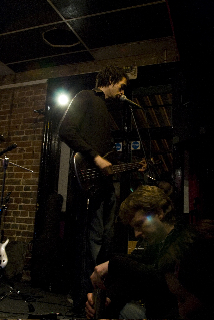
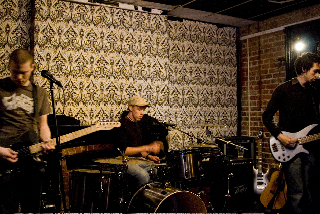
The main event of the evening, however, was Haunted Stereo, made up of members Andy, Anja, Dave, Joanna, Kenta and Lewis. They describe themselves on their MySpace page as "melodramatic popular song/folk/indie", which is immediately intriguing. The band's lineup changes from song to song, with some songs focusing on traditional guitar and drum sounds, with others bringing the folk angle to the fore with violin and accordion taking centre stage, others still involving banjo, the aforementioned electric ukulele and even a glockenspiel at one point. They're nothing if not diverse.

But what of the music? Well, their own description, as it turns out, is pretty apt. There's a definite folky edge to many of the songs thanks to the instrumentation involved and the patterns used in the backings. The melodrama comes mostly from the vocal lines which are simple, subtle and sometimes mournful, rising over the top of the busy backing. The combination of instruments means that although at times the band's pieces are filled with activity, with violin lines, accordion harmonies, banjo plucking, piano lines, drums and guitar parts all competing for attention, they have a pleasantly clean sound which, should you be that guy who sits there listening analytically until he learns how to hum the most obscure harmony part to a song, will make you very happy.

I was impressed with Haunted Stereo. I have a feeling they're another band that maybe won't be to everyone's taste due to their out-of-the ordinary stylings and instrumentation, but there's certainly a lot to like. The performers all obviously have great technical ability and versatility, and the songs are all extremely listenable, with more than a touch of Belle and Sebastian to one or two of them. They offer an interesting twist on the "folk rock" genre, artists of which The Hobbit seems to attract like flies (but, err, in a good way) and a sound that, even if it's not your thing, is nothing if not memorable.

Live music is absolutely not dead. Musicians with genuine creativity, too, are still alive and kicking, and this gig proved that. However, it's only by stepping outside the comfort zone of the national and commercial radio stations, and the pure banality of the popular music charts, that you find this creativity. What I've certainly opened my eyes to over these last couple of visits to The Hobbit is that there's a lot of very talented musicians out there who have no desire whatsoever to appear on The X-Factor in order to be catapulted to stardom and a career of mediocre, predictable songs. This is a good thing, as my thoughts on commercial crap are well-known and well-documented. Haunted Stereo are anything but commercial, but they have carved out a comfortable niche all of their own and I wish them every success in building their fanbase and being stars of the melodramatic popular song/folk/indie world.

Good music should speak for itself. And it does. I've enjoyed some good music recently. You should switch off your radio and join me.
Liveblogging from the bar

Well, here I am again, "here" being The Hobbit, aforementioned little live music-friendly pub, waiting for another group to strut their stuff on the tiny downstairs stage and sipping on a vibrantly radioactive-looking Gandalf as I wait.

I'm here as a result of a very pleasant and courteous Facebook message from Andy of Haunted Stereo who you'll recall, if you'll cast your mind and/or your browsers back, was playing The Hobbit the same night as Penny Arcade but I was too full of drinks that look more like toilet cleaner to be able to comment coherently on.

Given that I was asked so pleasantly, and my dubious "research" for the last post (well, hyperlinking the bands in question's MySpace pages) showed that Haunted Stereo would be a potentially entertaining band to watch, I find myself here at the bar with another glass of Domestos and a chicken-obsessed drunk making "small talk" (which, of course, is anything but) with the poor saps serving drinks.

I am blogging from the bar because I can. At least I'm honest about it. A full report of the gig will follow sometime in the next couple of days (i.e. when I actually have a free moment to write it). Along with a SquadCast.

Rock on!

Penny Arcade Live at the Hobbit

Photography in this post courtesy of Laura Bishop. If you're reading on Facebook and you can't see said pictures, click here to see the full article.

So I went out the other night. This is a pretty rare occurrence and worthy of discussion in and of itself but I'm not here to do that. Instead I'm going to be focusing on the gig I went to see – Penny Arcade, live at the Hobbit pub, Southampton, UK. I'm going to say now to all the gamers reading that this post has nothing whatsoever to do with Gabe and Tycho and the nomenclature of the band is a complete coincidence, apparently. Who am I to argue?

Live gigs here in Southampton are often a case of a million people crowding into a tiny pub that can seat about three old men and a dog around the fire, listening to ear-shatteringly loud music whilst downing drinks that look like they've been piped directly from the local toxic waste dump to the spigots, served frantically by an underpaid and overworked staff clearly insufficient in numbers to cope with the number of rabid, binge-drinking fans.

The Hobbit is, of course, no exception to this rule, with crowds regularly squeezing into its little downstairs bar (a little larger than the average living room) to listen to some tunes and destroy their brain-cells with the vibrant primary colours of the Lord of the Rings-themed cocktails. Actually, "themed" might be pushing things a bit far, as I don't remember Gollum having a thing for Bols Blue, though many is the time that consumption of too many Gandalfs has led to a fall into darkness, albeit not accompanied by a big flamey demon thing. (Balrog. I know. Be quiet.) Despite all this, however, the Hobbit remains a popular nightspot with a lot of local acts of a variety of styles from the Southampton area performing there on a regular basis. Plus sometimes there's a guy who comes around and sells fish. Really.

Penny Arcade (photo by Laura Bishop)

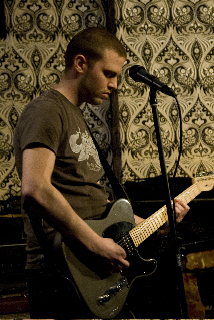
Penny Arcade, consisting of Alex Burton on guitar, Matt Rampton on vocals/bass and Tom Uplifter on drums, were performing as part of a complete evening's set including other local performers Andy from Haunted Stereo, and Long Shore Drift. In total, they graced us with six songs, including Straight Through, I'm Not Sleeping, Are We Talking, Jaws of the Enemy, Katie and a work-in-progress song called "Rocket Ship" performed solo by vocalist Matt. Are We Talking and I'm Not Sleeping can both be heard on their MySpace page, if you're reading this and are curious. You know you are.

Penny Arcade's sound is a pleasingly smooth guitar-bass-drum combo which, when coupled with the distinctively melancholy sound of Matt's vocals, is very listenable. The band keeps a deliberately lo-fi sound, with minimal guitar effects being used and repetitive, hypnotic guitar/bass riffs and beats making up the majority of the songs' backings. Performing with a more "clean" sound and using minimal effects to hide behind can be a challenge for many bands as it often highlights the shortcomings of their own technical abilities, but Penny Arcade manage to perform very tightly together as an ensemble. Their songs have an intimate, personal feel to them, with Matt's vocal performance style of eyes closed, mouth to the microphone and little in the way of body movement draws the audience in and encourages them to focus on what it is he is singing about throughout. This is a great style to perform in a venue as intimate/cramped (delete as applicable) as The Hobbit – arguably made rather more poignant by consuming just one too many Gandalfs to get one to that "drunken melancholia" stage.

Alex Burton on guitar (photo by Laura Bishop)

Penny Arcade's style undoubtedly isn't for everyone. They're low on flashy glitz and overt showmanship, both in their unassuming physical performance styles and the sound of their music in general, but they're all the better for it – to me, at least. All three performers look deep in concentration during their performance, which is in keeping with the "personal" feel to the songs, and the whole gig felt like the audience were being let in on some kind of secret. This is the kind of thing that I have a lot of time for, and it's this kind of feel that keeps people coming to the Hobbit for gigs – however sticky the floor gets, however terrible those vibrantly-coloured cocktails may make you feel the next day, however many sweaty bodies you may be squeezing yourself up against (and not in a good way… usually) – it's the intimacy of the venue and, by extension, the intimacy of the performances there that works so well. Penny Arcade fit right in, and I hope to see more of them in the future.

Matt Rampton on vocals and bass (photo by Laura Bishop)

As for the other bands? Well, to be honest, I couldn't comment. Gandalf number three made me fall into darkness.

Photo credit: © Laura Bishop, 2009.

Art/Fart

Now with pictures! Happy now? 🙂

The idea of "games as art" is an over-discussed topic and has been since the days of the later Final Fantasy games, which many regard as one of many points where video games just started to show their potential to tell interesting stories in interesting ways.

So I'm not going to talk about games as art – at least, not "mainstream" games. I want to take a moment to share a few curious experiences I've had recently. I hesitate to call all of these examples except one "games" by virtue of the fact that they're not really traditional "games" as such, more interactive artistic works, and I think that's fast becoming a genre of its own – something I'm all for.

A few of these games are probably quite well known by the side of the gamer community that is interested in this sort of thing, a couple of others you may not have heard of. So I hope that by the end of this post you might be inspired to check out some things a little bit outside the box. You may well find them pretentious, boring and crap – I'm sure many people do – but like any work of "art", there are bound to be differing opinions, expectations and feelings about them.

So let's jump in with probably the most well-known of the titles I'm going to discuss today. There may be spoilarz ahead… and you can click the game titles to visit the sites for them. (If you're reading this on Facebook, you might not be able to. Click here to read this post properly.)

Braid

Braid
Braid

Braid is a game by Jonathan Blow that represents, to me, one of the interesting things about the Xbox 360 – the fact that this is a console with such diversity that triple-A "blockbuster" titles like Gears of War 2 and independent "arthouse" (for want of a better term) games like this can happily coexist on the platform quite comfortably. With the recent launch of the NXE and the Community Games project, I think it's relatively safe to say that Braid will not be the last game of its type that we'll see.

But what is Braid? Ostensibly it's a platform game that largely centres around puzzles rather than action. The central game mechanic is an interesting "time rewind" system which has an interesting twist put onto it in each of the game's worlds. In some worlds, you can simply rewind time if you make a mistake. In others, certain areas or objects are immune to time manipulation, so you can rewind time in the areas around the object and remain unaffected by this. In yet others, time winds forwards while you run to the right and backwards while you run to the left. It's an interesting mechanic that makes for some absolute brain-benders, and I maintain that I'm far too stupid to ever solve the game without help.

Still, the interesting thing about Braid for me, and the thing which divides opinion the most, is the "meaning" behind it all. Each world is preceded by a series of text interludes, describing the main character's quest to reach a princess in floaty, dreamy, vague language and tying the central mechanic of each world in with the main character's conflicting emotions and feelings about time, place, love and loss as he proceeds through the game. It's a fine line between "emo bullshit" and "existential masterpiece" – and there's plenty of people on both sides of the debate on this one. One thing is certain though, everyone who has played the game has plenty to say about it, whether it's good or bad.

Passage and Gravitation

Gravitation
Gravitation

These two "autobiographical" games by Jason Rohrer at first glance appear to be simplistic "retro" style games with eye-catching super low-res pixel art. But look into them a little deeper (or, if you need a little prompting, as I did, read the Creator's Statement that Rohrer has thoughtfully posted for each game) and you'll find that each of these two games represent a deeply personal exploration of a certain aspect of "life" to Rohrer – with Passage offering a look at mortality, companionship, ambition, love, loss and the balance between these things and Gravitation looking at the concept of fatherhood, the creative process and again, the balance between these things.

Each is represented very simply with the aforementioned low-resolution pixel art. But it's the little things about the presentation and the games themselves that carry the deeper meaning. In Passage you start on the left of the screen, with more of the "world" – your life – stretching out ahead of you. Very shortly after the beginning, you have the choice of picking up a companion, who then stays with you until almost the end of the game. This makes you unable to reach some areas of the game, but it's actually quite difficult to consider leaving her behind. If you're me, anyway.

As you progress through the game, you gradually move across the screen towards the right side, meaning that at the beginning, you are looking forward to what is ahead, while at the end you are looking back on where you have just been. Shortly before the end, had you chosen to take your companion with you, she dies, leaving you as an old, lonely man left to trudge on towards his own death alone. This moment, although it is represented simply by the companion suddenly turning into a gravestone and the speed of movement of your character suddenly cutting to a quarter of what it was originally, is a hugely touching moment due to how understated it is. For me, it put across the idea that death is unglamorous, is unavoidable, but there is always someone left behind to trudge on without the person who is gone. I found it to be quite a beautiful, thought-provoking sentiment that is all the more poignant when you read Rohrer's description of the meaning behind the game.

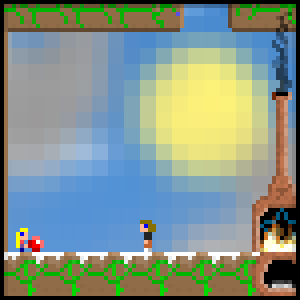
Gravitation, conversely, does not deal with a subject such as death, but rather the struggle that a creative person has between his art and his family. The game starts with you playing "catch" with a child figure. Each time you bounce the ball back to the child, a little heart appears above their head, but you cannot make any progress in the game itself by doing this. To score "points", you have to leap up a huge tower, with gravity that is constantly changing, presumably representing varying degrees of motivation (or "mania" as the Rohrer puts it), and collect stars, which fall to the ground and form rocks. Following this, you have to drop back down and push these blocks into a furnace.

The twist is, the more stars that drop, the less able you are to get to your child to play with them, as the rocks that appear form directly in front of your child, blocking your way to her, and this also seems to have an effect on the gravity of the game. So it becomes a balancing act between play with your child and the "work" of pushing the blocks into the furnace.

These two games are two of my favourite examples of this subgenre because of their simplicity of presentation and gameplay, and the amount of "interpretation" that can be had by looking more closely at what is happening. I think it's also really interesting to see "autobiographical" games, as Rohrer calls them, and he himself points out that this is not something that many developers have done as yet.

The Majesty of Colors

The Majesty of Colors

This is another game that chooses to use 8-bit style pixel art as its means of presentation, giving it a distinctive look and character that seems entirely appropriate for the game. I can't pin down why this is, but I love it. This is also the first of two games hosted on Kongregate, which originally became my favourite Flash games site purely for the presence of Desktop Tower Defense following my brother's recommendations, but seems to be developing into an interesting community of indie developers, "interesting game enthusiasts" like myself, and illiterate 12 year olds who just want to play stuff with badly-drawn animé-style characters. Fortunately, like the Xbox 360, the groups seem to coexist quite happily, meaning we get titles like this.

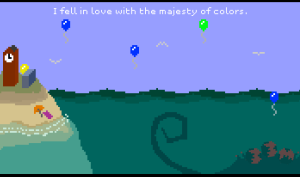
In The Majesty of Colors, you play a betentacled sea monster. The game opens in black and white with balloons floating past your face and the "monster's" inner monologue represented as text across the top of the screen. Grabbing a balloon and bringing it close to the monster's eyes suddenly brings the world into vibrant colour, and the story itself begins. Essentially, the player can choose to manipulate the humans who appear on the scene either through violence or helping them, and this eventually leads to one of five endings, each of which involves the "monster" (whom, it transpires, is actually a person having a dream) awakening in very different ways.

I kind of don't want to say anything else about this one, because I believe it's worth experiencing. It's a simplistic game with not a lot of "point" to it as a game, but it's very much an interactive work of art to me.

Coil

Coil
Coil

The first of two games by Edmund McMillen, Coil is a self-professed game with no instructions that requests you "keep an open mind while playing". It's presented in a rather abstract manner, with mouse-driven mini-games interspersed with Braid-style text interludes. The story of the game appears to be deliberately ambiguous to provoke discussion, but the consensus from many people seems to be that it is about a woman who was raped and the feelings she develops towards the child that is the product of that incident.

Like The Majesty of Colors, I believe this is a "game" that's somewhat open to interpretation, and another that will probably split opinion. The lack of instructions can make it challenging to progress, but it's worth persevering with the story to see what you think of it.

Aether

Aether
Aether

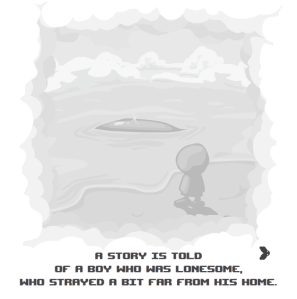
Another from McMillen, Aether seems to be a rather personal story about childhood feelings of inadequacy in the eyes of others. Players swing through space atop the back of a curious blob-like monster trying to solve simple puzzles on planets to restore colour to their lives. The game is a somewhat abstract "journey into imagination" that seems to represent an individual's struggle for validation and acceptance by others. It also has some fabulously hypnotic dynamically remixing music which really helps with the atmosphere.

So there you have them. Pretentious crap or an interesting method of displaying a work of art and telling a deeply personal story? I vote the latter, though I am more than prepared to hear people disagree, which they no doubt will!

'Tis the season to be miserable

So what's the deal with winter anyway?

Trite opening I know but it bears some discussion. Exactly what is it about those winter months that makes an already-curmudgeonly old git like myself into a regular Sad Sack? I refuse to believe there's not an answer beyond "it's cold" because I'm not the only one it happens to.

Case study number one: my very good friend, who we'll just call "E" in case she minds being used as a case study, cited the example to me that every bad breakup she's ever had took place in the month of December, almost without fail. Is this a symptom of the winter blues or just a coincidence? Whatever it is, it's made her just as distrustful of the month of Our Lord's birth than I am.

Who knows. All I know is that it's dark in the morning when I go to work, often dark in the evening when I return. The general public are in that irritatingly frenzied state of "panic buying" – because some people still aren't aware that most shops are shut on Christmas Day after all – and all those little annoyances about the general public that you already notice more than the average man in the street when you work in retail suddenly become ten to fifteen times worse. (I have no scientific basis for quoting that figure, I just thought I'd channel the arseholes who come up with make-up "fake science" adverts for a moment – they're gone now, don't worry.)

Last year I had the most miserable Christmas of my life. My wife-to-be had departed for Bolton to spend Christmas with her family (duty calls and all that) and I was scheduled to work.

But I had 'flu (and don't even get me started on that "man flu" bollocks that is such an unfunny running joke in this country), so I was confined to bed, unable even to go to work and spend time with the few buddies who were still here. Nope, instead I lay in bed on Christmas Day until about 3pm, only rising to make a Beechams Hot Lemon drink when the banging headaches and joint pains were getting a bit much.

I know there's people out there who have far more miserable Christmases than that, but this is my rant and god-dammit if I'm not going to be a bit selfish! (I also hate how political correctness dictates the necessity of a paragraph like this one, but that's another post all of its own)

Anyway. This Christmas is fortunately shaping up to be a lot better, as my now-wife Jane and I are spending our first Christmas on our own as a married couple.

It's not that I don't like spending time with people, you understand.

Actually, that's a lie. It's EXACTLY that I don't like spending time with people. Especially stressed-out people which, it often seems to me, is becoming more and more a part of the holiday season. The clue's in the name, people! A holiday should be a break, not an excuse to panic over a fat-ass turkey and whether or not you've got enough bloody vol-au-vents to feed Uncle Boggart.

Breathe.

So, there you have it.

I hope you, if you're reading this, have a better experience in the wintertime than either I or several of my friends have had or, in some cases, are having.

And if you do have friends who are having a tough winter, give them a hug. Sometimes it's all you need to let someone know you care, and it immediately makes things feel that much better.

I know, I'm a big girl, but I don't care.

Merry Christmas.

HUMBUG!!!

On Evil

After completing Fallout 3 recently, I suddenly had a hankering to return to Oblivion, a game I hadn't played for well over a year. Fallout had tickled my free-roaming Western RPG bone (if there is such a thing, and I don't invite you to postulate where it might be in the comments) and I wanted more.

Oblivion is one of those RPGs I've started at least ten times with different characters to experiment with different things. The thing I've really liked about it every time I've played it is that each time I emerge from those Imperial sewers I can wander off in a different direction and do something completely different. One time I went straight for the main quest (and didn't finish it). One time I headed straight for the Arena in the Imperial City to kick some ass (bare-handed on that occasion, that was an entertaining challenge). One time I headed for the Mages' Guild and took that questline to its conclusion. Yet another time I decided to explore the dungeons scattered around the landscape, simply to acquire as much loot as possible.

But there's one thing that all these trips into the wilderness had in common – they all involved me being "good". Not once did I veer towards the dark side, bad Jedi, Renegade, negative reputation, whatever you want to call it. I always do this. In any game that promises "moral choices" I inevitably end up playing the "good guy" because, at heart, despite my grumpy old man persona, I'm a good guy. I even did this in Fallout 3, where it's kind of "all right" to be a bit of a bastard because, well, everyone else is.

Not this time, though. I decided that this time was going to be the time I went very, very bad in Oblivion.

I started by hunting down the Gray Fox to start the Thieves' Guild questline, which I promptly made my way through. For those of you unfamiliar with it (and be aware there are spoilers ahead) this sequence of quests takes you from lowly burglar up to an extremely high-profile thief, culminating in you stealing one of the series' titual Elder Scrolls from the Imperial Palace. By the time you've pulled this off, if you're anything like me, you feel like you're a badass thief, but you also feel faintly bad for taking advantage of the blind monks you stole it from.

This is nothing – nothing – compared to how sullied you feel after completing the Dark Brotherhood questline, however.

The Dark Brotherhood come to you in your sleep after you commit your first unprovoked murder in the game. In my case, this happened as part of a sidequest I happened to be completing at the time. I had two possible solutions to the quest, which essentially revolved around a captured bandit and his lover having a disagreement. My choices were to either betray the bandit or his lover. I elected to betray his lover, who had put across the impression of being something of a heartless bitch anyway, and after all, honour among thieves and all that.

Actually, "betray" doesn't quite sum up what I did to her. I broke back into her house while she was sleeping and shot her in the head with a magic arrow, which exploded and sent her flying, smacking straight into her ceiling before collapsing in a crumpled heap in front of her fireplace. This spectacle was faintly amusing, as ragdoll physics deaths are often wont to be, but the ominous words across the top of the screen "Your murder has been witnessed by forces unknown…" sent a slight chill down my spine. Sure, I'd stolen stuff before, but the Thieves' Guild questline had felt faintly "Robin Hood"-ish. This was getting into full-on evil territory now, and I wasn't sure I liked it.

I also wasn't sure I liked it when a mysterious robed gentleman visited me while I was sleeping off a level gain and offering me membership in the Dark Brotherhood conditional on my murdering an old, helpless man named Rufio.

In for a penny, in for a pound. I killed Rufio and thus began my run through what many believe to be Oblivion's best questline. The Dark Brotherhood storyline is a tale of murder, betrayal and vengeance filled with a lot of violence and some excellent plot twists, some of which are left for the player to interpret themselves, which is a touch I really liked. For example, one late quest in the sequence has you picking up a series of "dead drop" orders containing the names and locations of people for you to assassinate. Now, you can blindly continue through this sequence of assassinations by simply following your quest log's instructions – but if you actually look at the dead drop items in your inventory, you may spot that at a certain point, the "handwriting" that the notes are written in changes. At the time, I simply figured this to be some variation or inconsistency in the presentation but it actually turned out to be an extremely pertinent piece of information.

I had a massive amount of fun with the Dark Brotherhood questline but, as I say, it left me feeling faintly soiled. The experience I had, though, plus the fact that it had an actual emotional impact on me – arguably a more powerful emotional impact than a "good" questline – makes me more inclined to check out more "evil" options in other games from the outset. I know I'm certainly keen to try Fallout again as a more "evil" character in the future, if only because Fallout makes a big deal of the fact that your choices are supposed to have pretty major consequences later in the game. I'm yet to see if this actually is the case, but I'm certainly interested to find out.

Now, of course, my Oblivion character is on a quest for redemption. Wish her luck.

Board Gamery

Happy December, everybody, and I hope all you vidyagames fans out there survived the November onslaught of awesomeness. I plumped for Fallout 3 and played it from beginning to end, loving every minute… but more on that another day. There have been plenty of "November games" blog posts all over the place so I thought I'd take a step back and blog about something different for a change.

I've mentioned board gaming before but I think it's time we had a full-on post devoted to it. So here goes.

I've been a fan of tabletop gaming for many years, ever since my then-teenaged brother's then-girlfriend introduced me to Hero Quest and Space Crusade, games which captivated me not only with their cool, super-detailed little Citadel Miniatures pieces but the fact that they told a story and did something far beyond games that I had played in the past had done. They had interesting mechanics that went beyond "roll and move", they had an interesting twist on the traditionally competitive nature of other board games by pitting up to three players (the Heroes or the Marines, depending on if you're talking about Hero Quest or Space Crusade) against one more powerful player (the Dungeon Master or the Alien).

I was so captivated by Hero Quest and Space Crusade that I managed to convince my folks to get me a copy of Advanced Heroquest for one Christmas/birthday/present-receiving opportunity – this despite the fact that I didn't really have anyone to play with on a regular basis. AHQ took Hero Quest and took it to the next level, with a more "RPG" style system involving character statistics, equipment, hit rolls and all sorts of other interesting rules. More intriguingly, it featured both random dungeon generation, meaning a different experience every time, plus a comprehensive set of rules for solo play, so that my lack of gaming friends living nearby wasn't an issue.

Fast forward a few years and we reach the present. At some point last year, my buddies Sam and Tom and I decided to sit down and play some board games. We started with Risk and then, following some lucky victories on eBay, we dug out Hero Quest and Space Crusade.

This was the beginning of things – that and discovering Board Game Geek, a site with a big, lively community that discusses board games in great detail and offers excellent, articulate community reviews. (Board gamers seem to be typically rather more articulate than many video gamers, I've noticed.) Over time, we started to amass a collection of interesting and out-of-the-ordinary board games. I'd like to share my thoughts on a couple of them with you now.

Pandemic

Pandemic is a peculiar game from the off in that it's not competitive at all. It pits two to four players against the game itself. The premise is that the players are all members of an elite disease-fighting organisation and have been tasked with curing four deadly diseases that are sweeping the planet. Each player has a unique "role" which gives them a special ability – the Medic, for example, is better at "cleaning" a city of disease, the Scientist discovers cures easier than the other characters, the Dispatcher can move other players on their turn to put them into a strategically advantageous position, the Researcher can exchange information (coloured cards that have to be collected as a set to discover a cure) with other players easier than the others and the Operations Expert can build a Research Facility (a location where cures can be discovered, and also a means of "fast traveling" between locations) anywhere at no cost.

It's the balance between these roles and the strategy which you have to develop that makes this game so interesting… and it's the random element thrown up by the fact that the diseases spread a certain amount each turn that makes it exciting and difficult. It often seems relatively easy to get to the "halfway" point with two of the four diseases cured before an epidemic sweeps through an area which had looked somewhat "quiet" before, leading to a situation difficult or even impossible to recover from.

Pandemic is simple to learn and encourages a huge amount of communication and strategising between players. I really like it, even though the "Heroic" game we've been playing recently (which makes the game more challenging by throwing more "Epidemic" cards into the mix) kicks our ass every time we play it. It's the kind of game where you think "well, next time if we do this…" every time.

Our worst game lasted two turns. That's two players' turns, not two rounds of the table.

Check it out on Board Game Geek.

Agricola

I mentioned this on the recent Squadron of Shame podcast (see links to the right if you want to listen or subscribe) but it's worth mentioning again. Agricola is currently one of the Geek's top-rated board games. Players take on the role of a 16th-century German farmer struggling to get by in difficult times. Throughout the course of the game, you have to try and feed your family, grow your family (more family members means more actions per turn), plough fields, sow crops, breed animals and ensure that your farmyard is as full as possible.

The difficulty comes in the fact that all this has to be done in the space of 14 turns, which never seems to be quite enough time.

Each turn, players use one of their "family members" to take an action from the "action spaces" on the board in the middle of the table. This could be anything from taking resources, required for building pretty much everything, to actually building said structures, to baking bread to produce food. The interesting way the game works is that as it progresses, more and more action spaces become available so it gradually increases in complexity as time goes on – that and the fact that once one person has taken an action, no-one else can on that turn.

I am shit at Agricola. I'm not sure what it is – perhaps it's an inability to look as far ahead as my buddies – but I enjoy it nonetheless as it's satisfying to put together your farm, however feeble it ends up looking at the end of the game!

Check it out on Board Game Geek.

Mystery of the Abbey

Describe Mystery of the Abbey to someone and the first thing everyone says is "Oh, that sounds like Clue(do)". Try it – here's a description.

There's been a murder at the Abbey. The players have to discover the identity of the culprit by gathering information, eliminating suspects through questioning and deduction before finally revealing the identity of the perpetrator.

It's more interesting and thought-provoking than Clue, though, in that it requires you to spend a little time formulating your questions. Rather than simply "calling Colonel Mustard into the library with the candlestick", you have to actually ask your fellow players questions, being careful to phrase them in such a way that reveals information to you and not to others. Players that you question can either take a vow of silence, in which case no information is exchanged, or answer your question, which gives them the automatic right to hurl a question straight back at you.

The Abbey setting provides scope for a number of interesting rules, too. Every four rounds, the investigative monks have to tromp back to the Ecclesia to take Mass. At Mass, as everyone knows, monks gossip, so players have to pass a particular number of cards (each card representing a monk who DIDN'T commit the crime) to the next player on the table. In this way, it becomes another challenge to conceal certain innocent monks from the other players for as long as possible.

Then there's the Penance rules. These are some vaguely-defined but incredibly harsh rules that punish not following the way of the Abbey. If a player moves out of turn, or breaks a rule, or forgets to move the little bell that marks progress towards the next Mass, then the other players can call "Penance!" (by common agreement) and send the monk back to the Ecclesia to miss a turn atoning for their sins. The Penance rules are particularly harsh, especially given the fairly mild-natured manner of the rest of the game, but it gives the whole thing a slight air of tension which is enormously entertaining.

Check it out on Board Game Geek.

So there you have it. Three great games that I highly recommend you check out if you're the slightest bit interested in going beyond what more "traditional" games like Monopoly can offer.

We're Doing It Wrong

Facebook readers! Read the full post with videos here!

My hatred and loathing for my home country of the UK has been well documented both on these pages, on Twitter and in various other places that I've deposited little pockets of mental detritus around the Web. The reasons for this are manifold, of course, but the recent US elections highlighted one of the reasons that I don't feel proud to be British, English, United Kingdomish, whatever you want to call me.

Congratulations, by the way, America. You made the right choice by electing Obama as President-elect, the first black President the US has ever seen (a fact the BBC were fond of reminding us roughly every ten seconds during their coverage). You have elected a leader who is intelligent, articulate and inspirational – a leader who certainly gives the impression that he can make a difference and who inspires trust in the things he says. His acceptance speech made me want to shed a tear and made me feel proud and patriotic… towards America.

I'm sure pretty much everyone has seen this by now, but here we go again:

The man is a fantastic public speaker, it can't be denied – even if you don't agree with everything he says, or doubt he'll be able to get the job done, or whatever… there's no denying that he knows how to instill confidence and pride in a crowd.

We get this:

This is Gordon Brown. He is our Prime Minister. Our unelected Prime Minister, I might add, who sat waiting for Blair to resign like a rabid dog waiting to pounce on a hunk of meat before jumping in and continuing the mess his predecessor had created.

There are many things I object to about Gordon Brown and his government. The biggest thing that struck me about the US election is that I actually cared about the outcome. I cared about the candidates. I was keen for Obama to win because I supported him as a person, I supported what he stood for and I found him an inspirational candidate. I felt uneasy about McCain and particularly about the Evil Ice Bitch that stood with him with her strangely plastic face. Conversely, I've watched several UK elections over the years and not one of them has inspired the same kind of pride, patriotism and edge-of-the-seat excitement that the US elections did. This is largely to do with the fact that our politicians are boring and uninspiring, as clearly demonstrated above.

Couple this with the fact that they seem to make consistently stupid decisions, particularly when it comes to things like criminal rights, education and the like, and I can say with some confidence that I have roughly 0% confidence and trust in our government… and the trouble is that the "other sides" don't inspire much confidence either. David Cameron is a posh public-school boy who is widely regarded as "out of touch" with much of society. I will likely vote for him in the next election purely because I've seen what a hash Gordon Brown and the Labour Party have made in the last few years, but I know that it's unlikely there will be any great change. Our "third option", the Liberal Democrats, may as well not exist because they consistently gain so little votes in the elections that their presence is merely an annoyance to the "big two" parties.

Our MPs are fond of that particularly odious brand of management-speak and obfuscation of what they actually mean through dumb buzz-words. (I realise "obfuscation" may qualify as one of those words, but I like it.) None of them will ever answer a direct question. I realise that this is nothing new, but it does little to inspire confidence. Obama has, conversely, in the speeches I have witnessed so far, been relatively plain-speaking and comes across as honest. Time will tell if he can live up to his promises, but at least I'm feeling pretty good about him at the moment.

I don't see any change forthcoming in the UK. Each new generation of politicians in this country is more boring, dull, morose and out-of-touch than the last. Each new generation is doing more and more damage to the country in the name of being "progressive" and encouraging "diversity" when in fact all they are doing is removing rights from people who deserve them and providing them to people who don't, like criminals and poorly-behaved children in schools. As a result, the country is becoming apathetic, with little to no respect for authority. There's no chance of any kind of "revolution" forthcoming because the country is so weary and exhausted by the constant beatdowns and the amount of effort it takes to get a straight answer out of a politician.

I realise this all sounds a bit Daily Mail-ish and for that I apologise. But I wanted to share my thoughts, post-election. I am filled with pride and "patriotism" (for want of a better word) towards America at the moment, but it only highlights the fact that we're doing it wrong here.

A Jedi in New York: Day 5

I'm writing this post retrospectively as Jane recovered yesterday and I spent the day feeling rather unpleasantly ill, finally experiencing the unpleasantness of vomiting first via my mouth then via my arse at about 5am. I feel a bit better now though, if tired. Maybe we're allergic to New York, maybe we picked up some weird virus, I don't know. But I think we're both over it now having spent some time talking to God.

Despite this, we had a great day yesterday. We visited the Natural History Museum which, despite getting up the earliest we've managed all week, we somehow didn't manage to get into until after lunch. This may have been partly due to our practical demonstration of the difference between "local" and "express" Metro trains – the latter of which was the first one we boarded today, then wondered why it sailed past the station for the Natural History Museum, then streets beyond it until we were well over 40 blocks away from where we wanted to be!

We're going back to the Museum today to see some other bits because we didn't have a lot of time to see things in the end, though we got a chance to see the dinosaurs and an interesting section on Asian peoples. We got kicked out at closing time though – 5:45 – so we decided to head down to the south end of Manhattan to take a look at Bodies… The Exhibition. I think most people know about this by now, but for the uninitiated, it's an exhibition showing how our bodies work via the means of real-life dissected bodies.

This wasn't as gross as I was expecting, interestingly. It was, however, interesting to see the different body parts, how they interact and what they actually look like. There were also some interesting displays on the blood supply to various parts of the body, where they had injected the veins and arteries with a special dye and then chemically "decomposed" the rest of the body, leaving only the blood vessels.

The other great thing about Bodies which I hadn't really considered before was its stunning use of lighting. The whole exhibition hall was very dark, with pools of light surrounding each major exhibit, but also focusing very tightly on small "body trivia" signs on the wall. The overall effect was very distinctive and memorable, and lent a huge amount of atmosphere to the whole exhibition.

Finally, once we had done this, it was time to go out for dinner to a restaurant I'd heard a little about from a few people and was intrigued to try, though it had a reputation for being expensive. I am referring to Ninja New York, a themed Japanese restaurant where you are served by ninjas and the food is self-proclaimed "high-end Japanese cuisine". The food was indeed tasty, and the "interactive" dishes, which often involved something exploding or having to pull a sword out of something followed by it emitting an atmospheric mist were great. We also got an after-dinner magic show by "New York's tallest ninja" who displayed some Derren Brown-style tricks to us which he admitted were inspired by the performer, and that he secretly hoped Derren Brown didn't get too popular in the States because he'd then be relegated to the status of "Oh hey, you're that guy who does stuff a bit like Derren Brown". His mastery of manipulation and misdirection was excellent though, and it was a great display to finish the meal with.

The only things with the Ninja restaurant was you need to be 1) really hungry (we had a five-course banquet…) 2) really rich (…for $50-$70 each) and 3) not mind that "recommendations" sometimes turn into "orders" without you remembering having ordered them (and to counter this, if something unexpected arrives, simply tell them… they're ninjas, they can handle it). All in all though, it was a fantastic meal that is worth experiencing, particularly, I would imagine, if you have kids.

We're flying home at 10pm local time tonight. Neither of us want to go home. We've started to feel "settled" here now and are coming to terms with New York's own little idiosyncrasies, although the Metro still occasionally bamboozles us. We'll definitely be back, without question.

A Jedi in New York: Day 4

Still here! Again, another short entry as it's pretty late, once again, and we both need our sleep! My legs are exhausted from the amount of walking we've both been doing.

Today we went to the Museum of Sex (surprisingly work-safe – the website, anyway) as it was something that little bit "different" to the norm, plus it was somewhere that we could again use our New York Passes.

There are three exhibitions on at the Museum at present – The Sex Lives of Animals, Sex and the Moving Image and a selection from the Museum's permanent collection.

First came the Animals section, which presented an interestingly "alternative" take on natural history and biology by focusing exclusively on the sexual behaviour of animals, mostly looking closely at unusual behaviour which in many cases, the curator describes, goes against Darwin's theories of natural selection, against Creationism and instead presents a third possibility.

In practical terms, this meant we got to look at videos of animals masturbating, fucking every possible way they could and even some discussion on homosexuality in animals, including the story of the gay penguins And Tango Makes Three which got banned from many, many educational institutions. It was interesting and, yes, different, as expected.

On the floor above was the Sex and the Moving Image exhibition. As the name implies, this exhibition charted the use of sex (or lack thereof) in movies from the earliest black and white silent films, where sex was mostly implied (with the exception of "stag" movies – early porn films, very few of which have survived due to their illegality at the time, but some examples of which were on, err, "display") through the more liberal approach that developed over the years, taking in (no pun intended) Russ Meyer and Deep Throat all the way to modern porn and celebrity sex tapes, contrasting hugely with how mainstream film deals with sexual encounters. There were also some shorter videos from Beautiful Agony (NSFW) showing different people's faces during orgasm, and a selection of sex-themed commercials from over the years.

Then in the final room we had the selections from the Museum's permanent collection, which included male and female RealDolls (sex dolls that run into the thousands of dollars due to their supposed "realism") to a selection of sex machines, including a terrifying-looking one that was essentially a rubber cock attached to a Black and Decker drill.

So that was nice.

Anyway, we spent rather longer in the Museum than we had intended, as we'd originally planned to move on to Bodies… The Exhibition and also potentially to go and see Ground Zero later in the day. However, we'd also made plans to meet up with the fine gentlemen Papapishu and Regulus for dinner in St Mark's Place at a Japanese joint called Kenka which is often filled with Japanese ex-pats, is very noisy, serves traditional Japanese food that isn't sushi (which I've never had before, and which proved to be delicious, even the deep-fried garlic) and serves terrifying "specials" such as bull penis.

So it's been a good day, only marred by the fact that Jane's not been feeling too well off-and-on since last night. I'm sure you'll all join me in wishing her a big "get well soon".