#oneaday Day 745: Miss Catherine O'Gyny

20120203-033504.jpg

I've been rather disappointed by the attitudes I've seen over the last couple of days, from people who, though in many cases I've not had the opportunity to speak to directly, I would consider to be my peers — those working in the game journalism business, and specifically those from the UK.

What I'm referring to here isn't a blanket problem with all UK game journalists or the industry at large, but it is a relatively widespread one, and one which I don't particularly want to get into direct finger-pointing about. I do, however, feel that it is worth mentioning.

Context: Last night there was a launch party for the impending UK release of Atlus' excellent Catherine. If you're not familiar with Catherine, it's a bold, daring game that doesn't shy away from adult themes, and explores the concepts of relationships, commitment, infidelity and the power of sex through well-written dialogue, well-realised characters and some very striking, surreal imagery. Despite its subject matter, it never oversteps the boundary into tastelessness, and the vast majority of the game's sexuality is implied rather than made explicit.

So of course it would be an excellent idea to launch the game in a strip club. Of course that would be a sensible idea, particularly given that there is no strip club (or indeed any strippers) in the game, which handles sexuality in an understated, tasteful manner which respects the player's maturity.

Some people on Twitter quite rightly spoke out and said that they felt this venue for the game's launch was totally inappropriate. Some brought out facts and figures to back up their arguments. But surely even without facts and figures, anyone with half a brain could see that hosting a launch event for a game in a strip club is just a terrible, terrible idea.

Apparently not. The people who raised objections to the venue were told by some attendees that they were taking things too seriously, that they were trying to unfairly tar people with the "sexist" brush, that it wasn't really anything to worry about. Arguments got heated in many instances. I kept well away from the whole thing and observed — usually the best choice in this sort of situation.

The issue that really bugged me, though, was that for many of those who were at the event — I wasn't, I hasten to add — it seemed a simple matter to dismiss the inherent misogyny in hosting an event at such a venue. The objectors were accused of "overreacting".

Fact is, the video games industry has always been male dominated and, despite the number of prominent women who are now involved, is still a male-dominated industry. Hosting events like this is not going to make women (and, indeed, some men) feel welcome to the industry, and from the outside it just looks sleazy — both for the industry at large, and for Catherine, too, which, as a genuinely thought-provoking, mature game for adults, it does not deserve. None of that is an overreaction. The industry needs to be more inclusive.

All this isn't the first time the reaction of many UK media types has bugged me, however. Late last year, industry trade publication MCV held the Games Media Awards ceremony, during which people from across the industry were to be celebrated for their achievements. It should be a prestigious, high-profile ceremony — and to some extent, it is. However, all trace of credibility for the event was lost for me when I clapped eyes on its Twitter feed, which was encouraging attendees to get as drunk as possible and show up naked, and continually promised "industry boobs" — a supposedly hilarious joke whereby if the account got enough followers, they'd show a picture that actually turned out to be the flabby chest of one of the gentlemen had reviewed the UFC Personal Trainer product for Kinect. IT'S CLEVER BECAUSE IT'S NOT ACTUALLY SEXIST BUT LOOKS LIKE IT IS, DO YOU SEE?

I have always been of the attitude that an awards ceremony should be a professional affair — dinner suits, shiny shoes, that sort of thing. That doesn't mean that you can't have a bit of fun with it, but the babbling of the GMAs' Twitter account really seemed to cross the line with its crass humour, so I happened to mention it one day on Twitter, noting how the behaviour of whoever was running the account had actually put me off wanting to find out more about the ceremony.

I was promptly retweeted and mocked for, again, "taking it too seriously".

In my experience, "you're taking it too seriously", "I didn't mean it" or "I was just having a laugh" are some of the weakest defences that there are. They show complete disregard for the other person's feelings and put across the notion that it's all right to do or say anything you want, so long as it's "a joke" or not meant to be "taken seriously". The other person should just lighten up, stop being such a stick-in-the-mud, take the pole out of their arse.

The Games Media Awards got their comeuppance when sponsors Grainger Games ended up acting like a bunch of dicks, however. The hypocrisy of some, who had previously been advocating the crass humour of the Twitter account, now lambasting Grainger Games for its inappropriate behaviour in person was almost amusing.

In the case of the Catherine event, I feel very disappointed in the way many UK journos have behaved. While I'm sure the event offered a great networking opportunity, the fact that it appears no-one saw fit to object to the venue and instead were more than happy to hoover up the free drinks is a bit sad. It's highly likely that there were some people there — male and female — who would have felt very uncomfortable in that situation, but felt like they would be unable to mention it for fear of ruining the networking opportunity, or the relationship they might have with public relations representative. The fact that those who weren't there who did object to the venue were promptly called out and, in some cases, ridiculed, is really sad, and the flimsy justifications and excuses offered by those who were in attendance are what I find particularly disappointing.

In order to fight the perception of the games industry as an all-boys' club in which only twentysomething men can participate, events like this need to stop happening. There's no good reason the launch couldn't have taken place at any old bar — but I have a horrible, sleazy, sneaking suspicion that the strip club venue was chosen precisely because it has provoked the discussion it has. You know the saying… "any publicity is good publicity", right? Would people be as aware of Catherine if all this hadn't happened?

In short, I just think that the industry is better than this. And if this is the direction that members of the industry think it is appropriate to go in, then I'm more than happy that my current career sits on the sidelines and concentrates more on the analytical, business side of matters rather than flashy, over the top, exclusive events like this.
#oneaday Day 744: Being a Sidebar to That Interminable Games and Art Discussion, Regarding Visual Novels

20120202-010015.jpg

Games are art, games aren't art, games can never be art. Who gives a toss? Actually, judging by the amount of discussion this topic has been generating over the years, quite a few people. For me and my friends, it was Final Fantasy VII that first made us even consider it. Nowadays, of course, Final Fantasy VII and the JRPG genre in general is regarded as something of a cliche, but that's not what I'm going to get into here.

Instead, inspired by finally getting around to downloading, installing and starting Katawa Shoujo, I wanted to say a few words about the visual novel genre of interactive entertainment, and its tangential relevance to the "games as art" issue.

For the uninitiated (and those too lazy to click on the link above), Katawa Shoujo, which apparently literally translates to Cripple Girls, is a visual novel-cum-dating sim developed by members of notorious Internet cesspit 4Chan. It casts the players in the role of a teenage boy struggling to come to terms with his own condition — arrhythmia. As part of his rehabilitation and treatment, he's transferred to a special school that specifically caters to students with disabilities, and from here he comes to know a variety of strange and wonderful characters, most of whom each have some sort of disability. After the first act, the game then proceeds down one of several paths depending on which girl in the cast the player decides our protagonist is going to pursue.

I shan't talk any more about Katawa Shoujo specifically at this time, as I'm still partway through my first playthrough and don't want to draw any conclusions just yet. But what playing it is reminding me is that visual novels are one of my favourite styles of games — and yet, ironically, they're barely games at all by the traditional definition.

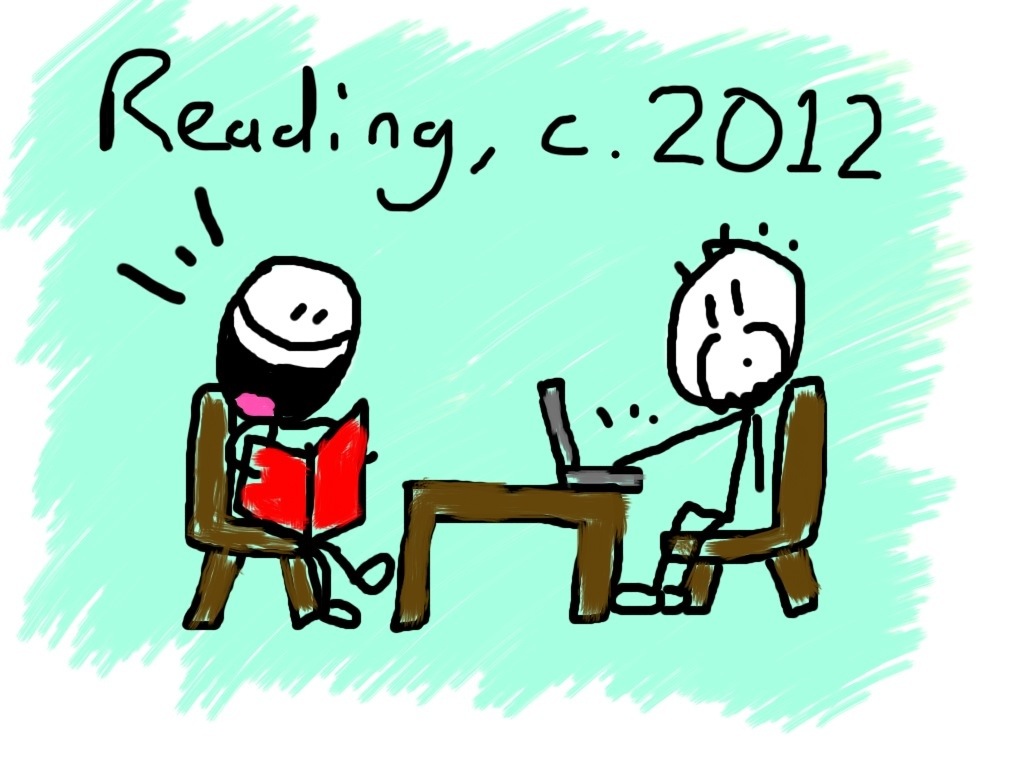
I know I said I wouldn't talk any more about Katawa Shoujo yet, but in Katawa Shoujo so far, I have pressed the "continue" button a whole lot and made approximately four choices in about two and a half hours of gameplay. I do not feel short-changed by this, as the stuff for which I am pressing "continue" is interesting, compelling and utterly addictive in exactly the same way that a good book is.

The situation is pretty much the same with titles like the Ace Attorney series, arguably my favourite series of all time. The vast majority of your time in these games is spent pressing a large "continue" button, with the occasional choice of where to go next, what to examine and, in the series' iconic courtroom scenes, using what you have discovered at the appropriate time to prove your case. In these games, there's one set solution and no deviating from it — but again, I don't feel short-changed at all.

Why? Well, the technical limitations of the genre mean that you find yourself filling in the blanks with your imagination a lot more than you might if the game were fully-voiced, fully-animated and provided complete freedom of interactivity. Instead, you're presented with static backdrops; character stills overlaid with maybe three or four different frames of animation to represent different emotions; and text. Lots of text.

The latter part is what puts a lot of people off visual novel titles — the "it's too much reading" argument — but it's from all the text that these titles gain all their power. Typically involving the player getting inside the head of the protagonist and playing things from a first-person narrative perspective, the use of text throughout allows for a far more in-depth exploration of the character than we get in even the lengthiest of RPG. We know what the protagonist is feeling; how he reacts to events; what his attitudes towards the other characters are; and any conflicts he might be feeling. It's a curiously intimate relationship that the player of a visual novel has with the character they're ostensibly "controlling", but this intimacy is oddly often amplified by how infrequently you get to make choices or speak for the protagonist. The choices you make, in many cases, are extremely important, and in some cases can cause the entire plot to veer off in a completely different direction. Their relative infrequence makes them powerful moments to mull over.

But what of the relevance to the "games and art" debate? Well, visual novels present an interesting medium for a variety of artists to express themselves. A novel is typically the work of one person — the writer, perhaps with an illustrator in tow depending on what type of book it is. A painting is the work of a visual artist. A piece of music is the work of a composer. But a visual novel requires all of these things — art, music, sound, writing and in some cases, animation and acting — making it a distinctively collaborative, cross-disciplinary medium. Alongside this, it's one of the most accessible forms of game there is — if you can read, you can play, understand and enjoy a visual novel even if you've never, ever picked up a controller before — meaning it has an inherently larger potential audience than the relatively specialised "gamey games" markets. It distinguishes itself from movies, animation and TV shows by providing a middle ground between the "show, don't tell" of moving pictures and the pure imaginative effort required when reading a novel.

In short, it allows for stories to be told in a way that is unique to its own medium. These stories, while often following similar patterns and very often involving big-eyed anime girls, are no less valid and worthy of study, interpretation and criticism than those presented in more "traditional" media. In fact, if anything, the fact that the visual novel is a relatively new and emergent art form merits more attention than it actually gets.

And sure, while many visual novels descend into Japanese absurdity, titles like Katawa Shoujo; Digital: A Love Story; Don't Take It Personally, Babe, It Just Ain't Your Story; and numerous others all push the boundaries of what it's possible to make interesting interactive entertainment from, along with taking on subject matter I can't recall ever being dealt with (tastefully, anyway) in other types of game.

Consider how simple early movies were and how sophisticated they are now in comparison. Given visual novels' relative infancy compared to other media, imagine what the possibilities might hold in the future. Will we ever see a title like this regarded as "interactive literature" or equivalent?

Who knows. All I know right now is this: if your primary motivation for playing interactive entertainment is to be told a story that draws you into its world and characters, you'd do well to check out titles like those that I've mentioned above.

#oneaday Day 743: Out

20120201-014508.jpg

It occurs to me that I haven't "been out" for ages. Not literally; I left the house both yesterday and today and will probably do so again tomorrow. I'm referring to what people mean when they say they are "going out" for an evening — that is, hitting the pubs and clubs of the local area, and probably drinking heavily along the way. Motivations for "going out" may vary — meeting with friends, going on the pull or simply just for something to do — but the results are usually pretty similar.

The vast majority of my "going out" when I was younger (read: during the university years) was conducted in conjunction with my good friend and Agricola demon Sam. We had quite a few memorable nights over the years, but they often tended to follow a fairly similar pattern.

Sam and I, and possibly a few others, would decide that we wanted to go out for some reason. In fact, there wasn't always an explicit reason — "Let's go to Lennon's" was usually reason enough.

Regardless of whether there was a reason or not, we would get ourselves into whatever we considered our glad-rags to be, and head out for our target — usually either the aforementioned Lennon's or Kaos, two grotty little student-heavy nightclubs within easy staggering distance of most of our homes, and two places with a predilection for cheap drinks that were usually 1) a knockoff of a recognisable drink and 2) out of date. Lennon's, in particular, proudly sported a fridge which noted "contents may be out of date" and the happily sold you said contents for £1 a bottle.

The reason we went to these places rather than somewhere bigger and (arguably) better? Stubbornness, partly, but also none of us were particularly hardcore clubbers. None of us were into doing the drugs (to my knowledge, anyway) and none of us were bigtime drinkers. Both Lennon's and Kaos allowed you the authentic clubland experience of being in a dark, smelly room with music too loud to talk to your friends over, but were both small enough that you never lost track of your friends for very long. Lennon's, in particular, was roughly the size of a large garden shed and entirely contained in a single room, so if you had reached the stage where you couldn't find your friends in there, you had definitely had too much.

Part of the appeal of "going out" for some is going on the pull, hoping to score some sweet lovin' from some trophy guy/girl that you'd had your eye on all night. Or, as the evening went on, anyone who looked vaguely in your direction or accidentally made eye contact.

Suffice to say, our attempts in that regard were usually confined to standing on the perimeter of the dance floor having picked a "target" that we decided we quite liked, and then staring at them off and on for most of the night. When closing time rolled around, we would then leave with the lingering sense of regret that we should have probably actually gone and tried to talk to them, or at the very least danced near them in the vain hope they might pay attention.

I can only remember a single successful instance of "pulling" in my entire life. I was at Kaos, this time with the university theatre group, as it was our wont to invade Kaos every Monday night and enjoy their plentiful stocks of Newcastle Brown Ale and vodka-fake Red Bull. On this particular occasion, I had had a fair amount of vodka and fake Red Bull, and was consequently of the opinion that my dancing was The Shit.

"You ever tried ecstasy, mate?" yelled some Neanderthal I didn't know in my ear as I wildly flailed around the dance floor.

"No," I replied honestly. Almost immediately afterwards I was grabbed by a nearby blonde girl (named Beki, as it turned out) who proceeded to snog my face off.

"Yeah," said the guy to me after Beki had allowed me to come up for air. "You'd love ecstasy."

Quite.

So why don't I "go out" any more? Several reasons, really: I don't really drink any more; I live a long way from anyone who might want to "go out"; but most of all, I'm not sure I see the point any more.

That said, I can think of two people offhand who may well be reading this for whom I would happily make an exception and subject myself to the cavernous depths of The Dungeon or the sticky floor of Lennon's. But that's more because I haven't seen them for ages and miss them rather than any particular massive desire to go clubbing. I certainly don't feel the same pressure I once did that I perhaps "should" go out, head off somewhere by myself and have a miserable experience of the type outlined here.

Perhaps I'm just an antisocial old bastard. We can probably all agree on that.

#oneaday Day 742: Being a Treatise on the Nature of Friendship in the Digital Age

20120131-010259.jpg

Today was a good day, because I took the relatively rare opportunity to take a friendship with an "Internet Friend" to the next level — real friendship. Speaking face to face. Being able to see each other, and having to actually speak words instead of typing things.

My erstwhile Internet Friend Holly and I had been conversing online for some time after a chance encounter — as I recall, it was a Twitter follow and a question on Tumblr that has long since been lost among pictures of cats and pushed Formspring answers. Regardless of exactly how it happened, we got chatting, and we did that Internet Friends thing of talking a whole bunch, going quiet for days, weeks, months at a time, and then picking up where we left off without too much difficulty. A familiar story to many of you reading this, I'm sure.

As it happens, Holly used to live where I now live (not literally in the same house, that would be super-weird). As such, she decided to come on down to visit her friends who are still in the area now she's elsewhere in the country. And we decided that it might be fun to meet each other and hang out.

Now, anyone who's ever broached the subject of a real-life meetup with an Internet Friend, whatever the motives for doing so might be, will doubtless be aware of that feeling of unease and anxiety that comes as the date for your meeting approaches. (Or perhaps it's just me. For the sake of this entry, however, I am going to assume you know what I'm talking about.) Will your friendship successfully carry over into the real world? Will you be able to make the same jokes you do on Twitter/Facebook/Tumblr/text message/however you've been conversing previously? Will the other person take one look at you, think you're some sort of hideous freak and run screaming out of the door?

Statistically, this is fairly unlikely to happen — in my experience, anyway. Out of all the Internet Friend meetups I have had over the years (and I've had a surprising amount, now that I come to think about it), only one encounter was a failure, and even then, it wasn't completely disastrous — we just didn't click in person for whatever reason. Past successful meetups saw me attending a showjumping event; getting married (though, granted, that didn't end all that well, but that's not the point under scrutiny here); flying to Toronto to play a ton of boardgames, see the sights and get sunstroke at the zoo; flying to Boston for super nerd-convention PAX East; having someone other than my brother and his family to visit when I'm in California (not that I don't enjoy seeing my bro!); and, indeed, my current living situation and relationship with Andie can also be attributed to a successful Internet Friend meetup.

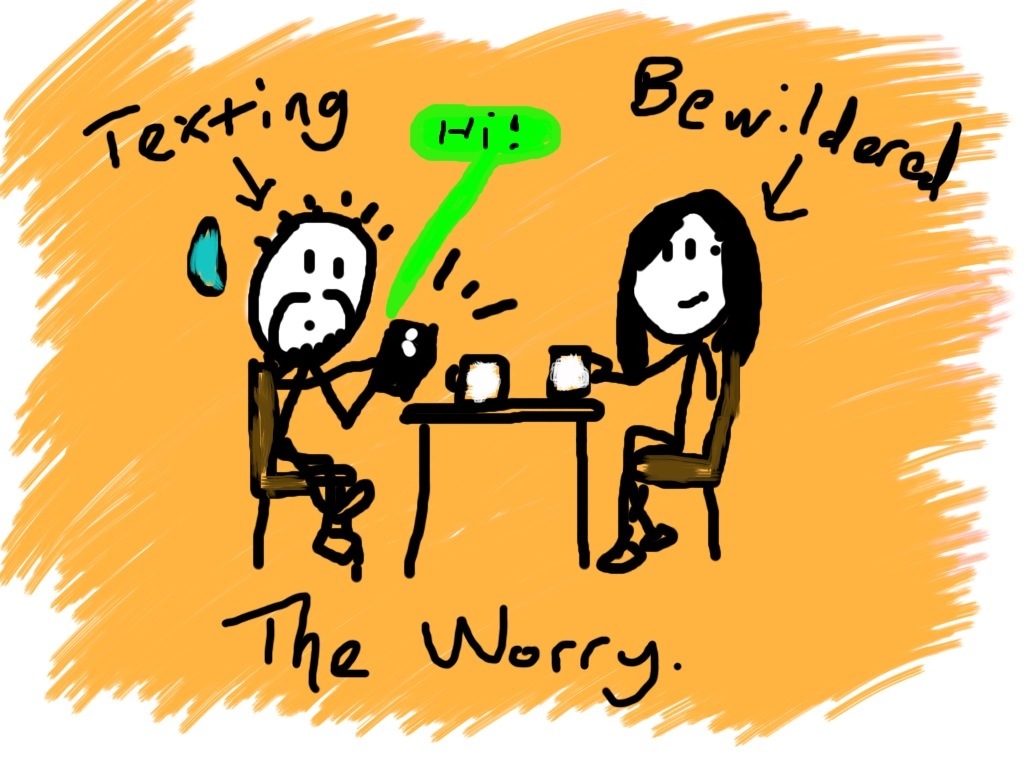
That one failure has haunted me a bit over the years, though. Despite all the other successful encounters, I still think back to that awkwardness I felt when I met Julia for the first time, and how awful I felt on the way home, thinking that all our long, heartfelt emails to one another had turned out to be essentially worthless. As those who know me well (and regular readers) will know, I am not the most confident person in the world, so to feel rejected like that — regardless of whether she had actually rejected me or it was simply my own social ineptitude that had caused the awkwardness — well, it hurt, quite a bit. As such, any time I've had the opportunity to meet up with someone I get on well with from the Internet, I've always been wary. All my insecurities and neuroses about my appearance, my personality and everything else all come out to play, and I find myself wondering if meeting is actually a good idea or not. In short, I worry the situation in the image above is what will happen.

Fact: it usually is a good idea to meet, and the situation in the image above is, mercifully, fairly rare. Look at it this way: you get on well online for a reason. For most people (those who aren't making a specific effort to troll, anyway), their online persona is a pretty true representation of the person they are — often sans any insecurities they have in face to face meetings. And if you get on well when speaking in text, it's pretty likely that you will get on in person, too.

You're doubtless waiting on tenterhooks to know whether or not Holly and I hit it off, then. (Maybe not.)

We did. We managed to easily fill several hours of conversation on a variety of topics, and both left feeling good that we'd done that. We're hopefully going to do it again before she has to depart back to far-off climes (relatively speaking). I'd call that a successful Internet Friend meetup, then, resulting in a real-life friendship. Hurrah!

So there you have it. You can make a Real Friend out of an Internet Friend. But you probably knew that already.

#oneaday Day 741: Glee - It's a Feeling You Get When Your Brain Finally Lets Your Heart Get In Its Pants

20120130-005623.jpg

I posted a short while ago that I had been watching Glee, and had found myself surprised that I was rather enjoying it. Like many other people (I imagine) I had certain preconceptions as to what the show would be about — misconceptions, as it happens. Misconceptions fuelled by media coverage of the phenomenon of "gleeks", and endless playing of their version of Don't Stop Believing on the radio.

Watching the show with an air of objectivity, i.e. having ignored most of the coverage about it because of my misconceptions it was cheesy and lame, has surprised and delighted me with its quality. I'm genuinely enjoying it — cheesy songs and all — and have come to care about the characters. As I've said on a number of occasions before, caring about the characters in something is the one thing that will keep me watching or playing something, even after said piece of media in question might have long outstayed its welcome with other people. And I can see how Glee could easily rub people up the wrong way. It's an acquired taste, but one I have well and truly acquired with aplomb.

Glee is good at high school angst. Above all else, outside of all the cheesy songs and elaborate dance routines, it's about teenage troubles. And some surprisingly weighty issues, too — I'd assumed that it would all be a bit Disney, judging by the saccharine, autotuned nature of the music. But in the space of the season and a quarter that I've watched so far, the show has taken in teen pregnancy, homosexuality, bullying, infidelity, abstinence, discrimination and a wealth of other topics, and it's handled them all in a surprisingly sensitive manner. Most of the "dealing with" said issues involves singing a song that is tangentially related to the issue in question, but somehow this never seems too forced. Sure, if you're going to go over it with a fine-tooth comb and pick apart exactly why a high school could never have the budget to pull off some of the productions they do, you'll come away feeling slightly I satisfied by the whole experience. But accept it for what it is — a heavily stylised depiction of high school that blends realism with escapist fantasy — and there's an incredibly satisfying, well-written and, at times, very touching show underneath.

It's a show of great characters, too. Mr Shuester (or however you spell it) is a great lead. While there's an element of "cheesy choir leader" about him by the nature of his character's role, he's a deep, interesting and flawed character who presents an interesting counterpoint to the colourful adventures of the teen stars. Sue Sylvester, too, makes a brilliant "villain", and is all the more powerful for being a very complex, unpredictable character. It would have been easy to leave her as nothing but a heartless bitch, but even well into the second season, she continues to surprise.

Barring a few missteps early in season 2 — the themed episodes based on Britney Spears and the Rocky Horror Show were a bit silly in that they felt far too shoehorned in, even for a show about retrofitting pop songs to express your inner angst — the show is fairly consistently great. Said theme shows were followed up by some brilliant episodes, however, with the eighth entry of the second season providing one of the most genuinely moving moments I've seen in a TV show in recent years. (I shan't spoil it for those who intend to watch it, but suffice to say for those who have seen it, it's the bit where that song "You're Amazing" is used, if that's what that song is actually called. I'd check, but, you know, I can't be arsed. You know the one I mean.)

I will be following Glee with interest as it continues — particularly as the high school nature of it means that the entire cast of kids will theoretically have to be replaced over the course of the next few seasons.

#oneaday Day 740: A Story About a Girl I Once Knew

20120128-235611.jpg

Those of you who have been reading for a while will probably know I used to be a teacher. Those of you who are new to this blog… I used to be a teacher. Three years in secondary education, a term in primary.

I had a fairly hellish time for the most part, culminating in having a nervous breakdown and having to get signed off sick with stress. While this meant that I could legitimately sit at home in my pants and play video games all day while getting paid for it (and not having to write about said games), it was a demoralising, embarrassing experience that reflected much of my time in the classroom — demoralising and embarrassing.

But it wasn't all bad, and lest you get the impression that I spent my entire time in the classroom hating every single child who sullied the sanctity of my room with their presence, I wanted to take a moment to appreciate one particular student who has stuck in my mind ever since. She isn't the only one, and if I'm strapped for writing ideas I will talk about my memories of the others at a later time. But she is the one that popped into my head when I was considering what to write about this evening. I attribute at least part of this to the fact she has a memorable name, and is the only person I've ever known with that name.

Her name was Berri, and when I knew her she was in year 8, or the second year of secondary school. I only knew her for a year, as I was only employed at the school in question for a year thanks to the headteacher who employed me officially being Shit With Money. But that's another story.

Berri may have only been in year 8 at the time, but she was incredibly mature for her age. She was the sort of kid you could have an actual meaningful conversation with, rather than simply chasing them up for homework. She was intelligent, witty and had common sense. She also had the patience of a saint, something which I display for the vast majority of the time but sometimes found reaching breaking point when confronted with a class of unruly, uncooperative children who thought their weekly Music lesson was an excuse to goof off. Berri never got annoyed, though, even when young Danny, her classmate who liked to climb bookcases and shout "CUNT" at people, was at his worst.

Berri was also very musical, which meant that the vast majority of the secondary school music curriculum was pitched way below what she was capable of. She never minding mucking in and doing a task that was beneath her ability level, though, and if she finished early she was more than happy to go and sit in a practice room playing her violin. Although classical music isn't particularly cool among kids, seeing a peer who is good at a musical instrument is usually enough to impress even the most unruly child into temporary silence. In retrospect, I should have perhaps taken advantage of this fact more regularly.

In short, I appreciated Berri for being one person in those classes of 30 that I didn't have to worry about. She was one pupil who actively made my life easier and more pleasant, rather than more difficult and unpleasant. Her practice room was often a haven of calm when the rest of the class, supposedly composing a piece based on Indian raga, were in fact just trying to see who could press the "DJ!" button on the school's keyboard the most in the space of five minutes. She never said anything, but I could tell from the way she acted and looked at me sometimes that she understood how much pressure I was under, and how difficult I found dealing with the unruly mobs. That look of understanding that she occasionally gave me was one of a few things that kept me safe in that hellhole.

I always thought that she was out of place at that school, populated as it was mostly with the sort of twats you'd see on Britain's Chavviest Teens, should such a show exist. I hope that whatever reason brought her there wasn't enough to keep her there, and I hope that in the intervening six or seven years since I last saw her that she has been able to make the most of everything that she had to offer the world. If she went on to university after school, she'd be about halfway through her course now. I wonder what she's doing.

Wherever you are, Berri, and whatever you're doing, thanks for making my life a fraction easier. I wish you the best of luck as you look forward to your life as an adult truly starting, and hope you achieve all that you deserve to.

#oneaday Day 739: I'm Flickin' Me Net

20120128-003638.jpg

I mentioned it briefly yesterday, but I feel some good, old-fashioned enthusing about Netflix is in order. I know, I know, you American types have been enjoying its streamtastic charms for a very long time now, and us Brits have been watching enviously for the whole time (and occasionally trying to do clever things to see if we can get signed up) — but now, we have it too.

And it's awesome.

As I've noted on some post back in the dim and distant history of this blog, I'm not huge on movies. It's not that I don't like them, it's that I'd rather spend two hours at a time doing something else. I'm not sure why this is. Perhaps there's something in my brain that sets me up to enjoy interactive, rather than passive entertainment — I'll happily sit and play one game for hours at a time, after all. But that doesn't explain why I might take a new TV show discovery and devour large proportions of a season at once (see: Community). That's no more interactive than a film, and yet I have no qualms in doing that.

I think my main bugbear with movies has historically been their perceived "value" when buying them to put on your shelf. I have a bookcase in front of me at the time of writing — look, it's over there — that is almost filled with DVDs. (The bottom two shelves are console games.) Of those DVDs, the only ones that I think I have watched more than once or twice are the TV show box sets. The movies I've kept around… well, I'm not sure why, really, since I certainly haven't watched Human Traffic for a very long time, and my copy of Hot Fuzz actually remained shrink-wrapped for a considerable period, too (it was cheap in HMV, then it was on TV, so I didn't really need to watch the DVD). I guess there's some sort of curious feeling of "attachment" to many of these movies, like I remember the time I bought them and associate them with a particular period in my life. As such, it's never really occurred to me to get rid of them, even though I rarely watch them.

The age of Netflix, however, has me rethinking this. Now for a few quid a month I have instant access (assuming I have an Internet connection) to a pretty huge library of movies and TV shows. Some are complaining that the selection is a little limited at this time — and perhaps it is if you're a big film buff, but it's certainly more than satisfactory for me at the moment. And the reason I mention the "perceived value" vs "time constraints" thing above is that I've been more than happy to just sit and watch a movie on Netflix, because I know that I haven't spent £[x] on it, and have to feel obliged to enjoy it.

It's the same for the TV shows, as it happens. I've been meaning to check out Twin Peaks for a very long time, for example — even more so since I played Deadly Premonition — but never got around to picking up the DVD set. It always seemed a bit expensive for something that was — to me, anyway — an unknown quantity. Would I like it? (As it happens, I love it, 90s hairstyles and all) Would it be worth the money, or would I be stuck wishing I'd spent my £[x] on something better?

This consideration is now irrelevant. Like Spotify allows me to check out music that I might not have felt inclined to buy outright, Netflix allows me to broaden my tastes in film and TV shows without any risk of feeling like I've wasted my money. And through the "creepy" (no it's not) autoshare to Facebook facility, I have plenty of opportunity to check out what my friends are watching, start some discussions about it and become more "well read" in the media of TV and film.

So, then, fellow Brits; if you have a decent Internet connection and like watching people perform for you inside your TV, PC, iPad or iPhone, I suggest you get yourself signed up for a free trial. For me, it's been worth it purely for the iPad compatibility — Netflix on iPad in bed has revolutionised insomnia.

#oneaday Day 738: Diversifying

20120126-220014.jpg

In a recent blog post, one Ben Goldacre described Spotify's auto-sharing behaviour as "creepy" and called for greater transparency in opt-out procedures. While I don't disagree that users should have the option of whether or not to share what it is that they're doing, I do disagree with the good Doctor's assertion that showing off your tastes to others is somehow "creepy" or "wrong".

The reason I don't find it either of those things is because of discovery. Spotify is built in such a manner that it's easy to check out an artist or album you're unfamiliar with in a risk-free environment. You don't drop any money on the album directly, so if you wind up hating it, you haven't lost out. And if you end up loving it, you can whack it in a playlist or star it for future reference.

Combine this ease of trying things outside of your usual comfort zone with social features and you get a powerful tool to expand your own tastes. Because music is an ever-present part of society these days — silence, it seems, is frowned upon by most people, particularly those of more tender years — conversations about what artists are awesome are less common than they once were in the age of buying CDs (and, heaven forbid, cassettes). Music is just there for many people — a disposable thing that people may well have a strong connection to but perhaps don't always think to actually discuss,

What Spotify's sharing feature does is allow you to see what friends have been listening to and, if it takes your fancy, jump right in there and have a listen yourself. I've discovered more than a few new favourites this way, and I'm certain other people will have been curious about some of my tastes too. I don't have any objection to people seeing what I've been listening to and I'm certainly not ashamed of it. The same is true for Netflix, newly launched in the UK and nicely integrated with Facebook to allow you to share what you're watching. On the whole, I'm much more inclined to pay attention to new releases if my friends are enjoying them rather than if they're simply "critically acclaimed". See: The Squadron of Shame

Goldacre suggests that people will make judgements based on what you have been listening to, and your playlists which, if you weren't already aware, are made public by default. And perhaps people will — but the attitude I have always taken with personal taste is that it is just that: personal. If you're the sort of person who ridicules someone else just because of what music they listen to, how they dress, or their appearance… I probably don't really want to know you. Everyone is free to make their own choices with regard to what entertains them (unless, you know, if you're into something fucked up and illegal) and so people should not feel ashamed or embarrassed to share what it is that they have been enjoying.

In fairness, it's entirely possible that there is the scope for cyber-bullying among schoolkids based on what they might have been listening to with Spotify, or the content of their playlists. But there's the scope for cyber-bullying based on their photos, their status updates, all the other stuff that's on Facebook, too. This isn't excusing it. However, it does mean that Spotify itself isn't some sort of creepy bully-magnet. As with all forms of social media and teens interacting with others on the Web, it's important for parents to be involved and aware of what their offspring are up to. If it looks like causing a problem, they should be familiar with the options that are there to protect people — and Spotify has those options if, for whatever reason, sharing things does become a problem. But someone's listening habits are public by default — and why shouldn't they be? There's nothing to be ashamed of there.

Perhaps I have a naïve view of social media and sharing information on the Web. But I just don't see how sharing your entertainment consumption is particularly harmful. Sharing deeply personal information, yes. But the fact that you listened to the Lazy Town soundtrack today? For me, that's the start of an interesting conversation, not something creepy.

#oneaday Day 737: Attack of the Clones

20120125-220706.jpg

So it seems that Zynga, lords of the social gaming space, are cloning Nimblebit's Tiny Tower. This isn't the first time Zynga has ripped off someone else's game and removed all trace of personality from its visuals, and it certainly won't be the last. The different this time is that people are actually taking notice, because Tiny Tower, for all its faults — and it has many, that not even its glorious retro pixel art aesthetic can counter — was extremely popular, made Nimblebit a fair amount of money and was even chosen by Apple as its iPhone game of the year.

Zynga's new game is called Dream Heights and one of the guys from Nimblebit conveniently compared it to his game here. As you can see, it has pretty much all the gameplay of Tiny Tower with none of the visual appeal.

Now, in the mainstream games market, this sort of thing is generally frowned upon quite a bit. For all of the complaining that the big shooter franchises all look very similar, they at least try to differentiate themselves with how they play, the modes they offer and the like. Battlefield 3 offers a very different experience to Call of Duty. I don't care for either of them, but I can appreciate that each appeals to a different subsection of the audience,

In mobile and social gaming, however, developers and publishers seem to have no such scruples. In my current position writing game reviews for Inside Social Games and Inside Mobile Apps, I regularly see games that are almost identical to each other. Most of them follow the FarmVille model to one degree or another — you click on things, there's a countdown timer before you can click on them again to get a reward, there's a list of insultingly simple "quests" on the left side of the screen, you get experience points every time you exhale and, generally speaking, the game is designed to be a series of not very well disguised Skinner boxes.

Other popular genres include the growing hidden object genre, where you're sent into a cluttered room/street/train carriage and tasked with locating lists of completely arbitrary items, with scenes tied together by an often flimsy excuse for a plot. Just in the last couple of weeks, Zynga released Hidden Chronicles on Facebook, only to be followed this week by the almost identical World Mysteries from Brazilian developer Vostu. See, it's not just Zynga doing it — it goes both ways, too.

Fans of Spry Fox's fun puzzle game Triple Town on Facebook and Google+ may also want to check out Yeti Town on iOS by the obnoxiously-named 6waves Lolapps. This game has drawn criticism for ripping off Triple Town completely and releasing on iOS before Spry Fox were ready to release their own iOS version of their game. You may argue that Spry Fox should have been quicker off the mark in getting their iOS version to market, but it's hard to believe that 6waves Lolapps came up with an identical concept (not almost-identical, identical) completely independently of Triple Town.

Independent developer Vlambeer ran into this issue last year when, like Spry Fox, they were beaten to the punch on an iOS game. Gamenauts' Ninja Fishing hit the App Store shortly before Vlambeer was ready to release its own title Ridiculous Fishing, itself a reimagining-cum-sequel of its earlier Web-based title Radical Fishing. I'm very pleased to see that Vlambeer will be speaking publicly about this debacle at GDC this year.

Where does it end, though? Games are a creative art form and for all these clones to hit the market is to do the medium a disservice. You don't get books hitting store shelves where an author has simply done a Find and Replace on all the characters' names from someone else's work, nor do you get movies which are simply shot-by-shot reconstructions of another movie. We get remakes, sure, but at least those are usually reimagined for a contemporary audience — and they're being honest about their source material rather than attempting to pass themselves off as a completely new product.

This practice needs to stop. Unfortunately, cloning, it seems, is already an established part of mobile and social game development. In the long term it will only hurt everyone's business.

So devs? Be bold. Come up with an original idea. Don't call your game "innovative" if it's the same as something someone released last week, and the week before, and the week before. Try something new. Break out of established conventions. The most memorable games in the mainstream are the ones which tried something new. The moment we see a successful social game break out of the market's conventions is the same moment we'll see people willing to be a bit less cynical and a bit more enthusiastic to see what this burgeoning industry has to offer.

#oneaday Day 736: To Sir and Miss, with If Not Love then At Least Fondness or Enduring Memories

20120125-010533.jpg

Following a conversation with Andie, I thought I would challenge myself to name as many teachers from my own schooldays as I possibly could, along with the contribution they made to making me the person I am today, for better or worse. Mostly the better, I think, which doubtless they'll be delighted to know if they do happen to be reading this, as unlikely as that might be.

If you are one of my old teachers and you are reading this and I forget to mention you, I apologise in advance.

Anyway. Let's consider these in roughly chronological order.

At primary school, our early years were accompanied by Mrs Place. I have to admit I don't remember a great deal about her, but I think given my tender age at the time, that can probably be excused.

Class 2 in primary school was taken by Mrs Robson, whom I also can't remember a great deal about. I do remember her not being there one day though, and me being tricked into saying "shit" to Mrs Powell the cover teacher by Natalie Forster, the bitch.

Class 3 was taken by Mr Edwards, who had a bit of a mullet and a moustache. He liked to play the guitar at every opportunity, meaning that "Circle Time" (the point of which I'm still not sure of even having been a primary school teacher myself) more resembled a campfire singalong than anything more meaningful. It was fun though.

Class 4 was taken by Mrs Barrett, a formidable lady by all accounts who had some very old-school values. The rest of the school was terrified of her, because she had a withering look that could cause geese to fall dead out of the sky if she so desired it. Once you got into class 4, however, it became apparent that she wasn't so scary after all, and even had something of a sense of humour. Her insistence on strict discipline meant that she ran a tight ship, and her class achieved well. Crossing her made you feel like, as cliche as it sounds, you had let yourself down.

On to secondary school, and my form tutor was Miss Quirk. She was Scottish, had short black hair and said "poem" as "poyem". She taught Maths, but I don't think I ever had a lesson with her.

Elsewhere in the Maths department was Mr Wilbraham, who may or may not have had a drinking problem. He was certainly rumoured to have a drinking problem, but I can't say we ever saw any direct evidence of that. He was another of the Mrs Barrett breed — regarded with fear and misunderstanding from afar, but actually turned out to be very pleasant to work with once you were in his class. He didn't help me enjoy Maths, however.

The English department was my second favourite department. At various points, I was taught by Ms (not Miss) Derbyshire, who was a bit like Victoria Wood when she was being funny; Mr Bowie, who was the obligatory male teacher whom all the girls fancied, was very cool and convinced me to explore the music of Jeff Buckley; Miss Idziacszyk (I think I've even spelled that correctly), who was a good, knowledgeable teacher, particularly at A-level. On one memorable occasion, Mr Bowie came with us to a local recording of Songs of Praise which our steadfastly secular school had, for some reason, been invited to. On that occasion I had my shortest ever relationship with a girl — we went out for a week, during which time I saw her once, kissed her once before she decided she wanted to go back to the way things were before.

The Music department was my favourite department. Initially staffed by Mr Murrall and Mrs Choy-Winters, later by Mr Murrall and Miss Garrick (whom my erstwhile best friend Craig fancied the pants off) and even later by Mr Murrall, Miss Garrick and Mr Wrigley. All of the teachers in the department were laid-back, fun and a pleasure to be with both in lessons and outside. By far the highlights of my time at secondary school were the school concerts, during which staff and student were able to interact in a way that just wasn't possible in the normal classroom.

Up in the Upper School were the Geography and History departments. Here, two particular teachers stood out — Mr Mason (pictured above) on the Geography side, and Mr Watts on the History. Mr Mason had long hair and a porn star moustache, and always spoke in a calm, quiet voice. Instead of shouting when he got angry, he went quieter. It was terrifying.

Mr Watts, meanwhilem was the exact opposite. He could shout your face off, and frequently did. Despite his deservedly formidable reputation, he was an excellent teacher. Okay, I can't remember a lot of what we covered in History, but I certainly remember the lessons I had with him — and the occasions he looked out of the window, saw a year 7 kid and just tutted and shook his head.

Mrs Lloyd taught Integrated Humanities and Sociology. She knew a lot about her subject and was also one of those teachers whom it was very easy to talk to. Perhaps it was the nature of the subject itself, which often dealt with issues that affected us directly, or perhaps it was just her nature. Either way, I remember her very fondly.

Then there's the senior staff. I have fond memories of Mr Cragg the erstwhile head teacher for understanding fully why I turned around and lamped Murray Crofts in the face after the little cunt had been harassing me all day. And Mrs Knight, who was a motherly figure to much of the school in many ways — right down to inflicting embarrassing discipline on those who stepped out of line. (One of the worst punishments, particularly for younger kids, was to be forced to have lunch with her, or to to be on "Five minute report" to her.)

There are doubtless plenty of others I've missed — Miss Cuthbert, who was one of heads of Sixth Form, and regularly tried unsuccessfully to get us all being a bit more religious; Miss Stafford the art teacher, whom I didn't spend a lot of time with (as is probably apparent from the pictures which accompany these posts); Mrs Graham the formidable and terrifying Home Ec teacher.

I know one thing, though — as difficult as schooldays were at times, I'll remember the adults who got me through it for the rest of my life, even more so than those whom I considered close friends at the time, but have since drifted far away to pastures unknown.

I now know first-hand how hard your jobs were, Sirs and Misses. I respect you even more than I did back then. Those of you who have the courage to remain in education with the kids of today, I salute you.