#oneaday Day 835: I Finished Nier

20120503-020725.jpg

As the heading says, I have indeed finished Nier… once, anyway. I'm going to hold off on doing a "review" as such for the moment, however, for several reasons. Firstly, a full understanding of the game is only attained following several playthroughs. And secondly, Nier is a fine example of how the "reviewing" system we use most of the time is, at times, flawed.

Nier enjoyed mediocre review scores on its original release, netting a Metacritic average of 68. As people who care about such things will tell you, 68 is not "bad" if you're taking 50 to be "average", but unfortunately no-one does. The assumption is made by most people that anything under 80 is not really worth bothering with, and anything 90 or higher is an essential purchase.

But in my experience, it's often in these slightly lower areas that you get the most interesting games. They may be rough around the edges, they may not be perfect, but by golly they have soul.

If you were judging Nier purely mechanically, it's easy to see why it attained the mediocre review scores it did. There are a very limited number of environments to explore which you spend a lot of time backtracking through. The environments are pleasant enough, but not that interesting. The enemies are repetitive. Combat can be a bit clunky. Most of the magic spells are fairly useless. The AI partners you pick up over the course of the game are completely useless. Most of the game's quests involve either killing things or fetching things. Choices you make don't matter. And the "real-time" mechanic for growing crops is just ridiculous.

The thing is, though, play Nier and become invested in its story, and absolutely all of these factors cease to matter completely. Nier tells an interesting, mature, emotional tale, and it tells it well with a small cast of well-defined, unique (and bizarre) characters — and a much larger supporting cast who make the bleak, far-future world of the game seem all the more believable. It piles on the darkness but knows how to lighten the mood with a pithy comment or two at just the right moment. It constantly does things you don't expect — with the story, with the characters, with the style of gameplay, even with the camera angles. It encourages the player to get inside the head of this unyielding, determined protagonist and almost "method act" their way through the game as he toils and struggles to save his daughter.

Do Nier's occasionally-clunky mechanics and sometimes-repetitive gameplay make it a "bad" title? Absolutely not. They may, however, put off the less patient players out there — and that's fine. Those who stick with it will find themselves enjoying a surprisingly creative adventure, while those who chose to forgo the game's hidden charms and depths for whatever reason doubtless have plenty of other things they'd like to spend their time playing.

The sad thing, though, is that the mediocre review scores were probably enough to put a lot of people off even trying the game in the first place. Why bother buying and playing a "68" when you could play a "90"? This problem becomes compounded when you take into account the fact that a lot of publishers make strategic decisions about what franchises they want to explore further — and in extreme cases, which development studios get to keep taking home their paycheques — based on Metacritic scores. Do you think we'll ever get another Nier (or at least a game like it)? Probably not. Why? Because it's too risky. Nier has its fans, sure, but they number relatively few, and aren't necessarily going to be enough to let the game make a profit.

I'm glad Nier exists, though. It's evidence that all hope is not lost for creativity, maturity and a desire to do something a little bit different, even in these days of budgets spiralling out of control and a growing desire to create games that are "services" rather than "creative works".

Nier most certainly is a creative work, a labour of love, and it should be applauded for that.

#oneaday Day 834: RUMOUR: Rumours 'Rumoured', Says Rumour-Monger

20120502-005626.jpg

If you've ever started a conversation with "I heard that…" and then gone on to explain exactly how you heard somewhere/from some guy in the pub/from "The Internet" that something awesome/awful is going to happen, then I urge you to think before you speak in future. Because if you continue with that sentence, you're simply feeding the rumour mill, and the rumour mill doesn't produce good things and help us make the Bread of Truth. It produces garbage and poo, and then squishes it all out into the world's most unpleasant pâtĂ©.

Tortured (and gross) metaphors aside, it's a fact that I wish more people — particularly in the press — would cotton on to.

Today, for example, saw news that Liberty X "might be" reforming for a new album and a tour. Firstly, I don't think anyone wants that, and secondly, the only evidence that such a reunion "might be" happening is the fact that they were photographed together outside the ITV studios and — get this — they were smiling. Stop the fucking presses.

There are a ton of journalism sectors that are particularly prone to this. Showbiz columns report who might be sleeping with whom. Sports columns report who might be moving to some other club for a disproportionately enormous amount of money. Music and arts columns report who might be working on what. And then, of course, there are the tech-related industries.

Anything related to Apple is accompanied by an inordinately huge amount of rumourmongering, for example. In the run-up to the company's announcement of the third-generation iPad, all sorts of nonsense was flying around. This ranged from suggestions that it might not have a Home button to the frankly astonishing assertion that the reason iOS apps had started having textures like leather and the like in the background was because the new iPad would have a haptic display — i.e. one where you could feel textures as well as see them.

The video games industry is far from immune, either. Rarely a week goes by without one outlet reporting on some rumour from a mysterious, anonymous source and the "story" then being picked up by every other news site on the Web as if it were fact. This particular rumour mill goes into overdrive as a hardware generation starts to wind down and people start wondering what the next generation of consoles might look like. Inevitably, the vast majority of stories turn out to be absolute bollocks, and on the rare occasions when an outlet or reporter writes something that turns out to be true, there's at least a day's worth of smug, self-satisfied cries of "Called it."

No you didn't. You were throwing darts blindfolded, and you happened to hit a lucky bulls-eye. Your other fifteen darts are embedded in the barman's testicles, the barmaid's left boob, the right ear of that hard-looking dude who drinks absinthe by the pint and the TV that was showing the Bolton v Wigan match. (Everyone is angry. I'd run, if I were you.)

So why do we persist on reporting on these festering sores on the very arse of journalism? Because they attract attention, particularly if they're controversial. If one site prints a story that Liberty X is reforming, or that the next Xbox will feature a system to prevent used games from working on it, or that the iPhone 5 really, totally, absolutely positively is coming out this time, then that will attract commenters like flies around shit. And that means page hits, advertising revenue and the little graphs that make the men in suits happy moving in an upward direction. Who cares if it's absolute nonsense dreamed up by someone who cleans the toilets at Microsoft? Print it!

I make a point of not reading any stories that start with the prefix "RUMOUR:" now. And should I ever find myself back on the news desk for a popular gaming website, I will most certainly do everything in my power to avoid reporting on such nonsense — unless some actual investigation turns up something interesting, of course. But blindly parroting another site's "anonymous source"? No. Just no.

So, then, I reiterate: think before you speak/write/publish. Because rumours are rarely helpful. Remember that time it spread around the whole school year that you'd shat your pants when in fact you'd just sat in some mud?

Yeah. That.

#oneaday Day 833: Some Further Thoughts on Nier

20120501-010050.jpg

I haven't yet finished Nier, but I thought I'd take a moment to write a little more about it since I've been playing it quite a bit over the course of the last week or so.

Nier is a game that rewards patience and perseverance. The game's enormous number of completely optional sidequests is testament to this fact. These sidequests tend to fall into one of several categories — gathering materials, killing things or delivering things. There are a couple of outliers (one of which I'll discuss later) but for the most part they are mechanically very simple, and usually simply involve beating up a bunch of monsters or running from one place to another.

In gameplay terms, they're very boring, and this is one of the reasons why Nier received rather mediocre reviews on its original release. But thematically, they are entirely appropriate. Nier himself is known among his peers as "that guy who will do anything" and so is regularly called upon by various villagers to do things for them. Some are respectful and kind about this, others less so.

The key thing about the gruelling experience that is attempting to 100% the sidequests in Nier is that it reflects Nier's own struggles. Life in his world is hard, and everyone has to pull together in order to survive. This sometimes means knuckling down and doing things you don't really want to do, or things that are time-consuming, or things that are expensive. By completing these quests you may not be directly making Nier himself any stronger, but you as the player come to understand his strength of character and his resolve to do the right thing. Couple this with Grimoire Weiss' sarcastic comments about the inane nature of the tasks his companion is asked to complete (which reflects what the player might be feeling about taking on such seemingly meaningless missions) and you have a very clever piece of characterisation and storytelling that would only really be possible in the medium of video games.

Some aspects are just ridiculous, however, the most notorious of this being the farming minigame, where Nier is able to grow various crops outside his house and then harvest them, hopefully for profit. The thing is, these crops grow over the course of a day or so of real time, meaning that anyone getting serious at farming is going to have to do one of two things: play Nier for weeks at a time, or take the path of least resistance (which I don't know anyone who has played the game that hasn't done) and start messing around with your console's clock. I can't speak for the process on PS3 as I haven't tried it, but on Xbox this is an unnecessarily cumbersome experience that involves quitting the game entirely, turning off the Internet connection (to stop the clock being automatically set), resetting the time and then reloading the game. It works, though, and allows for a considerable amount of harvesting in a very short period of time.

One quest in the game (and a related achievement/trophy) practically requires that you do this. It involves cross-breeding various colours of flowers in order to produce rare breeds. The trouble is, the game doesn't explain how this works anywhere, and debate still seems to rage on the Internet at large as to what is actually necessary in order to perform this task in the most efficient manner possible. In some senses, this could be argued to be another aspect of the game inviting the player into Nier's shoes and tasking them with finding out how this flower cross-breeding works, then applying that knowledge in the game — because it sure as hell isn't going to tell you.

How anyone was expected to do that without a strategy guide to hand is anyone's guess. Still, even when simply following instructions on how to do it (with something along the lines of a 10% chance of success each time) it's strangely satisfying when it does all come together.

I'm about 77% of the way through the sidequests in the game now, meaning that shortly I'll be able to pursue the rest of the game's main plot, which has been both interesting and unconventional for a Japanese game so far. I'll talk more about that when I come to do more of a "review" of the entire experience, however. The game also supposedly encourages repeat playthroughs (minus the sidequests, thankfully) to get to several different endings, but how this actually works I haven't found out yet.

In fact, I've managed to remain completely spoiler-free for the entire game so far, meaning I've been able to appreciate all the game's unexpected and bizarre things as they happen. This has been a big part in why I have come to regard the game so fondly; though the characters, writing and music are all excellent too. Again, though, further thoughts on these when I've actually beaten the whole thing.

For now, I have some white moonflowers to harvest, if you'll excuse me.

#oneaday Day 832: The Seven Wonders of Waterdeep

20120430-005221.jpg

So, birthday number 31 has been and gone and it's been a pleasant one. It's been a rather more low-key affair than last year's few days of awesomeness that Andie arranged, but it's still been a fine day filled with good friends, board and computer games, cookies, coffee and Catan.

I wanted to talk a little bit about two of the board games we played today that weren't Catan — 7 Wonders and Lords of Waterdeep. These two titles are relatively new to me (in fact, today was the first time I'd even seen Lords of Waterdeep, let alone played it) but I like them both a great deal. They're very different from one another, so let's take them one at a time.

7 Wonders is a card game based around the concept of civilisation-building. Unlike many other civ-building games, however, a game of 7 Wonders is over and done with relatively quickly thanks to its simple, elegant mechanics.

The game is split into three "ages", each of which has its own deck of cards. These are dealt out equally to each player to give them a unique hand. Each player then picks one of the cards from the hand and passes the rest on to the next player. Some cards may be built for free, some require the payment of gold coins (represented by cardboard chits) and some require specific resources to use.

Resources are depicted in an abstract manner by cards — unlike games like Catan, though, they are not expended when used. Rather, they represent a player's potential to produce a certain amount of that resource per turn. For example, if a player has two cards with "wood" symbols down on the table, they may play a card which requires one or two "wood" resources to use, but the wood is not expended in the process. In order to get the ball rolling, each civilisation has its own "starting resource" which it doesn't require any cards to make use of — and player may pay gold to one another to "borrow" resources. Again, this does not expend the other player's resources, nor does it stop them from using the same resources themselves.

Cards are split into several different types — basic resources (wood, stone, brick, ore), luxury resources (glass, silks, papyrus), trade buildings (which generally allow players to acquire resources from other players for cheaper), point cards (which simply score points), guild cards (which provide bonuses at the end of the game for certain specific cards), military cards (which represent a civilisation's military strength in an abstract manner) and science cards. Science cards form the basis of the game's most complex mechanic — collecting sets of the same type of "science" provides the player with points to the value of the number of cards squared, while collecting one of each of the three "science" symbols provides the player with a further 7 points.

Players may also choose to build a stage of their civilisation's Wonder. This costs several resources and prevents the player from using a card that turn in the process — however, this can be a good strategic means of preventing the next player from getting a card they really want. Building a Wonder stage either provides the player with points or a special ability of some description. Some allow cards to be acquired for free, others allow players to rifle through the discard deck and build something which is already out of play, others still bend the rules in different ways.

At the end of each "age", players tot up their military strength cards and compare them to the players on either side of where they are sitting. If their military strength is greater than their neighbour, they gain a point bonus that increases with each "age". If it is weaker, they take a score penalty. This remains the same — -1 — in each stage of the game.

At the end of the game, all scores are totalled up and whoever has the most points wins. Simple.

7 Wonders is a fun game because it's quick to pick up and understand (despite what my description above may read like to you, it's actually fairly straightforward to learn even if you're a complete board game newbie) and fast-paced. There's little in the way of "analysis paralysis" as people agonise over which cards to play, and you can get through an entire game in well under an hour. Despite its brisk pace, it has plenty of depth, though, and various randomised elements provide each session with a degree of variety.

Recommended, then.

Lords of Waterdeep, meanwhile, is a Dungeons and Dragons-themed building game where each player is competing to score the most victory points by the end of a limited number of turns. Most of these victory points come from the completion of "quests", most of which require the expenditure of resources and money — in this case, the resources being adventurers of various types. This is D&D, after all!

The basic gameplay is quite similar to Agricola. A variety of "action spaces" are available on the board, and players take it in turns to place one of their "agents" on a space to claim it and perform its action. These actions range from simply taking resources or currency to more complex activities such as playing "intrigue cards".

Quests are completed simply by having the appropriate combination of resources on hand, at which point the player flips over the completed quest card and takes any rewards printed on it. Quests are divided into several different categories, and at the start of the game each player receives a secret card telling them which categories of completed quests will score them bonus points at the end of the game.

The aforementioned "intrigue cards" provide a lot more interaction than something like Agricola in that they are typically used to attack other players or benefit whoever is playing them in some way. Some cards allow the player to steal resources from others. Others simply force other players to give up resources, or allow the player playing the card an extra turn. They can turn the tide of a round completely almost immediately, and provide great scope for both laughs and wanting to throw chairs at your opponents.

Players may also build buildings in the city, which become extra action spaces but typically provide a bonus to whoever "owns" the building when used. The exact buildings which turn up in the game are randomised, too, so there's an element of chance and uncertainty to what is coming up rather than the more predictable turn order of Agricola.

I enjoyed Lords of Waterdeep a lot. I'd need to play it a few more times to understand its nuances, but I felt like I understood what I was doing a lot better than Agricola. (I am constantly comparing to Agricola because mechanically it is relatively similar, though arguably less complex.) At no point did I feel I was "out of my depth" or being "left behind" — there was always something worthwhile to do, but it never felt like there were too many things to do and not enough time to do them in, which is my biggest bugbear with Agricola. It's not a "beginners'" game by any means, but for those who enjoy a good Eurogame and have any fondness for D&D, it's a worthwhile investment of your time.

Two great games, then; if you're a board game fan, be sure to check 'em out. And if you're at all interested in the hobby but perhaps don't know a great deal about it, I strongly suggest you check out Wil Wheaton's new YouTube show Table Top, in which he sits down with a variety of famous people (well, famous geeks, mostly) to play a game, explaining it along the way. It's a good way to get a feel for how a game works — including the dynamic of group interaction during play. So far they've covered Catan and Small World.

And on that note, time for bed, I think. Night-night.

Pete, age 31

#oneaday Day 831: Another Year

20120429-015818.jpg

So, as of the time of writing, I've just turned thirty-one years old. As becomes increasingly common as the years pass by, it doesn't feel any different to being thirty.

I was mostly prepped for the supposed horror of turning thirty by my parents. My father in particular apparently didn't take to turning thirty all that well, so I was expecting a semi-to-fully traumatic experience. It actually turned out to be a rather pleasant experience, as I was whisked off on a weekend to London by my girlfriend Andie, and then had the chance to see a bunch of friends for curry and good times.

A lot has happened in the space of the last year. Having been forced to move back home with my parents due to my shattered personal life from the year prior, in August I moved back out again. At the time I was working for GamePro and was earning a decent wage from it, too, so Andie (who was also living with her mother at the time) and I decided that we were both in a situation where we could get a house and move in together. So we did. And that was good.

Since that time, GamePro collapsed — in December of last year, to be specific. I was very sad about this, as I felt I'd found my "calling" — I did a great job of posting the daily news there, and my hard work was appreciated by the people I was working for. I was grateful for the opportunity, grateful to be accepted and appreciated in what I was doing, and grateful to, for the first time in my life, have a job that I actually enjoyed.

I was half-expecting the collapse of GamePro to signal another disastrous collapse in my own personal circumstances. At the time, I didn't have enough money saved up to survive for very long and still be able to pay my tax bill at the beginning of next year. I started frantically applying for jobs and finding the same situation I had done prior to starting at GamePro — no-one was interested in me. I don't know whether it was my lack of "relevant" qualifications for certain sectors, my wide-ranging experience that covered both teaching and writing positions, or something else. Whatever it was, it carried a significant risk of making me feel like absolute crap again.

Fortunately, I found myself with a new job before long, and I'm enjoying it. I'm constantly learning new stuff, too, which is a big bonus. My writing may not be quite so much in the "mainstream" public eye any more, but I'm find with that; it means that I have to deal with far fewer hormonal teenagers who can't spell, punctuate or formulate an argument. I also haven't had any accusations of being a paedophile since starting my new job, either, which is always nice.

What else? I've bought a new computer, bought an Android tablet, discovered My Little Pony, played all three of the "Operation Rainfall" role-playing games on the Wii, finally started playing Nier, started a few creative projects, started, stopped, started, stopped and started again at the gym lots of times… the list goes on. When put that way, it probably doesn't sound all that interesting, really. But I can't say it's been a shitty year, unlike certain previous years I could mention. On the whole, it's been a reasonably good year and hopefully things will just continue to improve.

Now it's time to go to bed. I've had friends over playing TrackMania, Dungeon Defenders, 7 Wonders and Catan this evening, with more arriving tomorrow for further board game fun and frolics.

See you on my "proper" birthday.

#oneaday Day 830: Roguelikes, for the Adventure-Curious

20120428-020706.jpg

I was having an idle discussion with a couple of people on Twitter earlier, at least one of whom I know reads this blog (hi Anne!) and the subject turned to that of roguelikes. This is a genre of gaming that I've got to know quite well over the last couple of years and while I'm still not that good at them (I'm yet to beat one, for example), I feel I know a bit more about the genre now.

Quick recap for the uninitiated: a roguelike is a (usually) turn-based role-playing game typically focused on exploring randomly-generated dungeons, killing as many monsters as possible and acquiring lots of lovely loot. Sometimes there is a plot or quests and usually there's some way to "win", but they tend to be monstrously difficult games and generally feature "permadeath" in that they delete your save game if you happen to kick the bucket during one of your (mis)adventures.

It's easy to see them as utterly impenetrable, however, thanks largely to the fact that many of them are presented using purely ASCII graphics, making them look more like something from Teletext than cutting-edge interactive entertainment. The fact that some of the more popular ones have a key command mapped to literally every key on the keyboard (shifted and non-shifted) doesn't help matter, either.

So what I've gone and done is pick out some of the roguelikes I've played over the years that seem to be pretty accessible and easily-understandable. Then, if you're curious, you can try them out for yourself. If not, you can, I don't know, go and harass a badger or something.

So let us begin.

Diablo III

Okay, technically it's not a roguelike in the strictest definition of the genre, but Blizzard's upcoming title shares a lot of DNA with the genre. Randomly-generated dungeons, a focus on combat and loot whoring rather than plot (though the game does have a story, and seemingly somewhat better delivered than in its predecessors) and even the option for permadeath if you're feeling masochistic. The Diablo series has always been very accessible yet deep for those willing to invest some time and effort into it, and early indications seem to be that the third iteration will be no exception. It also has a great multiplayer mode, which is the highlight of the experience for many.

Where to get it: Buy it for PC here. It'll be released on May 15, but you can preorder and pre-download now.

Dungeons of Dredmor

Dredmor is an independently-developed roguelike from Gaslamp Games. The game casts players in the role of a male or female hero with a custom combination of skills — some useful, some just plain bizarre. It's then up to the player to battle their way down through the titular dungeons on their way to a confrontation with Dredmor himself. Dungeons of Dredmor is accessible in that there are not many commands to remember and the base mechanics are pretty simple. It also has attractive pixel-art graphics, a bizarrely cheerful soundtrack and an excellent sense of humour. The developers also regularly release updates to the game that improve the experience significantly.

Where to get it: Buy it for PC and Mac via Steam.

Hack, Slash, Loot

Hack, Slash, Loot differs from many other roguelikes in its scope. Its quests are short, there's no level grinding for experience points and the only stuff the player character can carry is the stuff they have equipped. Potions and scrolls are used immediately, and equipment is swapped out when picked up, meaning players have to weigh up whether or not their newly-discovered loot is worth taking with them. The whole thing is wrapped in an endearing retro aesthetic and its difficulty level is fond of kicking you repeatedly in the face until you cry. As compensation, however, the more you die, the more characters and quests you unlock.

Where to get it: Buy it for PC and Mac via Steam.

Doom: The Roguelike

Doom: The Roguelike (or DoomRL as it is often referred to) is an excellent example of the creativity often seen in the genre. The game is quite literally a reimagining of the original Doom but rendered as a roguelike. Until recently, it combined the original music and sounds of Doom with ASCII art, but the most recent update has added graphics, new music and remastered sounds. It's a simple but fun experience and works considerably better than you might expect. Best of all, it's free.

Where to get it: Download it for PC, Mac or Linux for free here, though the Mac port is a bit dodgy.

Tales of Maj'Eyal

Tales of Maj'Eyal (formerly Tales of Middle Earth) is one of the more well-established names in the free roguelike sector. It's a more complex game than some of its peers, but its interface is accessible and the mechanics are straightforward to understand. There are lots of different character classes to try, and lots of locations to explore. The game is relatively unusual in the genre for including a "world map" and towns to explore between dungeons, giving it a more traditional RPG structure while still punching you in the squishy bits with its difficulty on a regular basis.

Where to get it: Download it for PC, Mac or Linux here.

100 Rogues

The quintessential iOS roguelike, 100 Rogues combines attractive retro pixel art with simple mechanics and addictive gameplay. The quest is short enough that it could potentially be finished in one sitting, and you get the opportunity to battle the Pope. Like most of its peers, it's incredibly challenging, but very addictive.

Where to get it: Buy it for iPhone and iPad here.

There are hundreds of other examples out there, but these are some that I've played and enjoyed as someone who is still something of a greenhorn in the genre. Why not check them out? In my experience, roguelikes are some of the best games for creating "emergent narratives" — that is, the stories that occur naturally through your play rather than an explicit narrative included by the developer. Stories like these, for example.

#oneaday Day 829: Nier: Some Early Impressions

20120427-003819.jpg

I've been playing Nier, a game I've been meaning to try for absolutely ages and struggled to find a copy of. As it happens, my local second-hand games emporium had a copy, allowing me to sample its delights. Like many titles I've wanted to try for a while, I've managed to go into the experience with a relative sense of "beginners' mind", allowing me to enjoy it as if it were "new", so to speak. This, I feel, is a key part of the Nier experience, since it continually throws you curveballs as you play, remaining constantly surprising.

At its heart, Nier is a simple action RPG, but to call it that is to do it a gross injustice. The hack-and-slash combat may be a bit simple, but when combined with the variety of bizarre magical attacks Our Hero gains the capability to perform over the course of his adventure, the gameplay is shaken up regularly enough to keep you questioning exactly what sort of game it is that you're really playing.

So far I've experienced open-world "run around and kill shit to get their stuff" gameplay; lots of "fetch quests"; side-on platforming sections; top-down Zelda-style sections; fishing; "bullet hell" shooter sections… and I have little doubt that the game has further surprises along the way.

Nier subscribes to the "less is more" viewpoint by taking place in a relatively limited geographical area. Within these relatively few zones, however, lots of things happen. Locals have their own little questline stories to follow, many of which end in surprisingly bleak tragedy. Some people drop a few hints about Nier's curious far-future setting. It's quite a believable world at times, and your attachment to it as a player grows as Our Hero tries his very best to Do Good.

One of my favourite things about the game so far has been the stark contrast between the random errands you find yourself doing for locals and the more intense, "main story" stuff which tends to culminate in ridiculously over the top boss fights. For the best part of 10 hours, for example, I barely gained any experience points whatsoever, instead choosing to pursue quests. In the process I acquired plenty of items and money, but most importantly I learned a great deal about the world of Nier and its characters. It's a vaguely similar approach to what The Last Story does with its completely optional, often seemingly reward-free sidequests on Lazulis Island. By immersing yourself in the lives of the characters going about their day to day life, their struggles carry greater meaning when things start to get a bit crazy.

The writing is worthy of note, too. Early in the game, Our Hero acquires a sentient magical book known as Grimoire Weiss, and there are some extremely well-scripted sequences between the two of them prompted by all sorts of things — starting a new quest, going fishing, coming across a new location. The very British-seeming sarcasm of Weiss is juxtaposed beautifully with Our Hero's stoic determination — but Nier himself isn't above the odd sarcastic comment. "Try not to get crushed!" yells Weiss during an intense boss battle that carries the risk of being crushed. "That's good advice, thanks," spits Our Hero sarcastically as he rolls to escape the aforementioned fate.

I'm given to understand that there are numerous endings to the game requiring several playthroughs to fully appreciate, so I'm going to reserve full judgement and further comment on the game until I've done exactly that. I will say, however, that I am having a blast with it so far, and am even enjoying running back and forth doing errands for the people of Nier's world.

Expect further bulletins as events warrant!

#oneaday Day 828: It's Time to Get Over the Graphics Thing

20120426-001100.jpg

I read this piece on Game Informer tonight. It made me cross. If you can't be bothered to read it yourself, the gist of the piece is that Xenoblade Chronicles, one of the best games of the generation (in my humble opinion, anyway) "deserved better than what [Nintendo] forced [it] to be."

To be fair to the author Chris "Warcraft" Kluwe, he does commend the game's strengths: its excellent world, its inventive, creative ideas; even going so far as to say that the game had the potential to be "this generation's Final Fantasy VII". But to say that the Wii "laughs at [developer MonolithSoft's] dreams… and flushes them down the toilet of GameCube-era hardware Nintendo likes to call cutting edge" is a spectacularly blinkered viewpoint.

The fact is, it's unlikely that Xenoblade Chronicles (and its spiritual successors The Last Story and Pandora's Tower) would ever have been released had it not been for the Wii. The Wii's lower demands in terms of asset production means that a sprawling, ambitious game such as Xenoblade Chronicles can be produced on a fraction of the budget of an HD title. Even then, though, MonolithSoft had to cut corners; the "gasping fish mouths bobbing up and down through beautifully crafted dialogue" that Kluwe refers to are a symptom of this.

The sad fact is that Japanese role-playing games are not the unstoppable juggernaut they once were. Where once they were a system seller, now they are a niche interest at best. The "mainstream" has shifted well and truly to the West; even Square Enix's venerable Final Fantasy series is seen as little more than a particularly well-polished curio these days. Big-budget role-playing titles for HD consoles such as Lost Odyssey and, to a lesser extent, titles like Nier (aside: which I'm currently playing and is awesome) struggle to find a substantial audience (compared to "triple-A" titles, anyway) and, by extension, the ability to recoup the enormous spend necessary to craft a beautiful world in high definition and 5.1 surround sound. So developers and publishers simply aren't taking the risk because it's, well, too risky.

But the Wii gives them a platform to make these titles without having to spend as much money and time on the creation of assets. It's not a case of Nintendo "shackling an obviously talented team like MonolithSoft to the ball and chain of the Wii because [they] want to sell waggle" (for just one of many things wrong with that statement, Xenoblade Chronicles features no waggle whatsoever). It's a case of Nintendo giving talented teams the opportunity to do what they do best and then release them to a market of enthusiasts who are still clamouring for these titles. Yes, the Wii has a lot of waggle-based crap. But it also has an impressive library of Great Games That Absolutely Fucking No-One Has Ever Heard Of Ever Because They're A Bit Weird Or Nichey And Have 480p Visuals.

Just because JRPGs don't sell well compared to titles like Call of Duty and Mass Effect doesn't mean that no-one wants to play them any more. In fact, the audience for the genre is probably actually the same size that it's ever been; the difference is that the Call of Duty players have sprung up around them and outnumber them considerably. Given the simple choice between making something that will make fans happy and something that will make a metric fuck-ton of money, the vast majority of publishers will take the latter option. That's simply "good business", and there's nothing wrong with that at all — developers gotta eat, after all. But to deride Nintendo for providing a platform eminently suited to developers who actively want to create niche titles for console — games which often provoke intense passion among their fans (as you can probably tell from this post) — is simply ridiculous.

It's an age-old adage in the games industry that graphics do not maketh the game. Never has it been more true than in this strange period where we have two HD consoles and one SD system. Would Xenoblade Chronicles, The Last Story and Pandora's Tower have been better games had they been released on the Xbox 360 or PlayStation 3? Absolutely not. (Pandora's Tower, in fact, would have been considerably inferior due to the fact it actually makes good use of the Wii's unique control scheme.) They would have been better-presented games, sure, but the core gameplay in all three cases is brilliant — and, to add insult to injury, the graphics for all three aren't even what you could possibly describe as "bad" — just low-resolution. There's a difference — sadly, one seemingly lost on many reviewers who describe their visuals as "muddy" or "poor" and, in many cases, knock a point off the final score in punishment. I defy anyone who has stood on the Makna Falls overlook in Xenoblade Chronicles, seen the beautiful afternoon sunlight and shadows in the castle courtyard in The Last Story or stood atop the Observatory gazing towards the Thirteen Towers at sunset in Pandora's Tower to say that these games have "poor" visuals.

As such, I implore those of you who are gamers to stop caring so much about titles having pin-sharp graphics, fully orchestrated soundtracks and a voice cast of Major Hollywood Talent. Yes, these things make games more impressive and exciting to watch and play, but given the choice between a world made up of nothing but HD first-person shooters starring Morgan Freeman (with the world's population of racist teenagers on backing vocals via Xbox Live) and a world where I can play 100+ hours of Xenoblade Chronicles in 480p with a selection of unknown (but excellent) British voice actors, I know which I'd rather spend my time in.

That's just me, though. I illustrate my blog with stickmen, so take my word with a pinch of salt if you wish.

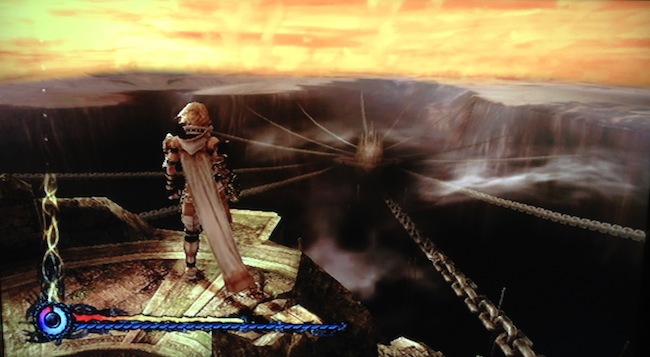
(Edit: Here's an unedited picture of Pandora's Tower running in 480p taken with my iPhone camera. Looks pretty lovely to me.)

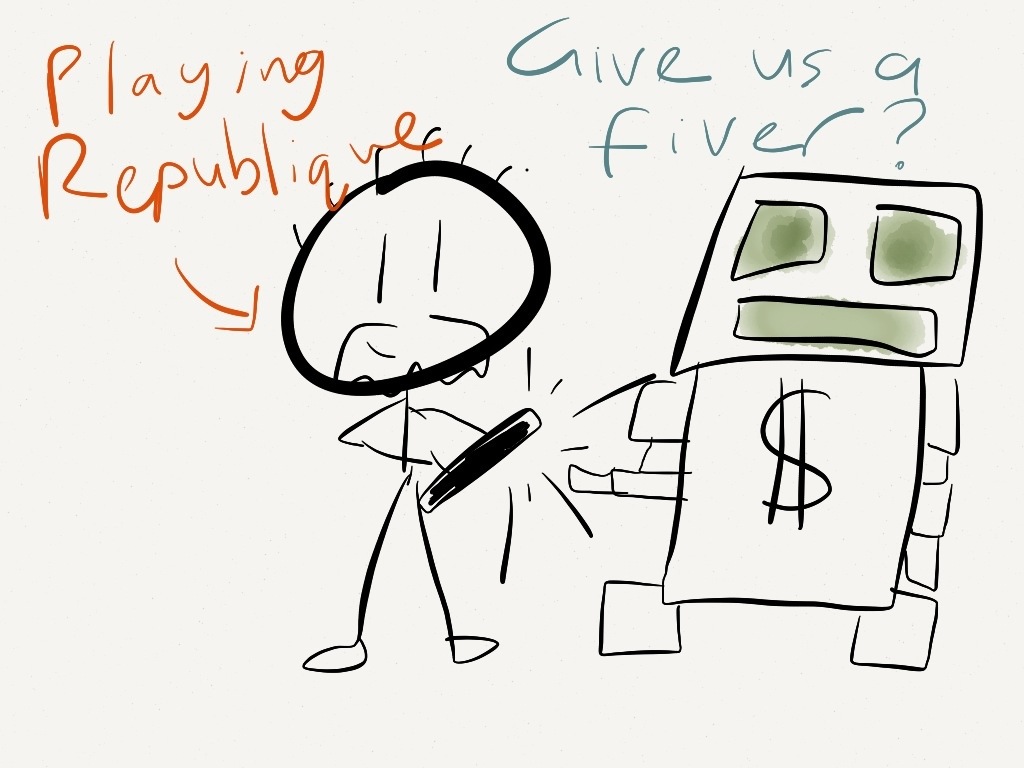
#oneaday Day 827: You Should Back Republique on Kickstarter if You're an iOS Gamer -- And Perhaps Even if You're Not

20120425-005649.jpg

I backed the highly promising-looking project Republique on Kickstarter recently. Despite it looking like a high-quality endeavour from a reputable team (including former Halo 4 creative director Ryan Payton, no less) it's struggling to reach its goal of $500,000 — as of the time of writing, it's sitting at $86,477 with 16 days left to go.

For the unfamiliar, Republique is a bold attempt to create a "triple-A" game experience on iOS. The goals that the team hopes to achieve include designing a game specifically for touch-based devices; creating an intense action game without a focus on killing; creating a game with a believable, non-sexualized female lead; exploring "heavy" topics and saying something "meaningful"; and pushing cutting-edge graphics on mobile devices.

All reasonable ambitions, you might think. The thinking behind the game's design is that "gamers will embrace iOS when more games are made for them."

That, unfortunately, is where the problem lies — a lot of people are still resistant to the idea that a mobile device can play host to a "proper" game — i.e. one that you play for more than five minutes at a time, that doesn't feature a three-star rating system on every level and doesn't offer the possibility of purchasing in-game currency for faster progress. (That said, the ever-greedy EA has been sneaking the latter mechanic into some of its recent games, much to the chagrin of people who hate that sort of thing, particularly when they've already spent $60 on the game itself, but that's beside the point.)

To look at the popular titles on the App Store, you'd be forgiven for thinking that these naysayers had a point. Of the top free iPhone games at the time of writing, pretty much all of them are either casual or social fare, riddled with microtransactions and designed more as a moneymaking "service" than anything with meaningful gameplay. (Yes, even the ridiculously popular Draw Something falls into this category.) Paid apps don't fare much better, either, with the super-casual (and a bit rubbish) Angry Birds Space topping the charts, closely followed by numerous other lightweight titles.

This isn't to say there are no "core" titles on iOS. Far from it, in fact — Square Enix, for example, has put out some excellent role-playing titles including Final Fantasy I, II and III, Chrono Trigger, Chaos Rings and Final Fantasy Tactics. Sega has rereleased a number of its old Genesis titles including strategy RPG classic Shining Force. EA has put out mobile adaptations of its popular franchises such as Dead Space, Mass Effect and numerous others. But why do these titles flounder — relatively speaking, anyway — when compared to more casual fare?

It's a simple numbers game. Not everyone who owns an iOS device is a "core" gamer. Angry Birds et al have their place among those of us who don't know what RPG, HP, MP or FPS stand for, or who think "bullet hell" refers to driving through a particularly unpleasant part of Manchester in the middle of the night. As it happens, these more casual players probably outnumber the more dedicated "core" types to whom "triple-A" titles such as Republique might be marketed to. As such, they appear to dominate the charts on a regular basis.

Does that mean that "core" developers should give up and not even bother trying to put together something impressive on mobile platforms? Absolutely not, though they should be aware of what they're getting into and the problems they will have to overcome in the process.

Firstly, one of these "core" titles probably isn't going to top the charts. The Angry Birds series, for example, has enjoyed well over half a billion downloads in its lifetime and made developer Rovio a worldwide phenomenon in the process. Its simple gameplay and premise mean that anyone can pick it up, play and have fun. (Unless you're me. I hate that stupid game.) Conversely, a "core" title likely has a barrier of entry — "you must be this familiar with video games to ride", if you will. Not only that, but its audience must be people willing to sit down with a game for more than a few minutes at a time while they're waiting for a bus, waiting for the kettle to boil or waiting for their bowels to evacuate.

Secondly, iOS players are curiously resistant to what they see as "high" prices. Square Enix's titles, for example, have caught frequent flak for being anywhere between $8.99 and $17.99. Compared to a new release on PC, console, Vita or 3DS, however, these prices are still eminently reasonable — but they're expensive compared to the $.99 you pay for Angry Birds, and the fact that they're deeper, more impressive, bigger-budget experiences than Rovio's avian-flinging nonsense isn't often taken into account.

The problem here is that in order for a "triple-A" iOS title with high production values to be successful, it will need to overcome that particular resistance that players feel to paying more than, say, $5 for a game. The Kickstarter for Republique will provide those who pledge $10 or more with a copy of the full game when it's released — and going by the pattern of other successful video game Kickstarters, the full version will likely cost more than this "backer's rate". We're likely looking at $15-20 at least, and that's a price point that takes the game well and truly out of "impulse purchase" territory.

Or does it? Consider Thatgamecompany's recent PS3 release Journey. This game costs $15 and lasts approximately two hours. People have been willing to part with this much money for what they already know is a two-hour experience simply because other people have said it is good. In many cases, people have done this without a second thought — going into the game with "beginner's mind" is regarded as an important part of the experience. Does the virtue of the fact that Journey is a game presented on a large television screen make it inherently more valuable than a portable title for a multipurpose mobile device? It's certainly perceived that way, but why on Earth should that be so?

As the Camouflaj team say on their Kickstarter page for Republique, though, developers need to take more risks if "triple-A" gaming on iOS is to be taken seriously. Lengthy, deep games can and do work on the platform, even if they don't chart very highly compared to casual and social juggernauts. The most important considerations for any developer thinking about doing this, however, should be designing it specifically for the device. That means building a game around a touch-based interface, not putting in crappy virtual joypads with no tactile feedback. A game with touch controls needn't be shallow — games such as Undercroft that recreate what would have been the mouse-driven interface of old PC games work well, for example, so there's plenty of scope there.

From what I know of the team behind Republique, I believe that they have a good idea of what they're doing. I believe that their game could prove to be an excellent example of what mobile platforms is capable of for "core" gamers. And I simply believe that the project should be supported, not because I want to see an end to the casual titles on mobile — they have their place — but because as a format, mobile devices' capabilities are more than broad enough to cater to more than a "lowest common denominator" audience. It should be supported because it's a worthwhile project that, if successful, will benefit mobile gaming in general in the long run — not just iOS. That means you embittered Android types upset that this title doesn't mention your chosen platform at all should consider throwing a few quid their way, too. Vote with your wallet, as they say.

Check out the Republique Kickstarter and pledge a donation here.

#oneaday Day 826: No Kind of Atmosphere

20120423-235558.jpg

I've been watching Red Dwarf on Netflix recently. In the process I've discovered that there's actually a hell of a lot of that series that I'd never seen before, so I've been delighted to (re)discover it.

Red Dwarf was one of those series that That One Guy At University Who Endlessly Quoted Things endlessly quoted. Well, perhaps not endlessly — sometimes he was quoting Blackadder. I'm only just now, some ten years later, coming around to the idea that I can actually watch those shows again without hearing That One Guy At University Who Endlessly Quoted Things' voice in my head.

That's beside the point though. And the point is that Red Dwarf is still an excellent series, for more reasons than one.

First up, it's quite simply an excellent comedy series. The small cast of exaggerated characters makes for some excellent comic situations. The fact that all of the characters have at least one major flaw in their personalities is what makes them entertaining, too — Lister is arguably the closest we get to a "straight man" in the show, but even he's flawed; he's gross, he's selfish and his reliance on curry as his primary form of sustenance doubtless makes him rather unpleasant to live with. Rimmer, meanwhile, is by turns arrogant and crippled by self-doubt; The Cat is vain to a fault; and Kryten has difficulty with acting independently when it conflicts with his programming. Put these dysfunctional characters together and you have a recipe for plenty of comic conflict.

The less-considered side of the show is that it's actually a surprisingly decent sci-fi show, too. While it doesn't have anywhere near the budget of what we might be used to from more recent titles — or even shows like Star Trek: The Next Generation, which ran at a similar time — it manages to convey a convincing feeling of what Life Is Like In The Future. The show doesn't batter the audience over the head with lengthy descriptions of what things do or how they work; rather, it simply drops things into conversation that make it clear that we're absolutely not on 21st century Earth any more.

Part of this comes from the show's use of language. Its use of terms like "smeg", "gimboid", "goit" and numerous other faux-expletives was initially to get around the fact that it wasn't okay to say certain things on television, but over time these words became part of the show's identity. Numerous other shows have taken a similar approach since — Firefly features Chinese swearing, for example, while Battlestar Galactica features the multi-purpose invective "frak" at regular intervals. (It's not clear how much Red Dwarf's use of fake swear words influenced these titles, if at all.) Initially, the presence of these words is jarring as you wonder what they mean and why they're not simply using regular expletives. But over time, as you become invested in the worlds created by the writers, you begin to let these words wash over you and enter your vocabulary even though, in most cases, they're completely made up, portmanteau words or "loan words" from another language.

Ultimately, Red Dwarf succeeds due to the fact it never tries to get ideas above its station. It knows that it's a low-budget sci-fi comedy with a small cast, and rarely attempts to deviate too much from that formula. Some may argue that the later seasons do deviate from this formula and are consequently weaker as a result, but having not (re)watched them yet, I'm not going to comment on that right now. One thing the show doesn't do, however, is rest on its laurels; each season has its own distinctive identity, and it's quite fascinating to see the changes it goes through as the years pass by and the budget increases.

It's still great, then, in short, and if you've never had the pleasure of watching it, then you should check it out. It's all on Netflix (in the UK, anyway), so be sure to check it out if you're a member.