1190: Dev Diary 5

I've been thinking about interface design today. I told myself that I wouldn't faff around with the default RPG Maker bits and bobs too much so as not to hold up actually writing the story, but in practice it's so simple to tweak this stuff that I couldn't help myself. In doing so, I've immediately made a difference to the game that makes it look a little less like a half-arsed default RPG Maker project and has a bit more individuality, despite still largely using stock assets.

As a reminder, here's a typical shot of how it looked before:

oneyearlater5And here's how a different moment in the game looks as of today:

oneyearlater14Not a huge difference, I know, but the astute among you will notice two things: firstly, the colour of the text box has changed to a deep navy blue rather than the default gradient fill, and the main game screen now has a Persona 3-style "clock" in the upper-right corner of the screen, indicating what time of day it is. Presently, this only shows the time of day, but I'm toying with it showing what day it is, too — my hesitation on this note is that which day it is is only relevant for part of the game rather than the whole thing.

Earlier today, the "clock" was much bigger and looked a bit like this:

cRuISM7 - Imgur


I actually kind of liked it at the larger size, but it was overlapping the portraits of characters who appeared on the right-hand side of the screen a bit too much for my liking, so I reduced it a bit.

The reason I changed the colour of the text box was because I was experimenting with some scripts that changed the behaviour of the menu. Specifically, they allowed a "wallpaper" image to be applied, so my menu screen now looks like this:

oneyearlater10I figured I'd run with the "flat blue" colour scheme, and add a nice silhouette of Ami in the background for a bit of visual interest, and tweak the message box colour to match for consistency's sake. The silhouette image shows up nicely in the various menu screens without being too obtrusive, as you can see from this shot of the save menu:

oneyearlater15

In fact, it shows up particularly nicely when choosing to quit or return to the title screen — a happy coincidence of the fact that selecting this option darkens the screen somewhat:

oneyearlater16

Those of you who know RPG Maker well will also notice I've replaced the default font with the nice, simple and clean lines of Verdana. This was primarily to match the default font used in a message box script I'm using, because it was bugging me a bit that the font in my message windows and in the rest of the interface didn't match.

Oh, God. What is happening to me?

I jest. Fact is, today I'd reached a good natural "stopping point" in terms of composing the story, and it was as good a time as any to fiddle around with the "look" of the game a bit. I'm pleased with the effect it's had — they're only subtle little changes, but they've had a noticeable effect.

Now it's time to stop farting about with all this and move the plot onwards. To give you an idea of how things are going, the game is structured in several parts: firstly, there's a prologue; then there are five in-game days, during which a whole host of different things can happen according to exclusive choices the player makes in each of the morning, afternoon and evening time slots; then there are four unique "second parts" to the game, and one "true ending". So far, I've completely and totally finished the prologue, and I've finished the morning of the first day. If you're actually reading all the text like a normal person and not fast-forwarding it like me when I'm testing (yes, there is a fast-forward function) then there's probably just under an hour of Stuff to Do and Read so far. After I've created various environments once, I can reuse them for other events, which means that development will continue to accelerate as I progress through the story.

oneyearlater11Environments like the one seen above are quite complex, and most stuff in the game is "examinable", so there's a lot of flavour text in there. Now it's done, though, if I want Ami to come back here with another character — which I probably do — I don't have to design that map all over again. Which is nice.

Anyway. I'll leave that there for now. Just wanted to share how things were going!


1189: Lifesigns Critical

I completed a playthrough of the DS game Lifesigns last night, wrapping up a pleasantly satisfying experience that I enjoyed very much as a whole.

For those who haven't read my past enthusing on the subject, Lifesigns is an Ace Attorney-style adventure game/visual novel for the DS that happens to be set in a hospital and occasionally involve surgery sequences using the DS' touchscreen. Unfortunately for the game, on its original release this caused it to be compared unfavourably (and unfairly) to Atlus' excellent Trauma Center: Under the Knife, and as such it was passed over by many due to some rather middling reviews that missed the point somewhat.

Lifesigns proved to be a great experience for me, though, and it made me think about all the potential genres of gaming we simply don't get all that often. And when I say "genre", I'm not referring to whether something is a shooter or a platform game or an adventure — I'm talking about subject matter. Lifesigns is a medical drama, pure and simple, and that's something we simply don't get much in the gaming space. Trauma Center approaches it, but then veers off into crazy sci-fi town partway through — though the more recent Trauma Team does a much better job at remaining at least semi-plausible rather than going quite as batshit as its two predecessors. Then there was 1988's Life and Death and its sequel Life and Death II: The Brain, but both of those were more simulations of the surgical aspects than narrative-centric medical dramas. And don't even get me started on Surgeon Simulator 2013 — hilarious it may be, but realistic medical drama? No no no.

As you have probably gathered from my past enthusing on the subject, the strange and wonderful land of visual novels is one of the most forward-thinking subdivisions of the games industry in this regard. In visual novels, we have "slice of life" games that are about interpersonal relationships (too many to name); games about suffering with chronic conditions (Private Nurse); games about supporting people with terminal illnesses (Kana Little Sister); games about being a member of a rock band (Kira Kira) and plenty more besides. The freedom to pursue these rather unconventional subjects — unconventional for gaming, anyway — is due to visual novels' strong focus on narrative over gameplay rather than the other way around.

But that doesn't mean that there can't be any of what we'd traditionally call "gameplay" in there — Lifesigns is a great example of how you can keep something narrative-focused and still provide the player with things to do. The player has the option to move between different locations at will rather than being railroaded around the place by a completely linear plot; the player can ask various characters about pieces of information they have gathered; the player occasionally has to convince various characters to do or think things by presenting them with appropriate pieces of information; and, of course, the player has to pick up the scalpel and perform everything from appendectomies to emergency open-heart surgery.

Basically I think what I'm trying to say is that I'd just like to see more games about relatively mundane subject matter — and they don't have to be visual novels to be that way. I want to see an interactive sitcom in which you play one of the characters and interact with the others, but in which nothing of earth-shattering importance happens. I want to see more interactive medical dramas. I want to see more games like Ace Attorney where the focus in criminal investigations is on the lawyers, not the police or private detectives. I want to see more "slice of life" games like Cherry Tree High Comedy Club. And, should I find myself never having to look down the iron sights of a realistically-rendered machine gun ever again, I most certainly won't be sorry.

Note that as ever, I'm not saying that massively popular subsections of gaming such as competitive first-person shooters should go away. But I am saying that those of us who prefer something a little more sedate and cerebral should be catered to a bit more, that's all. We're getting there, slowly — I've certainly found enough to keep me entertained without even looking at the triple-A sector for a very long time — but there's still some distance to go before the same people who tune in to House every week are picking up a controller to play a new Lifesigns game.

1188: What the Hell Does 'Qoga' Mean Anyway?

So, I still have one ending of Ar Tonelico II left to see, but given that seeing it involves playing through approximately 85% of the game again, I decided to start the third Ar Tonelico game — the curiously-named Ar Tonelico Qoga — in the meantime. Also, I was waiting for my new old PS2 and my new copy of Ar Tonelico II to arrive before I returned to the lands of Metafalss, so it just made sense to try out the sequel while I waited.

And… gosh. The Ar Tonelico series' jump to "next-gen" consoles (how dated that sentence will look in a few months) meant that the team at Gust et al clearly decided to let loose with their wildest fantasies and build something that is, frankly, off the chart in terms of JRPG weirdness. And that's just within the first four or five hours; I've barely got anywhere with the story yet.

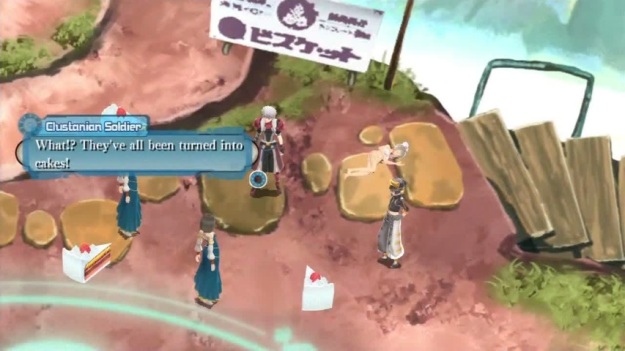
38-Qoga-00033Within the first five minutes, you're thrown into combat against what is either a big muscly man dressed in a cheerleader outfit or an incredibly masculine woman dressed in a cheerleader outfit (I haven't had that particular question conclusively answered yet), only to be followed by a tough-looking swordswoman inexplicably shapeshifting into the adorable young Reyvateil Saki, who regularly refers to herself in the third person and apparently has the ability to transmogrify assailants into cake, but at the expense of some of her memories. An hour or two later, you meet another Reyvateil named Finnel, who is a waitress at a local bistro, but who has somehow managed to get herself stuck halfway up a cliff a very long way away from where she is supposed to be. Also, there's some business with a master assassin who is dressed like a jester, one of the party members is clearly actually [SPOILER REDACTED] from [SPOILER REDACTED] rather than who they say they are, and somewhere along the line Reyvateils "discovered" the fact that if they take their clothes off, their magic gets more powerful due to their bare skin being able to absorb more magic from the tower, or something.
I would like to reiterate that I am approximately four hours into the game so far, and already this is the calibre of insanity we're dealing with. I shudder to think where this one is going to end up.

While none of the above descriptions are exaggerations, though, I have to say that the game appears to handle itself just as well as the previous entries in the series. It's got a self-consciously silly element, yes, and that's even more pronounced than the two PS2 games, but at the same time it also takes itself seriously when it needs to. Ar Tonelico Qoga's setting is a curious inversion of the first game's power structure in particular; whereas in the original game, Reyvateils were often treated as little more than servants to do their masters' bidding, in Qoga it's the Reyvateils (or, more accurately, the Clustanian Reyvateils) who wield all the power, regularly inflicting acts of genocide on humankind in the name of "Cleansing" an area. It's interesting to see the difference this makes to the dynamics of the game world — while I'm not far enough to be able to comment on this in detail yet, it's intriguing.

In all three games, Reyvateils are enormously powerful entities, but the way in which they're treated is very different. In the first game, they are, for the most part, downtrodden and treated like crap; in the second, they are mostly respected but also feared, particularly if they become infected with the "I.P.D." condition that causes them to become uncontrollable and dangerous; in the third, it seems, they are the "enemy" — or at least some of them are, anyway. As the jaunts through the mental worlds of their Cosmospheres make clear, however, Reyvateils are complex beings, just like "normal" humans, and no two are alike — so to say "Reyvateils are evil" is as ridiculous an assertion as saying "humans are evil".

I can't comment that much more on the plot as yet, but it's shaping up to be interesting — and if they go where they're implying they're going in Ar Tonelico II's ending, I'll be very happy indeed.

What has taken a bit of adjusting to so far is the new battle system. Just like Ar Tonelico II shook up the battle system from Ar Tonelico's interesting (if very easy) combat, Ar Tonelico Qoga completely reinvents in-game combat once again, replacing the turn-based fighting of the previous games with real-time arena-based combat that requires you to attack rhythmically in order to build up the Reyvateil's enthusiasm and, well, make her clothes fall off. Sorry, "Purge". I haven't quite got my head around it yet as it's fast-paced and confusing (and challenging!) but it's certainly an interesting change from the previous games, and I look forward to discovering its hidden depths over time.

I'm looking forward to "Diving" into the two heroines and finding out more about them. Even the first levels of their Cosmospheres in this one seem to indicate that they're both, as the vernacular would have it, "dealing with some shit", so I'm intrigued to find out what makes them tick — and also to figure out how on Earth this whole new "Hyuma" system for programming their song magic works. I get the feeling it's going to be a long, bewildering and enjoyable journey.

1187: Dev Diary 4

This is actually more of a "writing diary" rather than a dev diary, because I'd like to talk specifically about the way I write, and how this relates to the game I've been making.

I've never been the sort of writer who plans things out in exhaustive detail. I know, I know, this is probably woefully self-evident from the nonsensical ramblings I've been posting here for the last 1,187 days (and more occasionally beforehand, too) but it works for me. It got me through all of school, all of university and what has so far been a relatively lucrative career in writing professionally.

Note that I'm not saying I don't plan things out at all. (Although some better planning would have probably avoided that awkward double negative right there.) No, instead what I tend to do is get things firmly in my mind in fairly broad terms, then "fill in the blanks" as I go along. It's not quite writing by the seat of my pants, but it's also not doing a detailed, bullet-pointed list of every single point I'm going to cover over the course of the complete piece. It gives me a sense of structure, but also allows me the flexibility to veer off in another direction if I want to. Those of you who have read my past month-long creative writing endeavours on this site will have likely spotted the points in the (largely improvised) narratives where I had what I thought was a great idea at the time and proceeded down that path with gay abandon, sometimes to discover I'd written myself into a corner and promptly had to dig my way out somehow. (Oh, God. I shouldn't have said that. You'll all be looking for those moments now.)

Anyway, how does this relate to One Year Later? Well, quite a lot, as it happens. Writing an interactive game isn't quite the same as writing a novel. Even writing a visual novel isn't quite the same as writing a regular novel, since you (usually) have to deal with branching plot paths and whatnot. In the case of One Year Later, there is a linear path of "story beats", for want of a better word, but each of those has several different possible things that could happen, and within those several different possible happenings comes a series of optional things that people might not see at all. These optional things let me play with various aspects of the characters while still allowing the plot to continue moving forwards.

This is all very vague, as I'm trying not to spoil things, but let me give you a specific example to make things a bit clearer.

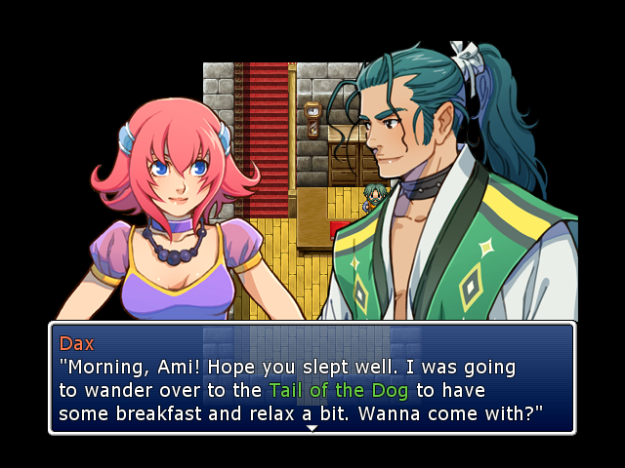
Who wouldn't want to go and have breakfast with Dax here?

Early in the game, the protagonist Amarysse wakes up bright and early in the morning and goes out into the city. As she's leaving the inn where she's staying, she's accosted by Dax, one of the other main characters, who invites her to go for breakfast with him. If she accepts, they go for breakfast, they have a nice chat and various tidbits of information about both Ami and Dax are revealed, after which time passes and it becomes the afternoon. If she refuses (or, more accurately, defers his invitation until she has all the information available to make a decision) then she can go out into the city streets, where she comes across Feena, another one of the main characters, who invites her to go shopping. The player can only pick one or the other during this particular "time slot" of the game; both focus on Ami and a different main character, and both have the potential to reveal some new information, but they also exclude each other.

Someone who wants to go shopping with Feena, obviously.

This, naturally, presents a challenge in later scenes, where I can't really refer to information in scenes that the player might not have seen. However, what I can do is use the built-in game mechanics to determine whether or not Ami knows about a particular subject, and if she does, trigger some different (or additional) dialogue to if she was discovering this information for the first time. An example of this comes if Ami chose to speak to Feena earlier in the game and revealed the information that Feena is, for some reason, not as happy as she could be. In game terms, hearing this information for the first time rewards Ami with a "topic" item called "Feena's Worries"; later, asking Feena specifically about it when given the opportunity upgrades the topic item with new information (she's not happy with her work), allowing Ami to then automatically pick up on little things that Feena says about her work and put them in context — something that she doesn't do if she doesn't have any knowledge of the topic at all, or if she doesn't know that the thing that's making Feena antsy is her work.

It's very interesting (and challenging!) to write this way, as it really forces me to think about the characters and how they might have interacted in the past, and how that might inform their future interactions. One Year Later is a game all about dialogue and interpersonal relationships, so it's important to get this right. I hope I do!

This particular piece of dialogue only shows up if, indeed, Amarysse discovered Feena's real age the previous night -- an optional bit of dialogue that some players might miss.
This particular piece of dialogue only shows up if, indeed, Amarysse discovered Feena's real age the previous night — an optional piece of information that some players might miss.

What this brings me on to is something I suddenly noticed very consciously earlier on while writing some optional, missable incidental dialogue between Ami and Feena: I very much get "into character" while writing.

I say I noticed this earlier; I've actually been conscious of it for quite some time when doing more traditional writing — it's one reason why I enjoy writing stories from the perspective of a first-person participant narrator — but it seemed particularly pronounced earlier. I very much felt like I was "inside the heads" of both Ami and Feena as they talked to each other about, frankly, fairly mundane things — things that those racing through the game would miss, but which those who wanted a deeper understanding of these characters would appreciate as a reward for thorough exploration and investigation.

The thing to be careful of when feeling like this, of course, is getting that characterisation across to the player, who doesn't "know" these characters in quite the same way as I do. Since while I'm writing the dialogue between these characters I'm effectively "role-playing" them, hopefully this will give the dialogue a reasonably natural-feeling flow. This is something that I won't be able to tell for sure until someone else who doesn't know these characters at all plays the game — which is a scary prospect, for sure!

Anyway. That's it for today. I've been doing some good work on the game recently and making some good progress. There's not enough there to proudly show off in playable form yet (though there is just under an hour of "Stuff to Do" implemented now, which feels a significant amount!) but there will be before long. In the meantime, I intend to post some occasional thoughts on the subject of its development on this 'ere blog as I (hopefully) continue to make progress.

One day you might even be playing it. Who knows?

1186: Don't Hate

There's a curious phenomenon in comments sections around the land. And that phenomenon is that it is seemingly the law that someone, somewhere, must hate everything. Actually, that's badly phrased; I don't mean that one person hates everything — though I'm sure there are people who do — but instead I mean that whatever the thing that has been posted, there will always be at least one person who dislikes it for some reason and is inevitably the sort of person who is very vocal about their dislike of it.

This seems to happen particularly frequently in sectors that already have passionate userbases, or in which the userbases are seen as being a "subculture" and/or outside the "norm" somehow. I'm thinking specifically of the video games and anime sectors here — and before you start on me, for all the massive steps forward these media have made in terms of mainstream acceptance over the last 20-30 years they are still indelibly tarred with the "geek" brush to one degree or another.

Today, I was exploring the RPG Maker community who, by all accounts, appear to be a fairly friendly and helpful bunch for the most part, as I've previously mentioned. I was curiously browsing through some of the other users' projects in progress and came across a few interesting-sounding games. One of the users noted that they had submitted their game to Steam Greenlight, the process whereby a game can end up being sold on Valve's popular PC gaming digital download storefront if it gets enough positive votes from the community.

The game, by all accounts, sounded interesting and unconventional, and something I'd be intrigued to play. It was an "artistic" game, for want of a better word, designed as a means for the author to show what it was like living with depression. The author said upfront on the site that it was a mostly-linear, narrative-centric experience with a lot of text, and made no apologies for this fact. (For people like me, the terms "narrative-centric" and "lot of text" are selling points, not things to be ashamed of!)

Sadly, the Greenlight comments section was less than supportive for various reasons, featuring disparaging remarks for everything from it being "another depression game" (oh, sorry, there have been so many of those) to dismissing it simply because it's an RPG Maker game. I've made my feelings on the latter point quite clear in the past, but they bear repeating: if a tool is available to help someone realise their artistic vision, there's no reason why they shouldn't use it, regardless of how many other people are also using it. And besides, some of my favourite games in recent memory have been RPG Maker titles — Corpse Party, To The Moon, Cherry Tree High Comedy Club… all of them were made in earlier versions of RPG Maker that were considerably less sophisticated than the excellent toolset that is VX Ace.

But I digress. The point is that the comments section was filled with hate for the sake of hate rather than actually constructive feedback. The fact that the game in question (Actual Sunlight, I believe it was called) was "another depression game" and an RPG Maker project had nothing to do with its quality, or its "value" to the Steam community as a whole, and yet these things were used as reasons to reject it, without even bothering to check it out.

In the anime sector, it seems that it's fashionable to hate on whatever the biggest name show is at the time. Most recently, this has been seen with Sword Art Online, which I found to be a rollicking good time with an astonishingly spectacular soundtrack, some memorable characters and an interesting, intriguing and pleasingly mature (for the most part, anyway) storyline. It was a good show, in short; while it perhaps wasn't the most intelligent anime you'll ever see, it was certainly far more than a dumb, formulaic show.

Perhaps not something everyone would want to watch, no, but certainly far better than the overly-negative comments that would appear on J-List's Facebook page any time site owner Peter Payne posted a piece of artwork relating to SAO. (Granted, J-List's Facebook page is a place where any time a picture of a vaguely attractive anime girl is posted, one specific user will always be along within three comments of the start of the thread to helpfully inform everyone that "[he] would fuck her", so it's perhaps not the best place to go for objective criticism, but still; you'd expect a community of Japanophiles such as the followers of J-List's page to be a bit more enthusiastic about the things they supposedly like!)

I honestly don't get why this happens, and it seems to happen a lot. Why waste your time on hate when there is so much stuff out there to get you excited? Wouldn't you rather feel happy and intrigued by something than angry or upset?

1185: Top Ten Panty Shots in Video Games

I'm not normally a big fan of Ben Kuchera's work (for reasons I won't go into right now because they're not relevant to what I want to talk about) but he's bang on the money (no pun intended) with this piece.

I shan't reiterate Kuchera's points here — read the feckin' article! — but I will say that on this note, I do agree with him.

The Internet's (and tech in general's) reliance on advertising has to end. It's not sustainable. It simply isn't. And in the meantime, all it's doing is devaluing content, pissing people off and causing us to continually circle the plughole, drawing ever closer to being sucked into oblivion forever, or at the very least into that weird, disgusting black smelly goo we found in the end of the pipe the last time our sink got blocked.

Whenever a site like, say, Kotaku (who are usually the ones who get picked on for this sort of thing, but they're far from the only offenders) posts some bullshit story that gets everyone riled up about how irrelevant/pointless/offensive it is, the war cry that goes up is that they're doing it "for the hits". More accurately, as Kuchera says, they're doing it for the pageviews, because like it or not, the bullshit stories that make everyone angry are the ones that lots of people take a look at "just to see what the fuss is about". The Daily Mail makes a living from posting this sort of garbage on a daily basis; Kotaku at least punctuates its rubbish with some interesting and thought-provoking pieces, while the Mail is just uninterrupted crap. As Kuchera notes, though, the bullshit more often than not pays for the interesting and thought-provoking pieces.

It's not just professionally-written content that suffers from this problem, though. Look at Facebook and the idiotic, illiterate ads that festoon its sidebar on every page. Look at Facebook (again) and its obnoxious, obtrusive "Sponsored Posts" thrusting themselves in your face uninvited. Look at Twitter and its "Promoted Tweets" that you don't want to see. Look at whatever bullshit ad WordPress has decided to serve up underneath my writing on this site (although only on the mobile site, seemingly) Look at the mobile app I reviewed today, which rammed two full-screen ads down my throat before I could even open the main menu, and two more when I started picking a photo from my device's photo library to manipulate. (I was not kind to said app in the review.) Look at the ads you get for casinos and shady-sounding "download services" any time you browse for porn or torrents or anything else you wouldn't admit to looking for in polite company, but which we all know everyone looks for. (Yes, even you, you pervert.)

Internet advertising isn't positive or helpful. It is, for the most part, shady, misleading, obnoxious and obtrusive. Which is, of course, why it's so understandable that so many people — particularly the tech-savvy among us — run ad-blockers and thus deprive many sites of what little revenue they are scraping in from these revolting blights on the otherwise awesome nature of the Internet's global community.

I don't run ad-blockers. Honestly, this isn't for any particularly noble reason — I simply haven't set one up. But knowing what I know of the online publishing industry from the inside, I don't intend to run one, either. Those "One Weird Tip to Peel Your Skin Off and Whiten Your Teeth in the Casino that One Weird Old Florida Mum Found While Downloading Now!!" ads are many sites' main means of income. This isn't the magazine industry — there's no "cover price"; no newsagent looking over your shoulder and asking rather bluntly "you gonna buy that, mate?" (The magazine industry is, of course, in decline, meaning its model isn't necessarily particularly desirable either — but what do you think damaged it beyond repair in the first place?)

It's clear that this situation has to change. But it's not going to be an easy process. Readers used to consuming content for free and blocking ads are going to have to suck it up and start paying for their content. Content creators need to be confident enough in their work to make it worth paying for. And those responsible for the sort of bullshit ads you see on the Internet every single day… well, frankly they need to find a new career, because they've done more than enough damage to the media biz already.

If things don't change, there are going to be big problems down the line. Whether these problems take the form of the entire "new media" industry turning into the most stupid parts of your Facebook News Feed over and over again or the business collapsing entirely remains to be seen — but I'd rather not see either of those things happen if at all possible.

1184: For the Love of God, Please Learn About Snopes.com

Hello, you, random acquaintance and/or friend of my parents on Facebook. Yes, you. The one who has been clicking "Like" and "Share" on everything from posts that imply you want cancer to kill everyone if you don't click "Like" to posts that wilfully spread misinformation, such as accusations that Red Bull causes brain tumours, that baby carrots are saturated with chlorine, or that aspartame causes cancer, brain tumours and multiple sclerosis.

You know who you are.

I'd like to introduce you to a website. I'd like you and this website to become best friends. I would like you to go to this website any time you find yourself questioning the validity of something that someone else asks you to share. I would like you to check this website before you share the thing that someone asks you to share. And if this website informs you that the thing that someone asks you to share is not, in fact, true, please politely tell the person who asked you to share the thing about this website, and direct them to the relevant entry debunking the thing they asked you to share. (Conversely, if this website informs you that the thing that someone asks you to share is, in fact, true, feel free to share as you see fit, but please stop using quite so many exclamation marks.)

This website is called Snopes.com.

It may not look like much, but it has been around in one form or another since 1995, and has been debunking chain letters and other urban myths ever since. It is a valuable resource that has been proven on numerous occasions to be both accurate and reliable. Please use it.

The reason I bring this up is that the unpleasantness that accompanied the Boston Marathon yesterday has brought with it a number of stories that are complete fabrications, and which have nonetheless found themselves spreading at an alarming rate across all varieties of social media. There is a convenient page summarising all of the claims made about the Boston Marathon and the events which supposedly occurred there right here. Please read it. Please familiarise yourself with it. Please take note of which stories are completely false and/or based on inconclusive, unproven information. Please do not share stories which have been proven to be false, or which are based on inconclusive, unproven information.

You may feel that there is "no harm" in "raising awareness" of issues by sharing things like this, even if they are not true. Unfortunately, that is not the case. By polluting social media with falsehoods, it becomes difficult for people who are personally invested in an unfolding story such as the Boston Marathon bombings to determine what the facts really are. By polluting social media with falsehoods, you run the risk of causing considerable distress to these people who are likely already very emotional. By polluting social media with falsehoods you continue to perpetuate a cycle where people willingly share misinformation in lieu of actually doing something useful, because clicking "like" and "share" feels like you've done your bit. And, frankly, by polluting social media with falsehoods, you make yourself look uninformed at best; gullible and stupid at worst.

So use a bit of common sense, will you? The next time something sounds unbelievable, it probably is; before you jump on that "Share" button, pay a quick visit to Snopes.com and look up the key points. And if Snopes.com tells you that the claims are complete rubbish, for heaven's sake don't just share them anyway. Educate the person you saw them from. Teach them about Snopes.com. And hopefully together we can make the world a less ignorant place.

1183: Suit Up

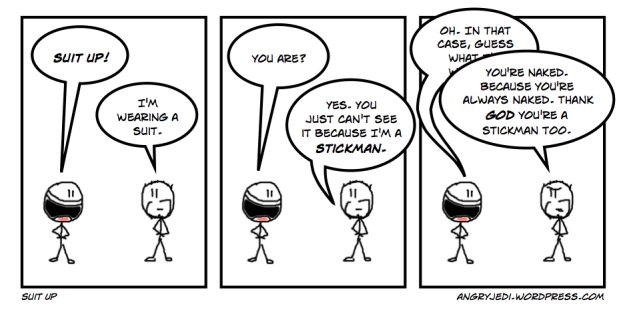
Page_1I was exceedingly bored today, so rather than sitting around in my pants as I usually do I decided to put on my suit for no reason other than for the hell of it.
Well, there were a few reasons, to be honest. I'm not a particularly vain type, as anyone who has met me and seen the state of my hair (both -cut and facial) will attest, but I've never quite been comfortable with my "look", for want of a better word. I don't really have a signature "look" unless you count "jeans and (usually) geeky T-shirt" as a "look", and I'm not sure I do, because that involves pretty much the minimum amount of effort possible that enables you to go outside and not be arrested.

I also wanted to see if there was any truth to the pseudo-psychological theory that if you dress "professionally" you'll be in a more "worky" frame of mind.

I've also been watching a lot of Friends recently and noted that most of the male characters in that spend a lot of time wearing suits. (This was, of course, followed up by the character of Barney in How I Met Your Mother, who makes wearing a suit into an explicit character trait rather than something that "just is".)

So what were my conclusions?

Umm… to be honest, I'm not sure I really have anything particularly… conclusive. That said, wearing a suit is more comfortable than I remember, though it can get a bit hot and stuffy if you keep the jacket on.

Did I feel more "confident" and "professional", though?

I can't really say with any certainty. This is perhaps largely to do with the fact that I put it on once I had done all my paid work for the day and was taking a wander into town to sit in various coffee shops and post things on Games Are Evil then work on my game a bit. To my credit, I did get quite a lot done, but I think this may be more to do with the amount of coffee I consumed and my surroundings than what I was covering myself up with. Or perhaps it was part of the whole equation.

Oh well. I can't say it was a particularly unpleasant experience, anyway. And since I'm working from home and not in an office, it's about the only airing this suit gets apart from weddings (yes, people I know who got married in the last year, I wore the same suit to your wedding that I "just wear" or put on for job interviews) or job interviews (yes, people who interview me, I wear the same suit to your interview that I wear to my friends' weddings) so I might as well give it a day out every so often.

Am I going to "suit up" as my "new look" though? Probably not. I have far too many geeky T-shirts that I actually like showing off. (No-one has recognised my Deadly Premonition one yet, frustratingly.)

1182: Fixed That For You

Page_1I've had a week of not having a lot of luck with technology. Firstly, I was reminded that my electric piano was suffering a sticky key issue on the B above middle C (which is quite a commonly-used note) and proving rather difficult to play effectively. This was annoying, because as I noted yesterday, I'd just come into possession of the official piano arrangements for the Nier and Final Fantasy X-2 soundtracks along with some fan-arranged printouts of a variety of anime and game pieces.

Secondly, my PS2 Slim mutilated my Ar Tonelico 2 disc right in the middle of one of the endings I hadn't seen, causing it to freeze up completely and not be able to go any further. (I have since replaced the PS2 Slim with a PS2 Fat — which hasn't arrived yet — and acquired a new copy of Ar Tonelico 2, but that's some money I didn't really need to spend.)

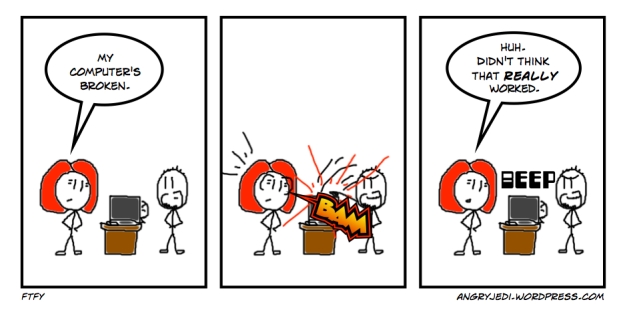
Fortunately, one of these problems has been rectified thanks to Andie's willingness to get her hands dirty and tinker around inside things. (Get your mind out of the gutter.) Loosely following some instructions online, we took the casing off my Yamaha P80 and had a look inside. It wasn't immediately obvious what was causing the key in question to stick, but as it happened, the process of popping it out (which we didn't even manage to do completely, just sort of half-out) and popping it back in again completely fixed the problem. This was, as I'm sure you can imagine, extremely pleasing as it means 1) I don't have to attempt to fit my piano into the back of a Peugeot 207; 2) I don't have to drive it 25 miles to the nearest Yamaha engineer; and 3) I don't have to pay aforementioned Yamaha engineer £100+ to get it fixed. Don't get me wrong, I would have happily paid Captain Piano-Fix his fee in order to get things sorted, but given that the fix was apparently that simple — I guess the key must have got knocked out of its normal place somehow, perhaps while we were moving house — I'm glad that I don't have to do any of the above three things.

This isn't the first time I've seen something get "fixed" by peculiar means. Back in university, I came into possession of a Sega Saturn, which I still own to this day (though I no longer have any games for it). The controller that came with the Saturn didn't work very well, so, having nothing better to do that evening — my housemate was out and no-one fancied going down to the Union to get obliterated on Juicy Lucies — I took it apart and decided to see what I could do, despite not having any clue whatsoever about how it worked. Eventually, I ended up cleaning the contacts on the circuit board using a piece of kitchen towel dipped in vodka — I honestly have no idea why this particular combination of things seemed like the right thing to do at the time; I was possibly a bit drunk — and putting it back together again. Astonishingly, it worked after this. To date, I have no idea if my ridiculous efforts to "fix" the thing actually had any effect or whether it was just the simple process of taking it apart and putting it together again.

I guess the moral of this story is that if something is broken (and out of warranty) then there are worse things you can do than pull out all the screws, pull everything out and then put it back together again. Obviously don't try and do this on a human body, however, because 1) human bodies don't have any screws and 2) they're a lot harder to put back together once you've disassembled them, which is why degrees in Medicine take so long to complete.

1181: 1:20am Blogging

It is 1:20am and I haven't written anything here, nor do I have any particular idea as to what to write about. So I'm just going to write any old crap that comes into my head right now. I hope you'll forgive me for that. This isn't going to be a "freewriting" exercise as my brain is not awake enough for the mental agility required for that (though doing freewriting when absolutely exhausted is probably an interesting exercise in itself) — instead, it's just going to be… stuff. All right? Good.

As I was logging in to write this post, I happened to see what my "top searches" are. I find these interesting to look at every so often as they provide a curious insight into how people are finding me here. And it's not always in the manner you might expect. (Those bloody stickman GIFs I made a while back attracted a lot of people, but that seems to have died down somewhat now.)

My top searches at present are "My Girlfriend is the President Irina Route", "Candy Crush Features on PC that Aren't on Mobile", "You Have Earned a Trophy" and "Cis Male Guilt". I think that about sums things up nicely, doesn't it? If any of those things have brought you here, allow me to address them in order: Irina's route in My Girlfriend is the President was my third favourite route after Ell-chan and Yukino but ahead of Ran-neechan; Candy Crush Saga is a mug's game whatever platform you play it on, so go and buy a copy of Bejeweled instead; well done, you have earned a trophy; and cis male guilt is one of the most irritating blights on the Interwebs of 2013. Happy? Good.

I've had a fairly dull day today, which is why I don't have a lot to talk about, really. I've done a fair amount of work on my game, though nothing significantly more interesting than the stuff I talked about yesterday. In terms of how far through the "plot" I am, though, I've officially finished the first "day" in the story and got the structure in place for the next five in-game days to branch off in several different directions and lead the player towards one of the endings. So progress is being made — noticeable progress — which is exciting.

In other news? I had a little play on the piano earlier, but given that the B key above middle C is sticking and making it very difficult to play at times, doing so is an infuriating experience. It is doubly infuriating because I have just come into possession of the piano scores for the Nier and Final Fantasy X-2 soundtracks along with a bunch of fan-arranged sheet music for a selection of tracks covering everything from Ar Tonelico 2 to School Days HQ. I would very much like to play all these and record them to share with you, but without a working B key I can't do that to the standard I'd like to. So next week I have to take my keyboard to a scary man in Ringwood who will hopefully fix it without too much difficulty.

That's about it, really. I think I'm going to go to bed now. Andie's having a night out with her friends and isn't back yet. I have no idea when she will be back, but I will almost definitely be awake when it happens. Or perhaps not. I have no idea. I'm quite tired. To such a degree that I'm babbling nonsense out through my fingers, so I think it's probably best for everyone involved if I just cut my losses, click that Publish button and go to bed now. Good night!