As I noted the other day, one of the fun things about our trip to Toronto is that we've had the opportunity to sample some of the city's more colourful eating establishments. Mark and Lynette both know the places that Torontonians (I bet they hate being called that) visit on a regular basis rather than the inevitably much more expensive touristy places in touristy areas. Consequently, we've had the opportunity to eat well for relatively reasonable prices — Mark and Lynette refer to a $20 bill as a "yuppie food stamp" and it's easy to see why, since the vast majority of meals we've had while we've been here have come out somewhere in the region of $20 each.
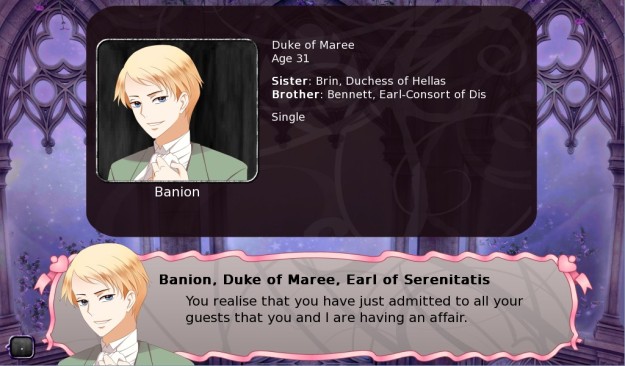
We've had a lot of Asian cuisine of various descriptions since we've been here, as I noted the other day. Today I added to the range of Asian foods that I've experienced by having a taste of okonomiyaki. I had no idea whatsoever what okonomiyaki was prior to today, but I had at least heart of it — the character Kirari in the visual novel Kira Kira (which is eminently worth your time, by the way) is obsessed with it.
I was half expecting okonomiyaki to be something similar to takoyaki — the small fried rice flour balls filled with octopus meat and other goo, then drizzled with Japanese mayonnaise. Okonomiyaki is, as it turns out, absolutely nothing like takoyaki. No; rather than being small bite-sized thingies like takoyaki, okonomiyaki is instead somewhat akin to a cross between a potato cake and an omelette, with lashings of a rich barbecue sauce-style substance slathered all over the top of it. I forget exactly what the omelette-type-thing was made from and am far too tired to actually research it at this hour in the morning, but it was quite tasty. Like an omelette, it could also be made with a variety of different fillings, ranging from beef to shrimp or squid. I had a squid one to make up for the fact I didn't have a squid taco at Banh Mi Boys the other day, so I now feel suitably guilty about devouring some of Ika Musume's relatives.
I wasn't quite sure what I was going to make of okonomiyaki, as I was aware going into it that it was made with onions, which those who know me well will know are a vegetable I despise with a great passion. (I had terrible trouble growing up convincing my parents that I really genuinely didn't like onions, despite actually retching at the dinner table when I could taste them on several occasions; the fact that being able to taste onion today still makes me retch makes me feel somewhat vindicated that I wasn't just being an awkward child about them.) Fortunately, however, the onions were shredded up to such a degree (not to mention having had the shit fried out of them) that they were inoffensive to my palate's delicate sensibilities, and consequently there was no retching.
Actually, I enjoyed the okonomiyaki very much. I'm pleased I tried it; I'm not sure it's my favourite of all the Japanese food I've tried to date, but I am happy that I've tasted it and now know what to expect should I find myself ordering it again.
Now all we have to do is complete the "Japanese trifecta" by having sushi one night this week and we'll be all Asianed out.
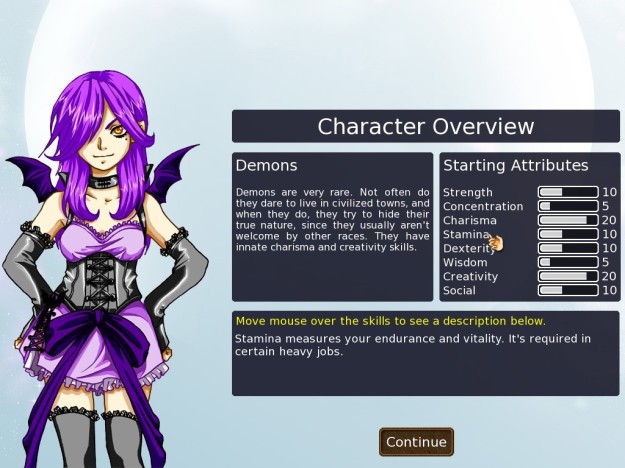 Spirited Heart does a number of interesting things that distinguishes it from Long Live The Queen. Chief among these is the fact that you're not playing a fixed character — you're playing one of your own design, to a certain extent anyway. There isn't any option to customise your character's appearance, for example, but the way you play does determine what sort of person your character ends up as.
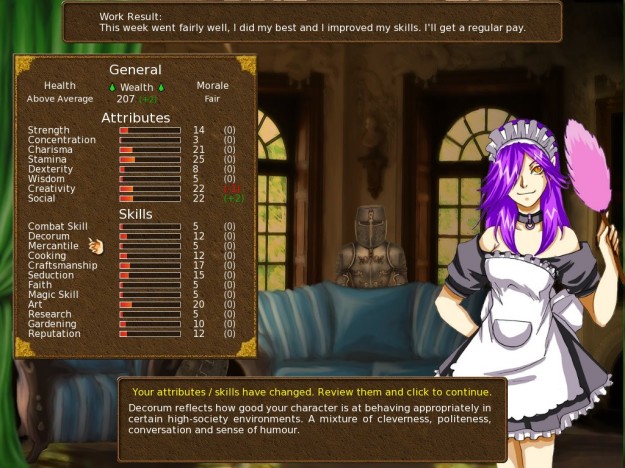 The way the game works is that each week, you choose whether your character goes to work or takes a week off. Going to work allows you to choose any occupations you meet the prerequisite stat requirements for, while resting allows you to restore your health and morale, which can often be negatively impacted both by going to work and through random events that occur. You can't go to work if you're too unhealthy or if your morale is too low, so sometimes you need to take a week off in order to progress. Working, meanwhile, often improves your stats and allows you to earn money, which can be used on more effective vacations when required.
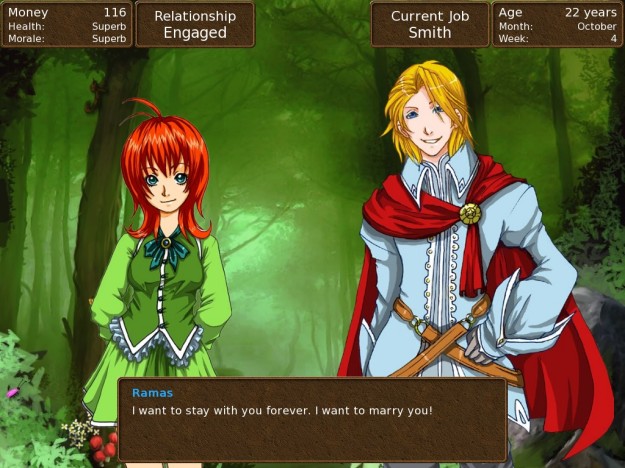 Just to confuse matters, partway through the game, my character was visited by her Goddess and tasked with attaining a particular "title" by the time she reaches the age of 30. Unfortunately, pursuing the elf of her dreams and following the Goddess' quest are not really compatible, since the Goddess' quest requires me to become an Artist, while pursuing the elf requires me to continue working as her maid. CHOICES. DECISIONS. CONSEQUENCES.
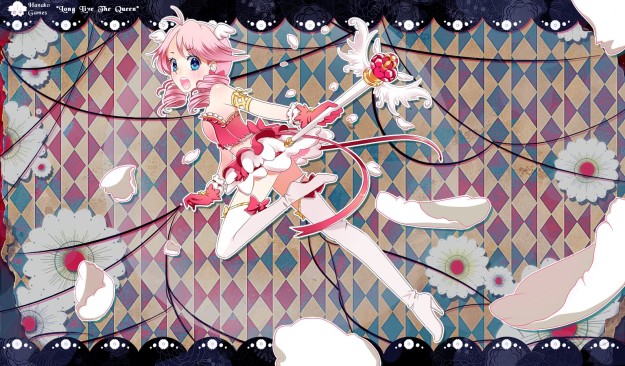 A short while back, a few indie developers that I enjoy the work of very much released a bundle of games that looked interesting. Among this selection of games was a title known as Long Live the Queen by Hanako Games, developer of Magical Diary, a game which I enjoyed very much. I picked up the bundle and, as tends to happen frequently with this sort of thing, forgot all about it completely until recently.
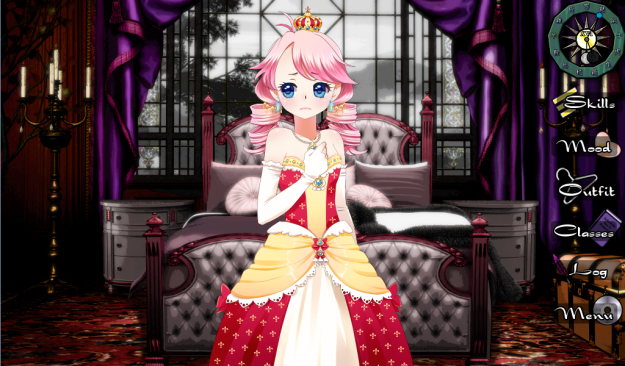 Essentially, Long Live the Queen is a game somewhat akin to old Japanese games like Princess Maker, in that you have a young anime girl to take care of and must train her up to deal with various situations appropriately. The course which the game's plot takes depends on the skills which you choose to train up, and the skills which you can train most effectively are determined by Our Heroine's current mood — for example, if she's depressed, she's particularly wont to express herself through things like music and singing, whereas if she's angry, she can channel her aggression into training in things like military strategy and proper use of weapons. Training to particular levels in things unlocks various costumes appropriate to the skills she's learning — for example, learning a lot of spiritual skills unlocks a priestess outfit, while becoming a "Lumen" and awakening to her family's magical heritage unlocks a particularly awesome "magical girl" outfit.
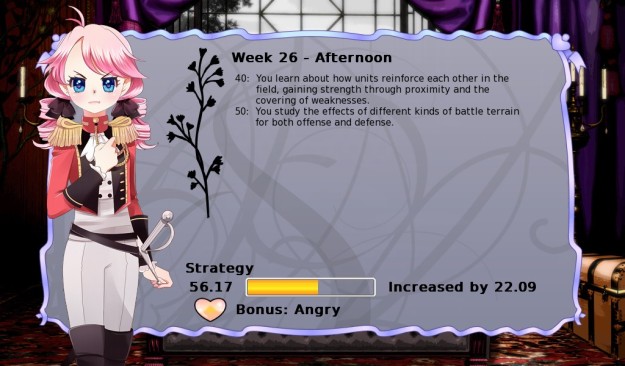 Making it through the game without dying horribly is a case of carefully making decisions and levelling up skills appropriately, and it's not at all uncommon for Our Heroine to meet a sticky end — in fact, it's positively encouraged via the "collect them all!" death checklist in the game's main menu. It's almost preferable to play the game like a roguelike — starting from the beginning, only saving when you're stopping playing rather than before you make a critical decision, and dealing with the consequences of your actions. In a nice touch, reaching the end of a game — whether with Our Heroine's coronation as Queen or with her death — allows you to export a complete log file of everything that happened so you can perhaps figure out what on Earth went wrong.