1488: Veeday

Andie and I are having a night away because like the good person I am I booked a nice evening in a hotel with a nice meal. Andie's currently somewhere between falling asleep and watching the morbidly fascinating spectacle that is the '80s gameshow 3, 2, 1 on Challenge TV, while I'm… well, writing this.

I don't remember ever watching 3, 2, 1 as a kid but I'm sure it must have been on at some point in my childhood, since it seemingly ran until 1988. I knew of its terrible, terrible mascot — a dustbin called Dusty Bin — but not what format the show took. Having somehow watched half (at the time of writing) of a single episode, I'm still a little bewildered. Oh well.

Besides watching questionable (though apparently ludicrously popular) '80s TV, we also had a go at the new Pandemic expansion In the Lab earlier. This adds some interesting new mechanics to the base Pandemic game, namely a separate Lab board in which you have to process samples of the four types of disease and make use of several different pieces of processing equipment to sort them into appropriate dishes. To treat a disease, you must then collect a specific combination of cubes, categorise the disease, test the cure and finally produce your medicine.

It's a really interesting twist on the base Pandemic mechanics because it totally changes the flow of play. It also slows down your actions significantly, which puts you significantly more at risk of losing the game through running out of cards. After just one game, I haven't quite grasped what you need to do differently, but I'm intrigued to try it again, either with other players or with the new solo rules that are also introduced in In the Lab.

Pandemic and its two expansions probably make up one of my favourite games in my collection, and one of the most interesting things about its fully-expanded form is how flexible it is. There are lots of different "roles" for the players to play, each with their own special abilities, and several different variants to try out. There's even a competitive mode where the team as a whole competes against a "Bio-Terrorist" player who moves around the board invisibly, somewhat similar to Mr. X in Scotland Yard. I haven't yet tried the latter form of the game, but I'm keen to give it a go the next time it's my pick at games night, I think.

Anyway. It is late and 3, 2, 1 is still burbling its surreal nonsense all over the television. I feel I should probably see the peculiar show through to its conclusion now, then tomorrow we're off to see the house we're currently in the process of buying. Scary.

Hope you've had a good Valentine's Day, regardless of whether you're in a relationship or not. If you are, I hope you had a good time with your partner of choice. If you're not, I hope you found something entertaining to do with your time. (I hear the Titanfall beta is quite good.)

Good night!
1487: Uchikoshi's Last Reward

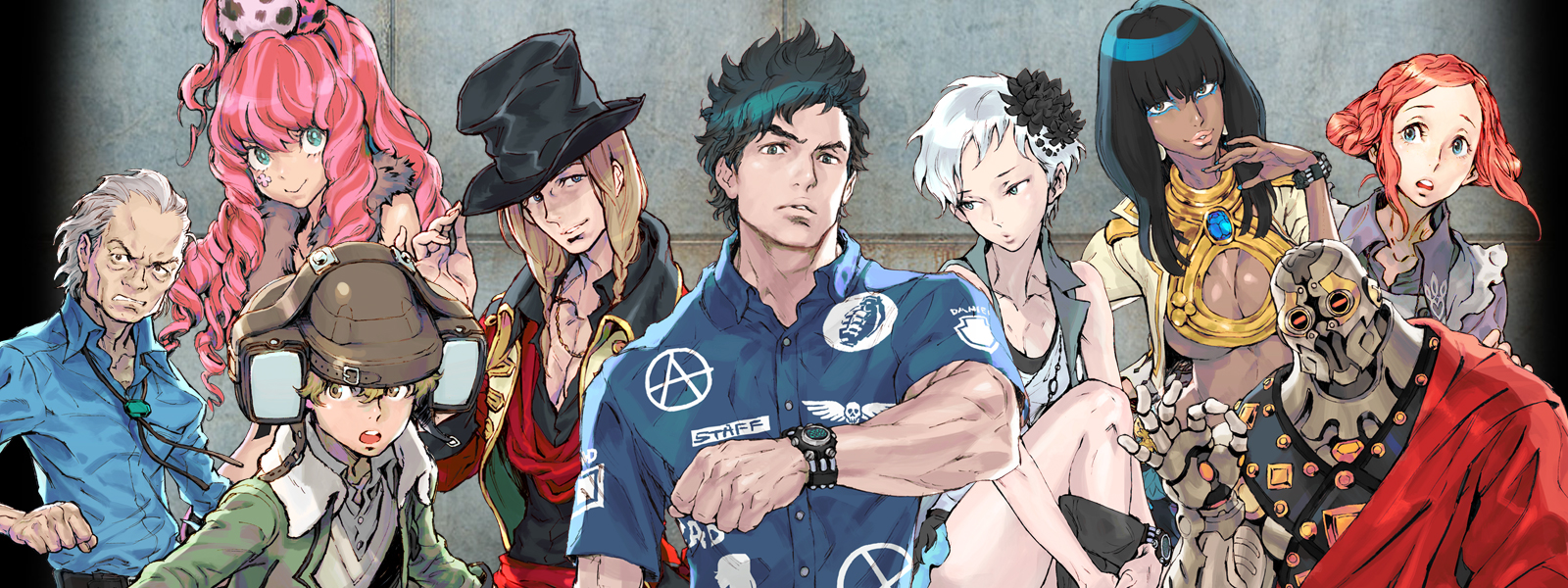
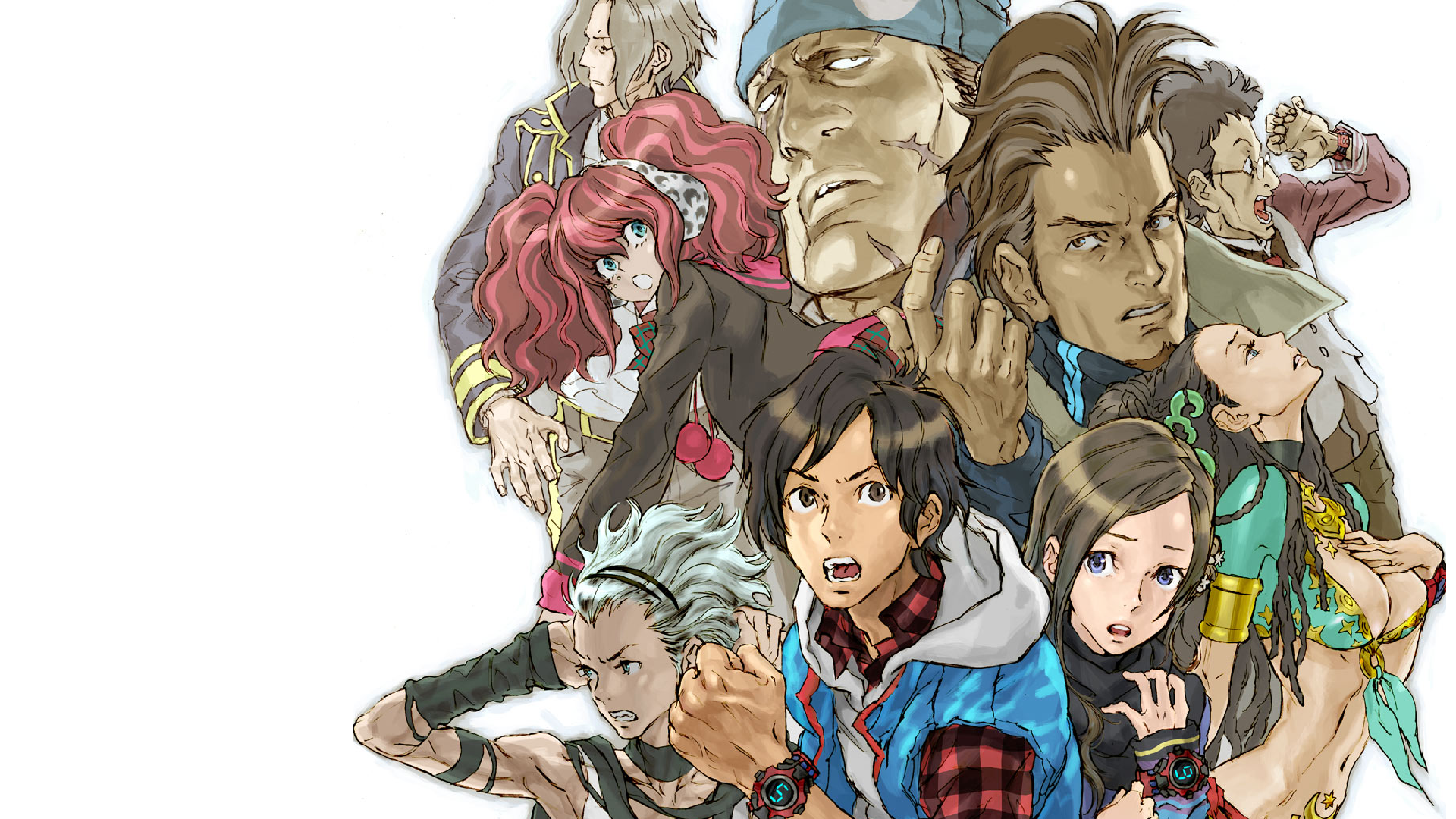
Kotaro Uchikoshi, the creator of the two Zero Escape games 999 and Virtue's Last Reward, opened an English language Twitter account today, even despite his own admission that his English is not all that great. Still, he felt compelled to communicate directly with his fans since, surprisingly, it seems the majority of the Zero Escape fanbase is actually in English-speaking territories — and that neither 999 or Virtue's Last Reward sold well enough in Japan to make a third and final installment in the series possible in the immediate future.

This is… distressing to see, frankly. Uchikoshi's Twitter feed is heartbreaking to read. Even through the occasionally slightly broken English — his English is certainly better than my Japanese, mind — it's clear that there stands a passionate man who would like nothing better than to realise his grand vision for his magnum opus, a man constantly frustrated by the realities of the modern games biz — key word "biz" — and a man who genuinely feels bad that he's letting his fans down. I find it incredibly sad that someone doing such wonderfully distinctive things with interactive storytelling has been put in such a position in this, an age where story-centric games such as Gone Home, The Stanley Parable and numerous others can be held up and celebrated — even declared "Game of the Year" in some quarters of the Internet. Surely the modern industry is diverse enough to support both the Titanfalls of the world and a third installment in the Zero Escape series?

999-pic

Perhaps it is — in fact, given the outpouring of support I've seen for it today, I know it is — and Uchikoshi simply hasn't yet found the right route to market. Despite the bleak, apologetic nature of his tweets, it's clear that he hasn't given up hope as yet. Following a heartfelt plea for any prospective investors to contact him directly via Facebook (I'm providing the link there on the off-chance that anyone rich is reading and feels like funding Zero Escape 3) he attempted to reassure fans that Zero Escape 3 "will definitely be released somehow, someday!" And I'd like to believe that he's right.

The question is "how?" Uchikoshi claims that he's considered crowdfunding but was concerned that it wouldn't be "persuasive" enough, but this may partly be due to the fact that crowdfunding is still yet to make a huge impact in Japan; it's still primarily a Western thing, with the exception of a few Japanese developers like Nigoro (though still in collaboration with Western publisher Playism, I might add) turning to the platform to fund projects such as La-Mulana 2. I would have thought that Kickstarter would be an ideal solution for Uchikoshi to clearly solicit and demonstrate fans' support for the Zero Escape series, but this may not help the situation in his native Japan, which is where the problems really are. I'm assuming there are some sort of rights issues involved with developer Spike Chunsoft that prevent him from striking out on his own and making Zero Escape 3 as an independent developer, or releasing 999 and Virtue's Last Reward (and Zero Escape 3) on PC, or…

Well, anyway. Sadly, I don't have the power to do anything about the situation. But it will be absolutely criminal if someone with as clear an artistic vision as Uchikoshi isn't able to realise his creative visions due to matters of "business". This is something I hope that the industry as a whole can solve together; regardless of whether or not you liked 999 and Virtue's Last Reward, you can hopefully agree that the gaming landscape is a richer place with titles like them in it. Creative, interesting games should be encouraged and rewarded; instead, if we're not careful, we'll drive people like Uchikoshi away forever and be stuck with an vicious cycle; an endless of soulless but profitable games, and no-one wanting to rock the boat by doing something a bit different.

Zero-Escape-Virtues-Last-Reward-Review-Topper

That's a Doomsday scenario, obviously, and unlikely to happen, particularly while the Western indie space is flourishing to such a degree. Now we just need the East to follow suit.

I wish Uchikoshi the best of luck in his endeavours to get Zero Escape 3 into the hands of those of us who really, really want to see it, and would urge you to support him in any way you can if you believe in interesting, distinctive games that do some truly creative things with the medium as a means of interactive storytelling.

1486: Funny Ha-Ha

As I type this, a Dave broadcast, repeat, whatever (probably repeat) of a Frank Skinner stand-up show has just finished. It made me laugh rather a lot. I haven't watched a Frank Skinner show for quite some time and I was pleased to see he doesn't appear to have changed all that much — he still primarily tells imagery-heavy stories about sexual encounters, and in doing so paints quite the vivid picture with his words.

Catching this show got me thinking a bit. I haven't watched a whole lot in the way of stand-up comedy for a long time, whereas it used to be something I really enjoyed doing. I think part of this is due to the fact that I don't really know who's good these days — and the little modern stand-up I have seen doesn't really appeal all that much. This may partly be due to the fact that you tend to catch stuff like this on Dave or BBC3, the latter of which in particular is aimed at young and stupid people.

Comedy goes in cycles and phases, and the comedians who are popular at any given moment give a good snapshot of culture at the time. A few years back when Eddie Izzard was popular, for example, that kind of fast-paced, clever humour was fashionable — everything tying together. Today, it seems that one fashionable style of comedy is the string of unrelated one-liners, one after another — funny, sure, but it doesn't quite "click" with me as much as the intertwining threads of something like Izzard's comedy.

I haven't seen a lot of musical comedy of the the kind best exemplified by Bill Bailey and Tim Minchin recently, either. This is a real shame, because both of these performers are clearly very skilled musicians as well as witty comedians. Both still occasionally show up on comedy panel shows — a good means of catching favourite comedians long after their standup isn't seen quite so often on the television — but, you know, I'd pay good money for a new Bill Bailey show.

I saw Bill Bailey live when I went to the Edinburgh Festival from university, and it was a magical experience. I, and many of my companions who were also in attendance, immediately fell in love. Many of us were familiar with Bailey's work on TV shows, but perhaps not his stand-up; after that, meanwhile, it wasn't long before all of us went and picked up all his DVDs.

I don't really have a point to all this. Perhaps I'm asking in a roundabout way whether there are any good comedians out there who are worth seeking out. For reference, I enjoy stuff like Bill Bailey, Eddie Izzard, Dara O'Briain and that sort of thing. (I've even been known to enjoy Michael McIntyre, though as I recall you're not supposed to admit that sort of thing. But ah, fuck it.) Any must-see comedians out there that I'm missing out on?

1485: Trigger Happy Havoc

I've been refraining from talking about it until I put my review up, but now that's safely filed, I feel I should enthuse somewhat about Danganronpa: Trigger Happy Havoc.

For the uninitiated — and all the people who constantly claim they have no idea what Danganronpa is — allow me to explain.

ADOOOOORABLE.
ADOOOOORABLE.

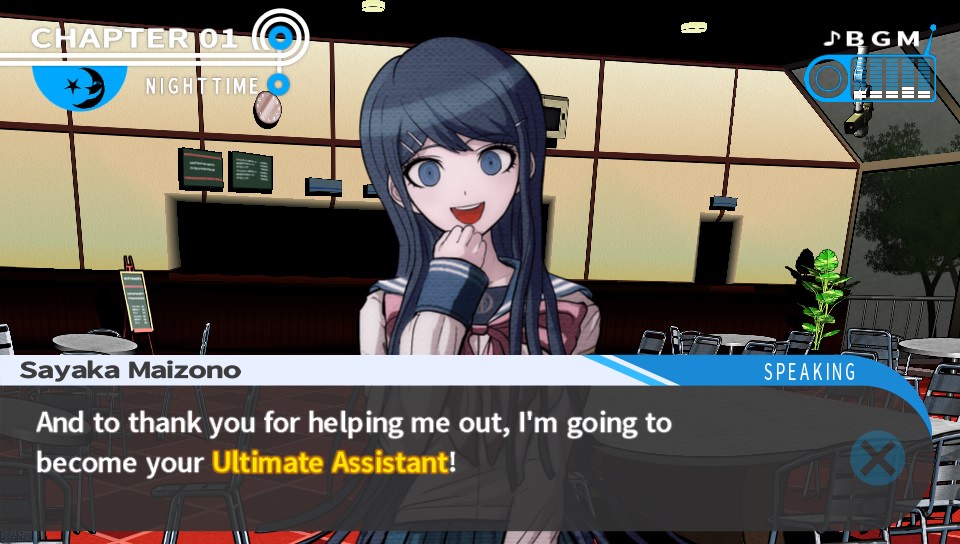
It's a visual novel-cum-adventure game from Spike Chunsoft, the developers who brought us the Zero Escape series that consists of 999 and Virtue's Last Reward. Its concept is something of a cross between Corpse Party and Zero Escape: a disparate group of individuals are kidnapped, trapped in an enclosed environment (in this case, a twisted, not-quite-right version of a school, hence the Corpse Party comparisons) against their will, and then presented with a series of challenges between them and their final escape. In Zero Escape's case, this was a matter of solving puzzles and choosing the correct path to the end; in Danganronpa's case, meanwhile, it's a little more complex.

The game's Zero-equivalent Monokuma — a far more in-your-face and sinister antagonist than the largely hands-off Zeroes — challenges the game's cast to a "killing game" in which anyone who successfully gets away with murder graduates from the twisted school and gets to escape; meanwhile, everyone else gets "punished" by, well, being killed. Conversely, should the "Blackened" murderer be found out, they get punished, but the remaining students don't get to escape — they just have to continue their school life.

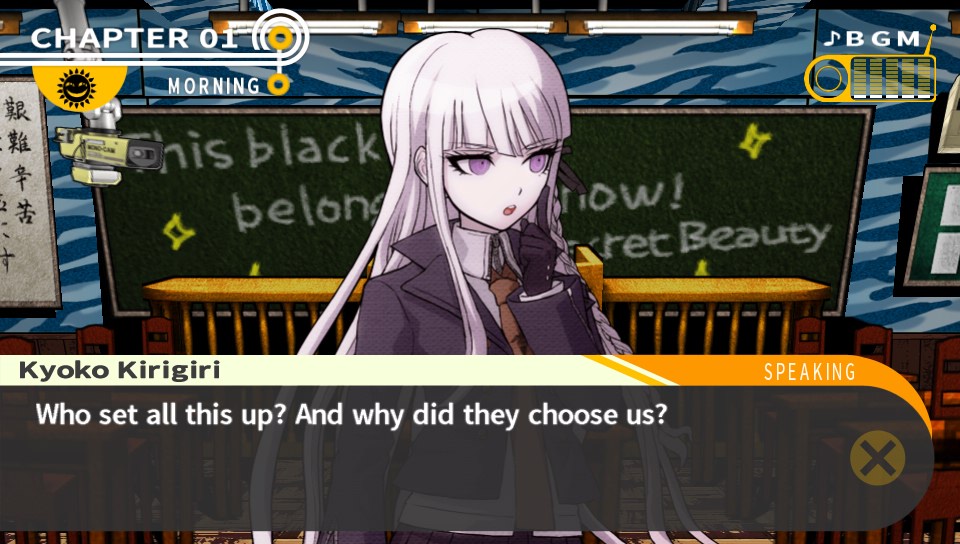
The game unfolds over a series of chapters, each of which involves the surviving members of the cast investigating the mysterious school, trying to get to the bottom of what is going on and then, subsequently, investigating a murder that happens. This is then followed by a "class trial" in which everyone argues and yells at each other and, if you've done your job correctly, the culprit is identified and punished. In between these phases, you get short periods of "Free Time" in which you can hang out with the remaining characters to build up your relationships, which subsequently unlocks "skills" for use in the trial segments.

Ooh, I know, I know. It's... [SPOILERS]
Ooh, I know, I know. It's… [SPOILERS]
The trials themselves are a far cry from Ace Attorney territory. The majority of them revolve around a mechanic called "Non-Stop Debate" in which the characters continue speaking their lines whether or not you're ready to continue, and you have to shoot down "weak points" in their arguments with the "truth bullets" you gathered over the course of your investigation. On the default difficulty, for the majority of the game you'll only have to identify which statement to shoot down with a single truth bullet; on harder difficulty levels (and at certain, critical moments on normal difficulty) you'll also have to choose the correct truth bullets to refute the statements you think are false. This then gets even more complicated as the game progresses as people start shouting over the top of each other, represented by irrelevant "noise" statements floating across the screen and getting in the way of the things you actually want to shoot down.

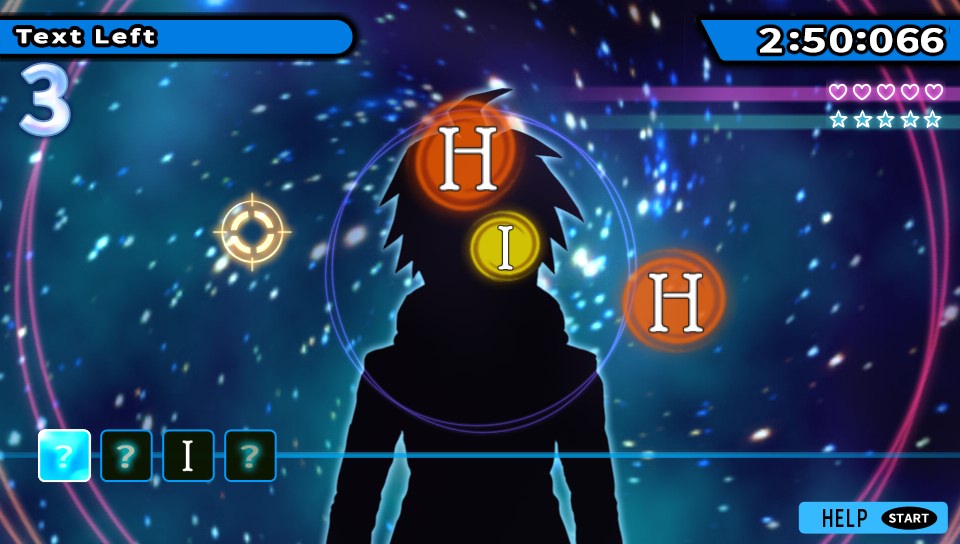
This Hangman game has a lot more at stake than a stickman's life.

These arguments are supplemented by Hangman-like sequences in which you have to recall specific pieces of information by spelling them out, rhythm action sequences in which you struggle to make yourself heard over someone's constant objections and, at the end of each "case," a Trauma Team-style summing up of exactly what happened by assembling a comic strip depicting the events leading up to the murder, and what happened after that.

It's a fascinating game; perhaps not as "clever" as 999 and Virtue's Last Reward, but that's no bad thing — while 999 and Virtue's Last Reward specialise in bending your brain around complicated narratives with peculiar structures, Danganronpa's relatively straight line to the finish still manages to have plenty of surprises, twists and turns along the way, and has no qualms whatsoever about killing off its main cast with alarming rapidity.

In short, my review has hopefully already made this abundantly clear, but if you have a PlayStation Vita and the slightest interest in intriguing, compelling murder mysteries, you should abso-posilutely pick up a copy of Danganronpa this week. No, I don't care if you're already playing Bravely Default. No, I don't care if you're getting stuck into Lightning Returns. Danganronpa is fantastic, and I don't mind admitting that I want as many people as possible to play it so we continue to see more and more games like this in the West.

1483: Virtue's Almost-Last Reward

I will finish this game. I will finish this game. It's been 40 hours. It's a matter of pride now.

There may be mild spoilers for Virtue's Last Reward in this post. There will almost certainly be spoilers for 999. I haven't quite worked out what I'm going to write yet; I just feel like I need to do something like a brain dump in order to try and work out what on Earth is going on.

Putting in a "read more" tag so those casually browsing the front page don't run into any spoilers… see you after the jump if you're continuing to read.

Continue reading "1483: Virtue's Almost-Last Reward" →

1482: Lego, not LEGO

Andie and I went to see The Lego Movie today (or, if you work in PR, The LEGO Movie™) — it's the first time we've been to the cinema for ages since neither of us really like going all that much, but given Andie's admirable obsession with Lego (we have three awesome display cabinets with City stuff in at our place, and I'm sure our new home will have considerably more) there was never a time where we weren't going to see it.

I shall refrain from spoiling the movie too much, save to say that it's an excellent kids' movie of the type designed to appeal in numerous ways to grown-ups as well. The concept of Lego being an all-ages toy (whatever it might say about upper age limits on the boxes) is specifically lampshaded, and there are numerous cameos from characters who have been immortalised through various Lego sets over the years — ranging from Star Wars to Lord of the Rings via the DC universe.

What I did want to talk about is how Lego has done a great job of positioning itself to a ridiculously broad market in 2014, and how that's changed significantly over the years I've been alive. Or, at least, the way I've come to look at Lego has changed significantly over the years, anyhow.

I never really got hugely into Lego as a kid. I'm not sure why, really, since you'd think it would appeal to my inherent creative sensibilities. But no; my brother was the big Lego person in our family, though I certainly delved into the big brown plastic box full of it that was a fixture in the playroom when I was growing up. I liked the idea of Lego — something which you could use to build anything you wanted — but always felt a little intimidated by it, too.

Part of the reason for this was that in the big brown plastic box was an extremely well put-together house, complete with doors, windows and a slopey roof. I liked looking at this house because I was impressed with the craftsmanship — I assume it was originally the work of my brother, though I don't know if it was assembled from instructions or not — but I also didn't want to take it apart, because it was "complete", and taking something apart that is "complete" didn't quite feel right to me. Unfortunately, it consisted of all the "best" pieces, which made building other coherent structures a little more difficult, so ultimately I never really became much of a builder.

That was how I thought of Lego; it was something you built things with. I didn't really think of it as having much of a "personality" as such, despite the presence of minifigs. (Incidentally, I was very happy to see that the "spaceman" minifigs, which appeared to be all we had in the big brown box, were specifically brought up in the movie.) It was just sort of… there, and given that I didn't end up building all that much stuff with it, it drifted out of my consciousness for many years, never to return until I met Andie, really.

Today, however, Lego very much has a personality, demonstrated aptly by the movie. But I think the slightly irreverent attitude that Lego is infused with today started somewhat earlier. I can't say for certain exactly when it began, but I have a feeling the computer games made by Traveller's Tales have a lot to do with it. Again, I haven't played all that many of these, but they have developed somewhat over time, too — they began with "silent movie" recreations of Star Wars that ended up being hilarious because of their lack of dialogue, and gradually moved into movie adaptations that used actual lines and sounds from the movie, and subsequently on to original titles such as Lego City Undercover.

The personality of the latter in particular was very evident in the movie, and it's one of the things that made it so enjoyable — it was silly, highly quotable nonsense for children, but at the same time the references and sly winks throughout were clearly aimed at those of us who are old enough to have kids of our own (whether or not we actually do).

In short, it was a lot of fun that I highly recommend you go and see. I'm glad to see something as cool as Lego endures so well in the modern world, and solid adaptations like The Lego Movie will undoubtedly help it continue to do so.

1481: Faceoffs are Magic

Picked up a copy of the My Little Pony Collectible Card Game the other day, and Andie and I gave it a shot tonight. After some initial confusion over some of the rules and how it all worked, I think I've grasped how the flow of play goes now, and I'm interested to try it again.

I haven't played a CCG since the name Portal was primarily associated with Magic: The Gathering rather than Valve. I never really got hugely into Magic (or the game I half-heartedly started collecting but never once played before, the Star Trek: The Next Generation Collectible Card Game) but recently, with some attempts at Netrunner (not technically a CCG, but it was originally) and now this, I'm interested to play more.

Being based on My Little Pony: Friendship is Magic, the My Little Pony CCG isn't based around direct conflict. Rather, it's based on the rather family-friendly premise of solving problems and giving "troublemakers" the boot before they cock up your plans to solve the aforementioned problems.

The mechanics are relatively straightforward, though not introduced massively clearly in the rulebook. Essentially, each turn you have a certain number of action points to spend, which is determined by the player with the highest score. Consequently, a trailing player has the potential to catch up somewhat by the fact that they'll still have the opportunity to play more cards.

During your turn, you can play "Friends" either directly to one of the two Problems in play, or into your Home, from which they can later be moved at a cost of two action points per card. Cards often have prerequisites and costs in order to play — for example, in order to play one card, you might need to spend two action points and already have two yellow Power points on the board.

Once you've spent all your action points, you check to see whether you've amassed enough Power of the appropriate colours to "confront" a Problem and score a point for it. If two players both have enough power to confront a Problem, after you score a point, you have a Faceoff over it, where you compare your respective Power levels, replace the Problem and score bonus points. On the off-chance you've scored from both Problems in play at once, you have a Faceoff, even if your opponent doesn't meet the requirements for either. Again, this replaces the problems, sends all the Friends home and discards any other cards, meaning both sides then have to start building up Power again to confront the next Problems.

What's difficult to judge from just one play of the game is how the different colour decks play. It seems apparent that the Fluttershy starter deck is concerned with amassing strong amounts of Power very quickly — the Caretaker ability that pops up quite often allows certain cards to boost the power of other ("Critter") cards, for example, which means you can quite easily muster an unassailable force of Friends to hoover up Points nearly every turn — while the Pinkie Pie starter deck is more concerned with fucking over your opponent by reducing their power or removing certain cards from the board.

There's a couple of aspects of the game that appear to be fairly key to strategy — firstly, how you "flip" your main character card, and secondly, how you use Troublemakers.

To the first point, "flipping" your character card involves meeting a specific condition, after which you can turn the card over and use its more powerful "Boosted" side for the rest of the game, which generally has a higher base Power level, a special ability and fewer restrictions on the cards you can keep in your Home area. Fluttershy seemed quite easy to flip, since she simply needed to confront a Problem with another Critter in tow, whereas Pinkie Pie seemed significantly harder to flip — she has to confront a problem unopposed by any of her opponent's cards, which means she probably has to make a bee-line for her own starting Problem before things get too hectic.

To the second point, Troublemakers are cards you play and flip over on your next turn, which then block your opponent from being able to confront a problem, since they first need to beat the Troublemaker at a Faceoff. The flip side of this inconvenience you give them is that if they do beat the Troublemaker in a Faceoff, they score points for doing so, then can potentially pick up some points for the Problem too. With some Troublemakers worth 3 points, that's potentially a gain of 4 or more points in a single turn, which has the potential to completely swing a game from one way to another — you play to 15.

Anyway. To cut a long story short, I won, 15-3, though I'm not sure it really counts since it was a training game. I'm intrigued to try it again, and potentially to try out some of the other character decks and see how they work. Looking at discussion of the game online, its apparently simplicity appears to be somewhat deceptive — there's a fair amount of deep strategy possible to incorporate, as with any good CCG, though naturally there's always the question of who has the "better" cards if you've started delving into the world of booster packs.

There will be more ponycards in the near future!

1480: Before the End of After Story

Looking back over these entries, I can see that I started watching the Clannad anime quite some time ago, and still haven't quite finished it. I'm closing in on the end, though, but it's tough going. Really tough going.

In short, its reputation as "the crying anime" is pretty well-deserved, given that the last three episodes have all, well, you know. Let's just say that watching them first thing in the morning while trying to get fired up to do some work perhaps wasn't the best idea.

This isn't a bad thing, of course, and one of the things I've come to particularly like about Clannad is that, despite its reputation, it's not overtly emotionally manipulative. There's a lot of filling in the blanks yourself, a lot of figuring things out — and that moment when you come to a realisation yourself is what hits the hardest. Certain things aren't made at all explicit, leaving you to come to your own conclusions about what happened. Said conclusions may not be particularly difficult to come to — I'm trying to remain spoiler-free here for the sake of those who haven't seen it — but still, somehow, you're left with a few questions as to whether or not you're really right. After one episode I watched, I simply couldn't go back to it for a couple of days because the possibility of something awful having happened that I wasn't sure I'd reached the correct conclusion about was something I couldn't quite deal with at the time. Eventually I found the courage, though; like any tragedy, you have to face up to things sooner or later.

Part of this vaguely ambiguous feeling about it stems from the faintly otherworldly, dream-like atmosphere it has. I commented back when I was watching the first series that there was something of an air of melancholy flowing through the backdrop of even the most joyful scenes, and this continues during the After Story second arc. After Story also contains more in the way of outright tragedy, but the obviously bad things happening aren't necessarily the most affecting moments — it's the consequences that sometimes come two or three episodes later that hit the hardest.

Similarly, After Story continues the seemingly unrelated parallel storyline that appears to have nothing to do with the main narrative, but which occasionally kind-of-sort-of-possibly-maybe? reflects what's been happening in terms of tone and overall feeling. Having not yet watched until the very end of the whole series, I can't yet tell if this is wrapped into the overall narrative in a specific way, or whether it remains as it was left at the end of the first series — as a story one of the characters ends up telling — but it's certainly something that regularly gives you food for thought throughout the entire run.

I'm appreciating it because I find the protagonist Okazaki quite relatable, too. He's a young man (I know I'm not quite so young as I used to be, but humour me) who appears to have a certain degree of difficulty showing outward signs of emotion, but who occasionally explodes with pent-up feelings that simply can't be held in any longer. To those not familiar with him, he might seem cold or morose, but the complete run of Clannad reveals him to be a sympathetic character who quietly deals with his own turmoil as best as he can while trying not to bother other people with the things that are on his mind. Despite this, he's a passionate, caring person who tries to do the right thing and gets frustrated when the injustices of the world conspire to prevent him from doing just that. He's humble and realistic; he doesn't get ideas above his station, but he wants to try and do what he can for the people who love him.

I'm intrigued to see how it all ends. I have about five or six more episodes left, I think, and things are starting to tie themselves up towards a conclusion. I have literally no idea how it will actually finish right now, though I'm sure there will be more tears before the final credits roll.

1479: Moneybags

Andie and I have bought a house. (Or possibly, "Andie and I are buying a house" — I'm not entirely sure which tense is appropriate at this stage.) Thus far the process has been significantly less stressful than I have been led to believe, but I'm sure there's still scope for something to go horribly wrong along the way. Until that time, however, I'm going to enjoy what has, so far, been a fairly painless process.

One thing that has struck me during this process, however, is how much your perception of money can change in such a short space of time. Or, indeed, how much the quantities of money you deal with on a regular basis can change in a short period.

When you're young, getting a couple of quid pocket money is a lot. Getting an expensive present — something that costs £20 or more — is pretty awesome, and getting a really expensive present — a games console, say — is really awesome. At the same time, if you're not dealing with a lot of money at once, it can be easy to disregard it completely. I recall when I was very young — like, early primary school young — thinking that cashpoint machines simply gave you money if you put in the right number. It didn't even occur to me that you had to have that money to your name in order to be able to receive it in physical form.

Then you move into your teenage years, and start having a bit more money of your own. It's still not in huge quantities, though that said there's plenty of teenagers wandering around sporting the latest iPhones, so modern teens are certainly getting money from somewhere. Some even save up and get their own car, although admittedly said car tends to be a rustbucket monstrosity that will fall apart the second you look at it.

Then on to university, where, in many cases, you'll have early encounters with both crippling debt and seemingly more money than you know what to do with. You'll start paying rent, which costs hundreds of pounds a month, and you'll have expenses to consider. You'll get thousands of pounds through a student loan, then blow it on booze and whatever else students spend money.

Despite university being a whole bunch of years ago now, I must confess that I still find myself in that mindset sometimes. I feel like I don't have much money coming in — even though I'm drawing a respectable wage and can live comfortably — and even a hundred pounds feels like a lot of money.

Until now. We're buying a house, which costs six figures. This involves being saddled with a six-figure debt, and spending five figures up front. The most I've ever spent on something in one go up until now was four figures on a computer, so the prospect of spending five figures at once is… well, it's a little mind-boggling, if I'm honest. I'm not sure the idea has sunk in yet.

Still, at least once all the house stuff is sorted we can hopefully both go back to thinking about much smaller numbers on a regular basis. At least until we decide we want to move and buy another one somewhere else…