1668: Gentleman Friends

Longtime readers may recall that some time ago I extolled the virtues of a (Vita-compatible) PSP game called Sweet Fuse — a game that I've recently returned to in order to clean up some endings I missed.

This peculiar game is a visual novel-cum-dating sim in which you take on the role of Saki Inafune, niece of legendary game designer Keiji Inafune (of Mega Man and Mighty No. 9 fame), as she gets caught up in a plot led by a terrorist dressed as a pig to take over the video game-inspired theme park Inafune-san designed. Along the way Saki (and you) will encounter several gentleman friends, each of whom has their own unique narrative path that branches off in the latter half of the game after a shared beginning.

Sweet Fuse is what's known as an otome game, meaning it's primarily aimed at a heterosexual female audience — or at least depicts heterosexual romances from the perspective of a female protagonist. Such games are relatively widespread in their native Japan, but it's quite rare to get them localised for the Western market, which still seems to assume for the most part that the majority of gamers out there are testosterone-filled heterosexual men. As such, Sweet Fuse immediately sets itself apart from other games of its type — and this is without taking its unusual premise into account.

Speaking as a heterosexual gentleman who has played his fair share of bishoujo games (visual novels and dating sims aimed at a heterosexual male audience) I initially wasn't quite sure what to make of Sweet Fuse. In this type of game you're often encouraged to put yourself in the shoes of the protagonist to such a degree that they rarely appear on-screen and, when they speak, their dialogue is unvoiced. This is, in theory, to allow the player to project themselves onto the protagonist and imagine it's themselves embroiled in the situations depicted throughout — be they fantastic, romantic, erotic, strange or just plain messed up. It's an effective device that tends to work well. But, I found myself questioning before I started playing the game for the first time, will this still work if the protagonist is a different gender to me?

The question of whether male players can "identify" with female protagonists is often mocked among the more social justice-happy members of the games press, but in the dating sim and visual novel space, where you're encouraged to inhabit the role of the lead character a lot more intimately than in other types of interactive entertainment, it's an important consideration. Part of the way these games work on an emotional level is down to your own personal opinions and tastes — who do you find attractive or desirable, physically, sexually, emotionally and in terms of their personality? If you're outside the target audience of a work, inhabiting the headspace of a protagonist that pointedly is not you, and considering potential partners that are contrary to your own usual sexual preferences, can that really "work"?

Well, of course it can; most of us have read books, seen films, watched TV series where we've rooted for characters to get together, even if they don't match our own characteristics or preferences — and for female fans of games, they have to do this a lot of the time anyway. All this is, I've found, abundantly true with Sweet Fuse. As a heterosexual dude, it's liberating to play the role of Saki and consider the virtues and vices of these different men as I choose which of the narrative paths to pursue. And, it turns out, it's not all that difficult to put yourself in Saki's shoes and contemplate which one is most attractive or desirable. (Urabe. Without a doubt.)

Like any good visual novel, Sweet Fuse's various narrative paths are all unique, but all feed into a single interpretation of what is going on. Pursuing a single character and then putting the game down gives you a satisfying ending to the story, sure, but in some cases doesn't reveal any of the truth behind the bizarre situation that forms the basis for the game. Others provide teases of information; others still are clearly the "main" routes that provide the most information. All are worth exploring — and it's for this reason that I've picked up Sweet Fuse again after quite some time not playing it.

With, I think, two routes left to go (plus possibly a refresher on the others I've previously completed) I still haven't got to the bottom of the mystery surrounding Count Hogstein and his apparent vendetta against the main cast. I'm very much looking forward to discovering the truth — the paths I've played to date have been by turns heartwarming, touching, intriguing and thrilling; now, it's time to see Saki's saga through to its conclusion, and wonder if we'll ever see a game quite like Sweet Fuse in the West again.
1667: Depression's a Bitch

I'm conscious of adding to the noise surrounding this topic at the moment, but given, well, the nature of the topic, I felt it important to speak about it.

On the off-chance you've missed the news, it seems that beloved comedy actor Robin Williams was found dead recently in what appeared to be a suicide. The star had been struggling with depression for some time, and the conclusion to his life story is an all too common tale for those who suffer under the weight of the Black Dog's attention.

I have written about depression numerous times on this blog, but at times like this it pays to re-explain some things to those who have never encountered it or do not know what it is like to be plunged into that particular world of darkness. I have no shame in saying that I have suffered because of it, and it has helped define the person I am today, both for better and for worse.

Depression is something that is difficult to define, because it changes its own manifestation so frequently, and seemingly at random. On some days, it can make you want to not get up, not get dressed, not leave the house. On others, it can make you want to go and look at things that make you sad, pondering what might have been. On others still, it can make you have strongly emotional reactions to the slightest stimulus. It beats and pounds on your brain; it makes you think you're stupid, worthless, ugly, fat, disgusting, useless, incapable of doing anything worthwhile, doomed to failure; it makes you think nobody loves you, nobody cares about you, nobody would even notice if you were just to die here and now; it makes you wonder if life is even worth persevering with if all each new day brings is more pain.

It doesn't strike every day, either. A depressed person is not perpetually down or sad. On some days, they can go about their business perfectly normally, as if nothing is wrong. Sometimes, a poorly timed comment or a badly phrased joke can bring the Black Dog back at a second's notice; others, it is banished to a cage in a far-off corner of the mind. But it always breaks out again eventually.

There is no "cure". There is no magic bullet. You can learn to cope with it, but it never truly goes away. And on days when just everything seems to be getting worse and worse, the temptation can be to want to escape from it through the only means seemingly available: to escape this world altogether, in the hope that the next, whatever that might be, is more hospitable. I've only come close to contemplating this during one period in my life — the time when my marriage fell apart is when I felt lower than I've ever felt in my life, and on more than one occasion I wondered if it would really matter, if anyone would really care if I were to just end it all and leave the world behind me. Obviously I didn't do that, otherwise you wouldn't be reading this now, and I'm glad I didn't; while I wouldn't say my life is perfect just yet, it's certainly been making slow but steady progress back into a territory I would describe as "on track".

And yet here's the thing: I still get depressed. I live in a house that I own along with a wonderful partner whom I love very much. I'm soon to start a new job that should be a good fit for my skills and experience. I've bought a new car that I like a lot. I'm in a position where I don't have to panic too much about money. I have most of the things I want in life, and the means to acquire those that I don't. And I still have my health, all my limbs and my mental faculties. I count these blessings — and plenty of others besides — every day, and yet still there are some days where the darkness is inescapable; some days that just lay you low, unable to do anything, unable to define exactly "what's wrong".

That's what depression is. It can strike anyone, anywhere, any time. It doesn't make any distinctions based on any of the labels we humans like to ascribe to one another. At best, it's an inconvenience. At worst, it's a killer.

Should any of the above seem familiar to you, I'd encourage you to talk about it when you can. Don't be afraid of judgement or negativity; reach out to those you know and trust — or a professional trained in such things if there is no-one in your personal life that you trust enough with this — and speak up. Don't suffer in silence. You matter, even if there may be days when it doesn't feel like it. The world would be a worse place without you in it.

Most of all: good luck. The battle against depression is a tough, never-ending fight that can never truly be won, but, as we so regrettably saw with Williams, it sure can be lost. Hold your head high, stand up to that Black Dog and tell it to fuck off. You'll be surprised how many other voices you'll hear; you are not alone.

1666: You're Never Finished

Occasionally, my mind gets into an almost comatose loop, and I find myself going round and round the same websites, over and over again. I hate the loop — and I'm growing to hate the websites and all that they stand for in 2014 — but still I do it compulsively, habitually, regularly.

First I'll check Twitter. Then I'll check Facebook. Then I'll check Google+. Occasionally I'll poke my head in the sites for my Final Fantasy XIV guild or the Squadron of Shame, but more often than not, it's just those three sites. And there's rarely anything interesting to see on any of them — but still I feel compelled to do it, particularly if there's a little red number at the top of the page.

The same is true on my phone. I'll check it every few minutes, looking for little icons across the status bar and hoping that something interesting might have happened. But it rarely does, and still I do it.

I'm talking about "notifications", one of my least favourite developments in modern technology. Turns out I have the sort of brain that gets extremely uncomfortable if something is left "unfinished"; if a little red number is there, suggesting that there's something that requires your attention.

Trouble is, most notifications these days aren't necessary. On Google+, since the Squadron of Shame moved its base of operations to its own site, the only notifications I get are from people who gave a comment I left on a YouTube video six months ago a "+1", saying that they "liked" what I said without actually having to interact directly with me. On Facebook, where I rarely post any more, my only notifications come from replies to a comment thread I long since lost interest in. And Twitter's 2014 incarnation sees fit to notify you not only when someone replies to you, but also when they "favourite" or retweet something you posted — or, in comedically ridiculous levels of Inception-style madness, when someone retweets something you retweeted.

The provocation of this sort of compulsive behaviour is entirely deliberate, of course; these sites' use of notifications — and mobile app developers' use of notifications, too, for that matter — is designed to get you doing exactly what I'm doing, which is visiting the sites or booting up the apps several times a day just to see if the notifications are anything useful. They inevitably aren't, but there's always the hope.

Provoking this sort of behaviour can't be healthy. It doubtless plays havoc with people who already have more obsessive compulsive tendencies than I do, but just from a user experience perspective it's frustrating to never feel like you're "free" — there's always something out there demanding your attention. Look at me, that little red number says. I'm important.

It's because of all this that I find myself considering daily whether or not I should nuke my social media presence altogether and simply interact with people through more private channels — email, blog comments, chat messages, the Squad forum. Every day it gets more and more tempting to do so, so one of these days soon I might just do it — and this time for good. This isn't what I signed up for at the dawn of the social media revolution.

1665: Shock Value

I'm pretty open-minded, as longtime readers will already be aware. But last night I, for pretty much the first time I can remember, found myself genuinely shocked by something that had been not only allowed on TV in the first place, but deemed worthy of repeating on one of those "nothing but repeats" digital channels — in this case, quiz show specialist channel Challenge.

There were two shows broadcast last night, neither of which I'd ever heard of prior to seeing them. And, having seen them for the first time last night, I'm now in no hurry to do so again.

I lump them both together like this because they both approached the same subject matter from a slightly different angle — the concept of humiliating contestants, causing them physical and mental discomfort and even inflicting pain in some cases. The shows in question? Distraction and Killer Karaoke. Both parts of the episode of Distraction in question are embedded in this post; watch at your own risk!

Distraction first. This was a Channel 4 show hosted by Jimmy Carr, who I've always interpreted as "cheeky" and occasionally a little bit risque, but never outright mean. Distraction turned that perception on its head — but more on that in a moment.

Distraction was first broadcast in 2003 and continued until 2004, so it had a relatively short life compared to some other gameshows. The concept of the game was twofold: in the initial elimination stage of the game, four contestants would compete against one another to answer insultingly easy question (in the episode I saw last night, all of the questions were from Key Stage 1 junior school material) while being distracted through various means. In the second stage of the game, the last remaining player would be presented with their prize, which would be damaged in some way if they answered any of their final questions incorrectly. The grand prize would either be a car — which would have parts of it smashed or defaced for an incorrect answer — or a pile of money, which would be destroyed piece by piece somehow with every incorrect answer.

The twist was the distractions themselves: these weren't simple things like someone buzzing in your ear. In the episode I saw last night, the very first game saw all four contestants sitting in toilet cubicles, with the only means of them "buzzing in" to answer a question being to do a piss, which would cause a light to go on above their stall. Later stages saw the contestants being thrown around and pummelled by professional wrestlers while answering questions, and in the final pre-prize stage, getting piercings with every correct answer, causing them to suffer more and more pain and discomfort the more questions they got right.

Killer Karaoke, meanwhile, operated on a similar premise. Hosted by Steve-O, of Jackass fame — which should probably tell you something about what to expect — the show challenged contestants to sing their way through popular songs while being, there's no two ways about this, abused in various painful ways. One contestant was on a swing and was unpredictably "dipped" into a tank full of snakes over the course of her song. Another was forced to wear vision-impairing goggles and walk barefoot through a cactus-strewn obstacle course while singing. Another still was strapped into a suit with a dancer "puppetmaster", who pushed her around as she sang, smashed a bottle over her head, rubbed a raw eel over her face and finished the song by slamming her face into a cake.

I had exactly the same reaction to both shows: initial surprise and laughter at the seemingly slapstick nature of it, gradually giving way to feelings of unease, horror and even disgust at the fact that people were genuinely being hurt — both physically and psychologically — in the name of entertainment. Slapstick comedy is nothing new, but both of these shows felt like they crossed a line somewhat: that not everyone was "in on the joke" as a willing participant. In Distraction in particular, Carr's appallingly written material — at least I hope it was written and not delivered ad lib — didn't come across as the usual cheeky, light-hearted jabs you hear him making on shows like 8 Out of 10 Cats and its ilk: it came across as just plain mean.

It was pretty telling that we didn't see or hear most of the participants' reactions to his spiteful comments; one contestant — a woman named Gabriela Blandy, whom it just so happens that I was at university with, and who decided to chronicle her experience in this beautifully written blog post — just looked plain miserable; the very picture of despair. ("I finally realise how shameful all this is," writes Blandy, reliving the experience, "and why I was never able to tell them I wanted to be an actress. I would have been admitting I was prepared to do anything to make it. There’s no Steven Spielberg, sitting in the audience, thinking: wow, that girl has talent! Besides, the talented ones are at home, learning monologues, putting genuine work in.")

Both shows were certainly effective in their shock tactics and I don't doubt that I'll be remembering them both for some time to come — likely when I least want to. But, on reflection, even admitting the fact that both made me genuinely laugh several times, I don't think I ever want to see them — or anything like them — ever again. And it's not very often I say that.

1664: The Myths of Modern PC Gaming

I witnessed a surprisingly civil online discussion earlier on about that rather tired old topic, console vs. PC gaming, but despite the civility it seems that a lot of people on the "pro-console" side of the fence still hold more than a few misconceptions about what PC gaming is all about.

Let's take a moment to address some of these points.

PCs require maintenance.

While this was once true, with Windows 95, 98 and XP seemingly all having some sort of built-in failsafe that caused them to slow down to barely usable levels after about a year or so, necessitating a full reinstall, Windows 7 and beyond, in my experience, run perfectly happily without complaint and without requiring anything special to be done in order to keep things running efficiently. If updates to drivers or other software are required, the respective pieces of software will generally notify you — or, in many cases, simply update themselves in the background without you ever knowing. All you, the user, really need to do is ensure you have some sort of security software installed to protect yourself against viruses and the like.

PC games are riddled with compatibility problems.

Another issue from the past that is, in 99% of cases, no longer relevant. If you're trying to run an older game, then perhaps you may run into some issues — though in most cases, a quick Google will reveal what you need to do to get it running on a modern machine, and the solution is often simple — but if you buy something new (and by "new" I mean "released within the last five years") all you generally need to do is put in the disc or click the "install" button in Steam, then start playing as soon as it's ready. Easy.

PC games require adjusting settings.

The limit of most setting adjustments I do these days is as follows:

1) Ensure game is running at 1920×1080 resolution if it doesn't default to that (and most do).
2) Adjust detail level if framerate is unsatisfactory and game doesn't auto-suggest best settings (and most do).

I think everyone can manage that.

[Console X] does [Y]!

PCs do literally anything you want them to. Consoles have access to selected digital media sources, sure, but on PC you can access anything available on the Web, not just those services with apps that have been specifically designed for the system. Not only that, but thanks to services like UnblockUs it's a snap to access digital content that is normally region-locked to other territories. (UnblockUs will work with consoles, but it requires far more tinkering with the settings than the PC version does — on PC you simply download a small executable file, run it and then turn it on and off from the Windows System Tray as needed.)

Oh, but Kinect…

Shut up.

[Console X] has [exclusive game]!

This is the only mildly compelling argument in favour of consoles, but in reality, choosing a digital entertainment system is far more than just choosing the exclusives. (And there's nothing wrong with having several systems on hand for just this reason.) PC versions of games are, in most cases, the definitive versions, with the best graphics, most customisable settings, mod support (official or unofficial) and the greatest flexibility with regard to control schemes. Even a shoddy console port on PC (I'm looking at you, Binary Domain) is technically superior and more impressive than its console counterpart — and for those who care about such things, PC games will typically all run in true 1080p without breaking a sweat.

As for those exclusives, well, PC as a platform, having been around for a lot longer than anything else on the market, has a gigantic library of games, far bigger and more diverse than any one console will ever be able to offer. If you claim there isn't a PC game out there that interests you, you aren't looking hard enough. Plus thanks to services like GOG.com, old games are still just as relevant as the latest and greatest — something which simply isn't true on the latest consoles due to the lack of backward compatibility.

You want specifics? If you think that Destiny is a compelling reason for consoles being "better" than PC, ponder this for a moment: Destiny is a blend of two game genres — first-person shooter and massively multiplayer online RPG — that have been the PC's bread and butter for years now. While Destiny itself may not be coming to PC — although, to be honest, I'll be very surprised if it doesn't eventually — there are plenty of alternatives and equivalents.

I prefer gaming from my couch.

So game from your couch. Most modern PC video cards have at least one HDMI out socket, allowing you to connect your computer to your TV just like a console. The HDMI port also carries audio, too, so you don't have to faff around with separate audio cables and speakers like you once did either. Couple that with the fact that Xbox 360 controllers are natively supported by Windows (both wired and wireless — though you will need an adapter to use the wireless ones) and wireless keyboards and mice are more affordable than they've ever been, and there's absolutely no reason you can't have a great PC gaming experience from your couch. Make use of Steam's Big Picture Mode to manage your game library and the experience is all but indistinguishable from using a console.


Note: Nothing in this post is intended to say that consoles are in some way "bad" or "inferior" to PC — I still play games on PC, console and handheld devices. There's a certain joy in being able to insert a disc and just start playing — though with the rise of mandatory installs, this is rapidly becoming a thing of the past, even on console — and there are, admittedly, a number of interesting console-exclusive titles that, in some cases, may never make the jump to PC.

The original discussion stemmed from someone's question about whether they should spend a chunk of money on a PlayStation 4 or a new phone, and PC was touted as a third option — one I'd firmly stand behind. Speaking as a former member of the games press, at present I can't in good conscience recommend the PlayStation 4 to anyone simply on the grounds that there aren't enough interesting games available for it that you can't get anywhere else… yet. This will doubtless change in the future — there's a lot of great-looking stuff coming next year — but speaking right now, in August 2014, a PC is a much more sound investment for both video games and home entertainment purposes.

1663: Freewriting

Buggered if I can think of anything to write today, so I'm going to fall back on my old "emergency stopgap" measure, which is to indulge in a spot of "freewriting". For the uninitiated, this creative writing exercise, which I learned at university, involves setting a timer for a short period of time of your choice — I've gone for ten minutes — and then you just start writing and don't stop until the time is up. In this case, I'm hoping that continuously writing for ten minutes will cause something vaguely interesting to pop out of my head. If not, then you'll get a glimpse of how my thought processes work, because one of the key things about freewriting is that you don't stop to edit or tweak your writing as you go along. This means you can sometimes end up with very long paragraphs like this one, so let's nip that in the bud before it becomes too much of a problem, shall we?

Freewriting has, for me, led to a number of interesting compositions over the years. I don't know if I still have the pieces I composed as part of my Creative Writing module at university, but they were intriguing. Some were purely fantastic. Some were reflective. Some were very literal. All of them came out of my head relatively unprompted, just by sitting down in front of a page — handwritten in this case — and writing. What I'm doing with today's entry — and have done a couple of times in the past — is exactly the same. (Six minutes and fifty seconds to go.)

Tomorrow, I'm picking up my new car. I haven't owned a car for a while, so it will be nice to have one again, albeit a "nice thing" that comes with a lot of expenses attached. It was pleasant to be able to go through life without worrying about the cost of car insurance and the like, so I'm not relishing the prospect of a return to that world, but I am particularly looking forward to the ability to get out and about a bit more easily when Andie isn't here (and, by extension, has the car that we currently share between us.) I'm hoping that having easy transport — and by "easy" I mean "not the bus" — I will be more inclined to do things that involve getting out of the house, like going to the gym, going for a swim or, hell, just going to town for a wander around or something. As I've mentioned in previous entries, spending all day every day at home can cause you to go a bit "stir crazy" after a while — I'm sure anyone who has spent any length of time either un- or self-employed will be able to empathise with this.

Four minutes thirty seconds to go and my brain is telling me I need something new to talk about. So what should it be? Umm… maybe the music I downloaded and printed recently? Regular readers will know that I'm a big fan of Square Enix's MMO Final Fantasy XIV, and I was delighted to discover that a nice chap on YouTube had done some piano arrangements of selected pieces from the soundtrack. I have a good collection of other Final Fantasy piano collection albums that I very much enjoy playing, but as far as I'm aware there's no "official" one for XIV, so I was interested to come across this chap's work. Turns out it's very high quality, so I was more than happy to fling him $40 (about £25) for his hard work in arranging and transcribing 36 tracks over 140 pages of music. I shall look forward to getting stuck into learning and playing some of those in the next few days and weeks — perhaps I'll even record some for the enjoyment of you, readers. Yes, you. That'd be nice, wouldn't it? (That wasn't meant to sound sarcastic, but as I was typing it I realised that it probably does. Oh well. No turning back now.)

I've also set up the keyboard amp that my parents dumped on me last time they came. This hulking piece of extremely heavy audio equipment is something I've been trying to avoid coming back into possession of for a while, mostly because I didn't really need it, but also because audio equipment scares me a bit when it makes loud popping and buzzing noises, which this amp has something of a tendency to do. However, now I've let it "warm up" and used it a little over the last couple of days, it seems to have calmed down a little bit, and it actually produces a somewhat more satisfying sound than my previous keyboard solution, which involved a MIDI connection to my Mac and using Logic Studio to produce the instrument sounds. Logic's instrument sounds are high-quality, for sure, but the Mac's speakers are a bit weedy and subsequently it wasn't quite as impressive as it could be. (In our new house, there's also the minor issue that the MIDI cable doesn't reach from the keyboard to the Mac, but that doesn't really matter now.)

Anyway. My ten minutes are up, so that's that. Sorry for the abrupt ending. Apparently I tried to cram too much into such a short space of time, but them's the breaks. Technically I'm breaking the rules here by going past the time limit, but whatever. Anyway. Now I'm finishing. Good night.

1662: Moving Pictures

Call me a traditionalist, out of date, out of touch, whatever you like, but I'm really not a fan of the current obsession with video as the be-all and end-all of publishing things online.

I have numerous feelings about this, not least of which is the fact that as a former member of the gaming press, it smarts to see my particular skillset — writing compelling words about my specialist subjects — being sidelined in favour of video, but as a consumer of online content, it also frustrates me immensely, too.

Put simply, I like to read. I prefer to read. If I see an interesting-sounding link on social media, I'll read it if it's text, but if it's video I will, nine times out of ten, not watch it. And this is true whether I'm sitting at my computer or browsing on phone or tablet — though it's particularly true when I'm browsing on a mobile device, since due to patchy network reception and exorbitant data charges, watching video on the go is often, to say the least, a somewhat subpar experience. Text is much more desirable in these circumstances. (This is to say nothing of live broadcasts, which are even less desirable than video on demand to me.)

There are types of content where it's simply easier to refer to text, too. Take game guides or tutorials in general, for example; while video can show you the things the creator is trying to teach you in context, it's difficult to refer back to specific points or cross-reference things, whereas this is a snap to do with text. Again, if I'm using a mobile device to browse this information, I much prefer having the information open in front of me to keep referring back to, rather than watching a video and having to take as much in as possible, perhaps over the course of several viewings. It just doesn't seem like a very efficient means of delivering information — particularly when that information is complicated.

This isn't to say video can't work, of course. Video is a great means of delivering educational content that you passively absorb rather than actively refer to while working on something. Crash Course on YouTube, which my friends Mark and Lynette introduced me to recently, is a good example of this.

And video is great for comedy, when said comedy has been written to be performed in the form of video. Glove and Boots is my current favourite example of this:

I just get a bit annoyed when people make sweeping declarations about video being "the future" of online content, as if those of us who still like to read words on a page rather than watch and listen are somehow irrelevant. Like so many other things, there are plenty of different tastes out there, and lots of different ways of doing things. Rather than only pursuing one to the exclusion of all others, let's accept that fact: continue to provide relevant, interesting content to all people and all tastes, not just the fashionable, young market who, at this point, are obsessed with video. My individual opinion may not matter all that much, but I'm pretty sure I'm not the only person out there who will close a tab without checking out an "awesome" link if the link turns out to be just another video.

1661: Dead Dancing

Fancied a bit of a change today, so I decided to grab a copy of a game I've been keeping one eye on for a while now: indie title Crypt of the NecroDancer, which hit Steam Early Access recently.

Several hours later, I realised that I'd been playing Crypt of the NecroDancer for a very long time, and I was starting to do everything — not just in-game actions — in time with the beat in my head.

Rewind a moment, for those unfamiliar with Crypt of the NecroDancer: what the hell is this curiously-named game? Well, it's yet another example of one of the current "indie darling" genres: the roguelike. But this game's a bit different from the many, many other procedurally generated hack-and-slash RPGs out there, in that it's actually more of a rhythm action game than anything else.

Yes, you read that correctly: a rhythm action game. Crypt of the NecroDancer eschews the complexity of more stat-heavy roguelikes and RPGs in favour of an extremely simple system that only requires you to use four buttons on the keyboard: the directional arrows. Everything you do involves pressing one or two of these keys in time with the music — even using items. It takes a little getting used to, but the reason for this lightweight control system becomes obvious almost immediately: this is a game about sticking to the beat, watching for patterns and learning to exploit them, not about min-maxing your gear and gaining experience. It has a distinctly arcadey feel to it thanks to mechanics like score multipliers and powerups, and it's structured in such a way that play sessions are quick and brutally difficult, particularly once you get out of the first of the four "zones" that make up the game in its current Early Access form.

Speaking of Early Access, this is one of the most "complete" Early Access titles I've played to date, consisting of four zones with four levels each (three standard, one boss), each of which has their own music, composed by Danny Baranowsky, of Super Meat Boy and Desktop Dungeons fame. The music is absolutely fantastic, covering a variety of different electronic dance music styles and tempi, and gives each level a unique feel that you'll come to know and love (or hate) very well as you try again and again to make a little progress.

Progress in the game is somewhat akin to that other well-regarded lightweight roguelike of the moment: Rogue Legacy. Through playing the game normally, you'll acquire diamonds, which can be used to purchase permanent upgrades for the dungeon and your character, ranging from extra health to new items that show up in chests. The twist is that diamonds "expire" after you enter the dungeon again, so in order to unlock something expensive you'll need to collect all the diamonds you need in a single run — something that becomes "easier" (in that you'll start picking up more than one diamond at once) as you get into the harder zones.

The whole game is utterly charming, with some lovely pixel art — though a V-sync option would be nice to prevent the occasional bit of screen tearing that is apparent — and some well-designed, distinctive monsters, each of whom have their own attack patterns you'll have to learn how to tackle while staying on the beat. The use of a female protagonist feels a bit like she's there for the sake of it just so people can point at the game and use it as an awesome example of a game that uses a female protagonist by default — but this isn't a problem as such, more a pointed response to the growing focus on social issues that much of the games business has right now, for better or worse. Only idiots will actually complain about it, and besides, the finished version will have numerous unlockable characters, anyway, a la Spelunky, so I can only assume that those who do have violent objections to playing as a woman for any length of time will be catered to in this way.

Long story short, Crypt of the NecroDancer is looking (and sounding) absolutely fantastic so far, and I can't wait to see the finished version. There's every possibility that this could be one of the next big things in the indie space, and I would absolutely love to see it on other platforms — its quick-fire gameplay would make it an ideal fit for Vita in particular. Let's hope it sees enough success to make that happen.

1660: Stop Wasting Cool Licenses on Monopoly

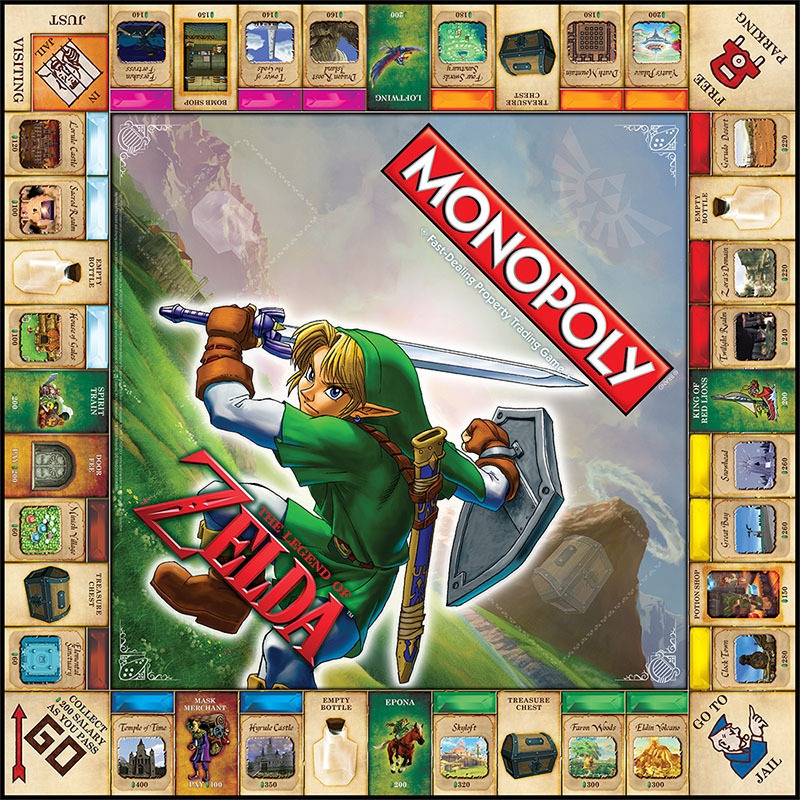
Hey! Listen! There's a Legend of Zelda board game coming! Awesome! Take a look!

zelda-board-monopoly…Oh. Monopoly. Again. Great.

Yes, indeed: the latest in a long-line of quick-and-easy cash grab Monopoly sets is one based on Nintendo's Legend of Zelda series, a franchise that has been running almost since the dawn of gaming, and one which has consistently provided gamers with some of the most enchanting interactive adventures of all time, blending childlike wonderment with epic heroic fantasy.

The Legend of Zelda, meanwhile, has not been particularly known over the years for its protagonist Link's desire to build up a sizeable portfolio of property, nor has Hyrule society ever been particularly dependent on capitalism. Link, more often than not, does good deeds out of a sense of altruism, or occasionally for the promise of "something good" (inevitably in bold print) — said "something good" is rarely financial reward, with questgivers instead tending to give him something of much more practical use.

I'm a bit annoyed about this. I'm not a particularly huge Zelda fan myself, but this is, without a doubt, a colossal waste of an awesome license. Monopoly is a terrible board game to shoehorn the Zelda license into. It's a terrible game in its own right, too, but I'm aware some people still like it, so I'm not going to push that angle too far — besides, my own personal dislike of Monopoly isn't why I'm frustrated to see Zelda squandered like this.

No, instead I find myself wishing for a more appropriate use of the license. It doesn't have to be an original board game in its own right — though that would be cool: spectacular Polish RPG series The Witcher is soon to get its own cool-looking original board game, so it's not without precedent either — but surely, surely there are better ways that Zelda could be adapted for tabletop play?

Here's just a few suggestions:

  • The Legend of Zelda: Carcassonne — Standard Carcassonne, except the tiles are all made up of actual tilesets from past Zelda games — A Link to the Past's 16-bit top-down graphics would be ideal for this. Meeples could be replaced by the different, distinctive races of creatures you come across in a typical Zelda game — one player could have a set of Gorons, while another could have Zoras, another still could have the Kokiri, and so on.
  • The Legend of Zelda: Catan — Much like Carcassonne, the bare minimum you need to do to make a convincing Zelda Catan set would be to redo the tile artwork in an authentically Zelda-esque fashion. You could incorporate some of the new rules and tweaks from things like Star Trek Catan — variable player powers is neat, for example — and Catan's numerous expansions for different scenarios.
  • The Legend of Zelda: Talisman — Talisman is, while flawed as a game, a decent depiction of an epic quest to achieve something. Reskinning this would be a more appropriate use of the license than Monopoly.
  • D&D Adventures: The Legend of Zelda — The dungeon-crawling co-op adventure games carrying the D&D brand are ripe for adaptation with Zelda artwork, enemies and items. You could even do a "Four Swords" thing, with each player having a differently coloured Link to control.
  • Arkham/Eldritch Horror: The Legend of Zelda — Okay, stretching things a bit here in terms of theme, but the mechanics of Arkham and Eldritch Horror are ripe for adaptation into a Zelda-style epic quest. There's exploration, treasures, character progression, battles, boss fights… everything a good Zelda game would need.

And this is just off the top of my head. All of the above would need very little adaptation in order to create a more convincing tabletop Zelda experience than Monopoly ever will. Come, on, Zelda Monopoly even still has "salaries", "Go To Jail" and "Free Parking", the latter of which in particular is completely incongruous with the setting.

So, this is pissing in the wind, I know, but please, please, license holders: when considering whether or not to license your awesome property for tabletop adaptation, please look a little further than Monopoly. It may be one of the most well-known games in the world, but there are hundreds, thousands of other, far better board and card games out there, most of which would be much better-suited for adaptations of this kind.


1659: Time Off

There's still nearly a month before I start my new job. With the job search over, this means that I am now being left largely to my own devices on a daily basis, which sounds like a dream come true, doesn't it?

It isn't.

Much like working from home isn't the wonderfully liberating experience you might think it would be, having a protracted amount of time to yourself with not a lot that you really "need" to do is not everything you might think it is, either. Days are long, boring and filled with vast tracts of nothingness, unless, of course, you find yourself something to occupy them with.

Most days, I'm pretty good at occupying myself. In the simplest cases, I'll simply play some games, watch some TV or read some stuff. Others, I might go out — maybe into town, or down to the gym, or just for a wander around outside. Others still, I might do things that "need" doing, like mowing the lawn or cleaning or tidying.

But there are days — today was one of them — where nothing feels like it's quite "right"; nothing feels like it will satisfy you. It's days like today that often see me sitting on the sofa staring into space for surprisingly lengthy periods of time, caught between desires, wants and needs, and never quite being able to muster up the energy or motivation to pursue any of them. Doing something I know I'll enjoy feels like a waste of time; doing something "productive" feels like it's an insurmountable challenge.

All this, of course, is a side-effect of depressive tendencies; it's not that I actually don't want to do anything, it's simply that, for whatever reason, my brain decides that it wants to be sad today, and the jumbled impulses the depressed brain fires out have a tendency to override everything else and prioritise that feeling of sadness. It's not sadness about anything in particular, it just is; it's just a frustratingly dark feeling from which it's difficult to escape, particularly if you're home alone, like I have been.

It's for this reason that I'm genuinely looking forward to starting work again — and genuinely looking forward to the fact that, for the first time in four years, I'll be working in a place where there are actual other living, breathing people with whom I might be able to interact on a daily basis. (Said interactions will, of course, be prone to my other big issue — that of social anxiety — but that's a bridge we'll cross when we get to it.) I'm looking forward to having the change of scenery each day — the chance to drive my new car and spend some time listening to the radio, music or podcasts; the opportunity to spend several hours away from the house; the pleasant feeling of "coming home" after a hard day's work — and of just, you know, doing something.

Tell that to my twentysomething self and he'd probably laugh in your face. But, frankly, life without work is not as fun as you might think it would be. (Well, it probably would be if you had more money than you'd ever know what to do with — though I imagine even that would get boring after a while.) Consequently, I find myself counting down the days until I become just another cog in the great machines of business — and genuinely looking forward to that day, rather than dreading it.