#oneaday Day 552: Christmas party season

It's the Work Christmas Do tomorrow. As is (apparently) usual, we're going to London to go and Do a Thing, then Eat Some Things, then Drink Some Things. I suspect I will probably bow out of the latter quite early like I did last year, as London bars are rather overwhelming. But we shall see.

I don't really know what to expect this time. The Do a Thing step for tomorrow is "Monopoly Life-Size", which I have heard is a lot more fun than actual Monopoly, because each of the "spaces" has a little room where you have to go and Do Stuff. I can see there being potential for some fun there, and my work colleagues are always a good laugh to hang out with on occasions like this.

For dinner in the evening, we are seemingly going to some sort of steak-centric restaurant. I am all for this, as I love a good steak, and it's something we tend not to have all that often at home. I think it will be a tad less pretentious as a meal than the last time we got together, where we went to one of the numerous The Ivy restaurants — the one in Covent Garden, rather than the famous club, though they are run by the same group — but I anticipate it will still be tasty. Plus being fed and not having to pay for it is always a great thing.

It's been a very tiring year work-wise, but it's been a good one — and I'm looking forward to the future. At some point relatively early next year, my role at the company will be changing somewhat; I'll be stepping aside from the social media duties I currently have and do not enjoy in the slightest, and becoming more involved in the development side of things, primarily on the testing front. I'm excited about this, as it means I can have a direct impact on the quality of the stuff we put out, plus I anticipate I'll get to learn a fair bit, too.

I won't be leaving aside the more creative parts of my job, though. I'll still be producing manuals for Evercade cartridges, and supporting those with material for the website and YouTube channel. Those are the parts of my work that I really enjoy — even if in 2025 it's an absolute fucking nightmare to get anyone to read anything. Still I persist, however; I still like to read stuff, so I'm sure there are at least a few people out there who appreciate some written material! (If you've never seen my written Evercade stuff, check out the Evercade Blog and you'll see all my stuff is marked with my name.)

Over the long (long!) term I'd like to put together something like a book on Evercade and its games, but while I've had all the other responsibilities to juggle, this is not something I feel like I've been able to make a ton of progress on planning and proposing, let alone realising. We'll see if that changes in the future. My goal is something along the lines of Limited Run Games' "The Complete Run" books, which will go through all the Evercade releases sequentially and provide Something Interesting To Read about all of them, be that historical information, tips on playing or just some interesting things to look out for. In essence, it'll be like my blog posts, but more formalised. If I can achieve that, I think I'll be satisfied that I've done something good for the world, on balance.

But anyway. All this is stuff to ponder in the future. Right now I smell bad so I need a bath, but I have a chat to moderate first. After that, it's off to bed, and then on to sunny London tomorrow daytime. I will doubtless be reporting in from the hotel tomorrow evening, so I shall see you then.


Want to read my thoughts on various video games, visual novels and other popular culture things? Stop by MoeGamer.net, my site for all things fun where I am generally a lot more cheerful. And if you fancy watching some vids on classic games, drop by my YouTube channel.

If you want this nonsense in your inbox every day, please feel free to subscribe via email. Your email address won't be used for anything else.

#oneaday Day 551: Mobile gaming is perceived as a "world of predatory monetisation and low quality" because that's what it is

A recent article on Gamesindustry.biz drew attention to a LinkedIn (ugh) post from one Christian Lövstedt, CEO of a company called Midjiwan AB, who is complaining that people don't take mobile gaming seriously.

Midjiwan AB, if you were curious, apparently make a mobile game called The Battle of Polytopia, which I've never heard of, which I suspect is at least partly what this is all about. In fairness to all the following, The Battle of Polytopia does not look all that bad… but I'd still rather play a game like that anywhere other than my phone. But I digress before we've even begun, so let's get back on track.

"Mobile gaming is one of the most played and most profitable platforms in gaming," Lövstedt says, "currently representing 55% of the global gaming market, but is often ignored and looked down on [because] it is perceived by too many as a world of predatory monetisation and low quality."

Okay. Let's start with this. People love to trot out that "over 55% of the market" figure (with variations on the exact figure quoted) but let's be real about this: the reason why mobile accounts for so much revenue in the global games market is precisely because it is a world of predatory monetisation and low quality.

Consider some of the most popular mobile games out there. Candy Crush Saga, which charges up to £34.99 for cheats that allow you to bypass levels — coupled with design that makes it near-impossible to win without buying these cheats. Gacha games such as Azur Lane, Granblue Fantasy and Fate/Grand Order, which exploit horny young people (particularly, though not exclusively, men) with attractive JPGs of hot anime characters, necessitating that you pay at least £20 at a time to be in with a reasonable chance of actually getting the character you want. And I'm pretty sure there are still plenty of "tap and wait" games out there that ask you to pay up to make things go faster or be able to simply play the game more.

When you consider that the term "whale" was coined to describe those who spend excessive amounts of money on free-to-play games, particularly in the social and mobile spaces — and that pursuing these whales to exploit them (at the expense of providing a good experience to free players) is a primary goal of the developers of these popular games — you will perhaps start to see exactly why mobile accounts for so much of the "market". It's because one user playing one heavily monetised mobile game will account for considerably more revenue than one user playing one pay-once-play-forever premium game on PC or console.

Games like this, you see, don't just ask you to buy them and are then happy with that. No; the most "successful" mobile games — measured by most folks who complain about mobile not getting its dues as the ones that generate the most revenue — are the ones that provide the opportunity for perpetual monetisation: the ones that entrap players into dark patterns that make them feel like they have to continually pay money into the game, month after month, in order to remain "relevant" and "current".

When you start from there, it's understandable why people see mobile gaming as rife with predatory monetisation and low-quality games. But let's look at the rest of this open letter.

"While some amazing mobile-first titles, like Monument Valley, manage to get the industry's attention," Lövstedt continues, "many other extremely popular and successful titles do not."

Monument Valley came out in 2014. That's over ten years ago! If you can't think of a more recent example than that of Doing It Right, I think we may have found the problem!

But he continues:

"Mobile games like Clash of Clans, Temple Run, Crossy Road and Candy Crush Saga are critically and commercially successful, yet are never or rarely acknowledged at game awards."

Perhaps that's because Clash of Clans, Temple Run and Candy Crush Saga are all prime examples of games with predatory monetisation and low quality? I actually don't know about Crossy Road, so I am willing to take a moment to actually research it before I brand it with the same scarlet letter. Give me a moment.


Tangent: Pete tries Crossy Road

"Contains ads. Contains in-app purchases". We're not off to a good start already. But let's download this and see.

After an initial tutorial, during which the simple tap-and-swipe, Frogger-inspired gameplay is introduced, I am given a "free gift" of in-game currency and then immediately invited to "win a prize". It costs the 100G of in-game currency I was just "gifted" to draw from a virtual gacha machine, which awards me with a mallard duck avatar to play in the game instead of the default chicken.

I am then taken to a main menu screen where I get an immediate popup about a new time-limited game mode and "sweet sales in the store". I'm then taken into that mode without having asked to play it. After playing it briefly, I am shown my top score with two non-descript icons, the purposes of which are not made entirely clear. It seems the one that the eye is most immediately drawn to — i.e. the one where you'd expect an "OK" button to be in typical UI design — is a "share" function for you to send a screenshot of your concluded run to any of your phone's connected social services or contacts.

After that, I am given a timer countdown to my next "free gift" and informed how many "G" of in-game currency there is "to go" until my next blind box of whatever the fuck you unlock in this game.

To Crossy Road's credit, it has no play-throttling energy system, no paying to bypass timers and it does have a one-off payment of £7.99 to remove all ads (if you're not already blocking them), but it also sells extra game modes, has "limited time sales" on special characters and sells a power-up to double your in-game currency income. And you can bet that it gets regular "content updates" to ensure there are always new things for people to pay for.

But it's just not very fun, the countdown timers and grind for currency make it feel more like work than play, and the "business" part of it being so front and centre is exactly why people don't take it as seriously as premium, pay-once games for PC and consoles.

So in conclusion to that little bit, while Crossy Road isn't as egregious as the other examples cited, it's still not… great. And certainly not the sort of thing that is in any way deserving of an award.


"Just because [low-quality] games [with predatory monetisation] like that do exist in the mobile market, it should not diminish the achievements of the market's best games," Lövstedt continues. "It perhaps makes them more impressive. And if we're honest with ourselves, there are AAA industry darlings crammed with the same monetisation mechanics."

Two things to pick out here: firstly, outside of the aforementioned Monument Valley (which, again, is eleven years old at this point), he cites no specific examples. And yes! Yes, triple-A does pull all this shit, too! And you know what? People hate it there, too!

"D.I.C.E., one of the better award bodies for acknowledging mobile gaming, has only ever nominated a mobile game for Game of the Year twice," he continues. "Angry Birds HD and Pokémon Go. And they were the only dedicated game awards body to nominate them, despite how commercially and culturally impactful both games are."

Okay. I have to look into this. Bear with me.


Tangent: Pete looks into the D.I.C.E. Awards

Angry Birds HD was nominated for Game of the Year in 2011 alongside Mass Effect 2 (which won), Call of Duty: Black Ops, God of War III and Red Dead Redemption. Honestly, the fact that it was even nominated is borderline laughable, because Angry Birds is not a particularly amazing video game. It's fine for what it is, but in 2011 people were still feeling the novelty of playing games on a tablet — the iPad first launched in 2010 — and the calibre of the other games that were nominated is just in a completely different league. What Lövstedt doesn't mention is that Angry Birds HD did win a D.I.C.E. Award that year — for Casual Game of the Year. Which is absolutely fair, although given it was up against Pac-Man Championship Edition DX, Plants vs. Zombies and Bejeweled 3, it wouldn't be my vote. (And I don't even like Plants vs. Zombies.)

Pokémon Go, meanwhile, was up for the 2017 Game of the Year award, where it was up against Overwatch (which won), Battlefield 1, INSIDE and Uncharted 4. My personal tastes put that as a much weaker overall lineup than that of 2011, but there's still a world of difference between gamifying Google Maps and the cultural phenomenon that was Overwatch in its first year. And, again, Pokémon Go won a perfectly acceptable award for what it is: Mobile Game of the Year.

Lövstedt is right; Pokémon Go in particular did have a certain amount of cultural impact, particularly as we moved into the pandemic years. But, again, it's just not a very good video game, which is why it lost out on the overall Game of the Year award. "A lot of people played this because they were bored" is not the same as "this is an incredible video game that should be celebrated as the pinnacle of its medium".


In conclusion, then, I have to reiterate that mobile gaming's reputation as being filled with low-quality games with predatory monetisation is well-earned. This isn't to deny that there are developers apparently doing interesting things on mobile — Lövstedt's own The Battle of Polytopia looks quite worthwhile, so I might have to actually give it a go — but at this point, the damage done by Apple introducing in-app purchases (and Google following suit) has already been done. There's no easy way to turn that back; no easy way to reclaim mobile gaming's reputation from those who, thanks to their greed, generate enough income to account for a supposed 55% of the global games industry's revenue.

Because what are Apple, Google and the other app store platform holders going to do? Just suddenly give up such a profitable revenue stream? Because let's not forget they get a cut of every purchase, so it is absolutely not in their interests to try and fix this.

Also, playing games on a touchscreen — particularly on small ones like those found on phones — sucks ass. This, honestly, is one of the biggest reasons I have zero desire to play any games on my phone today — even if they weren't low-quality games with predatory monetisation. Which a significant portion of them are, so I have precisely zero incentive to look any deeper — particularly because the vast majority of those which are cited as "good examples" (including the aforementioned Monument Valley, plus titles like Stardew Valley and Vampire Survivors) are available on platforms with control schemes that don't suck!

So in summary: if you want to be taken seriously, release your game on a platform that people will take seriously. Have you seen the shit they let onto Steam these days, recent examples notwithstanding…?


Want to read my thoughts on various video games, visual novels and other popular culture things? Stop by MoeGamer.net, my site for all things fun where I am generally a lot more cheerful. And if you fancy watching some vids on classic games, drop by my YouTube channel.

If you want this nonsense in your inbox every day, please feel free to subscribe via email. Your email address won't be used for anything else.

#oneaday Day 550: I'm so tired of online

I've had to block two different people on two different platforms today, both for the same reason: showing up uninvited and spewing some sort of borderline-abusive quasi-scolding because they happen to disagree with something rather innocuous that I had said. The details don't really matter — though if you must know, they really were innocuous opinions, firstly on the fact that localisation into English is not "censorship" (which it isn't, and if you're already typing an angry comment, I invite you to stop, take a deep breath, and just leave), and secondly, that it was surprising someone with terrible handwriting and an obvious lack of care in what they were writing could actually spell a rather complicated surname correctly. Hardly the stuff of epic meltdowns, I'm sure you'll agree — although the localisation topic does tend to bring some of the absolute worst people on the Internet out of the woodwork.

I have a zero tolerance policy for rudeness these days. If a complete stranger were to show up at my door and start hurling abuse at me, I would slam the door in their face. And as such, if a complete stranger decides to show up at my digital door online and start hurling abuse, I will gladly slam that door in their face, too. The platforms on which I blocked these two particularly odious individuals today — my other site MoeGamer, and my Bluesky account — both have pretty robust self-moderation tools that allow you to put nasty little piggies out of sight, out of mind, permanently.

My favourite moderation tool in this regard is YouTube's "Hide user from channel" function. YouTube does many, many stupid things, but this little option is a work of genius. Effectively acting as a shadowban, using this function on a user not only makes the comment you used it on disappear from everyone else's screens, including yours, it also prevents any future comments from that person from appearing on any of your videos. However — and here's the good bit — the user in question has no indication that this has happened to them, meaning they can quite happily continue spewing their hateful rhetoric "at you", and you will remain completely oblivious, while they inevitably get more and more frustrated. This is just delightful.

But you know what? I'm tired. It sucks that these mechanisms have to be in place for a quiet life online these days. And I'm increasingly fatigued with the very idea of putting myself out there — for what, exactly? — only to get chucklefucks who are incapable of responding to a post without resorting to The Usborne Big Book of Logical Fallacies crapping up the comments sections.

I don't do anything online with the intention of pissing people off, or even being a little bit provocative. I'm honest about things — I'm honest about the person I am, I'm honest about the things I feel and believe, and I'm honest about the things I enjoy. The thing I am most honest about is that I have absolutely zero desire to argue with anyone online, which is why, as a general rule, on platforms such as my YouTube channel and MoeGamer, I make a specific effort to focus on the good and the positive.

Yes, I rant and rave and complain a fair bit here — I will freely admit that! — but this place is for me. It's my place for self-expression, for self-therapy, for processing my own thoughts, feelings and emotions, and it just happens to be publicly accessible. That does not mean I crave sweaty Internet-poisoned dudes in my mentions arguing with everything I say. I am more than enough sweaty Internet-poisoned dude for myself; I certainly don't need any more.

It might be time for another social media break over the holidays. I've already dialled things back a lot from where I was, which is good. But the holidays promise to be a nice time with family, so I'm looking forward to enjoying the peace and quiet. And that peace and quiet will have to be, at least partly, of my own creation.


Want to read my thoughts on various video games, visual novels and other popular culture things? Stop by MoeGamer.net, my site for all things fun where I am generally a lot more cheerful. And if you fancy watching some vids on classic games, drop by my YouTube channel.

If you want this nonsense in your inbox every day, please feel free to subscribe via email. Your email address won't be used for anything else.

#oneaday Day 549: The Yakuza games are the ultimate video games

I've been thinking it for a long while now, and finally making some time to go back to Yakuza 5, which I left half-finished a good few months back, I have cemented my feeling that the Yakuza (or Like A Dragon, as they're now known, to be more true to the original Japanese title Ryu ga Gotoku) games are, in fact, Peak Video Game.

By this I mean that if there is a single game you are going to invest a lot of time and effort into playing, a Yakuza game is an excellent choice. And there are a whole bunch of them now! Best of all, given that each one unfolds in a different time period, they all have a markedly different feel from one another — and, of course, as the series goes on, it expands beyond its original setting of Kamurocho to a much wider variety of locales.

Thus far in my journey through the series, Yakuza 5 is the series at its most broad. Like its immediate predecessor, the game is split into several distinct parts, each with a main protagonist taking the leading role. Unlike Yakuza 4, however, which was entirely set in Kamurocho, Yakuza 5 features several town centres for the various different protagonists to explore before they all meet up for the finale.

So far I'm on the third part out of four, which means I've finished the initial part with longstanding series lead Kiryu Kazuma living under an assumed name and working as a taxi driver in Fukuoka, the second part that involves Taiga Saejima breaking out of prison, living for a brief while in a mountainside hunter village, then hanging out in Sapporo for a bit, and I'm now on the first half of the third part, which concerns Kiryu's adoptive daughter, Haruka, and her quest to become an idol in Osaka.

Thus far, each main section of the game has been very different from the last in terms of tone. Kiryu's started with a bit of "everyday life in a small city district" feel before ratcheting up the yakuza angle once the story got underway. Saejima's was quite a personal story of this imposing, hulking brute of a man and the soft centre within. Haruka's, so far, has been deliberately a bit silly, but also with a hint of the sleaziness and darkness that underpins the real-life idol industry.

The nice thing about giving each protagonist their own areas to wander around is that it allows them to have different activities available to them. Yakuza 5 introduces the concept of each character having a "Side Story" as well as the series' iconic "Substories"; each "Side Story" is quite an involved plot that runs parallel to the main scenario, and generally concerns the main character developing their skills in an area that is somehow important to them. In Kiryu's case, we get to work his job as a taxi driver; as Saejima, we take him through learning how to hunt on the mountain; as Haruka, we follow her idol career from its humble beginnings and onwards into greater success.

In each instance, the Side Story is handled in a different way rather than just being a glorified way of marking your progress through a series of cutscenes. Kiryu's taxi driving Side Story, for example, involves a combination of driving people around Fukuoka and ensuring that they get good service, punctuated by some extremely silly arcade racing sequences as he investigates a racing gang. Saejima's hunting sequences involve unique mechanics surrounding avoiding detection by wildlife, shooting rifles in first-person, surviving in extremely inhospitable conditions, and setting traps. Haruka's Side Story sees her having Dance Battles in the street, building up her performance-related stats in various ways, and working through an ever-lengthening list of obligations her career places in front of her as she grows in prominence and fame.

If the Yakuza games were just about the main plot, these Side Stories and the Substories, they would already be extremely substantial. But then there's all the other stuff too. Eating at all the restaurants. Training with each character's "master" to learn new moves. Seeking out unusual happenings to have "Revelations" that, again, unlock new moves. Playing darts, pool, bowling. Playing real-life Virtua Fighter 2. Playing a fictional but nonetheless enjoyable shoot 'em up. Catching prizes in the crane game. Hitting some balls at the driving range and batting cages. The list goes on.

The great thing about Yakuza games is that you can engage with them as much or as little as you like. If you want to plough through the story and just see what happens, you can do that with no real penalty. You might not have levelled up as much as if you'd thoroughly completed all the Substories, but you can do it.

Alternatively, I suspect most players will find themselves unable to resist engaging with at least some of the optional activities — because each of them are handled with such thoroughness, and are so enjoyable in their own right, that they could quite feasibly have each been their own standalone games.

This is the genius of Yakuza. Back in the '80s, the software publisher Imagine got itself into a lot of trouble as it attempted to develop a series of "Mega Games" for the Commodore 64 and ZX Spectrum, but none of these projects ever came to fruition — though some had some successor projects.

Yakuza games, meanwhile, are "Mega Games". Each entry is a single game that you could quite feasibly play for a very long time indeed — possibly even forever, depending on how much you like mahjong and shogi — and there is absolutely nothing quite like them out there.

And they're a markedly different experience from western open world games that provide a huge, boring map littered with objective markers and expect you to hoover them up systematically while working through a tedious skill tree that gives you 0.1% poison resistance with every level up or something equally meaningless. No; although Yakuza games are full of things to do — and each comes with a handy "Completion List" marking how much of all its component Bits you have "completed" — not one of them feels like it has been designed with "player retention" in mind. Not one of them is designed for the explicit purpose of 1) being your "forever game" and 2) monetising the crap out of its user base.

No; Yakuza's wealth of things to do is all in service of creating one of the most detailed, compelling worlds in all of gaming. And although I'm very behind on the series at this point, I am well and truly determined to catch up and see where things go from here. Because after this many hours, this many games and this many in-game years having passed, I care what happens to these characters!

If you've never played a Yakuza game and are daunted by the prospect of there being (counts) 11 games set in the main series continuity, a further two spinoffs in the same setting but not directly connected, and a wealth of other, non-canonical spinoffs that range from historical adaptations to a Fist of the North Star-themed adventure, don't be afraid! Start with Yakuza Zero, play it, love it, see how you like it. And then you'll understand. And, several games later, you'll be about where I am now.


Want to read my thoughts on various video games, visual novels and other popular culture things? Stop by MoeGamer.net, my site for all things fun where I am generally a lot more cheerful. And if you fancy watching some vids on classic games, drop by my YouTube channel.

If you want this nonsense in your inbox every day, please feel free to subscribe via email. Your email address won't be used for anything else.

#oneaday Day 548: The noodle chronicles

One of my favourite things about Paul Gannon and Eli Silverman's hilarious Cheap Show podcast is Eli's obsession with noodles, and Paul's performative weariness with this obsession. The result is that, on a semi-regular basis, the pair provide some reviews of a wide variety of different noodle products, and these have helped me — and doubtless many others — to discover things so far beyond the humdrum Pot Noodle that you wouldn't believe. It's a wild and wonderful world out there, so I thought today I'd share some personal favourites.

Samyang "Buldak" noodles

Image via ubuy, who are doing free chopsticks with this bundle! Not a sponsor.

These are the famous Korean "fire noodles" that were probably some stupid TikTok trend a while back. They're a stir fry-type noodle, which means you boil the noodles without adding any seasoning, then drain most of the water and add sauce and a sachet of goop before "frying" (actually just stirring around in the pan a bit for about 30 seconds while the heat is still on) and serving immediately. The result is a generous portion of glossy, medium thickness noodles, an angry red in colour thanks to the notoriously hot sauce, with no "soup".

These noodles come in a variety of different flavours. All of them claim to be "HOT chicken flavour", plus something else in the case of anything other than the regular ones in the black packaging. Don't be too concerned with that, though; a bit of investigating revealed that the "Buldak" part of their name is a reference to a Korean street food dish that involves chicken served with incredibly hot sauce, and the sauce is based on… well, the sauce, rather than the chickeny bit.

I've tried a few different flavours of these. The basic black ones are nice enough, so long as you can handle the heat, but my favourite remains the first one I tried: the "curry" flavour. Sadly, this particular flavour appears to have been discontinued, which is immensely disappointing, but the "Spicy Seasoned Chicken" flavour was also very nice, and a tad milder than the regular black ones. I have not, to date, tried the "2X spicy" ones that come in a red package, but apparently these are so spicy they are banned in Denmark. I don't know if that's actually true or not, but given that the regular ones will present quite a challenge for the uninitiated, I suspect a "2X" version will blow most people's heads off, and I've heard rumours of a "4X" variant, though I'm yet to see those anywhere.

On the milder end of the spectrum there are flavours such as "Cheese" and "Carbonara", both of which come with some cheese powder to mix in along with the spicy sauce. These were… okay, but I didn't love them. The Carbonara seems to be a favourite of a lot of people, but I didn't personally rate it that highly. The cheese one also absolutely honks while you are preparing it, leading my wife to brand them "Feet Noodles" and prohibit me from cooking them any time she was in the house for a good few months. She eventually relented because she was fed up of seeing them in the cupboard.

I also tried a habanero and lime flavour variant. These are my least favourite of the range to date, as the lime flavour is quite artificial. They weren't unpleasant, but I wouldn't choose to have them again when other flavours are so much nicer. From the currently available range at the time of writing, I recommend the Spicy Seasoned Chicken ones above all the others.

Anyway, whether or not you will like these noodles is entirely dependent on whether you can handle the spice — and, perhaps more relevantly, whether you enjoy the spice. My wife can handle a spicy dish, for example, but she doesn't enjoy anything over a certain heat threshold, and as such these noodles were not to her taste. Although the flavoured variants are noticeably milder than the regular black version, they're still pretty danged hot, so you better be ready for that.

If you are on board with the spice, however, an enjoyable noodle experience awaits. The sauce goes glossy and sticky with barely any provocation, lending a nice sweetness to the overall dish, and most come with a little sachet of miscellaneous dried bits to add a bit of texture. You can, of course, also customise these as you see fit; I've never actually done this, but I can imagine dumping a fried egg on top would be rather lovely.

A conditional recommend for these, then.

MAMA Shrimp Creamy Tom Yum Noodles

MAMA noodles provide a complete contrast to what we've just described. These come in a somewhat smaller package and thus provide a slightly smaller portion, but they make up for this by being soup-style noodles. For the noodle newcomer, this means that you add the various seasonings to boiling water when you're cooking the noodles, and this means you infuse the noodles with flavour and have a delicious soupy broth to enjoy both with and after you have consumed all the noodles.

MAMA do several flavours of noodles, all of which that I've tried are very nice indeed, and curiously they have two separate "Tom Yum" versions — one comes in a silver packet, and the other comes in a shiny orange packet. We're concerned with the shiny orange version today, whose sole distinguishing feature is that it is, supposedly "creamy Tom Yum" as opposed to just "Tom Yum", but the silver variant is nice, too. I think the orange one has the edge, though.

These noodles come with a sachet of powder and a sachet of goopy paste. As everyone knows, the best noodles have at least two pouches of Stuff with them, and this is certainly true for MAMA noodles, because they are delicious and flavourful. The creamy Tom Yum flavour is ostensibly "shrimp" flavour, but its more of a hot and sour, vaguely Thai curry-esque flavour with hints of lemongrass and a thoroughly pleasing richness to it that combines sweetness, sourness and saltiness together in each mouthful.

My top tip for these is to ensure that you put enough water in the pot for there to be some nice, vibrantly coloured soup along with the noodles. When cooking noodles, it's very easy to accidentally boil off all the water, and with noodles of this type, that means the majority of the flavour goes with it! Give them about 300-350ml of water, boil it, immediately bung in the noodles and flavourings, then serve after just 3 minutes of simmering. The result is delicious, and comes highly recommended for those who enjoy Asian flavours.


We discovered a while back that one of the side streets in the town centre now plays host to a wealth of "Asian supermarkets", and this is a good source for trying new varieties of noodles. I will be trying plenty more in the near future, and will do my best to report on my adventures as and when they occur. Until then, happy noodling — and if I catch you settling for the dirty pond water that is "Naked" or "Kabuto" noodles, we are going to have words. Words that conclude with me boiling up a big pot of MAMA Tom Yum for you.


Want to read my thoughts on various video games, visual novels and other popular culture things? Stop by MoeGamer.net, my site for all things fun where I am generally a lot more cheerful. And if you fancy watching some vids on classic games, drop by my YouTube channel.

If you want this nonsense in your inbox every day, please feel free to subscribe via email. Your email address won't be used for anything else.

#oneaday Day 547: School books

I've been thinking about school again. I do that a lot for some reason. Nostalgia for happier days in the past, perhaps. A melancholy reflection on a failed career. Or an earnest desire to go back. It doesn't really matter. I do it a lot, regardless.

One of the things that my brain has decided to fixate on today is the concept of "school books" — specifically, exercise books. I don't know why, but I really liked having a book for each subject's work.

Obviously, from a practical, logistical perspective, it makes sense to have one book per subject, particularly in secondary school, because pupils tend to have different teachers for different subjects. But it also makes sense in primary school to a certain degree, as it allows the teacher to clearly demarcate different subjects' work — which is taught at different times in the week — and for the pupils to easily compartmentalise the various things they've been learning.

I don't know. There was something inherently pleasing about every subject having its own colour, and I bet a lot of schools around the country used a similar colour scheme. We had red for English Language, green for English Literature, grey for Maths, orange for Science, blue for Languages, a different green for the subjects grouped under "Humanities" at our school (Geography, History, R.E.), and your Journal would be a different colour according to what year you were in.

That Journal was a handy little thing, too. It was essentially a weekly planner where we could record any homework we got from our subjects and the date it was due; it was then, of course, up to us to check it regularly and ensure we actually did that homework. This was before any sort of handheld electronic devices with reminders on them — pre-"smart" mobile phones didn't become particularly widespread among me and my peers until we were into sixth form. It was a good and healthy thing to do, I think; it helped teach us matters of personal responsibility — and also occasional bullshitting on the inevitable occasions when we had forgotten to check it properly.

The Journal was treated like some sort of holy book, though. Every single week, we had to get it signed by our parents to prove that they had seen we had been recording our homework, and every week, our form tutor had to sign it to confirm that our parents had signed it. A space on each week's spread was also set aside for any communications between our form tutor and parents — for more serious infractions, of course, you got a Letter Home from the school office, but for minor things (and not necessarily problems!) there was this space in the Journal.

Heaven help you if you doodled anywhere on your Journal, though. Defacing it in any way was an immediate ticket to having to buy — yes, buy — a new one. As you might expect, the end of term rolling around was an immediate signal to many of us to immediately deface the crap out of the Journal for the term just gone. These defaced Journals became companions to "The Rough Book" among me and my friends — there was something about the neatly laid out tables in the Journal that made it ripe for customising with ridiculous doodles. My favourites were ones where we absolutely covered the page with tiny stick figures, all standing on the various lines of the table, flinging themselves off the edge and getting up to no good. I kind of wish I still had some of those.

It was the same for your subject exercise books, of course. Some teachers insisted that, as our inaugural piece of homework for a new term, we should cover our exercise book as a means of discouraging and/or preventing any doodling on the cover. Most people went the "wrapping paper" route, but there was a fun degree of self-expression among us all, and there was always some posh git who would laminate the cover of their book at their Dad's office or whatever.

I realise, of course, that the relative strictness with which we were taught to treat our school equipment can be looked on, from some perspectives, as being stifling to creativity and borderline authoritarian. School in general has always been designed as a means of, among other things, socialising us into becoming "good citizens" — and part of that, at least when I was at school, involved treating things with respect — whether they were the things that had been given to you by the school, the things you had brought in from home, or the things your peers were using.

It didn't always happen, of course, but there was a certain degree of pride that pretty much everyone had in their school possessions. Outside of covering books, one of the best ways to express one's individuality was through the stationery you brought to school — and the pencil case in which you kept that stationery. Some folks had cool, branded, zippered pencil cases; others had little tins. I remember my proudest pencil case at school was a Nintendo-branded tin with Super Mario Bros. pixel art on the front; it was also one of my least practical pencil cases due to its size, but I loved it nonetheless.

Anyway, you'd think I'd have a point about all this but I really don't. Something just got me thinking about the colour of school books, so that's what I've talked about today. Hey! They can't all be winners. Or perhaps you found this absolutely fascinating, in which case I am happy to have served.

Either way, at 20 past midnight I think it's probably time to go to bed.


Want to read my thoughts on various video games, visual novels and other popular culture things? Stop by MoeGamer.net, my site for all things fun where I am generally a lot more cheerful. And if you fancy watching some vids on classic games, drop by my YouTube channel.

If you want this nonsense in your inbox every day, please feel free to subscribe via email. Your email address won't be used for anything else.

#oneaday Day 546: Why are we still arguing over "games as art"?

Back in April of 2010, the first time around on this #oneaday malarkey, I wrote a post responding to the late Roger Ebert's ill-advised argument that "video games can never be art".

Today, on the 5th of December 2025, some 5,710 days later (or "over 15 years" if you want to be a bit more normal about it), we are, apparently, still having this argument. Roger Ebert is, of course, dead, so this time around it has come from someone else: Ian Bogost, a professor at Washington University, St. Louis and hilariously forever doomed to be "most known for the game Cow Clicker" so far as the broader Internet is concerned.

A bit of context if you've not come across this chap before: Cow Clicker was designed as a satirical take on the rise of "social games", as they were known when they first started appearing on Facebook. You know the sort of thing: wait for timer to expire, click on thing, get stuff. Pay up if you want to get stuff more quickly. Marvel at the meaninglessness of existence.

Cow Clicker was good satire! It made some solid points about the way social games abused not only their players, but the broader community surrounding those players. Anyone who lived through Facebook in the 2010s will almost certainly remember being spammed with "invitations" to "help" on someone's "farm" or similar, because although it was patently obvious to anyone who had ever played a video game before that social games were absolute dog eggs, they introduced a lot of people who had never touched video games before to the idea of playing games on their computer or mobile phone. And, as a result, they are indirectly responsible for those tedious shitheads who argue that Candy Crush Saga is relevant to modern gaming rather than yet another abusive, predatory free-to-play game.

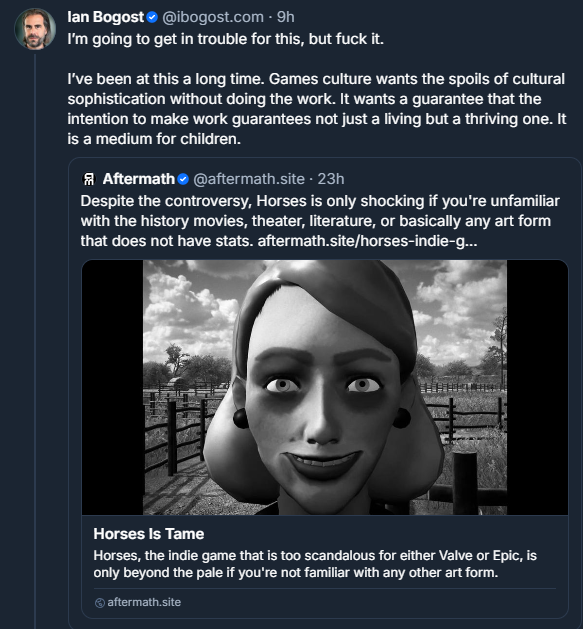
Anyway, I hadn't seen Bogost around for a while, but I'd always thought that he had vaguely… sensible ideas. Today he came out with these humdingers — relating to, of course, HORSES, the hot topic du jour (as you will know if you have read my last two posts and my piece on the game over on MoeGamer):

(Bluesky screenshot)
‪Ian Bogost‬
‪@ibogost.com‬

I’m going to get in trouble for this, but fuck it. 

I’ve been at this a long time. Games culture wants the spoils of cultural sophistication without doing the work. It wants a guarantee that the intention to make work guarantees not just a living but a thriving one. It is a medium for children.

(Quoting the following post:)
‪Aftermath‬
‪@aftermath.site‬

Despite the controversy, Horses is only shocking if you're unfamiliar with the history movies, theater, literature, or basically any art form that does not have stats.
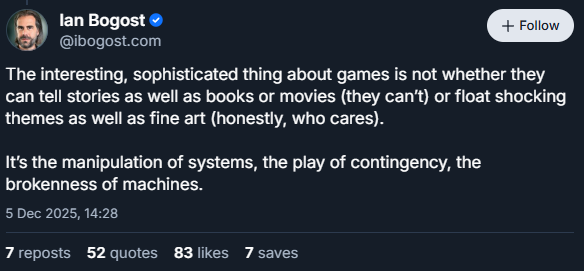
(Bluesky screenshot)
Ian Bogost
‪@ibogost.com‬

The interesting, sophisticated thing about games is not whether they can tell stories as well as books or movies (they can’t) or float shocking themes as well as fine art (honestly, who cares).

It’s the manipulation of systems, the play of contingency, the brokenness of machines.
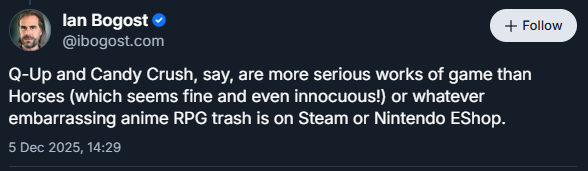
(Bluesky screenshot)
Ian Bogost
‪@ibogost.com‬

Q-Up and Candy Crush, say, are more serious works of game than Horses (which seems fine and even innocuous!) or whatever embarrassing anime RPG trash is on Steam or Nintendo EShop.

There are some truly amazing bad takes in this mini-thread, but his argument appears to stem from "I am older than you, therefore my opinions are the correct ones." At least he correctly assumed that he would "get in trouble for this".

He falls into the usual traps of assuming that books and movies are inherently superior forms of media because they have been around longer and are thus more refined, but this exceedingly shallow viewpoint fails to accommodate the existence of books and movies that are unashamed to be absolute pulp fodder, trash, blockbuster nonsense or whatever other mild pejoratives you might care to fling at them. Not only that, but gaming is a medium that has grown much quicker than both books and movies, at least partly because it was able to draw on artists' experiences in developing those mediums, and adapting the things that work into the interactive space.

Now, one area where I do kind of sort of align with Bogost is where he notes that games are "the manipulation of systems, the play of contingency, the brokenness of machines". However, where I drift apart from him is his seeming assumption that that is all there is to gaming.

Games can be about the manipulation of systems, the play of contingency and the brokenness of machines. There are some truly compelling games that focus exclusively on those things — and yes, there are plenty of those that I would well and truly describe as exhibiting their own form of artistry. There is an elegance to a well-designed, well-balanced game — it keeps you playing; it keeps you invested; it plays on your mind even when you're not directly engaging with it, in much the same way as a great work of art that you, personally, found particularly impactful "stays with you" long after you were in its physical presence.

This side of things is something that I feel the more "artsy" side of game criticism — and the more artsy side of gaming enthusiasts, for that matter — could do well to study more. As someone with an appreciation for both narrative-centric and mechanics-focused games, it is inordinately frustrating to see those who prefer narrative experiences completely dismiss the artistry of mechanics-centric games. At the same time, it is also frustrating when people who are primarily appreciators of mechanics will completely discount the artistry of a good story.

You see, games aren't one or the other! They can be both, or they can be one of those things — or they can probably be neither of them if you're determined enough. But in most cases these days, there's a little of column A and a little of column B in there — and both of those aspects have been developing rapidly as the medium and technology have evolved, to such a degree that it is an astonishingly galaxy-brained take to say that "games cannot tell stories as well as books and movies" as a blanket statement.

HORSES is an interesting one because it's not a very "good" video game in terms of its mechanical aspect, and there are arguments to be made that its narrative aspects aren't anything particularly out of the ordinary either. I enjoyed my time with it well enough — I found it compelling enough to play through in a single sitting — but I also found myself wondering if anyone would remember it a year from now, particularly if the whole situation with it being "banned" from various platforms hadn't happened. There are plenty of artsy-fartsy walking simulators out there, and some have done their job better than others; it's actually a surprisingly challenging genre of game to get "right", and opinions vary wildly on exactly what getting it "right" really means.

But that's art! Art provokes discussion and debate. It sometimes makes people feel uncomfortable. It sometimes carries deep meaning for people. It resonates with some people more than others, and for different reasons even among those who all found it "meaningful" to a similar degree.

I'm truly astonished that we're still in a situation where games are having to justify their existence as an incredibly creative, artistic medium in 2025. Yes, there's garbage out there — although let's not even get into the casual racism of Bogost's "embarrassing anime RPG trash" statement right now, which is another matter entirely — but there are garbage books, movies and paintings out there, too. To put "established" forms of media on some sort of unassailable pedestal purely because they've been around longer and because the Big Scary Professor At Washington U Says So is just absurd. Because if video games as a medium are not "established" by this point… exactly when is the cutoff point for them to be taken the slightest bit seriously?

There are certain people out there who seem weirdly desperate for video games to forever be regarded as toys for little children — particularly little boys. We are long past that. And I would expect someone like Bogost to know better by this point.


Want to read my thoughts on various video games, visual novels and other popular culture things? Stop by MoeGamer.net, my site for all things fun where I am generally a lot more cheerful. And if you fancy watching some vids on classic games, drop by my YouTube channel.

If you want this nonsense in your inbox every day, please feel free to subscribe via email. Your email address won't be used for anything else.

#oneaday Day 545: Couldn't drag me away

I played HORSES this evening. I wrote about it in depth over on MoeGamer, so go read that if you want to find out a bit more about it. Short version: it was a decent Art Game, I'm not sure it'll be remembered in a couple of years' time, and the controversy surrounding it is, frankly, laughable.

That side of things is worth pondering a moment, because it's been an absolutely absurd game of telephone that has culminated in some people — including professional games journalists! — coming out absolutely convinced that the game was justified in being banned because at one point during its development it had something they considered to be child sexual abuse material.

For context, this is the scene as it ended up in the final game. The only change is that the woman atop the horse-masked individual is now in her twenties rather than being fourteen.

If you think that scene is in any way sexual, I really don't know what to tell you. There's nothing the slightest bit titillating about the whole scene, and for the majority of it, it looks like this:

That's "you" on the left, and the girl on the right is the daughter of a wealthy businessman considering purchasing one of the "horses" in the game (actually enslaved, naked humans) — during this scene even the dialogue isn't remotely sexual; instead, the woman delivers a lengthy diatribe about how people should know their place in society, how those with morals perceived to be "loose" tend to have "dangerous" ideas, and how those who live their lives "recklessly and indulgently" end up getting what they deserve.

HORSES is provocative — deliberately so — but honestly, having played through the whole thing this evening, it is so laughably tame compared to some other video games out there that the entire situation just feels bizarre. There are people thumping tables out there arguing that this game deserved to be banned while having absolutely zero knowledge of what the whole thing is actually about, but for once it seems like the majority opinion — even among games journalists — is that this game doesn't deserve the treatment it's gotten.

And that treatment is worth talking about. As Chris Person notes in his excellent piece on the game over on Aftermath, HORSES encountering such difficulty with getting a widespread release is a troubling sight for the industry. "If this is what's considered the limit for which games can and cannot be sold on mass marketplaces," he writes, "then we're all in trouble, and everyone involved in that decision should be thoroughly embarrassed."

The problem is that Valve holds a near-monopoly on the digital PC games market with their Steam platform, and thus a game from a small, independent team with a limited budget not being able to release their game their is very bad news for that team and their game. HORSES has probably sidestepped this particular issue thanks to the widespread press coverage it has had, but it's a solid case study in why the present situation is a bit of a problem.

"Well, just release it elsewhere!" some of you might say. And sure: you can buy the game on GOG.com and Humble. But for most PC gamers, neither of those storefronts are the first place they look to get new games. For most PC gamers, PC gaming begins and ends with Steam — particularly if they do their gaming on a device like a Steam Deck, which, as the name suggests, obviously prioritises Steam as its main source of material.

As I say: HORSES itself is probably going to be all right after all the coverage it's gotten. But will the next game to suffer this situation be as lucky? Probably not.

And besides, part of the reason the HORSES situation specifically is so absurd is the fact that there is much worse stuff already on Steam with zero issues. Not only do reasonably big-name recent releases like Silent Hill f feature more explicit, disturbing content than HORSES does, but you also have shovelware shit like the Sex With Hitler (yes, really) series happily existing with zero issue. I'm sure I don't need to tell you that this is a rather major problem with consistency and transparency.

Transparency is, honestly, probably the biggest problem with all this. HORSES' developer Santa Ragione did their best to try and work with Valve on ensuring that it was compliant with all appropriate platform policies, and when its initial version was rejected, they changed everything that could have been remotely considered to be a bit dodgy — even if, as outlined above, it almost certainly wasn't dodgy. But they were given no chance to appeal, no second chance — it was just gone from the platform, and with it a significant opportunity at organic discovery.

The Epic Games Store situation is even more bizarre. It seems like Epic themselves re-submitted the game to IARC, an international body that issues local content certifications for digital games, and that caused the game to end up with an "Adults Only" rating from the ESRB, which isn't allowed on Epic (except for blockchain and NFT-based games, because Tim Sweeney is a cunt). This is unusual because it's not Epic's place to submit games to IARC or any ratings bodies — it's the responsibility of developers and publishers, and a storefront going out of their way to re-submit something that had already attained a rating is unheard of, and probably not actually allowed.

Anyway, it's all a shitshow, and with this coming amid payment processors continuing to cut off adult content creators and sex workers from their sources of online income, it's just generally a pretty dark, shitty time for various forms of self-expression.

I enjoyed my time with HORSES. I wasn't blown away, but I enjoyed it. It's definitely worth four quid and a couple of hours of your time if you're on board with narrative-centric games that have minimal mechanics. I wonder if it will be remembered in a few years for anything other than this whole situation with the platform holders.


Want to read my thoughts on various video games, visual novels and other popular culture things? Stop by MoeGamer.net, my site for all things fun where I am generally a lot more cheerful. And if you fancy watching some vids on classic games, drop by my YouTube channel.

If you want this nonsense in your inbox every day, please feel free to subscribe via email. Your email address won't be used for anything else.

#oneaday Day 544: Wild HORSES

The latest casualty in the ongoing wave of New Puritanism which appears to be spearheaded by Visa and Mastercard is a short, arty game known as HORSES. Thus far, it has been banned from release on Steam and withdrawn from sale on the Epic Games Store and Humble's store. (Edit: apparently Humble have put it back now.) At the time of writing, you can buy it from GOG.com. It's £3.99 and is apparently 2-3 hours long. If you're in the mood for something arty, unsettling and apparently the worst thing that has ever happened to society so far as payment processors are concerned, go grab it while you still can. I'm certainly intending to after this.

This whole ongoing situation has been really disappointing to see, because, as I say, it's a real wave of Neo-Puritanism that has been affecting all sorts of different online storefronts, types of media and subject matter. And, as people working in the more "adult" end of things have been yelling for a long time at this point, once these things start happening to material that you, personally, might find distasteful, it's not long before things that you, personally, are completely okay with start getting affected. Which is what has happened here.

The frustrating thing about this is that no-one wielding any of the power in this is ever honest about things. Visa and Mastercard won't say "no, we're not letting people buy porn". Valve won't say "this specific scene is why you can't put your game on Steam". Epic seemingly even went so far as to overrule the developer's content rating submission to ensure that it couldn't be sold on their storefront. And let's not even get into why it's ridiculous that the ESRB (or equivalent) "Adults Only" rating should preclude adults from being able to purchase material on an online storefront.

For quite some time, it looked like we were making some real progress in that area. The European games rating board, PEGI, allows explicit sexual content under its 18 rating now — there are even Nintendo Switch games that have explicit nudity and sexual content, though the fully "uncensored" versions tend to be physical exclusives. And yet, probably not coincidentally alongside the worst United States politics have been for many, many years, we are seeing legitimate businesses being forced to sit around twiddling their thumbs, potentially not being able to pay the bills, because someone, somewhere got a stiffy and got scared because it had never happened before.

It's ridiculous to see the amount of misinformation flying around, too. In the case of HORSES, the developer admitted that there was, at one point, a scene in the game that featured a 14 year old girl riding on the shoulders of a naked woman clad in a horse mask — and to those inexplicably defending the decisions of Valve, Epic and Humble, this is the same as illegal child sexual abuse material. Never mind the fact that the scene involved nudity but was not sexual — the two things are different! — or that the scene ended up being changed to involve a young woman in her twenties because the developers thought that fitted the tone of the scene better. No! To these people, HORSES is, was and always will be kiddie porn and thus the big, powerful corporations — step on me, Daddy, and I will lick your boots — are absolutely right to banhammer it so hard it leaves a crater right down to the Earth's core.

It's really discouraging to see the world continuing to find new and exciting ways to suck more. But I am glad that people — press and public alike — appear to be rallying behind the HORSES developers, and that people who might have previously gone "ew, porn is icky" are starting to see why sex workers and those who work in various forms of adult media are often considered to be the proverbial canary in the coal mine when it comes to matters of censorship.

I'm off to buy a copy of HORSES now. If this is the world's cleverest marketing campaign, I salute the people responsible. But somehow I think it's just the world reminding us that we're living through a really shitty age right now.


Want to read my thoughts on various video games, visual novels and other popular culture things? Stop by MoeGamer.net, my site for all things fun where I am generally a lot more cheerful. And if you fancy watching some vids on classic games, drop by my YouTube channel.

If you want this nonsense in your inbox every day, please feel free to subscribe via email. Your email address won't be used for anything else.

#oneaday Day 543: Tabbed browsing

I like browser tabs. I think they were a good invention, and a good addition to modern user interfaces in general — although not universally, as some application and website designers seem to think.

I find it convenient to be able to switch back and forth between things I might need to keep looking at. But I quite regularly come into contact with opinions that make me feel like I'm not using them in the same way as a lot of other people on the Internet.

For example, these are my tabs that are open right now:

Yes, that's all of them.

And yet just a few minutes before I started writing this entry, I saw this Bluesky post from Aidan Moher, one half of the delightful FunFactor Podcast that I've extolled the virtues of previously on this site. (Twice, in fact.) The fact the post is from Aidan isn't particularly relevant to what I'm talking about here. I just thought I'd take the opportunity to plug the excellent podcast he's involved in.

What Aidan's talking about here is by no means unusual, but it is completely alien to me. I have never left a browser tab open longer than 24 hours, and even then it's only to remember something that I will need in the very immediate future; in most cases I will use either a bookmark or a note in Google Keep instead and close a tab when I'm not using it.

This is the bit where I, apparently, differ from the "norm": when I'm done with the contents of a tab, I close it. Why would I leave it open if I no longer need that information right now?

These are my tabs right now, incidentally:

A few more, due to me checking the links on things that I've mentioned above, but all still mostly relevant to what I'm doing right now. In fact, hold on.

There. I don't need my email right now, so I closed it. See how easy that is? In fact, you know what?

Fuck yeah. Two tabs. One window. I probably don't even need Bluesky right this moment. In fact, yeah. Let's remove all distractions.

Hoo boy. I bet some of you are getting the collywobbles right now. How can this human being function with only one tab open? Quite easily, as it happens! The Thing I Am Doing Right Now is Writing A Blog Post, so that's all I need to have open. If I needed to research something specific while I was writing, I would have a tab open for it (or perhaps a separate window so I could see the research materials side-by-side with my post while I was writing it) — but since I don't, I don't have anything else open.

I hear horror stories about people having literally thousands of tabs open at once, and all I think when I hear that is… how the hell did you get yourself into that situation? This, for me, is the threshold of when it is Time To Close The Entire Browser And Start Again:

You know, the point where if you don't know a site's favicon, you're never going to find the right tab again? (It probably says something that I actually found it very difficult to find enough websites to open that many tabs without resorting to stuff like PornHub and Wikipedia.) Honestly even this is uncomfortable:

Basically I reach that right margin — the point where tabs start to contract and become less useful — and I find myself contemplating existence. Once you get to this point — which is everything on my Bookmarks bar, incidentally — I feel like you really start questioning whether you can feel God's light any more:

Like… help me out here. How is that useful? This isn't even a lot of tabs before it becomes a nigh-unusable mess of icons, and there are people out there using hundreds or even thousands of tabs at once? How do you function? How do you sleep at night?

There, that's better. Sorry, was hyperventilating a bit.

But seriously, I don't understand this peculiar relationship some people seem to have with tabs. Are you the sort of person who reads a magazine or a book and then just leaves it lying around randomly in your house, open on the page you last read? Do you open all your emails in individual windows and then leave them all open? Do you have over a hundred active WhatsApp messaging groups?

I ask these questions because I know there are people who do those things. And yet I, as someone who can often be disorganised and messy, is definitely autistic and quite possibly has ADHD tendencies (though those are undiagnosed, so I don't wish to concretely label myself in that regard) feel physically uncomfortable if more than about five tabs are open at once — and the concept of leaving some tabs open for a week or more is completely alien to me.

Browser tabs might have been a mistake for some people, apparently. But I feel like I'm using them "correctly", if such a concept exists. Put your shit away when you're done with it. It's very easy to do that in the digital realm. Just click that little cross button!

And mobile browsers who think I might want "tab groups"? I do not want "tab groups". Please stop adding new tabs to "tab groups" seemingly at random based on some indeterminate (and possibly inconsistent) context clues that I am not privy to. Just follow the basic rules of the Old Web: open a new tab if you're taking me off the website I'm on; just change the page if you're taking me to a different page on the same website.

Am I the only one who remembers that?


Want to read my thoughts on various video games, visual novels and other popular culture things? Stop by MoeGamer.net, my site for all things fun where I am generally a lot more cheerful. And if you fancy watching some vids on classic games, drop by my YouTube channel.

If you want this nonsense in your inbox every day, please feel free to subscribe via email. Your email address won't be used for anything else.