After reading up on their work a bit over on Hardcore Gaming 101, I've become interested in the Super NES games of a developer called Quintet. Their work consists of several games that I've heard of but never actually played, plus one PS1 game that I did enjoy and feel to this day is rather underappreciated: the unusual and interesting action RPG The Granstream Saga.
Quintet are perhaps best known for early SNES game ActRaiser and their subsequent Heaven and Earth trilogy, consisting of Soul Blazer, Illusion of Gaia and Terranigma. (The Granstream Saga is kinda sorta also part of this series, too, though in an unofficial-ish capacity and on a different platform to its three predecessors.)
I decided to start with ActRaiser, since when exploring a developer's work like this I like to start with their early titles and work my way forward through them to see how they developed over time. ActRaiser has primitive elements, for sure — most notably an almost total lack of narrative development, though there are some interesting events that come and go as you play — but by God it's an interesting game, the likes of which I've only ever seen on one (two?) other occasion(s) in the form of Arcen Games' similarly unusual and fascinating A Valley Without Wind.
ActRaiser casts you in the role of God. (Due to the SNES era being the dawn of Nintendo of America's prudishness that persists to this day, He is known as "The Master" in the localisation.) Your job is to deal with Satan. (Likewise, everyone's favourite Ultimate Evil is known as Tanzra in the English version.)
Satan has been up to no good, you see; taking advantage of God having a much-needed rest after Ultimate Good and Ultimate Evil had their last showdown, Satan decided that he should wipe out all of humanity, taint the land to make it uninhabitable by humans should God decide to try and repopulate the world, and then ensconce some of his most trusted lieutenants to make doubly sure that those pesky white-winged types didn't try and undo all their hard work. God isn't standing for this, of course, and so begins your unusual quest.
ActRaiser is split into two very different sections. When you first arrive in a realm tainted by Satan's machinations, your first order of business is to clear out the monsters roaming freely over the land. You do this by descending to the surface and possessing a conveniently placed warrior statue, which comes to life with God's holy power and proceeds to dish out some righteous justice on anyone who dares come in range of its blade. Fight your way through a distinctly Castlevania-esque level to a boss, kill the boss and you're ready for the next phase.
Once you've cleared out the monsters, God has enough power to create two followers, who immediately start shagging and pumping out new population for you, so long as you tell them to build some nice streets to put their houses on in a completely different mode that is somewhat like SimCity "Lite". The town then proceeds to repeatedly inbreed with each other as you direct their expansion efforts, with your ultimate aim being for them to build over the top of the inconveniently placed monster lairs around the land, each of which spit out annoying creatures that steal your population or set fire to your buildings at inconvenient moments. Once you've successfully redeveloped the monsters' areas of outstanding natural beauty, you then unlock the second action-platforming stage of the region, which is different and harder, with a different boss at the end. Once this boss is defeated, the region is at complete peace and you can then continue developing it or move on to a new region.
While these two elements of the game are obviously very disparate, they do feed into one another. Your performance in the initial action phase, for example, partly determines the maximum possible population the region will be able to sustain when you start developing it — score more points and you'll have a higher (unseen) cap on your population. Conversely, the more your population expands in the building phase, the stronger the warrior statue gets in the action phases and the more "SP" God has to spend on Miracles.
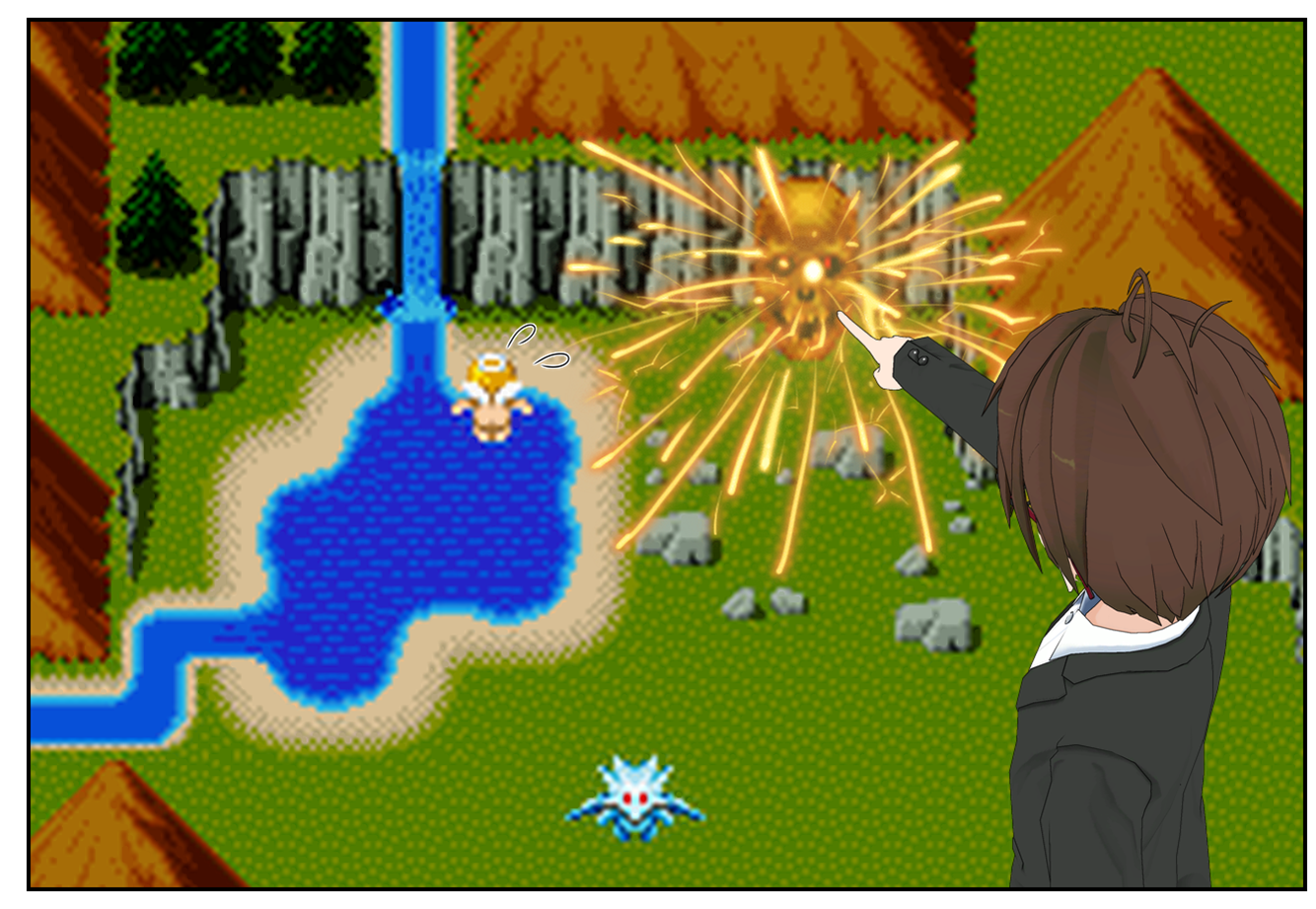
Oh yes, Miracles; these are a rather integral part of the building phase, and obviously the most fun, too. Beginning with a lightning bolt that burns down most things on a single tile (including houses) and working up to an earthquake that knocks down all low-level structures in a region, your Miracles are used to both direct development of the towns and clear obstacles out of the way. You have to force yourself to feel a certain amount of detachment when doing this, since as the tech level of each region increases and it becomes able to support houses that hold more occupants, it becomes necessary to demolish low-tech houses to make way for denser developments. And, being God, you don't use a bulldozer; you use natural disasters, which is far more fun. It's hard not to feel a little pang of guilt when you watch the little counter of "total population" in the upper-right corner of the screen plummet after you unleash an earthquake, though.
ActRaiser is a really interesting game. Both elements are solid, though neither of them are especially complicated. This is probably for the best; it keeps things reasonably accessible for those who tend to gravitate more towards one of the two styles of gameplay than another, though the difficulty of the action phases in particular is a little on the high side if you're not accustomed to how unforgiving old-school games are.
Ultimately it's a satisfying experience to descend to Earth and smite Evil before watching your little minions gradually spread out to cover the entire continent. You really do get the feeling that your people are relying on your divine powers, too; they pray to you every so often and ask you to help make things happen, and they'll reward you with offerings if you fulfil their requests. Many offerings can then be used in other regions to spread various innovations or culture, making the whole world work a bit better; for example, as soon as the second region discovers that wheat is a more productive crop than corn, you can then export wheat from this region to everywhere else so they can all take advantage of this improved efficiency. Likewise, when your followers reach a man lost in the desert a little too late, a distraught artist discovers the secrets of music, which you can then take to another region and use it to lift their spirits after they've been feeling a bit bleak. In this way, the world of ActRaiser feels very much alive, even if you're not dealing directly with named characters or a rigid, ongoing plot.
I like it a lot, in other words, and it makes me excited to check out Quintet's other work. You can count on a full report when I get to them.