#oneaday Day 812: Perspective (And Retro Filters), People, Please

20120410-004221.jpg

It was announced today that Facebook has acquired the popular mobile photo sharing and hipster filtering app Instagram, which has been available for some time on iOS and recently launched for Android phones. The deal was sealed for somewhere in the region of $1 billion in cash and Facebook stock, which is an excessively large amount of money by anyone's standards.

I shan't go into the ins and outs of the business side of things here (check my colleague's posts over on Inside Facebook for more details as well as a bit about what FB and Instagram have been up to together) but what I did want to talk about a little was the public reaction to the news.

In short, the reaction has not been overly positive, at least among the people I follow on FB and Twitter and their friends. I have seen numerous comments today that are simply along the lines of "oh, fuck" without any real explanation — basing their negative reaction simply on the widespread assumption that Facebook Is Evil.

As it happens, some of these people may be right to be a little concerned for the future of Instagram. Facebook has gobbled up several other social services over the course of the last few years, and the result has often been that said services disappeared without a trace. Location-sharing Foursquare rival Gowalla, for example, shut down its service a short while ago as its founders and key team members were reassigned to work on Facebook's own location service. Meanwhile, group messaging service Beluga was also swallowed up around this time last year, and eventually disappeared off the face of the Earth, only to be replaced by the Facebook Messenger mobile app.

Mark Zuckerberg has taken great pains to attempt to assuage the fears surrounding Instagram, however, noting that a key part of the service is its connectivity with non-Facebook networks such as Twitter, Tumblr, Foursquare, Flickr and Posterous. If Facebook is truly planning on keeping Instagram as its own independent entity to begin with, it wouldn't make sense to remove the facility to post to these other networks. What is probably more likely to happen is that Instagram's popular photo-filtering features will make their way into the official Facebook apps, making it even easier for people to take faux-retro pictures at every opportunity.

Perhaps Facebook will dissolve Instagram eventually, and that will be a bit of a pain for those who have Instagram but not Facebook accounts — but it won't be the end of the world as some people seem to be suggesting. There are plenty of other "hipster photo filter" apps available — Streamzoo and Lightbox appear to be two popular suggestions — and, in my purely anecdotal experience, the apparent majority of people who use Instagram use at least one other social service alongside it anyway, even if it's not Facebook, meaning they can simply direct followers to their Twitter/Tumblr/whatevr if and when they start using another service.

So Instagram being taken over by Facebook isn't cause for sadness, anger or irritation. It was a completely free service, after all, meaning in practice it had no real obligations to remain the way it was forever. Instead, we should be celebrating the fact that a small team succeeded in living the dream — to create something simple, fun and popular, and subsequently to make an absolute fucking butt-ton of money out of it. It's a success story of the modern age, made all the more notable when you compare it to the $35 million Yahoo! paid for Flickr back in 2007.

So if Facebook taking over Instagram bothers you, simply use something else — there's plenty of alternatives, as outlined above. In the meantime, the two companies can work on better integration of Instagram's popular features into what is, like it or not, the world's biggest social network. If you had paid money to use Instagram then you may well have a slightly stronger case for being pissed off; as it is, what we have here is a small company who offered its services to the public for free taking a once-in-a-lifetime business opportunity — and, more to the point, no real evidence that Facebook's involvement will in any way compromise what the service is now.

As with so many things on the Internet, perhaps it's best to wait and see what happens before getting irrationally angry or sad about this. Otherwise all that jerking's going to put your knee right out of joint. So to speak.

#oneaday Day 811: Some Handy Tips for Those of You who Wisely Picked Up Xenoblade Chronicles This Weekend

20120409-010604.jpg

Bought a copy of Xenoblade Chronicles? Firstly, well done. Secondly, it's rather good, isn't it? Thirdly, you've probably noticed that it's a massive, sprawling, deep game with lots of things to think about.

Being a grizzled old veteran who has played the game to death already, I thought I'd share a few tips to help you along the way. I'll try and remain spoiler-free in the process, and I won't be giving plot walkthroughs or anything like that — just general tips. Bulleted tips, even. Here we go.

(Note: If you're not playing Xenoblade Chronicles, this will all mean nothing to you. I'll be back in the normal world tomorrow.)

  • Pick a good, complementary party, but don't be afraid to experiment. You can make most combos work — and in fact to max out Party Affinity you'll probably have to — but a safe option is to have a tank (Reyn or Riki), damage dealer (Shulk, Dunban or Melia) and healer (Sharla or, to a lesser extent, Melia). Note that you don't need to have Shulk in the party, but it's easier to deal with visions if he is.
  • Don't forget to level up your Arts. You gain AP with every successful combat and these can be used to power up each character's Arts — the special abilities that they are able to use in combat. Don't forget to drop into the menu regularly to spend these AP — which each character has their own individual bank of — on improving their abilities, because the game sure won't remind you. On that subject…
  • Pick Arts that complement each other. Depending on your party lineup, ensure that you have Arts picked that work well together. Don't worry about changing around Shulk's Arts, since he has a fixed arsenal. But depending on who else is there and what they're capable of, pick ones that work well together. A good combo is to ensure that between all three members, you have the ability to Break, Topple and Daze an opponent. By doing this to an enemy that isn't immune, you buy yourself a good few seconds of uninterrupted beatdown time, which is very helpful on baddies with high HP. Note that most — but not all — bosses and Unique Monsters tend to be immune to Break and Topple.
  • In Chain Attacks, colour is everything. The other thing you should consider when preparing your party's Arts is to make sure that you have appropriate colours covered to unleash a decent Chain. The colours typically correspond to what the Art does — red ones tend to deal direct damage, pink ones tend to inflict Break, green ones tend to Topple and blue ones tend to be restorative or supportive — so a good thing to do is to ensure your whole party has at least one red Art equipped in order to do a damaging Chain Attack. When you start the Chain, choose a red Art to kick off, then when it switches to the next character, choose one of their red Arts and so on. Bear in mind that according to both random chance and Party Affinity, you may have the opportunity to continue the chain after everyone has had one go, so it's worth having more than one of the same colour if you can spare the slots.
  • Skills aren't as complicated as they look. The tutorial for the Skill system makes it sound bewildering, but think of Skills as passive bonuses and you'll be fine. Picking a character trait to focus on provides a bonus to a particular stat, then all SP earned (also after combat) will be applied to that particular skill branch. When sufficient SP have been earned, that bonus or passive ability starts to take effect automatically. Note that each character starts with three Skill paths, but has the opportunity to unlock up to two more through quests.
  • Skill Links let characters use each others' Skills. This is the complicated bit. You've probably seen that killing bosses nets you Affinity Coins. These are used to let characters "borrow" each others' Skills, thereby enabling them to get passive abilities they wouldn't normally have access to. For example, if Reyn has learned the skill to equip heavy armour, another character who is normally limited to light armour can Skill Link with Reyn in order to also be able to equip heavy armour. The number of skills characters can borrow from each other is determined by the number of Affinity Coins you have and the Affinity between the characters attempting the Link. Speaking of which…
  • Build up Party Affinity as much as you can. Your characters fight better alongside each other if they actually like each other. They also say different things in battle or when they jump in to conversations. There are lots of ways to improve this. Firstly, put the characters you're trying to develop the relationship between in your active party. Make the character you want to see the most gains the leader, since when party members jump into conversations, it improves Affinity with this person. Hit as many Burst Affinity button prompts in battle as you can. Encourage characters who are suffering from low Tension in battle (they'll have a purple cloud behind their face in the interface — run up to them and press "b" to whisper some sweet nothings at them). Don't forget to go and do Heart to Hearts when you have sufficient Affinity between two characters — these provide massive Affinity boosts even if you balls them up. And don't forget that you can gift Collectibles to characters via the Inventory menu — the game forgets to mention how to do this. Select an item, choose a character to gift it to and you'll see the affinity gain (or loss) it generates. For hints on what might be good items to give different characters, check the Achievements menu or think about the characters' personalities.
  • When hunting, use the reload trick. Saving your game then immediately loading it causes the monsters in a zone to refresh, so if you've run out of mobs you need to bash over the head for a quest, save and reload to respawn them. If you're hunting a Unique Monster and there's no sign of it in the place where it's supposed to be, do the same thing for a chance of respawning it.
  • If looking for specific weather, use the clock. Advance time from day to night (or vice versa) until you get the weather conditions you're after. Note that "thunderstorm" is a different weather condition to "raining".
  • Talk to everyone with a name. Speaking to a named NPC adds them to your Affinity Chart and sometimes improves your Area Affinity. When your Area Affinity levels up (it doesn't tell you when this happens, so check the Affinity Chart regularly), new quests become available, and named NPCs also get new items to trade with you. It's possible for every single person on the entire Affinity Chart to be joined to at least one other person by the end of the game, so consider that a challenge if you're a completionist.
  • Collect collect collect! Collect every sparkly blue blob you see. Not only will it help you fill the Collectopaedia, there's usually a questgiver somewhere nearby who will pay you good money for them. Or you can always gift them to characters.
  • Trading is usually a quicker way to fill the Collectopaedia. If you're struggling to find a specific collectible item in the field — and some are considerably rarer than others — then try trading with named NPCs instead of talking to them. When trading, offer them goodies that are considerably higher in value than the thing you're looking to grab — double is usually a safe bet — and they'll often throw in an extra free gift, too. Note that NPCs' inventories expand as Area Affinity improves. Their tradable items always come from the zone in which they are found.
  • Don't forget about Gems! Equipping gems in slotted items can make the difference between triumphant victory and crushing defeat. Note that bonuses to stats have a cap — if the bonus turns green in the menu, equipping further gems won't have any effect. Pick gems that help strengthen a character's particular specialisms rather than compensate for weaknesses — e.g. apply Muscle Up gems to Reyn to increase his physical defense to make him a better tank, add Strength Up gems to Shulk to make him deal more damage. Remember that Unique items (the ones with "U" on their icon instead of "S") have preset gems that cannot be removed.
  • Explore everywhere. Discovering new Locations, Landmarks and Secret Areas is a good non-combat way to gain experience points, plus it has the positive side-effect of filling in your map and providing you with places to fast-travel to. You might also be surprised where questgivers are hiding.
  • Do every quest you can. It may be time-consuming, but questing builds up Area Affinity and provides you with some good rewards that often negate the need to go equipment shopping. The stock "Monster", "Collection", "Search", "Material" and "Challenge" quests you get in every zone also provide a good way to get to know an area. Be sure to talk to the questgiver for these questlines several times as you can normally pick them all up at once — and you don't have to return to them to complete them. Never sell quest items — they'll be marked in the menu — or items you've seen in visions. You can get them back, but it'll be a waste of time, particularly if they end up being rare items. For quests with multiple outcomes, there are no "bad" consequences, just differing rewards.
  • Backtrack! When the story advances, that's usually a good cue to wander around the areas you've already visited and see if any new quests have popped up — some appear based on story progress rather than Area Affinity. Fortunately, the skip travel feature makes this a painless process. If you're not sure who to talk to, try looking for people on the Affinity Chart who don't have any links yet. There are some quests you can miss — these are marked with a stopwatch in the quest log. There's generally a pretty obvious mini "point of no return" before these expire, however, so be sure you've cleaned up your quest log before you answer "yes" to any important-sounding questions.
  • Don't rush. Xenoblade Chronicles is a big-ass game and there's a lot to see and do. Playing as a moderate completionist, it took me 101 hours to beat on my first playthrough, and I could have easily spent a lot longer. While it may be tempting to rush forward into the next plot beat, bear in mind that the quests, exploration and incidental combat is all there to provide a painless means to ensure you're strong enough to tackle the challenges the story quests provide you with. You'll be around the level 80 mark by the time you're on the home straight if you're doing it right — you'll hit a wall and be forced to grind (or backtrack and do all the stuff you missed!) for a little while if you haven't. That said…
  • Don't feel you have to get everything. Beat the game and you can do a New Game+ with all your levels, equipment and Party Affinity intact, but quests, Area Affinity and everything else reset to normal. Now you can rampage through the world with impunity and concentrate on picking up as many quests and entries on the Affinity Chart as you can rather than running away from red monsters.

Above all, enjoy. This is one of the best RPGs of all time, and it's wonderful to see so many people on my Twitter feed are playing and loving this at the moment. Stick it out to the end — it's a long road, but it's very much worth it.

#oneaday Day 810: Fancy Dress

20120408-014254.jpg

I love dressing up. Perhaps it's just part of my own inherent immaturity which I continue to cling desperately to as my 31st birthday approaches, but I love putting on a stupid costume that will get some laughs and playing a role. Oddly enough, it often actually makes me feel more confident than I do usually, perhaps because I'm kind of stepping out of my own skin for a little while and pretending to be someone else. Or perhaps it's because I associate it with acting, something I enjoy a great deal but haven't had the opportunity to do since university. (God, that was a depressingly long time ago now. Fuck.)

[Editor's note: It took some persuading to get Pete out of his sulk after coming to that realisation.]

My apologies. I was just… OH GOD

[Editor's note: And again.]

I'm fine. I'm fine.

ANYWAY.

Fancy dress. It's fun. And, on past occasions where it's been part of the social engagement I was attending, it is usually associated with a thoroughly silly, funny night out. I don't remember doing it much as a kid, but I certainly remember doing it a hell of a lot at university. The local charity shops tended to do a roaring trade around "social season" at the student union and local bars.

The earliest one I remember was a 70s night at our university hall of residence bar. Our flat was pretty good at socialising with one another, but we'd been consistently frustrated with the fact that none of the rest of the building seemed interested in going out or getting to know each other. (We discovered this within the first couple of weeks living there, when we attempted to organise a pub crawl and ended up being the only attendees.) We figured that the fun and frolics of a dressing-up opportunity would encourage a few people to make it out and make an effort.

We were, sadly, a bit wrong. People came out, all right, but when we got to the bar, we were pretty much the only people there who were in costume. I don't regret a thing, because it was around this point I discovered that moustaches are fun despite the fact that I was, at the time, incapable of growing my own. (If you have seen my face recently, you will doubt there was ever a time when I was incapable of growing facial hair, but it is, in fact, true; the most I could summon up at the age of 18 was a small, lop-sided patch on my chin.) As such, I found myself wearing an awesome stick-on moustache combined with a velvet jacket, frilled shirt and, uh, a pair of jeans. (The charity shops didn't have any suitable flares or, to digress for a moment, "bell-end trousers" as they were memorably referred to on Just A Minute the other day.)

Said moustache found its way all the way around our social group after we'd had a few of the hall bar's notorious cocktails (Juicy Lucy: 1 shot vodka, 1 shot blue curaçao, 2 shots Taboo, top up the rest of a pint glass with equal parts orange juice and lemonade, looks like water with Fairy Liquid in it and turns your poo green if you have too many; Passion Wagon: 1 bottle Reef, 1 shot Passoa, possibly the laziest cocktail of all time) and eventually alighted delicately back on my face rotated a full 180 degrees from its intended position, making me look more like a shitfaced Hercule Poirot than a 70s porn star. I don't remember much of what happened after that.

Or there was the Halloween party where I dressed up in the Scream costume. It was about the time Scary Movie had hit the cinema, so there was a lot of "WAAAZAAAAAAPPP"-ing from behind the mask. Coincidentally, wearing a full black robe and covering my face entirely, I felt incredibly confident. Perhaps I should become a ninja. Or some sort of cultist. Or a Sith.

Or the "Gangster Night" where I decided that the thing to do would be to dress up like 70s Guy again, complete with afro wig, stick-on moustache and hideous shirt. The band we had at university to pass our "Ensemble 1" unit — The Coconut Scratch Orchestra — was also performing, so I also had to negotiate a saxophone around my furry top lip and excessive amount of head hair.

I think one of my favourite dress-up occasions, however, was the time a group of ex-university musicians were playing in the band for a local pantomime and we made an executive decision to do the second half of one performance in full costume. I dressed up as a fairy. I looked beautiful, I'll have you know. And in fact, my costume was so good that when I took it off, it was mistaken for an actual costume from the show and pinched while I was socialising. When I returned to retrieve it, it was long gone, never to be seen again. I was very disappointed. I spent quite a lot of money on it and had rather enjoyed having long blonde hair for a little while. My only physical memento of the occasion was a saxophone reed forever stained with slutty red lipstick, though there are also photographs of my magical magnificence located somewhere on the Internet. You'll have to track those down yourself, though.

I've never crossed the line from "fancy dress" into "cosplay", however. I guess technically the Scream outfit was sort of cosplay, but not really. No, I'm talking about being such a fan of a particular character that I really, really want to dress up as them.

Part of the reason for this is that many of my favourite characters are simply incompatible with any or all of the following: my body shape, my age or my genitals. The facial hair is also an issue. Much as I would love to put on a frilly cravat and do a Miles Edgeworth, shaving my beard off after it having such a long-term residence on my face would just be weird. Which also puts any sort of cross-dressing scenario out of the window, too, which most people will likely be delighted to hear. (That said, my fairy costume saw me sporting a beard, so…) With the type of guy I am, the best possible outcome would probably be from some sort of "big dude in armour" type of arrangement, though I'm not sure there are that many big dudes in armour that I'm particularly fond of. Reyn from Xenoblade, perhaps. Though then we're back to the beard problem again. What a bunch of jokers.

I'm also never quite sure if there's a stigma attached to cosplaying at all. It's certainly a sign that you're taking your fandom of a particular thing over a very well-marked line, but does it make you into a hardcore "nerd"? It certainly broadcasts loud and clear that you're interested in something, and could well be a good conversation starter at conventions and the like. (Obviously I'm not suggesting walking down the street dressed like Cloud Strife or anything) For women, there's the "perving men" angle to consider, too, but at the same time you might argue that by dressing up in a distinctive costume you want people to notice you (just not probably quite like "that").

Anyway. I'm rambling, largely because it's 1:25 and my concentration is lapsing somewhat. So I'll leave that there.

Do me a favour, though; next party you throw, make it a fancy dress one. (And invite me, obviously.) I haven't been to one for ages.

#oneaday Day 809: PAX Pact

20120407-023755.jpg

Disclaimer: I'm aware that I wrote almost exactly the same post as you're about to read at this time last year, and for that I make absolutely no apologies.

It's PAX East time! Yay! I'm not there! Boooo.

I've not been to many conventions or big shows like that over the years, so I have very fond memories of those I have been able to attend. My decision to attend PAX East in 2010 was very much a spur of the moment thing — I'd decided I wanted to leave my primary school teaching job because I'd given it a chance and determined it wasn't for me, I was trying as hard as I could to pursue a career in the Writing Words About Games industry, and I was feeling a bit miserable and lonely. So, with a little financial help, I flew across the pond to Boston and went to my first big show in America.

It was an exciting time for a number of reasons. I'd just started working for Kombo.com which, while it didn't pay particularly well, provided me with a position where I could legitimately say I was a professional member of the games press. I knew that a large number of my buddies from communities such as Bitmob and The Squadron of Shame would be in attendance, so I'd have the opportunity to meet some people face to face. And I always love the opportunity to visit the States. I'd never been to Boston before, and while I was under no illusions that I'd be seeing much of the city while I was there, I was looking forward to being Somewhere New.

It was also terrifying. As a sufferer of social anixety at the best of times, the prospect of meeting people I'd only ever talked to on the Internet in the past was a scary one. What if we didn't get on? What if it was a massive disaster and it destroyed the carefully-cultivated relationships we'd built up with one another? What if I had nothing to say? What if I got lost and it was actually because they wanted to lose me? All these thoughts whirled around my head as I was on the plane, but I was very happy to discover that PAX was, in fact, a happy, inclusive and wonderful place for geeks of all descriptions to call home — whether they were someone who just liked video games or was also into collectible card games, role-playing games, board games, cosplay, the history of technology… anything like that.

That word — "home" — is an important one. Because it felt good to be there. It felt like a world which I wanted to belong to, surrounded by people that I wanted to be with. It was a world that accepted and embraced each other's differences and brought people from many different walks of life together in the name of common interests. Perhaps most importantly, it made friendships real. It's all very well chatting to people online on a regular basis, but once you've spent time with those people in person — seen them, heard them, hugged them, tickled their beards in a homoerotic manner where applicable — your friendship is on a different level. I haven't seen some of those people I met at PAX East 2010 in person since that weekend two years ago, but in many ways I feel closer, more connected to them than many of my — for want of a better word — "real" friends. Perhaps it's because they're also "Internet friends" that I speak to most days via Twitter, Facebook and G+.

Whatever the reason, knowing that lots of people I know are at PAX East right now and undoubtedly having a great time (and/or queueing for hours) makes me a bit sad — not that they're there, obviously, but that I'm not there with them.

I propose a pact, then, faraway friends: PAX East 2013. Be there. You have a year to prepare. Get cracking.

#oneaday Day 808: Xenoblade Chronicles is Out Tomorrow, and Here's Why You Should Play It

20120406-005656.jpg

As a European, I was lucky enough to be able to play the Nintendo-published, MonolithSoft-developed Wii role-playing game Xenoblade Chronicles last year. It ended up being my favourite game of 2011, and many North American gamer friends were suitably jealous that I had been able to play it through while they hadn't. I didn't feel too guilty, though, because North America has its own branch of Atlus and doesn't have to depend on other publishers to bring titles like the Persona series over.

But I digress. Xenoblade Chronicles is out tomorrow — April 6 — in North America, and here is why you should play it if you're an American. Or even if you're not.

The Japanese role-playing game genre is often accused of stagnation and a lack of innovation. This is, in fact, not particularly true — even the much-maligned Final Fantasy XIII was trying things which other role-playing titles hadn't attempted before. Okay, they weren't always successful, but it was at least attempting to innovate.

The real issue is actually that for whatever reason, Japanese role-playing games (and, to a certain extent, Japanese-developed games in general) have lost the resonance they once had with the core gamer audience in the West. Players are quick to judge them as clichéd and derivative before moving on to whichever game starring men in armour with guns is the flavour of the week. Specific attempts by Japanese developers to create games that appeal to Westerners end up having limited niche appeal despite their quality (see: Platinum Games' Vanquish, which isn't an RPG but demonstrates the point effectively) or end up being laughable attempts to pander to the Japanese image of what a Westerner supposedly wants (see: The Last Remnant).

Xenoblade Chronicles is a remarkable game because it nails that balance between Western and Japanese sensibilities, making a game that combines the positive aspects of WRPGs (freedom, exploration, a degree of sort-of-non-linearity) with those of JRPGs (stronger storytelling, more memorable, well-defined cast members, a firm sense of being unafraid to continually up the ante). The result is quite brilliant, and a significant step forward for the genre in one possible direction it way wish to take in the future.

The game casts players in the role of Shulk. Initially, he seems like every other teenaged JRPG hero, but a number of aspects make him stand out. He doesn't whine. He's not moody or angsty. He's just a guy, but he has a personality. He has friends, too, who form your early party in the game, and these, too, don't fall into the trap of clichéd character archetypes. This pattern continues throughout the course of the whole game. Even the "small furry thing" character introduced later in the story isn't typically irritating — he's quirky and silly, sure, but his character is defined well, and he proves to be more than just a means through which to provide silly slapstick gags.

The diverse, likeable cast you find yourself travelling with over the course of Xenoblade Chronicles' lengthy adventure provides several highlights to the game experience. Firstly, and most simply, they're a good ensemble cast who help drive the story forward. That's not their only function, however. As you might expect from an RPG, they each have their own role to play (natch) in combat, and finding the best combinations of three characters to take into battle is a key part of the experience. This affects not only your battle effectiveness, but also one of many stats that the game tracks in the background — Affinity.

Affinity is, quite simply, how much characters like each other. Characters with high Affinity with one another fight better alongside each other, but as their relationship develops, they also have the opportunity to participate in numerous "Heart to Heart" events that are scattered around Xenoblade Chronicles' vast world. These short sequences provide the opportunity for two party members — not necessarily including protagonist Shulk — to spend a little alone time with one another and get to know each other a little better. These typically involve multiple-choice conversations, providing the "correct" answers to which will give a big boost to the pair's Affinity with one another. (Giving "incorrect" answers often provides very amusing exchanges and still gives a smaller Affinity boost, however, so you shouldn't feel like you have to reach for the walkthroughs immediately.)

Affinity doesn't just affect combat and unlock Heart to Hearts, however; there's a host of little touches in the game that it affects, most notably during and after combat. Rather than simply yelling individual stock "battle victory" phrases, characters will often have short conversations with one another. This banter between characters is a real highlight of the experience, and while you will have heard everything they have to say a good few times by the end of the game, they remain entertaining and endearing.

Speaking of combat, Xenoblade Chronicles' battle system is a refreshing change from the turn-based systems that Japanese role-playing titles usually adopt. You control a single character out of the three in your active party, and are able to freely move around during combat. You and your party lock on to a single enemy at a time and automatically attack it, though many battles involve multiple assailants. In order to gain the upper hand in battle, it becomes necessary to make use of the unique skills the character under your control has.

Most characters have more skills than it's possible to hold in the "quickbar" at the bottom of the screen, so it becomes possible to customize the way they play to your own personal style. Some skills manage aggro, some attack areas, some provide more damage or inflict status effects when unleashed from beside or behind an enemy. Some skills are dependent on other characters doing things like knocking the enemy down or stunning them, and the AI which controls the other two party members does an absolutely astounding job of keeping up with what you're doing and understanding the strategy you're going for. It's very rare that you will be cursing the game for causing you to fail — more often than not it's a result of you either adopting a poor strategy, or simply needing to go and do something else for a while until you're a little stronger. This doesn't mean you have to resort to grinding, either — inevitably there will be some quests you have missed that you can go back and do, and returning to earlier-visited locations often throws up even more things to do.

Another great thing about the combat is that you can elect to control any of the game's cast in battle, not just Shulk. Each character plays in a significantly different manner to all of the others, so if you find yourself getting bored of the same old skills over and over, simply switch to another character for a brand new experience. Fed up of tanking? Spend some time with Sharla, a ranged character with healing abilities. Or Melia, a magic-user who can summon elementals that either provide ongoing buffs or can be "unleashed" to deal direct damage. Or the aforementioned small furry creature, whose skill names are genuinely hilarious.

Perhaps the strangest but coolest innovation in the combat, however, is the fact that you're occasionally presented with "visions" of the immediate future, usually when a character is either about to die or be afflicted with a debilitating status effect. A countdown timer starts, and you're given the opportunity to either do something to take attention off the enemy's target or warn another party member. If you do the latter, you're able to pick one of the warned character's skills to unleash — usually either a healing or aggro-management skill — and hope for the best. If you do the former, you have until the countdown timer depletes to do something very special, or your party member will suffer their grisly fate. It's a neat system that isn't overused.

Outside of combat, there's plenty to do, too. Exploring each of the game's massive zones rewards you with experience points and uncovers part of the map as you discover each sub-area. There are collectible items scattered around each area at random, with rewards on offer for collecting whole sets. Those who find item-hunting frustrating, however, may instead complete these quests by trading with other non-player characters. There are rare monsters to take down, loot to find, secret locations to discover. Xenoblade Chronicles' world is more than just a pretty backdrop for combat — it's a rich, beautifully-rendered environment in which to spend time, and it looks gorgeous. This may be a Wii title, and it may have been even more lovely to see it in HD, but it doesn't detract from the fact that the hugely-varied vistas you find yourself running and fighting over throughout the course of the game look simply magnificent. There's a waterfall you'll come across partway through the game which is genuinely breathtaking to look at, for example — you'll know it when you see it.

If the game's combat, quests and exploration aren't enough for you, there's also a deep Achievement system to delve into. Since these Achievements aren't online-connected, they're simply there as challenges for you to undertake, and all provide you with experience point rewards. In essence, they're mini-quests (although some will take you the majority of the game to complete) and rarely feel as "gratuitous" as some examples seen on Xbox Live and PSN. Rather, they provide yet another means of getting an enormous amount of entertainment out of an already vast, sprawling title.

This isn't even getting started on the deep crafting system, which allows characters to team up to create enhancements for their weapons and armour, with the results of their collaborative efforts dependent on their Affinity and compatibility with one another. Or the fact that the game allows you to change the time and fast-travel at will, eliminating a lot of the inconvenience and backtracking endemic to the genre. Or the colony-building minigame. Or the fact the voice acting is all British rather than American, giving the game a unique aural aesthetic in a genre typically dominated by whiny teenagers and squeaky-voiced females. Or the fact that when you're all done, you can New Game+ it and do the whole thing again with your levels, Affinity and a suitably broad spread of awesome equipment intact — something I will be doing when North America gets its hands on the game tomorrow.

Xenoblade Chronicles is, in short, a magnificent evolution of the Japanese role-playing game genre. While it's easy to dismiss it as "an offline MMO" or "a Final Fantasy XII wannabe", the reality is something quite different. This is truly a game that is greater than the sum of its already-fantastic parts, and one which will have you bellowing "Now it's Reyn time!" at your friends for months to come.

(Grab yourself a copy soon, though, as this is the kind of game that will get pretty tough to find pretty quick.)

#oneaday Day 807: Bully for You

20120405-010702.jpg

Courage is fire, and bullying is smoke.

— Benjamin Disraeli

Bullying is an odious practice, awful to witness and even worse to be the target of. Yesterday — and I am going to keep details deliberately vague here — I witnessed a good friend of mine get pretty ruthlessly picked on by people who should know better. Their words were continually twisted and very selectively shared with a wider audience in order to gain support for the bullies and tear down my friend piece by piece until the point they were trying to make — which I shan't go into here but I actually agreed with — was all but lost. My friend was left ridiculed and humiliated having been called a whole storm of names from people he had, in some cases, never had contact with before. Meanwhile, the bullies were left looking like white knights who had saved the day.

It made me very angry.

Bullying is about power, insecurity and, very often, a desire for approval. This incident — which took place on Twitter — was an apt example of all of the above. The bullies had a great reach thanks to their profession and their high follower counts, giving them a large amount of power by default. The fact that they were only selectively sharing the things my friend said with their followers was a sign of insecurity and a lack of faith in their own argument. And their desire for approval speaks for itself, really — otherwise why would they have engaged in such a toxic, public argument? It was deeply unpleasant to see and, as I say, the perpetrators in question should really know better than to behave like that.

I've been the victim of bullying on a number of occasions through my life, so I can relate to the feelings my friend has undoubtedly been suffering as a consequence of this incident. I suffered physical violence and ostracisation by my peers at primary school and, to a slightly lesser extent, at secondary school. I've been a victim of what I call "passive bullying" at one of the schools I worked at, where I was regularly left to sit by myself in the staffroom and was never invited into any friendship groups or cliques — a situation exacerbated by my own social anxiety, which was made worse by this going on.

And I've suffered outright workplace bullying, which is what I'd like to take a moment (edit: several thousand words, I apologise in advance) to talk about here, as it has relevance to the incident I described above — adults who should know better, in other words. Disclaimer: I shan't be naming specific names here, but those who know me well will likely already be familiar with the particular incidents that I'm about to describe. Those who aren't familiar with the specific instances I'm going to refer to, I hope they open your eyes a little to the fact that bullying among adults is most definitely alive and well, and it should really be unacceptable in a civilised society.

This is not an easy thing to write about, and will likely go on for some time, so I thank you in advance for indulging me and reading this.

It started with a review meeting. These were a regular occurrence at the place of employment in question, so there was nothing new there. Said employer had fairly strict policies in place to help control its public image — namely, employees were not permitted to engage in discussions relating to their job and the things they dealt with in the course of their daily work, and were not permitted to speak to the press. Not that that was ever an issue to my recollection. Given that all this was around the time that everybody and his dog was getting around to joining Twitter, it was a hot topic. I knew this, so I always took great care to never refer to my employer by name online and never to discuss the specifics of what I do.

So it was with some surprise that in my review meeting it was "suggested" to me that my target for the next review a month later should be to "stop talking about work on Twitter". At the time, I didn't think much on this until a little later, when I realised that such an "admission" — which had come from my reviewing manager, not from me — would look bad in the cold, hard light of the Policy and Procedure manual. As such, I took the opportunity to take the managers aside and politely request that my "target" be changed to something more appropriate.

My request was bluntly declined, and one of the managers even offered to go back through my tweets and highlight the ones he found particularly objectionable. I knew the ones they would be referring to — but as I said previously, I had always taken the greatest care to never share my place of employment in the public domain, and never to mention the specifics of my job. Their justification was that "people who knew me would know what I was referring to". I could see that fighting this would be an uphill struggle that I didn't need to have at this time, so I reluctantly acquiesced and the "target" stood firm on my file. I never mentioned anything even vaguely work-related from that point on.

I worked in a small department at the employer's place of business. We were understaffed and overworked, and this situation wasn't helped by the hasty dismissal of two members of our team who had been with us since "the beginning", as it were. One was dismissed for a Facebook prank gone awry, the other was dismissed following the complaint of a client. Both were disproportionately harsh penalties for the supposed misdemeanours in question — in the latter case, the client who raised the complaint was notorious among the non-management members of staff as someone who was difficult to deal with and rude as well as being someone who completely flouted the terms and conditions of her working relationship with us. The situation could also have been completely averted with managerial involvement — something which my colleague immediately sought when things got heated, but was unable to secure due to the fact that they were all locked in their office (busily dismissing another colleague, as it happened).

I sat in on the disciplinary proceedings and subsequent appeal for my colleague and friend. It was horrible to see. His arguments were fair and valid, but little heed was paid. As his nominated "second", I was able to ask questions which were to be recorded on the official notes of the proceedings, so I took great pains to think of some questions which would help clarify the situation in a way that would make my colleague look — as he was — innocent. Three questions into my list I was effectively told to shut up and stop slowing things down. It was abundantly clear at this point that no real consideration was being given to my friend's arguments and the issues I was hoping to raise — the decision had already been made before we walked into that room, and the same happened in the appeal process. It was utterly demoralising to witness.

So, two members of our team down, we struggled to keep up with the increasing demand for our services from clients. Our efforts were not helped by the introduction of a new initiative which had come down from Head Office which made life considerably more inconvenient for both us and our clients. As a team, we called an urgent meeting to discuss this initiative and how it wasn't working, and were ignored — despite the fact that written complaints from clients had come in echoing our own sentiments along with frustration at the fact that the two dismissed team members' particular, specific skill sets were no longer available.

One manager in particular had started watching us — and particularly me, for some reason — like a hawk. When we weren't dealing directly with clients, we were supposed to have time to train and improve our own skills so as to be able to provide a better service. It was a system that had worked well in the past and had allowed all of us to learn a lot both independently and from each other. By this point, though, any training session we held proceeded with the manager in question breathing down our necks, regularly asking what we were doing in an accusatory manner and frequently sending passive-aggressive emails about all the things we were supposedly doing wrong.

By this point, I had come to the conclusion that I did not trust the managers, particularly after witnessing the way they had treated my former colleagues. As such, to avoid hassle and confrontation, I made a point to stay out of their way, keep my head down and just get on with my job. My clients appreciated what I did for them (I'm aware this makes me sound like a prostitute but I'm being deliberately vague in all this!) and frequently sent in glowing letters of praise, and my colleagues appreciated it when I helped them using my own specialist knowledge. In short, I was doing just fine by myself.

One day, I was pulled aside by another of the managers and asked why I wasn't talking to them any more. I was accused of blanking them on the way into work — patent nonsense, I might add — and threatened with "behavioural conduct" proceedings if I didn't change my ways. I wasn't clear at all on what I had supposedly done wrong in their eyes, however — since I had had no need to speak to them except when seeking permission to perform specific tasks, I simply hadn't. A "keep out of my way, I'll keep out of yours" situation, if you will. It worked fine for me, but I wasn't specifically blanking them or anything, nor was I "resisting" any suggestions or feedback on the rare occasions when it was provided.

The latter incident, however, convinced me that it was probably time to move on. To prevent awkwardness, I spoke to one of the managers — not the one who had raised the "behavioural conduct" issues, but the one who had been watching over our shoulders while we trained, as it happens — and explained that I wasn't happy, I wasn't satisfied with my career progression (I couldn't see a clear onward path from my position at that point) and that I was considering moving on. I explained that I wanted to be open and honest about the whole thing, and that I did not want it to be the cause of any ill will or bad blood.

It was at around this point that the opportunity arose for me to do some "work experience" of sorts with a friend in the local area. Said work experience would provide me with the opportunity to move sideways into a different career that I was qualified for, and it would be a good opportunity to get some references for job hunting, since I already knew that my then-current employer's references were nothing more than stock letters that confirmed start and end dates. I explained to the manager that this was a possibility, but that I did not yet know the dates for when it would be happening as my friend had to clear it with her employer. I also explained that I would simply book holiday for the time in which I would be undergoing this (unpaid) work experience, as I still had the vast majority of my holiday allowance available.

As it happened, the week for this work experience eventually fell a week after a week-long holiday I had already booked months in advance to go and visit some friends abroad. I followed procedure to the letter, booking the extra week well ahead of time and going to the extra trouble to include a letter explaining the situation — that I understood it would be inconvenient for me to be away for two weeks instead of one, but that I had booked it as early as I could and that the unfortunate timing wasn't really up to me. I even offered to compromise by working some extra shifts in the couple of days I had between the two holiday periods. I got no response at the time, and when I checked in the system just before I left for faraway lands, my second request was marked as "approved".

While I was away, I received an email from the manager in question explaining that they were supposedly still considering my second week of holiday, and that I should go in to discuss it with them upon my return. It had already been approved, remember, so upon getting back home I printed out proof of this approval, took it to my meeting, expected to show it to the manager in question and that be the end of the matter.

It wasn't. Suddenly there was a whole ton of conditions attached to this week of unpaid work experience, the reasons for which I had been completely transparent about. Suddenly I needed a letter from the place I was going to confirming that they were going to offer me a job (I'd never said any such thing was a possibility). Suddenly there were all these hoops to jump through for a week of "holiday" that was, let's not forget, already approved.

I'm afraid to say that I lost it at this point. I was frustrated, tired, upset and angry, so I lost my cool and demanded to know why the manager was seemingly going out of their way to make my life difficult. It was a mistake to get upset — I knew that at the time, and I regret it — but while I was stood there talking about it there felt like no other way to express the frustration that had been building up inside me, the culmination of what had been by this point months of harsh treatment, mistrust, passive-aggressive messages and a complete refusal to listen to the team.

It had the desired effect, at least. The manager was stunned into silence, but unfortunately their next move was to phone up our overall manager who happened to be on holiday at the time. By all accounts, our overall manager was a rather weak, ineffective sort of leader, so I didn't expect him to achieve much. I lost my patience and simply left. Reasonable discourse was obviously out of the window on both our parts. Eventually, I simply left on my work experience week and heard nothing more about it until when I returned, at which point I was summoned into the office and invited to discuss the incident in a "recorded conversation" typed up by one of the other managers. I was totally misrepresented in the course of this meeting and made out to be the aggressor rather than someone simply frustrated by being continually stonewalled, and I was not allowed to leave until I had signed this document which contained numerous inaccuracies that would undoubtedly not look good on my file. Panicking and upset, I signed the document and left, not sure what to do next. I spent the remainder of the day regretting that I had signed the incriminating document, wishing I had torn it up instead.

To cut an already-long story slightly shorter, over the course of the next few weeks, the managers in question were even tougher on me. I found myself accused of various "misdemeanours" when in fact there were legitimate reasons for all of them — lest this sound like "she doth protest too much", let me give you a rather vague example: one client had a question about a particular service, I happened to be in a position to answer a question and demonstrate a solution about said service using my own personal account so I did so. The client left satisfied and happy, but this was ignored in favour of the fact that I supposedly shouldn't have been using said personal account during work.

This feeling of constant surveillance and being pulled up on even the tiniest things was getting to be too much. I was starting to feel the tell-tale signs of stress and depression tugging at my brainstrings, so I knew it was time to get out before I had another nervous breakdown. I tried to bring an official grievance against the management team regarding their treatment of me and the team — specifically regarding the holiday incident — but was unsuccessful. The justification? That I was bitter I had been passed over for a promotion and was thus simply causing a fuss. This was utter nonsense, as I knew the person who did get the promotion (one of my two colleagues who were dismissed, as it happens) was infinitely more qualified for the position than me, and had said so at the time. Thoughts of promotion had not even crossed my mind since I had tried for that position.

That was the last straw. I penned a very lengthy resignation letter and handed it in to our ineffectual wet-lettuce of an overall manager as I left one day. The following day, no staff members saw a single manager outside of the office. At the end of that day, I was summoned to the office and my notice was accepted, but rather than working it — something which I had said I was more than happy to do in my letter as I knew clients appreciated my services, knowledge and manner — I was told to leave and not come back. I was forced to say goodbye to my friends "under guard", as it were, and was specifically directed not to say goodbye to those who were around (not directly engaged with) clients and potential clients. I was escorted from the premises, and it was made very clear that I would not be welcome back. It was the final humiliation in a long line of belittlement, chipping away at self-esteem and insecure exertion of power.

I just hung around the city for a few hours. I remember sitting on a park bench and crying, then going home and crying some more. I was devastated. A job which I had once described as the most positive, supportive environment I had ever worked in had become a toxic, mean and deeply unpleasant place to spend time, and I had been hastily ushered out of the door before I had a chance to say a proper farewell, presumably out of fear that I would sow the seeds of discontent among the staff. They were already there, though; they didn't need any encouragement from me. In fact, a number of colleagues came to me after the fact noting how much they respected me for standing up to the bullying of management, and wishing they had the balls to do the same. It made me feel a bit better, but I was still crushed inside.

I don't normally hold grudges and am a very forgiving sort of person. But I have never forgiven those few people who took an amazing job that I adored and poisoned it beyond all recognition, leaving it a withered husk of its former self. I still remember that last day vividly, and it still upsets me to think about. I can't remember ever feeling so belittled and humiliated, or so frustrated at the fact that so little justice would be done to the people who had made me — and others — feel this way.

If what it takes to get ahead in business is to be a bully who tramples on the self-confidence of others to compensate for their own insecurities, then I'm quite happy toiling as I do in relative obscurity for an employer I like and respect a great deal. I am eternally grateful to the awesome people I have worked with and for ever since the awful times described above.

May you never have to suffer a similar fate.

#oneaday Day 806: Shadow Hearts: Covenant: A Scoreless Review

20120404-003526.jpg

Shadow Hearts: Covenant (aka Shadow Hearts II) is, quite simply, a must-play JRPG. Whether you're a devoted fan of the genre or a jaded veteran who decries its supposed lack of innovation in recent years, there is a ton of stuff for you to like in this epic PlayStation 2 title from Nautilus (née Sacnoth).

Let's rewind a moment before we get into specifics. Is it necessary to have played the original Shadow Hearts to appreciate its sequel? As you'll recall, I noted that the previous game hadn't aged hugely well, with its pixelated prerendered backdrops, wooden animations and low-budget voice acting bearing the brunt of the ageing process. It's still a solid game, but those who expect a bit more than a PS1 RPG that runs at 60 frames per second may find themselves suffering from culture shock for a little while — whether or not that culture shock is insurmountable depends entirely on the individual.

To answer the question, though, yes and no. That may be a copout answer, but it's true. Shadow Hearts: Covenant's story stands completely by itself as a self-contained tale, but it also follows on directly from the first game's narrative. There are a number of shoutouts throughout the course of the adventure which refer back to prior events, characters and locations, too, which will delight series veterans. In short, if you can't stomach the old-school sensibilities and aesthetic of the original, you can jump into Covenant without guilt, but those who are willing to play the two games one after the other will have an altogether deeper experience to appreciate.

What makes Covenant a more easily-palatable title than its predecessor, however? Many things, starting with the presentation. Rather than taking the old-school approach of polygonal characters on a prerendered backdrop, Covenant features fully 3D environments, albeit with preset camera angles a la Final Fantasy X. The characters have been infused with a great deal more detail, too, with hair and fur looking particularly good, and some excellent animations thanks to motion capture. Alongside this, the voice acting has been given a kick up the arse, with a full English dub, fully-voiced cutscenes for the more important story scenes and none of the original's corner-cutting. Were it not for the lack of widescreen support, this game wouldn't look out of place today being released alongside titles like Xenoblade Chronicles and The Last Story.

Like its predecessor, Shadow Hearts: Covenant revels in the fact it has an eccentric cast who rarely fall into standard JRPG tropes. While protagonist Yuri initially appears to be the moody "Squall" type, he quickly shows himself to be a deeply-nuanced character who undergoes some significant development over the course of the story. As he's joined by the other cast members, who include a puppeteer, an exotic dancer/fortuneteller/aromatherapist, a female German World War I officer (whose nationality and occupation quickly becomes completely irrelevant) and a fricking wolf among others, it becomes abundantly clear that we're not dealing with a conventional sort of JRPG setup here. To its credit, the game plays things admirably straight all the way through, which makes its more humorous scenes all the more effective — and proves that it's not afraid to make its characters suffer a little along the way in the name of drama. It doesn't descend into exaggerated melodrama at any point, and for the most part resists the temptation to get too wacky. Characters occasionally make a few "fourth wall"-breaking comments, though these are spread far enough apart to be effective and amusing rather than feeling like the game is going "LAUGH, DAMMIT!" A few characters are a little underdeveloped and underused over the course of the story (and one in particular is introduced much too late to give the player a chance to get to know them as well as the others) but this is a relatively minor niggle — those who are most important to the narrative are well-defined, deep, likeable cast members whom it's a pleasure to spend time with.

An RPG often lives or dies by its story, and thankfully Covenant provides a good one that I won't spoil here. But those who play for the joy of discovering things and building up an unstoppable fighting force won't be disappointed, either, for Covenant provides a brilliant combat system that puts many recent titles to shame. Based around the cool "Judgement Ring" system of the original game whereby successful actions are determined by timed button presses, and featuring multi-character combos, an array of wonderfully silly character-unique abilities and a flexible but simple magic system that allows for the detailed customisation of characters, Covenant is a satisfying game to play even during plot downtime. While each "dungeon" only contains maybe three or four different types of enemy tops (plus a boss, usually), combat is such a joy and the encounter rate is so finely tuned that it never becomes a chore. The fact that grinding seems relatively unnecessary if you take a little time to go and do some sidequests — which are worth doing, incidentally, as they feature some of the best scenes in the game — is also a pleasing development.

In short, the whole thing comes together to create a joyful whole that will keep you busy for about 40-60 hours depending on how much optional stuff you want to do. It's a good length — while it's approximately twice the length of its predecessor, it never feels like it's outstaying its welcome, with a wide variety of locations to explore, treasures to find and creatures to fight. Completionists who like to explore and find all the hidden secrets in a game will be amply rewarded, while those who simply want to charge ahead with the plot won't find themselves punished for wanting to progress.

As I said at the beginning, Shadow Hearts: Covenant is, quite simply, a must-play JRPG. Should you have the opportunity to pick up a copy, do so. I'm disappointed I didn't take the time to explore this series sooner, as it's shot to somewhere around the top of my list of favourite games of all time. I am, however, very glad that I took some time away from the mainstream, from current-generation consoles and from the shitstorm surrounding Mass Effect 3 to immerse myself in a true, underappreciated classic. You should try it, too.

#oneaday Day 805: Geek and Sundry

20120403-022323.jpg

I'm a big fan of both Wil Wheaton and Felicia Day. The pair of them, along with people like Jonathan Coulton, Paul & Storm, Gabe and Tycho and numerous others, have done a great deal to make being a geek "cool". And not in a particularly obvious "hey, we're going to make geekdom cool!" way — simply by being themselves and exhibiting an admirable amount of passion in their interests, they've brought numerous geeky pursuits to the attention of a wide variety of people who may not have investigated things like board games, web shows and other eccentricities before.

Today, Wheaton, Day and several others took a big new step in their campaign to provide bored geeks with ways to waste their time. The launch of Geek and Sundry had been teased — particularly by Day — for some time, and Sunday saw a 12-hour Google+ hangout "subscription drive" show to promote the new site, featuring a variety of events and very cool-sounding interviews. As I live in the silly UK time zone, I was fast asleep for most of these, but the good bits are likely on YouTube somewhere.

Anyway, what is Geek and Sundry? It's a YouTube channel. Nothing overly fancy there, but unlike a lot of YouTube channels, Wheaton, Day and their team have made a big effort to organise their work and provide regular programming. And between them, there's a wide variety of different shows that will cater to most (geeky) tastes. I spent a bit of time checking out a couple of the shows today, and I can see myself regularly checking in on them. They're good quality, interesting and presented by charismatic, likeable people. Doubtless not everything will be to everyone's taste — I know for a fact I have a number of friends who find Day's ditzy "Elliot Reed"-style personality quite irritating, for example, so they may wish to avoid her content — but there's a broad mix of things that should, between them, appeal to most people.

So what's on offer? Well, I could spend some time describing each show in detail but they've been good enough to provide trailers for each bit, so let's just explore those, shall we?

The Guild

Many of you will be familiar with The Guild by now, as it's been running since 2007 and has appeared on YouTube, the Xbox Live Marketplace, Zune Marketplace, MSN Video, iTunes, Netflix, Hulu and DVD. For those of you who aren't, it's a comedy series about the lives of a group of online gamers who all play a massively-multiplayer online RPG together. Exactly what game they play is never revealed, with them referring to it only as "The Game", but the focus is more on the quirky "real people" who make up the titular Guild rather than their online personae.

Day stars as Cyd "Codex" Sherman, who has to attempt to do her best when a guildmate — previously only known online — shows up on her doorstep. Hilarity, as you may expect, ensues.

Geek and Sundry will be showing the fifth season of the successful show.

The Flog

Fans of Felicia Day, this is where to go. The Flog is a weekly "vlog" show in which Felicia Day babbles nonsense for a few minutes and then goes off to do something interesting. The first episode sees her going to visit a blacksmith so she can better appreciate her Skyrim character's level 100 blacksmithing skill. She gets very excited about hammers, which is kind of adorable.

Tabletop

This has been the highlight of what I've watched so far. Wil Wheaton hosts a half-hour show devoted to a specific tabletop game. Throughout the course of each episode, he and his companions explain the rules of the game under scrutiny and play through it. (You don't see the whole game — just "edited highlights". Probably for the best, given the lengthy playtime of many board games.)

The format looks to be a great way to find out more about various tabletop games, and the banter between Wheaton and his guests is entertaining. The first episode demonstrates Small World, which is a game I've been interested in for a while.

Sword and Laser

Those who enjoy those strange tablet devices with paper pages will want to check out Veronica Belmont and Tom Merritt's show Sword and Laser. Based on the duo's podcast, the show focuses on sci-fi and fantasy and features interviews with authors, reviews of new releases and discussion of recent news in these genres.

Written By a Kid

This has the potential to be a lot of fun: original sci-fi, fantasy and horror stories by kids aged between 4 and 9 are turned into live-action and animated shorts by a variety of directors including Dane Boedigheimer (Annoying Orange), Rhett & Link (IFC's Commercial Kings) and Daniel Strange (Between Two Ferns with Zach Galfianakis).

LearningTown

Fans of "nerdcore" music will be right at home with this one, as dynamic musical duo Paul & Storm "blend vocal harmonies with comedic scenarios as they are tasked with reviving the flagging educational show of their childhoods".

If you've ever witnessed the majesty of Paul & Storm performing "Frogger: The Musical", then you'll likely know what to expect from this one.

Dark Horse Motion Comics

Finally, comic book fans will want to check in on the Dark Horse Motion Comics show, where a number of Dark Horse Comics properties including Hellboy, The Goon, The Umbrella Academy and others will be brought to live with motion graphics. The first episode is already up, based on "The Secret" by Mike Richardson, with art by Jason Shawn Alexander. (I know nothing about comics. I include these names for the benefit of people who do!)

I've subscribed already, as several of these shows sound like they're going to be great. The first episodes of some are now available, with others to follow in the next couple of weeks.

To find out more, check out the official website or subscribe on YouTube.

#oneaday Day 804: Watch Your Mouth... Uh... Fingers

20120401-234421.jpg

Today saw another shitstorm online. There seem to have been rather a lot of them recently, and this one wasn't helped by all the people feeling crabby about the inevitable fake news stories that April Fools' Day normally generates.

In this case, it was the turn of Draw Something creator OMGPOP to be in the spotlight, and not, for once, in a positive way. The phenomenally popular app is the new hotness in asynchronous gameplay, and it seemed like everyone and their dog was playing it.

Then Zynga bought OMGPOP for a frankly astonishing $180 million. Warning bells sounded for a lot of people as they became concerned that Zynga's corporate culture would come to the fore. The publisher is known for forsaking innovation — and sometimes outright stealing ideas — in favour of turning a quick profit. And to be fair, they're good at what they do. It's not as if OMGPOP was the innocent little virginal maiden about to be deflowered by the multi-phallused tentacle monster that was Zynga, either — Draw Something is monetised out of the ass, with even primary colours being unavailable to players unless they either play a whole lot of matches, fork over some money for an in-app purchase or buy the paid version of the game.

Even so, there was concern that the things that made OMGPOP an overnight sensation with Draw Something would be quickly lost as Zynga started to assert its influence. One employee known as Shay Pierce — who did not work on Draw Something — wrote a guest editorial for Gamasutra explaining exactly why he was going to be the only one not coming along for the ride on the Zynga train. The crux of his decision was to do with an iOS game called Connectrode which he had created. Signing up with Zynga may have meant signing away the rights to his creation, and he didn't want to do that. He was not directly asked to give up control over his game, but when he worked with an attorney to draft an addendum to his proposed job contract with Zynga, it was rejected outright.

Alongside this, Pierce also felt that his values conflicted strongly with those of Zynga.

"I believe that developers are at the front lines of game development and deserve to be treated well," he wrote. "I didn't trust Zynga to do so. It's not easy to pass up a lucrative salary and solid benefits, of course. But I realized that ultimately I was letting myself be guided by simple inertia. I was part of a herd, and that herd was all going in one direction (and doing so with great urgency). I would really only be doing it for the sake of going with the flow, and responding to pressure to either conform to corporate expectations, or be left behind. These are not good reasons to join a company whose values are the opposite of your own, or to compromise your ideals, or to give up control of something you rightfully own."

Pierce also noted that the word "evil" had been bandied about by industry pundits and former employees when discussing Zynga — a claim which he believed to be accurate.

"An evil company is trying to get rich quick," he wrote. "It's not making things of value, it's chasing a gold rush. An evil game company isn't really interested in making games, it's too busy playing a game — a game with the stock market, usually. It views players as weak-minded cash cows; and it views its developers as expendable, replaceable tools to create the machines that milk those cows. Zynga is not the only one of these, but yes, they fit my definition."

In short, his reasons for joining Zynga were genuine, heartfelt and well justified. He noted that he harboured no resentment towards his former colleagues and accepted that not everyone was in a position to be able to pick and choose the job offers they took. It simply wasn't for him, however, and since he was in a position to be able to choose supporting his ideals over a stable salary and benefit package, he did so.

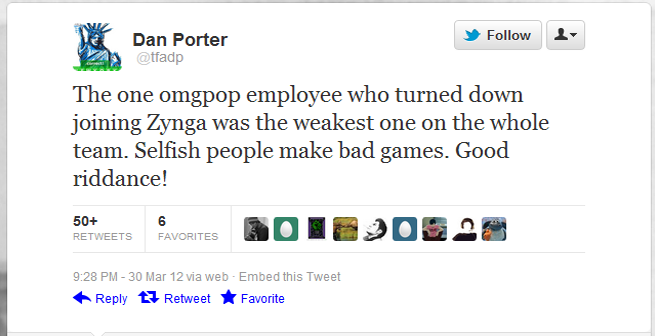
That looked to be the end of the story, until a couple of days ago when OMGPOP CEO Dan Porter decided to shoot his mouth off on Twitter:

This followed another piece on Business Insider where an anonymous OMGPOP source claimed that Pierce was about to fired at the time Zynga took over. Pierce claimed that an offer of employment was extended to him, however, and his discussion of contract negotiations certainly make it seem as though the anonymous source's claims were somewhat spurious.

Predictably, Twitter blew up with this news — and with good reason. Public behaviour of the sort displayed by Dan Porter is simply unacceptable and bad form. Pierce's piece on Gamasutra was both passionate and respectful and he made it abundantly clear that he did not think any less of his former colleagues who chose to go with Zynga. While referring to Zynga as "evil" is arguably a little strong, Pierce did at least go to the trouble of defining what the term "evil" meant to him — by his definition, it's certainly hard to argue with his view on the social gaming giant.

Two things happened as a result of this spat: a lot of people stopped playing Draw Something, and a lot of people downloaded Pierce's game Connectrode. It was a potent example of the power of social media to affect one's reputation. One careless tweet can have far-reaching repercussions — and deleting it won't help, since someone somewhere will have screen-captured it.

Porter has since apologised for his harsh words, noting that "the struggle to build and support Draw Something has been an emotionally draining and hard one" and that both he and the OMGPOP team found Pierce's comments hurtful. He attempted to justify his words by noting that "the 41 other people who made [Draw Something] happen… are the people I would throw myself in front of the train for and those are the people I want to celebrate."

The thing is, though, there's a marked difference between the things Porter said and the things Pierce said. Pierce was speaking his mind and standing up for his principles in a world increasingly dominated by big business. He didn't stoop to personal insults and he remained respectful throughout. Porter, meanwhile, spoke without thinking, quickly descending into personalised attacks without even stopping off for a bit of passive-aggressiveness on the way. No amount of backpedalling, apologising or making it sound as if he was actually doing it for his employees can change the fact he acted unprofessionally and inappropriately towards a former employee. Speaking to VentureBeat, he claimed that he felt Pierce's moment in the spotlight on Gamasutra was unfair, while the Draw Something team toiled in what he seemed to think was relative obscurity.

The thing is, Draw Something is hardly an unknown niche title. According to AppData, 31 million people have signed up for the game using their Facebook accounts, and there are doubtless many more who are playing using an email-only account. People already know about Draw Something, they already know about the outrageous amount of money Zynga paid for OMGPOP and are starting to get to the stage now where they're a bit sick of the whole thing. Pierce's piece, conversely, provided an interesting insight into the mind of a developer having to make a tough decision about his future career path. Given a choice between that and "Draw Something Continues to Sell Millions of Copies", I know what I'd rather read — in these business-dominated days when carefully-orchestrated PR plans regularly gag developers from speaking their minds and being honest with the press and public, I'd much rather take a rare opportunity to hear the truth straight from the horse's mouth.

Draw Something and OMGPOP generally will not be getting any further support from me. The industry can do without toxic attitudes like those displayed by Porter, and as far as I'm concerned, an apology doesn't make up for the regrettable fact that this whole situation arose in the first place.

You should, however, download Connectrode, because it's a rather nifty, original little puzzle game.