#oneaday, Day 328: Hi, America

Hai, America. You know, I've been looking at you for a while and I thought, you know, you're kinda cool and I wondered if you'd, you know, like to hang out some time, maybe, and get a coffee or something. Cause, you know, I, like, think you're pretty cool. And stuff.

I'm serious! I like your food. You sure know how to do a good breakfast. It's a breakfast worth getting up for in the morning. Sure, a typically British bacon sandwich is all very well and good, but there's little that can beat a stack of pancakes, some waffles, some French toast or indeed the wonder that is Eggs Benedict, which I discovered the other morning after spending the night with you.

You know what else? And this is going to sound a bit weird, 'cause I wonder how many people compliment you on this, but I think your bread is awesome. Sure, you can get fancy-pants bread from fancy-pants bakeries in the UK, but your everyday sort of bread, the sort that you make everyday toast and sandwiches from? That's functional at best, dry and sawdusty at worst. You make me appreciate a good sandwich. And I like sandwiches at the best of times. But you make me appreciate them more. I like that.

You also seem to have the art of the takeaway down to a fine art. We Britons of Britainland believe that we are the masters of the Chinese and Indian takeaways, but I can honestly say that I think yours are better. Your Indian curries are creamy and smooth and delicious, and your Chinese meals are full of flavour and they come in those awesome little cardboard boxes with the lids that are a good shape to eat the food straight from with a pair of chopsticks, instead of those foil trays with the cardboard lids that are always way too hot to put on your lap.

Since we're being honest here, I don't like how you use the word "an" before words that start with an "h", which isn't a vowel, and you spell "aluminium" wrong, not to mention your seeming aversion to the letters "u" and "s". Also, as our beloved comedian Eddie Izzard says, "herb" is pronounced "herb" because "there's a fucking 'H' in it".

But you know what? I don't care. I can accept your flaws because they make you more colorful (see what I did there?) and interesting. I can accept that you use the word "momentarily" different to the way I do, and I think it's charming. All your sweet, nutty bread and pancakes and Hollandaise sauce on eggs and love of good coffee and ability to put free Wi-Fi hotspots in places other than Starbucks just make me think that, you know, you're pretty sort of kind of cool and I think it'd be, you know, nice if we could, um, spend a bit more time together. If you know what I mean.
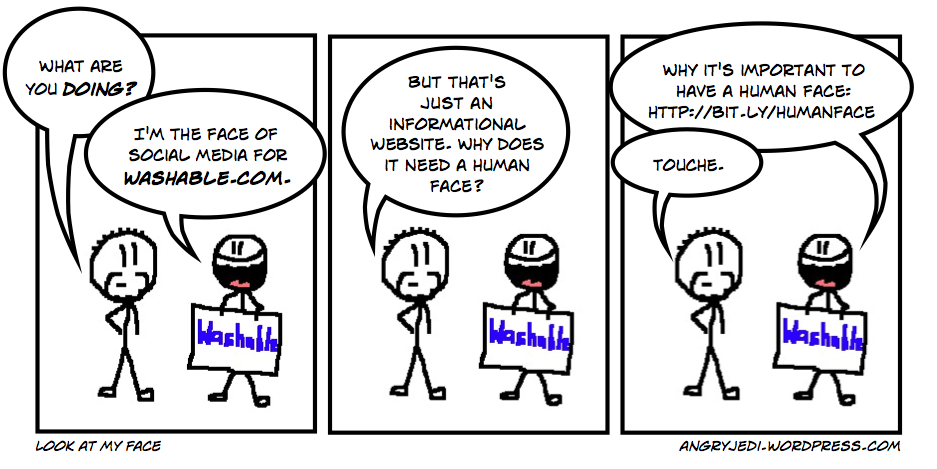
#oneaday, Day 327: LOOK AT MY FACE.

There are people out there who are paid frankly obscene amounts of money to develop a company or brand's "social media strategy". This is a position that wouldn't have existed five years ago, yet now it's the new hotness. If you've got anything to do with marketing, social media is where it's at.
These "gurus" have come up with their own set of arbitrary rules about what "works" and what doesn't. Supposedly, following their bible of social media norms helps you to get hits and be more influential online. Perhaps they're true. But some of them strike me as a little odd.

Take the way social media news website Mashable presents itself on Twitter, for example. Actually, first of all look at Mashable itself. Not the most personality-filled site at first glance, is it? Sure, the personalities come out in the writing, but at first glance it looks like just any other tech news site.

So then, take a peep at Mashable's Twitter account. Notice anything odd?

Right. Despite obviously being the official account for Mashable the site, and posting little more than links to their articles with little to no interaction with their millions of followers, they have taken the inexplicable decision to present the site not as a site, but as the face and name of CEO and founder Pete Cashmore. Thus, when something from Mashable comes up in your Twitter timeline, depending on how you've got it set up, it looks like these links are being posted by a person, not by an automated RSS-to-Twitter doobriewotsit. But they're not. Unless there's a very bored intern at Mashable in charge of doing that.

Now, the theory behind this is that putting a human face on a Twitter account makes it inherently more "trustworthy". As anyone who's used Twitter before will know, bots are a pain in the arse and should be killed with fire, but it's usually reasonably obvious that they are bots. There's the odd exception, but for the most part, it's very clear.

So, with that in mind, isn't it actually rather more dishonest to post automated updates from a website pretending to be an individual person? I honestly can't understand the logic behind it. I'm sure some social media guru out there will be able to educate me. But I know that generally speaking, if I'm looking out for an update from a particular website in my Twitter timeline, I'll be looking out for that website's logo, not some bearded guy with a slight sneer.

Unless Pete Cashmore thinks he genuinely is the logo for Mashable, in which case the website should replace its header with a GIANT PICTURE OF HIS FACE. Possibly with a big flashing logo saying "OBEY".

Maybe.

#oneaday, Day 326: Time Zone Trauma

It's rather late, I know. Although it's not late where I am, because as I may have intimated rather subtly above and in a post a few days ago, I'm in the States. Yayness, as Recette might say. In local time back home, it's currently 4:30am, while here it's 8:30pm. I have been up for over 24 hours. Hardcore.

Time zones are a bugger at the best of times, let alone when your own body clock is buggered beyond all recognition. There are a curious mix of influences at work here, as a combination of insomnia, stress, depression, lack of desire to go to sleep any earlier and friends in time zones other than my own all conspire to bugger up my sleeping patterns. In fact, I'm actually anticipating that I'll sleep better and at more "normal" times here than back home.

Before I left Southampton, I got chatting to a very lovely person online who happened to live in mountain country in the US. We were frequently up until 4 or 5am GMT talking about things, and that made getting up the following morning rather more difficult. However, being jobless and, at the time, shortly to be homeless, there didn't feel like much of note worth getting up for in the mornings. So, well, I didn't. Actually, I haven't heard from her for a while, so after writing this post I will email her, you see if I don't.

This had both benefits and drawbacks. Benefits included the ability to play Alien Swarm online with people I didn't normally have the chance to play online with. Which was nice. Drawbacks included going to the local shop in the afternoon, the man with the smelly armpits behind the counter asking "how my day had been" and me being able to answer quite honestly that it had been just fine, conveniently omitting the fact that I'd actually spent most of it asleep.

A mixed blessing, I'm sure you'll agree. But at least the shop was open until 10pm in the evening, so even though my day was 6 hours out of sync with everyone else, I could still, you know, buy bleach. Exciting is the life of the unemployed.

I'm actually quite looking forward to (hopefully) getting back into some semblance of normality if (when) I get a job. That or I should just move to the States, which I know there are a number of you currently reading this would be a plan you could firmly get behind. Well, I've got nearly a month to enjoy being on Pacific Time, so we'll call it a test run or something.

So then, who wants to sponsor my visa application?

[If the comic looks a bit different, it's because I forgot to bring my template with me. Whoops. Ah well. I got it near enough.]

#oneaday, Day 325: Interactive Fiction

There's a lot to be said for interactivity (or at least the illusion of interactivity) in storytelling. It allows things to be done that are simply impossible with non-interactive media such as books, TV and film.
I spent a couple of hours this afternoon playing Digital: A Love Story, a wonderful game set on the desktop of an Amiga "five minutes into the future of 1988". If you haven't played it yet and are intrigued by the premise, I suggest you play it before reading on, because I'm probably going to spoil some things about it. I'll try not to be too explicit.

At the outset of the game, the player is the proud recipient of a brand-new "Amie" computer with a built-in modem. Your benefactor also provides you with a phone number of a BBS that you might want to check out. And so the story begins with the player dialing into the BBS, complete with terrifyingly authentic-sounding dial and modem tones screeching from your computer's speakers. The player quickly gets friendly with a person named Emilia and things develop quickly in a manner that will be immediately familiar to anyone who has ever had an online relationship.

All is not as it seems, however, and the player, through a bit of investigation, discovers that there are strange things at work. The BBS crashes, and there is no way of getting in contact with Emilia. Just prior to the crash, she said she was "leaving home" and "getting out". Thus begins a quest across several BBSes, ARPANet and Sprint's long-distance calling-card system to track down Emilia and discover what happened.

The game is completely linear. Things happen in a set order, right up to the ending, when the player is faced with an inevitable conclusion that there really is no way around. At this point, we reach one of the most powerful things that gaming can do, and ironically one of the least interactive things about narrative games.

Offer the player the opportunity to do two things: do something, or walk away. Walking away is usually not an option, though Heavy Rain managed to convincingly offer this as an alternative at several points throughout its narrative. Digital: A Love Story, however, makes it abundantly clear that there is only one course of action open to you, and it's an unpleasant one. Given the great pains that the game has taken up until this point to make you "feel" for the characters involved, despite being based around screens of text, it is difficult to make that final mouse click.

This is something you just can't do with a book. Stopping halfway down the page and printing "Turn the page to see what happens next" is not an established literary convention, nor should it be. Same with TV and film; with those media, we're just along for the ride. It's the reason very few books save the Fighting Fantasy and Choose Your Own Adventure series are written in second-person perspective.

But with a game, the player has been driving the story all along, even if there is only really ever one thing they can do at a time to advance the plot to the next "event". That illusion of interactivity allows the player to be all the more invested in the story, as if they're part of the game world. This is further aided in titles such as Digital: A Love Story, which don't break "character" for a moment. As far as the player is concerned, they're using an Amiga… sorry, "Amie". They're not playing a game, they've been transported back in time to 1988, a land of 320×200 graphics, questionable multitasking capabilities and scanlines.

The ending of Digital: A Love Story is bittersweet and if you've engaged with the game up until that point in the way it is intended to be engaged with, you'll find it genuinely emotionally affecting. It's always interesting when a title which looks so unassuming can actually end up being more powerful than self-consciously "epic" CG cutscenes and over-the-top orchestral music with people singing in Latin.

So, if you remember 1988, if you ever had an Amiga or you remember the golden age of the BBS, check out Digital: A Love Story. It's free, and well worth your time.

#oneaday, Day 324: Humbug

It's easy to be cynical about Christmas these days, given that it starts in mid-September and proceeds to get increasingly more present in the months leading up to December until it is eventually omnipresent. (Happy, Mr Hussick?) By the time it actually arrives, people are so thoroughly sick of the whole "Christmas" thing that they just want it over and done with for another few months until the whole thing starts over again.
It's not like that for everyone, of course. I doubt that the kids out there are as cynical about Christmas. I certainly wasn't when I was a kid; Christmas was a time to be excited. There was a different atmosphere about the whole day, and not just the tangible excitement over getting presents or eating copious amounts of turkey dinner. It felt like a special day when nothing could possibly go wrong, when it would be impossible for Bad Things of any description to happen.

I haven't felt like that for years now. I forget the last time I felt that way, but I'm pretty sure it was back in my childhood. Perhaps there's more to be said for the belief in Santa Claus than people give credit for. It doesn't help that the last few Christmases I've had were pretty underwhelming at best and downright unpleasant at worst. The Christmas that I had to work over and then spent the best part of Christmas week lying in bed alone suffering with a strong bout of flu—proper flu, the "can't get up because your whole body aches too much" flu—was a particular lowlight, but the events of the past year haven't made me particularly feel like celebrating anything at any point.

I am spending this Christmas abroad, though, away from this cold, grey, depressing land. I'll be over in the States, where I'll be spending most of the time with my family, including my brother, his wife and his kids, whom I haven't seen for some time. I saw John earlier this year, but it's still been a while. I'll also be spending at least one weekend with my very good friend Mr Chris Whittington, former host of the Squadron of Shame SquadCast, and hopefully we'll get the chance to put together a special seasonal/end-of-year show for everyone to enjoy. Then we can kick 2010's ass out the door and let it rot in the gutter like it deserves to.

I seem to recall having similar thoughts at the beginning of this year; that 2009 had been, on the whole, shitty for most people involved including myself, and many of us started 2010 with hope for the future. I can say with some confidence right now that I'm just happy to get to the end of each day at the moment. Any time I've had a bit of long-term hope for the future, what with job interviews for positions I'd give my right arm for, those hopes have ended up being dashed for one reason or another. So right now it appears to be something of a case of taking each day as it comes and hoping something good eventually happens.

Not a great way to do things, but little else I can do right now. So you'll forgive me if I'm not exactly full of festive cheer.

#oneaday, Day 323: A Little Balance On The Gaming Issue, Please

An hour ago, the BBC aired an episode of Panorama, our go-to investigative journalism programme, on the subject of video games. The subject, predictably, was the ever-present "are video games addictive?" question that has been raised and not answered many, many times prior to now.
The programme made a few fair points that are more common sense than anything else. Firstly, those with addictive personalities are prone to becoming addicted to games. Many games have in-built reward mechanics which those who get easily addicted to things will… well, get addicted to. Social games like Farmville, MMOs like World of Warcraft and popular multiplayer titles like Call of Duty all take great pains to ensure a regular stream of rewards and gratification being sent in the player's general direction. Whether it's a "medal", a "completed quest" or simple experience points, there's a constant flow of something that leads the player to believe they're achieving something. Those who become addicted to things easily can use that as a justification.

Secondly, the programme pointed out that parental controls need to be used more effectively. Many children and teenagers are given free reign on their use of video games and as such don't limit themselves on how much to play, to the exclusion of other things. Parents need to get better-informed about the facilities available to them to control their children's playing habits. This is, sadly, something that many parents are very resistant to, despite the fact that the tools are there for use, particularly on the Xbox, which offers some of the most robust family controls that there are—as does the Mac, oddly enough.

There were no concrete conclusions drawn, however. The "conclusion", if you can call it that, was that more research was needed from an independent body.

The thing is, this discussion has been going on for decades now, and no-one has thought to actually do that research in an appropriately investigative and non-biased manner.

I was reading through a few Formspring answers from Leigh Alexander (I think) the other day and she made the very good point that those of us out there who write about games can't be called "journalists" in the same sense as those who write for, say, national newspapers on breaking stories. Our role as members of the games press involves reporting on carefully-disseminated information provided by PR companies, critiquing products on general release (occasionally before general release) and sometimes interviewing a developer from the industry. There's no real "investigation" there, there's no hard-hitting stuff. That's not necessarily a bad thing, but given that mainstream media tends to come down on the more negative side of the fence when investigating gaming, I think there's certainly scope for a counter-argument: someone who does know the industry well investigating the burning issues. And investigating them thoroughly using established journalistic, sociological research techniques.

Who's going to be the first person to step up and do that, though? More to the point, would anyone read it or take it seriously? Gamers, by their very nature, are defensive creatures, having been made out to be "the bad guys" by the mainstream media once too often. And those not "in the know" are often inclined to have their minds made up by sensationalist stories in the aforementioned mainstream media.

What we need is balance. What we need is a hero.

Wait, what?

#oneaday, Day 322: Chinese Whispers

Goodness me. Thank you to everyone who read yesterday's post, including the unprecedented 602 of you who showed up today. Whether or not you agreed with the sentiments therein (and whether or not you were polite about it), thanks for reading.

There have been some interesting developments in the whole thing over the last 24 hours or so. On the whole, the whole thing can actually be said to have had a positive outcome, though not quite through the means the originators of the meme intended.

In fact, the originators of the meme had nothing to do with the NSPCC, as predicted. Fellow blogger, Commodore 64 enthusiast and all-round fine, upstanding gentleman Glen McNamee did a bit of research on the issue and uncovered the fact that the whole thing had actually originated in two separate places in November as a bit of fun, with no charity links whatsoever. Read Glen's blog post about it here.

Dave Gorman also wrote an excellent post on how this sort of thing can undermine genuine fundraising attempts with honourable intentions. Also worth a read.

The interesting thing about all this, though, is the whole "Chinese Whispers" nature of it. By looking at people who had changed their avatar/status throughout the course of the day, you could see the gradual evolution of the whole thing. To start with, it was a "campaign to end child abuse". Then it was a "campaign by the NSPCC to end child abuse". And by the time people like me had written posts on the topic pointing out the flaws in the whole plan, people were taking great pains to explain that as well as changing their avatar, they had, in fact, donated, too. There were also a few people who were up-front about the whole thing and said they changed their avatar purely because they thought the cartoon characters were cool. Fair play to both parties; at least you're being honest. There was also a considerable proportion of people around Facebook who tried to convince everyone that the whole thing was a scam by a bunch of paedophiles aiming to lure children in with cartoon avatars. This last part is bollocks, by the way, in case you were worried.

So on the whole, the whole thing had a positive outcome. It provoked discussion (or rather, argument) and had the net result of shaming at least a few people into tossing a few quid the NSPCC's way, which I'm sure they're very grateful for, though they probably wouldn't have chosen to go about promoting it by people yelling at one another.

The thing is, though, couldn't the whole thing have been resolved without the need for drawn-out arguments in the middle of it? Probably. It's ironic; Web 2.0 is full of narcissism and vanity, but is also a breeding ground for sheep mentality. Some people copy and paste things or blindly follow instructions without considering the implications. Think before you post!

Let's leave it at that. The matter's over and done with. Resolved. Until everyone forgets about it and it happens all over again. When that does happen, just remember that famous and rather offensive comment about arguments on the Internet and the Paralympics.

Also, don't be a dick.

#oneaday, Day 321: Charities Have No Use For Your Avatar

Are you morally-conscious? Feel like you should be doing more to help your fellow man, but feeling a bit strapped for cash at the moment? Don't feel like putting together some sort of fund-raising event because, after all, it is a bit cold outside and it might snow.

Never fear! Web 2.0 is here to allow you to assuage your guilt without any need for financial or time outlay! All you need to do is change your profile picture and/or status to something vaguely related to the charity that you would like to support and that counts as you having Done Your Bit when it comes to Judgement Day. Me? I like the Cats Protection League, so I shall be donning a LOLcats avatar for the day.

Grumble, moan etc. I know. And I have a sneaking suspicion I may have mentioned this before.

The above piece of sarcasm is proudly sponsored by today's Facebook and Twitter campaign to get as many people as possible to change their avatars to their favourite cartoon characters of the 80s or 90s. This, apparently, counts as you "joining the fight against child abuse", and has been attributed to the NSPCC by several people. Go look at the NSPCC front page right now. Do you see any mention of any campaign "not to see a human face on Facebook until Monday, December 6th"?

No. I certainly don't. Probably because it actually has nothing to do with the NSPCC whatsoever, and probably because the NSPCC would rather you got off your arse and either did something to raise money for them or just reached into your pocket and sent them a tenner.

"Donating" your Facebook status or a tweet means nothing. And the "it's just a bit of fun" defence is bollocks, too; there are plenty of people out there who feel like changing their avatar (a task which takes, ooh, a minute at most?) and/or copy-pasting a status is absolutely "doing their bit" and absolves them of any sense of responsibility, putting them on the same level as someone who has diligently, say, organised a sponsored run, bake sale, 48 hour Desert Bus marathon, three-week charity wankathon, whatever. It doesn't.

This isn't a rant saying that everyone should donate to charity. I don't—at the moment I can't afford to. It's up to everyone whether they would like to support a charity that deals with an issue they feel strongly about. But "supporting" that charity means just that—supporting them and the work that they do. That means giving them some money, or some of your time, or just walking into one of their shops and buying a dodgy velvet jacket for a 70s night or something.

It doesn't mean changing your fucking avatar. How many people out there copy-pasted that status and changed their avatar and then felt all smug and self-righteous before going on to do other things, forgetting all about the fact that they hadn't actually donated any money to the charity in question, who probably had nothing to do with the campaign in the first place?

So don't let me stop you changing your avatars to your favourite cartoon characters. If you do, though, at least be honest about why you're doing so—perhaps you think Superted is awesome, in which case, say so and don't hide behind some kind of false altruism—or actually follow up what you're doing with a donation.

Rant over.

Actually, no it's not.

Girls, next time you feel tempted to post something that the "men won't get" in an attempt to "promote breast cancer awareness", realise that we all know what you're doing and would again much rather you just donate to a worthy cause like MacMillan, rather than supposedly "raising awareness" by being deliberately obtuse. How the fuck does that even work?

Rant over. For reals, yo. Take care of yourself. And each other.

#oneaday, Day 320: Achievement Locked

I've just done something I haven't done for a while. I've beaten a game with no Achievements. No, I don't mean that I played the game so terribly that I didn't get any Achievements (I don't think there's a single Achievement-supporting game out there that will allow you to do that)—I mean I started, played, enjoyed and beat a game which did not support Achievements of any kind, be they Steam Achievements, Xbox Achievements, PSN Trophies or a built-in Achievement-like system.
Said game was Recettear: An Item Shop's Tale, which I enthused about at some length a few days ago. I beat it tonight, but there's a load of stuff after the ending, too, so this isn't the end of my time with the game. I am, however, glad that there were no Achievements along the way.

Achievements are generally considered to be a good thing. And for some games, they are. Freeform games like Crackdown use Achievements to encourage players to try crazy things that they might not have thought to do otherwise. Skill-based games like Geometry Wars use Achievements to display player skill. But when you get into the territory of "Fire your gun 500 times", you know it's getting a bit silly.

I played Oblivion a while back and greatly enjoyed it. I got all 1250 Achievement points in it. The thing is, though, that wasn't the whole game. There are tons of sidequests in Oblivion which don't have associated Achievements. How many people do you think bothered to do them? Not many, I'd wager.

Achievements often direct your experience and encourage you to play in a specific way. For some types of game, that is good. In others, it's not. Part of the joy of Recettear is the discovery of how different things in the game work. Over time, you naturally figure out which customers you can get away with charging a bit more to, which ones will come in at what times of the day, which products appeal to which people and all manner of other things. Even the adventurer characters you can take into the dungeons have their own individual quirks for you to learn. As soon as you add Achievements like "Sell 20 Baked Yams" to that mix, you start playing differently in order to get that Achievement. You start focusing on becoming the best damn Baked Yams supplier there ever was, to the exclusion of more profitable things like treasure and adventuring equipment.

Achievements are, on balance, a good idea, I think. They provide an additional reward mechanic above and beyond that which the game should be offering anyway. But it's when they start to take over, to become the most important reward mechanic—more than the inherent rewards built into the game itself—that things aren't quite right with the world. It's a fine line, and I don't think making the support of Achievements mandatory is the correct way to be. Or if there's no way around that, let's see more games like DEADLY PREMONITION, which simply has an Achievement for beating each chapter, one for each difficulty level and one for 100%ing the game. Nothing more. Nothing more needed. Even then, I'm pretty sure there will be at least one person out there who will go back and replay the whole game just to get all three difficulty level Achievements. That shouldn't be why you replay DEADLY PREMONITION. You should replay it because it's awesome.

So, anyway. Don't be afraid to pick up a game with no Achievements. You might be surprised. Games can be fun without having to tell you how awesome you are every ten minutes.

#oneaday, Day 319: Report This Post, It Contains Opinion

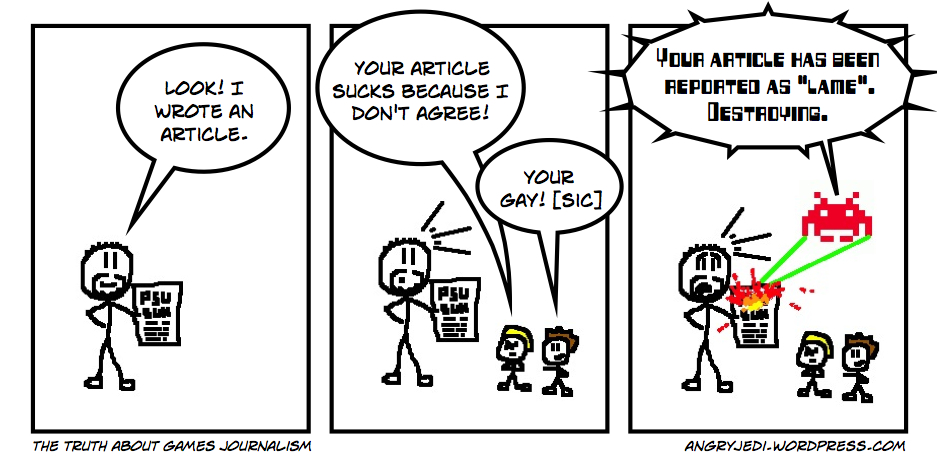
There is an increasingly popular—and increasingly worrying—tendency for games journalism and writing about games (which some people are keen to point out are two different things) to be judged as "broken" or "lame".

On paper, you can perhaps understand why this is. Gaming is one of the most popular subjects for wannabe writers to pebble-dash the Internet with, and there are so many people out there who want to do it "professionally" that a good 90% (I made that up) of gaming-focused sites out there can't even pay their writers, however awesome they are. As such, there is a lot of crap out there, but it's generally quite easy to spot, and there's certainly no need for sites like this.

Fellow #oneaday-er and all-round lovely grumpy chap Ian Dransfield of Play Magazine wrote an impassioned rant on this subject. I highly recommend you go and read it. Now. Go on.

I agree with the Dransfield. No kind of journalism should be homogenised, automaton-written garbage. It should have scope for individual opinion and comment, and certain outlets should have the opportunity to develop distinctive "voices" on the matter. It's worked for our newspapers for years, after all—for all the shit everyone gives the Daily Mail about their bizarre and often misguided opinions, at least they stick to their guns. Similarly, were the Daily Express ever to write about anything other than Princess Diana, the nation would be in uproar.

One of the things that bugs me most about today's games journalism is the plague that is N4G. For the uninitiated, N4G is a community-driven news-aggregation service. Community members may post articles to a "pending" queue, and they then have to get ten "approvals" in order to show up in the main news feed.

Fair enough, you might say. It separates the wheat from the chaff, surely. And surely the people who have approval rights must all be published professionals, right?

Wrong. Anyone can submit any page to N4G with no requirement that the article be your own. Get three articles approved by the community (a simple case of rounding up ten Twitter/Facebook friends to help you) and voila—approval rights. This then means that your opinion has as much weight as someone who's been doing the job for fifteen years.

This may still not sound unreasonable. So let me show you the drop-down menu of options available for "reporting" an article if you believe it to be "inappropriate":

Yes, you have read that correctly; one of the options for reporting an article as unworthy of appearing in the N4G news feed is that it is "lame".

N4G is seen as a primary means of promoting games-related articles, and sure enough, it does seem to generate a lot of hits for sites, so I can't fault those people who do take advantage of it to get more readers to their sites—fair play to you. I can say with some honesty, though, that I have never used it as a place to go to find out the latest news. The whole thing is too chaotic, too run by people who write comments after reading only the headline and not the article and—ugh—it makes me mad, I tellsya. I can't take it seriously in the slightest.

My main issue with it is one of the things Dransfield points out in his article: who are these people to say what is and is not "relevant"? What gives them the right to brand something as "lame" simply because it doesn't have "HALO IS A REALLY COOL GUY" in the headline? What gives them the right to ignore a supposed "duplicate article" on a subject which offers some opinion or additional facts over and above what has already been written first, in haste?

Absolutely nothing. Traditional news outlets and even longer-established specialist press (such as publications for music and films) aren't held to account in the same way. But games journalism, being a younger industry, seems to be held to entirely different standards, and judged unnecessarily harshly. There is a lot of negativity surrounding the games press, and not enough positivity. Trolling and flame wars are particularly prevalent on articles about games, and platform-specific articles seem to bring out the very worst in the community.

Here's food for thought then: in a world where we're so concerned about free speech a goodly proportion of the Twitter population in the UK (and beyond) is supporting the legal fees of someone they've never met, why are we so harsh on this particular breed of writers? Why shouldn't they be able to write what they feel, rather than what will "get hits"?

If you would like to share this post with the community, then please feel free to make use of the buttons below.